astronomy week 4: the sun's properties and nuclear fusion
 Call Kai
 Learn
 Practice Test
 Spaced Repetition
 Match
 Flashcards
 Knowt Play
1/20

Earn XP
Description and Tags
activities 4.1 and 4.2, homework 4
21 Terms
What are characteristics of the photosphere?
Surface we actually see, patterned with granulation
What are characteristics of the chromosphere?
Glows red due to emission from excited hydrogen gas
What are characteristics of the transition region?
The temperature rapidly increases as you move from under this region
What are characteristics of the corona?
A hot, wispy and dilute region where exotic ions of atoms produce unfamiliar emission spectra
The Sun's mottled surface features are called [?], which are brighter and hotter than the surrounding areas. These features are associated with [conduction in the solar interior, convection in the solar interior, radiation in the solar interior, or regions of strong magnetic field], a hypothesis which can be tested by measuring the [Doppler shift, Zeeman effect, or light intensity] in the bright regions.
Granules
Convection in the solar interior
Doppler shift
The (temporary, and moving) [sunspots or granules] are dimmer and cooler than the surrounding areas. These features are associated with [conduction in the solar interior, convection in the solar interior, radiation in the solar interior, or regions of strong magnetic field], a hypothesis which can be tested by measuring the [Doppler shift, Zeeman effect, or light intensity] in the dim regions.
Sunspots
regions of strong magnetic field
Zeeman effect
The sun rotates faster at its [equator or poles] than at its [equator or poles], a phenomenon called [?]. Because this occurs, the sun's magnetic field becomes twisted over time. Sometimes, loops of magnetic field pierce the surface of the Sun, causing [?] to develop. Eventually, the magnetic field violently snaps, releasing a burst of x-ray radiation ([?]) and plumes of charged particles ([?]).
Equator
Poles
Differential rotation
Sunspots
Solar flares
Coronal mass ejections
The nuclei of atoms are made up of [? and ?], held together by the [?] force. The process of nuclear [fusion or fission] occurs when two light atomic nuclei come together to form a heavier one (as happens inside a star). In the process mass is lost and energy is released. The process of nuclear [fusion or fission] occurs when one heavy atomic nucleus breaks into smaller pieces. This process also releases energy (and is used by humans to generate power on Earth). In both processes, the energy is created directly from the difference in final and initial [?].
Protons and Neutrons
Strong
Fusion
Fission
Mass
Since nuclei are either neutral or positively charged, electrical forces between them aren't attractive, and are often repulsive. In the Sun, what makes it possible for atomic nuclei to overcome their electrical repulsion?
The high temperatures in the Sun’s core
In addition to light and a helium-4 atom, the proton-proton chain creates
two protons that [?]
a neutrino that [?]
a positron that [?]
Can be reused in later proton-proton chains
Escapes freely from the Sun
Quickly annihilates with an electron

Here, bubbles of hot gas rise from the bottom of the layer. As they rise, they cool, and eventually sink - keeping this layer in constant motion.
Convective zone, layer C
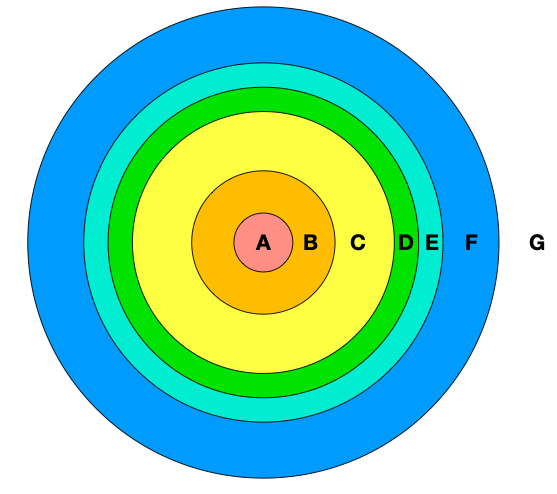
Hydrogen is fused into helium in this layer, releasing energy in the form of gamma rays.
Core, layer A
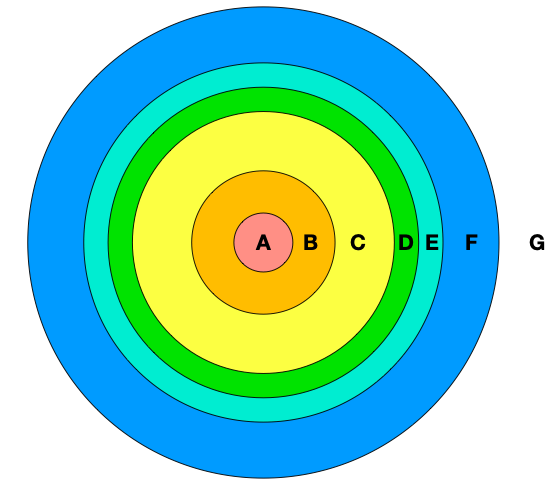
The temperature rises rapidly in this region.
Transition Region, layer F

This low pressure region is sometimes visible during eclipses, and glows red due to the H-alpha line. Spicules erupt in this region at speeds of 100 km/s.
Chromosphere, layer E
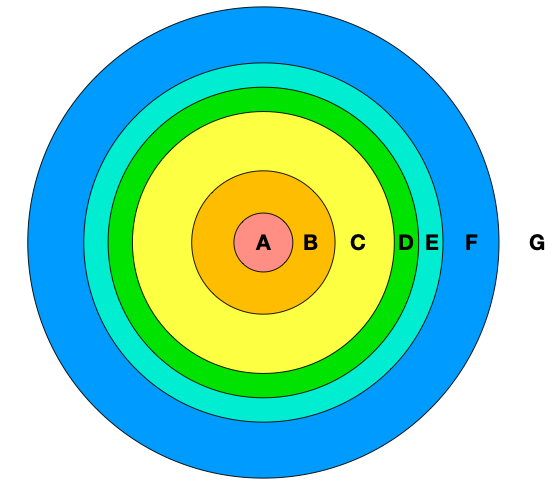
This high-temperature region is full of extreme ions, like Iron with 13 of its 26 electrons missing. These ions lead to a strange emission spectrum.
Corona, layer G

This layer is low pressure, so atoms are far from one another. They are mostly neutral, but because they are far apart, light is unlikely to interact with them - therefore light escapes from this layer.
Photosphere, layer D
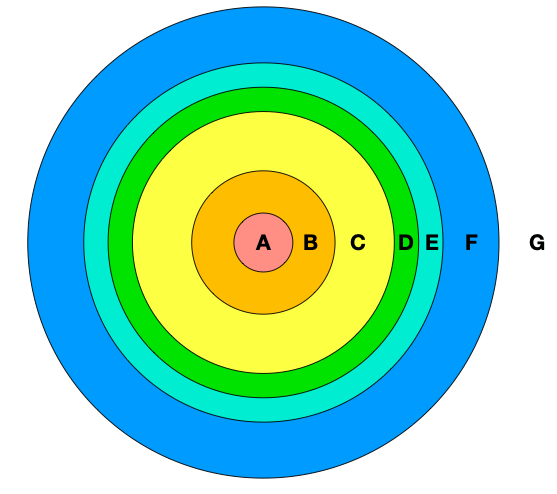
This layer is "transparent" because its atoms are hot and ionized, so don't absorb many photons as they move outward toward space.
Radiative Zone, layer B
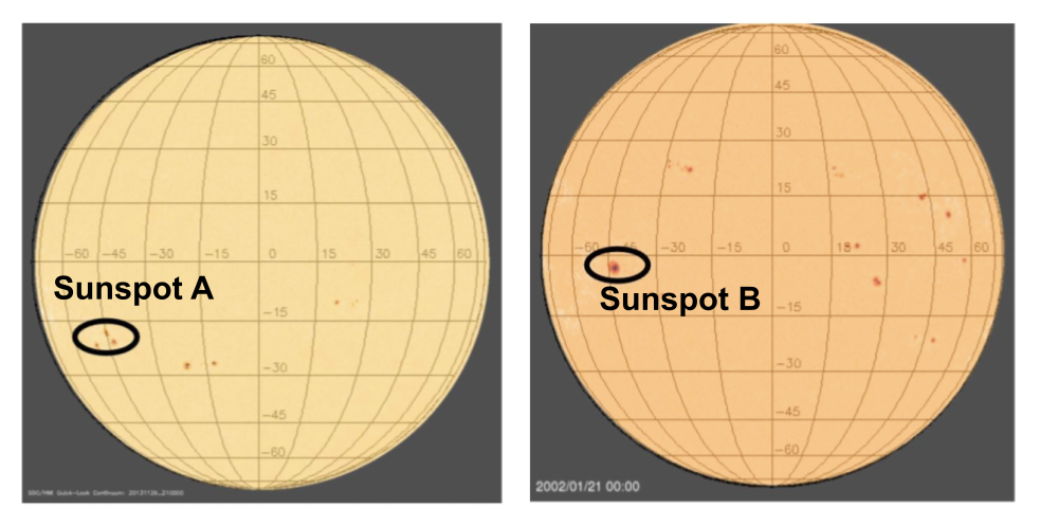
Two snapshots of sunspots on the Sun, with the Sun's latitude and longitude lines superimposed, are shown below. Sunspots A and B are circled and labeled.
What is true about the motion of these sunspots across the surface?
Sunspot A will move from left to right across the image more quickly than Sunspot B
Sunspot B will move from left to right across the image more quickly than Sunspot A
Sunspot B will move from left to right across the image more quickly than sunspot A
Suppose the core of the Sun contracts slightly. What might be the consequence of a contraction?
The temperature of the core would [increase, decrease, not change].
The fusion rate of hydrogen in the core would [increase, decrease, not change].
Increase
Increase
When we record the spectrum of a star, what layer of that star are we looking at?
[Core, Radiative Zone, Convective Zone, Photosphere, Chromosphere, Transition Region, Corona]
Photosphere
As hydrogen fuel runs out and helium builds up in the center of stars, there is still a lot of hydrogen in the envelope (non-core) of a star. If there was a way to remove the helium and replenish it with fresh hydrogen from above, the lifespan of stars could be greatly lengthened. The convective zone does move material from the surface of the star to the interior but it cannot replenish the hydrogen in the core to cause more fusion. Why not?
[It is too cold for the hydrogen to fuse once it gets to the core, It only can move light and not atoms or nuclei, It is not dense enough, It is separated from the core by another layer, It is full of ions not neutral atoms]
It is separated from the core by another layer