Molecular Orbitals
 Call Kai
 Learn
 Practice Test
 Spaced Repetition
 Match
 Flashcards
 Knowt Play
1/101

There's no tags or description
Looks like no tags are added yet.
102 Terms
What is a symmetry element?
This involves rotating or reflecting an object to make it look the same as it did before the operation
How do symmetry operations arise?
They arise from a molecule possessing a particular symmetry element
This can be applied to any aspect of the molecule, for this module the only important one is orbitals
What is the rotational axis?
A line at which you can rotate a object
The largest rotational axis called the principal axis by convention is usually the z-axis
This is the axis where you can have the most rotations with the molecule still looking the same
On the image C6 is pointing into the screen and out towards you
This is the principal axis as the benzene molecule can be rotated 6 times about it and still looks the same

What is a mirror plane and how do we label it?
This is a plane which reflects a shape of an object to the other side
This is given the label σ (sigma)
This can be horizontal or vertical giving the planes σh and σv
There can be multiple σv planes but only ever one σh plane
How do we label (principal) rotational axes?
An rotational axis can have the label Cn
The n is how many times an object can be rotated around that axis without looking different from its starting position
The principal rotational axis is the axis with the largest n value, this by convention is used as the z-axis
What is a centre of inversion?
A point through which any part of an object can come and go out the opposite side at the same distance and be an equivalent point
There is only ever one centre of inversion in a molceule
What does C∞ mean?
You can rotate an object infinite times and it would look the same in any position
See image
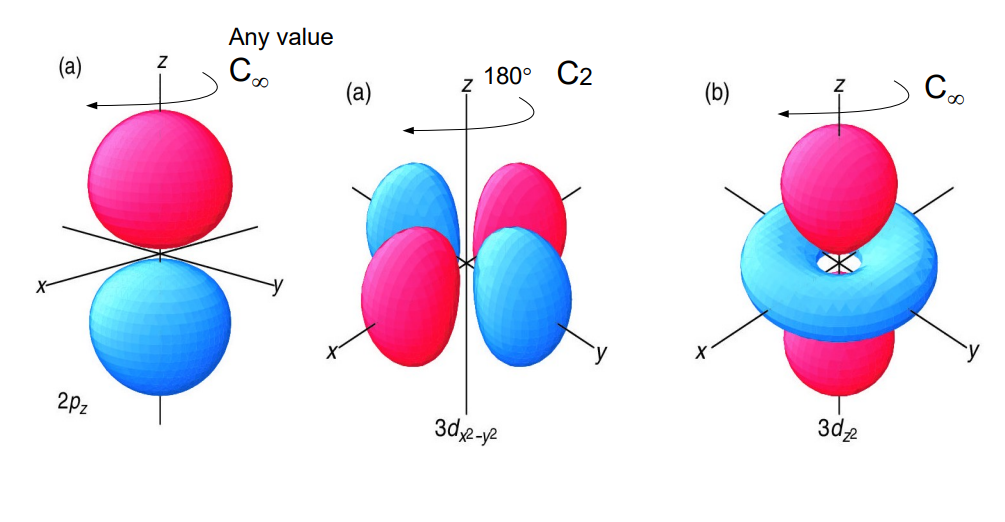
How many vertical mirror planes does a pz orbital have?
It has an infinite amount as you can keep cutting and it’d look the same
See image

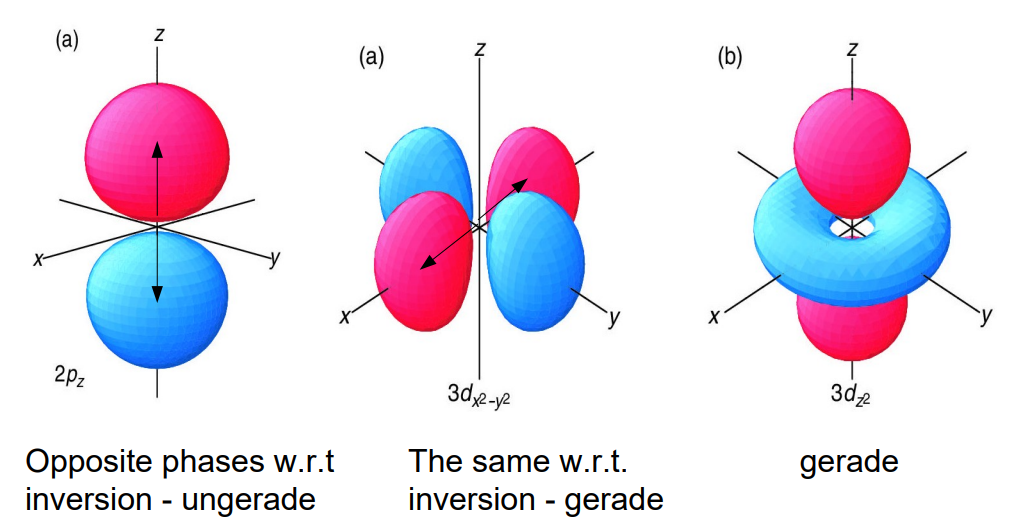
What does gerade and ungerade mean?
Gerade means that when you take part of an object/molecule/orbital and move that part to the opposite side and same distance with respect to the centre of inversion, it will be the same
Ungerade is when this is not the case, for orbitals this means that the phase changes when one part is taken to the opposite side
Note we can only use these labels when a centre of inversion is present
What does symmetric and anti-symmetric mean?
For mirror planes, if reflecting an object (like an orbital), maps something onto itself, then it is symmetric
If it is mapped as the opposite, then it is anti-symmetric (not asymmetric)
For example, a px orbital is antisymmetric as across the y axis/mirror plane, the phases of the lobes change, yet the shape is still symmetrical
An s orbital is symmetric because if you cut a line in the middle of it, the orbital is still the same phase all the way around

What does molecular orbital theory require?
Symmetric match of AOs
Overlap in space of AOs
AO’s need to be relatively close in energy
How many molecular orbitals should you get when constructing (hybrid) molecular orbital diagrams?
You should always have the same number of (hybrid) molecular orbitals as atomic orbitals
What are the two ways in which simple waves can interact with each other?
Constructively or destructively
See image

How do hydrogen 1s orbital wavefunctions overlap constructively and destructively?
Two in phase wavefunctions reinforce each other
When the overlap is better, the constructive overlap is better
Two out of phase wavefunctions interact destructively
When there is more overlap, the destructive overlap is better
When these two wavefunctions overlap, a node is introduced (a point at which there is 0 electron density)
More nodes=higher energy

For every bonding combination of a molecular orbital what must there also be?
An anti-bonding combination
How can 1s orbtials interact with each other and how do we name this?
Constructively or destructively to give bonding and antibonding MOs
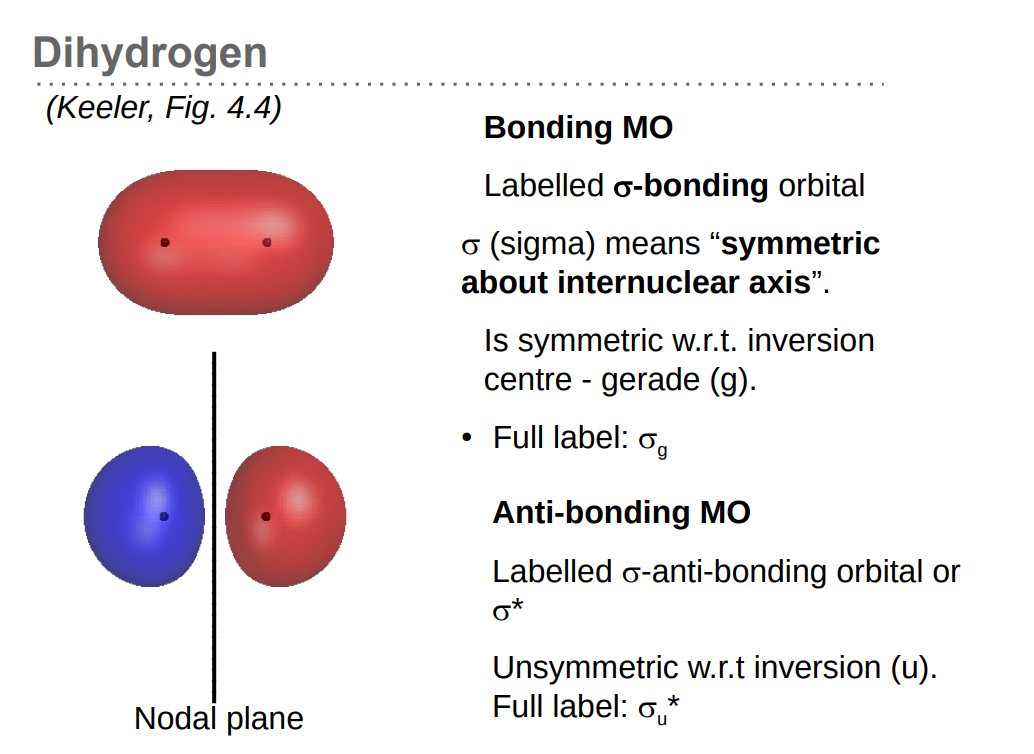
What does σ mean in reference to molecular orbitals?
σ means symmetric about the internuclear axis
If you put a line through the two nuclei and rotates the orbitals 180o, you would still have same shape

How do we calculate bond order in molecular orbital diagrams and what does it tell us about the bond?
A higher bond order means a stronger bond
This can correspond to the number of bonds in a molecule but this is not always the case
The bond order can also be non-integer numbers

What are bonding, anti-bonding and non-bonding orbitals?
Bonding orbitals are orbitals where there is constructive overlap of in phase orbitals
Anti-bonding orbitals are produced where there in destructive overlap of in phase orbitals
Non-bonding orbitals are produced when there is as much constructive as destructive overlap between orbitals or where there is no overlap at all
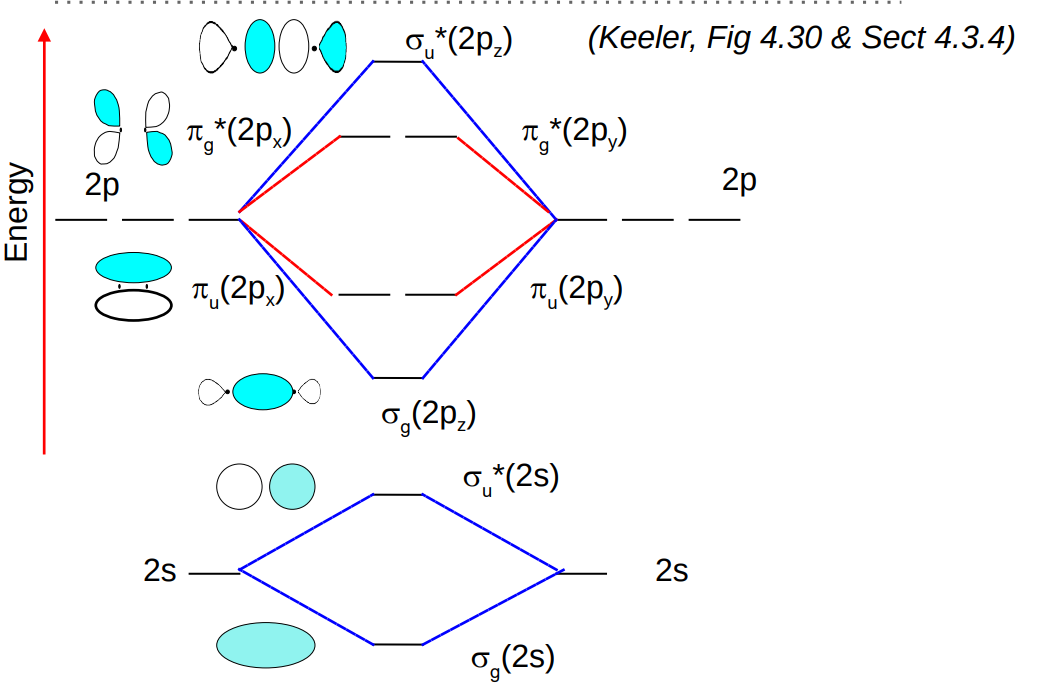
How do pz orbitals overlap and how do we name them?
One combination is bonding, one is antibonding
The pz orbitals are symmetric about the internuclear axis
The bonding molecular orbital is gerade, the antibonding is ungerade
The bonding combination is called σg (2pz) - 2pz is being used here since we used p orbital from the 2nd principal energy level
The anti-bonding combination is called σ*u (2pz)

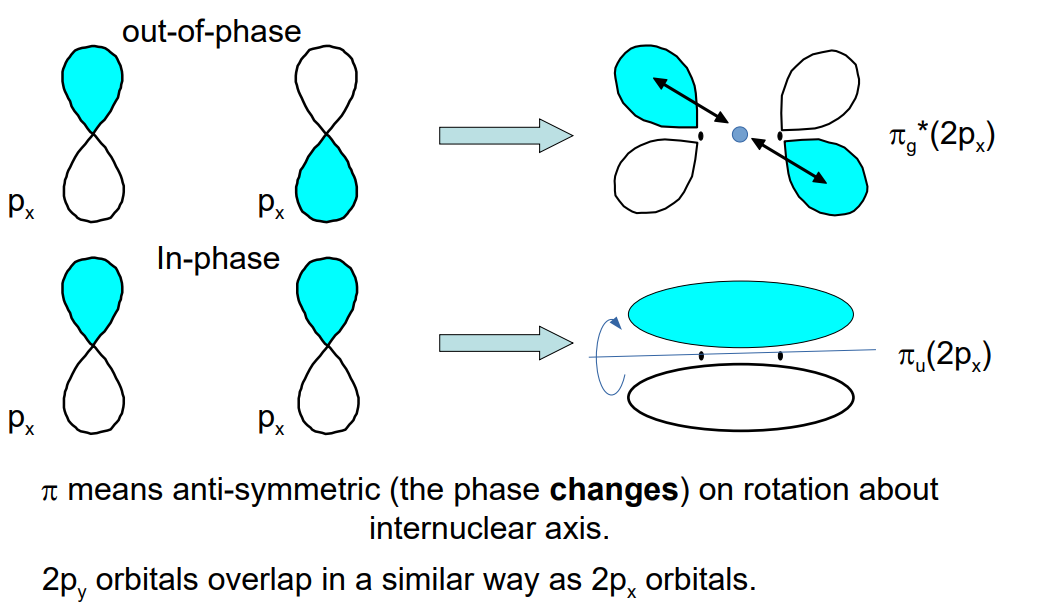
What does 𝝅 mean in reference to molecular orbitals
A molecular orbital is unsymmetric about the internuclear axis
This means there is no cylindrical symmetry if you were looking down the internuclear axis as they rotated

How do px/y orbitals overlap and how do we name them?
The px/y orbitals are unsymmetric about the internuclear axis as if you rotated them they would change phase
The bonding combination is ungerade, anti-bonding combination is gerade
How does the degree of constructive and destructive overlap of AO’s affect the energy separation of bonding and anti-bonding combinations of orbitals?
The greater the overlap, the greater the constructive and destructive overlap
This leads to greater energy separation
The energy separation for 2pz bonding and antibonding orbitals is the greatest because the orbitals overlap very well
The energy separation for 2px/y bonding and anti-bonding orbitals is smaller because the orbitals don’t overlap so well
You can see the differences in energy separation of a molecular orbital diagram

Draw a molecular orbital diagram for hydrogen gas
Why can molecular orbital diagrams give us a better idea of the properties of molecules than lewis diagrams?
MO diagrams tells us the arrangement of electrons within a molecule
From this we can see things like magnetic properties of elements

What technique can be used to see the different energy levels of molecular orbitals?
Photoelectron spectroscopy (PES)
How does s-p mixing occur?
The σg (2s) and σg (2pz) energy levels have the same energy so they can overlap
This makes the σg (2s) more stable and the σg (2pz) less stable
When does s-p mixing occur?
When a molecule contains B, C or N the energy separation between the 2s and 2p is small enough so they can overlap
When a molecule contains O or F there is no SP mixing
This occurs as the energy of the s orbital decreases
If a molecule contains one element from both these groups, we don’t know what occurs, so we just have to state whether we assume there is s-p mixing or not
Draw an MO diagram of a diatomic molecule with s-p mixing

How does bond distance increase down a group
Increases as the atomic size increases
Why does the energy of an s orbital decrease across a period?
The electrons in the orbital are pulled closer to the nucleus making the orbital more stable
There are stronger electrostatic forces of attraction between the electrons in the 2s orbital and the positive nucleus
Why is F2 more reactive than Cl2?
Possibly due to repulsion between lone pairs on F atoms
Electrostatic repulsion causes the bond to be less stable
Why do 2p elements for diatomic molecules with triple or double bonds, but 3 and 4p elements form molecules with multiple single bonds?
3p and 4p elements are bigger, making 𝝅-bonding much less effective as the bond distance increases
This means that these is less good overlap between p-orbitals making the bond less stable, increasing the energy

On an MO diagram, what atoms will always be the lowest in energy?
The most electronegative atoms
Which atomic orbital will contribute more to the bonding MO?
The lower energy atomic orbital will contribute more to the bonding MO and higher energy atomic orbital will contribute more to anti-bonding MO
Which orbitals does F use in bonding with hydrogen and why?
The 2p orbital
This is because the 2s orbital is too low in energy to bond with hydrogen’s 1s orbital (so F’s 2s orbital is non, bonding)
What ways can 1s orbitals from hydrogen and 2p orbitals from fluorine?
The 2pz orbital of F and 1s of H can overlap constructively or destructively
The 2px and 2py orbitals of F are non bonding
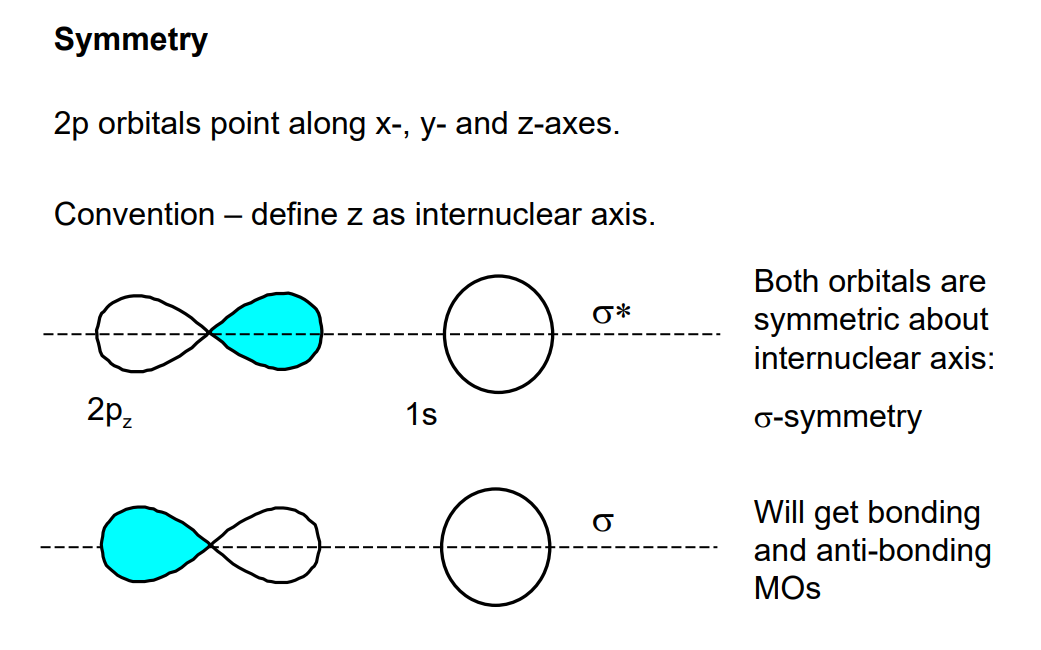
Why are the 2px and 2py orbitals of F non-bonding with a hydrogen 1s orbital?
They do not have the same symmetry as the hydrogen 1s orbital so they cannot overlap with it

Draw a MO diagram of HF (2s non-bonding)

Is the strength of a bond in the molecule X-Y the average of the bond enthalpies of X-X and X-Y?
No
The experimental value of the bond enthalpy is always higher than the average of the two bond enthalpies
MO diagram for NO
Note that there are no gerade/ungerade labels as there is no centre of inversion in NO

What are the HOMO and LUMO and why are they important?
HOMO - highest occupied molecular orbital
LUMO - Lowest unoccupied molecular orbital
These are the orbitals that are important for chemical reactions as the HOMO can give away electron density, and the LUMO can accept e- density
Another name for HOMO and LUMO?
Frontier orbitals

For a molecule like CN-, how does it’s ability to act as a nucleophile or ligand affect its bond order?
The electrons will come from the HOMO as they donate electron density to the other species
Because the electrons are coming from a bonding orbital, the bond order will decrease
Whether the bond order increases, decreases or stays the same depends on whether the electron comes from a anti-bonding, bonding or non-bonding MO
How does bond order affect bond length?
As bond order increases, bond length decreases and vice versa
In the molecule H3+, what combinations of orbitals can we have?
The first MO can have either a bonding combination where all of the 1s orbitals are in phase, or an anti-bonding combination where the middle 1s hydrogen is out of phase
The second MO has the same amount of constructive as destructive overlap whether that middle hydrogen is in a positive or negative phase, therefore it is non-bonding

Draw the MO for H3+

How can s orbitals on BeH2 combine with each other?

How can p-orbitals on Be combine with 1s orbitals of H on BeH2?
The 2pz orbitals can interact with the hydrogen 1s orbitals either constructively or destructively
There is one bonding and one anti-bonding combination
The 2px and 2py are non-bonding

Why are the 2px and 2py orbitals of Be in BeH2 non-bonding?
They don’t have the correct symmetry to overlap with the hydrogen 1s orbitals

Draw an MO diagram for BeH2 and calculate the bond order

How does the MO diagram of HF change if the 2s of F is not non-bonding? Explain the change
The 2s orbital has the correct symmetry to overlap with the hydrogen 1s orbital
It can either do this in phase or out of phase
Aa new orbital is added since now we have 5 atomic orbitals so we need 5 molecular orbitals
The 2s of F now contributes to the bonding and anti-bonding combinations of the 2p orbital of F with the 1s orbital of H
The 2py orbital lies on the nodal plane between the two 1s hydrogen orbitals and therefore cannot overlap with them

What combinations of atomic orbitals can give rise to molecular orbitals in water?
The 1s orbitals of hydrogen can both be in phase or out of phase
The ++ 1s orbitals can overlap constructively with in phase 2s and 2pz orbitals in hydrogen to give the σ(2pz/2s) combination, alternatively this can be anti-bonding with the -+1s combination to give σ(2s/spz)
The 2px orbitals can overlap constructively or destructively with the ++ and +- combinations of hydrogen 1s to give a bonding and anti-bonding combination
For the middle orbital it is essentially

MO diagram for water

How does photoelectron spectroscopy work?
It ionises electrons from molecular orbitals
The highest energy MO requires the least energy to ionise (e- has the lowest binding energy)
MO theory explains spectroscopy, VSPER does not
Construct a Walsh diagram to show the difference in energy levels between bent MOs and linear MOs (examples used are water and BeH2) and explain the differences in energy level between the MO energy levels.
When orbitals like the 2s and 2pz mix in a bent molecule, they can hybridise and create a better overlap, lowering the energy level of that MO
For the σ(2px) in a bent molecule, the overlap of the 2px orbital is less good with the 1s of the hydrogens because they sit lower in the plane of space than in a linear molecule

How can we use a Walsh diagram do predict molecular shape?
We can count the number of valence electrons in the molecule then fill each side of the Walsh diagram with that number of electrons
Whichever diagram was the HOMO of lowest energy is the more favourable arrangement for the molecule

What combinations of 1s orbitals can we have in a trigonal planar molecule of BH3?
The orbitals can all be in phase, or two can be in phase and 1 out of phase
The second and third combinations are degenerate

What are the different combinations of the 1s orbitals of hydrogen and the 2s and 2p orbitals of Boron in a trigonal planar molecule like BH3?
Note that we are looking top down
The +++1s combination can have an in phase combination with the 2s orbital of B or an out of phase combination to give a bonding and anti-bonding combination
The 2px combination can have an in phase and out of phase combination with a +- combination of hydrogen 1s orbitals to give a bonding and anti-bonding combination
This is the same for the 2py and therefore these MO combinations will be degenerate
The 2pz orbital of B lies on the nodal plane between the hydrogen 1s orbitals

Construct an MO diagram for a trigonal planar molecule (BH3)

How does the combinations of orbitals change for a trigonal pyramidal molecule?
The 2pz orbital can now be involved in bonding because the 1s orbitals are closer to the bottom lobe of the 2pz orbital
For the other orbitals, there is less good overlap because the 1s orbitals of hydrogen with the other orbitals
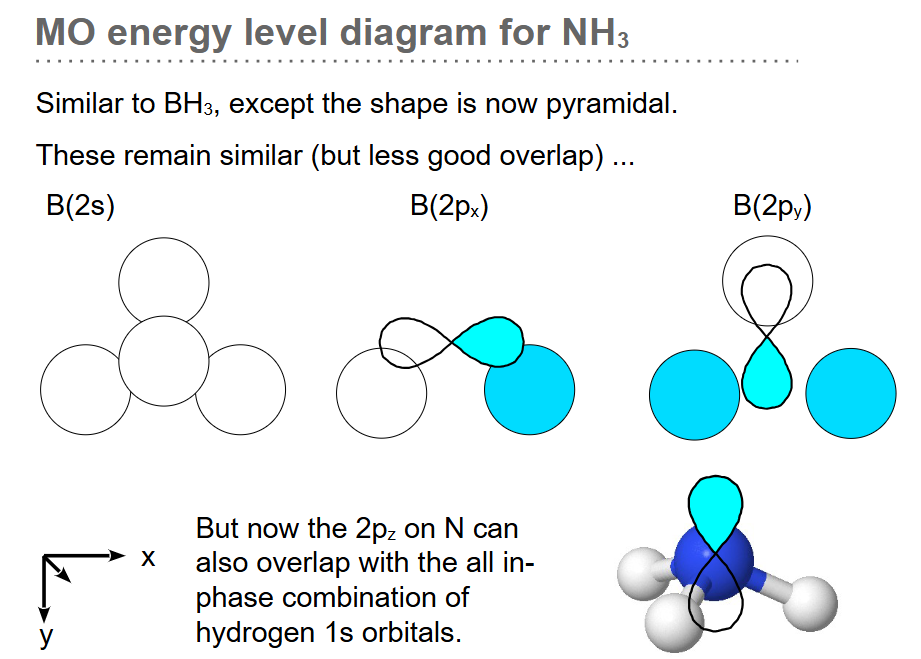
MO diagram for a bent molecule like NH3?
It is very similar to the trigonal planar, but the 2pz orbital that was non-bonding now forms an MO that is lower in energy and the 2s contributes to this MO as well

Walsh diagram for planar vs pyramidal EH3

For a linear triatomic like CO2 (O=C=O) , how can orbitals combine to get σ and 𝝅 bonds to form double bonds?
The 2s orbital of C can overlap with the oxygen 2s orbitals in in phase or out of phase combination
The 2s orbital of carbon can also overlap constructively or destructively with two 2p orbitals of oxygen
Note that if the oxygen 2s or 2p orbitals do not have (lobes of) the same phase pointing to each other, not matter what 2s C orbital was in the middle, there is as much constructive as destructive overlap and so the combinations would be non-bonding
The 2pz orbital of carbon can overlap with the combination of oxygen 2p orbitals as shown in the image constructively or destructively
For both the 2px and 2py orbitals on carbon and the two oxygen, they can all be in phase to give a bonding combination, out out of phase to give an anti-bonding combination
In the middle combination, no matter what direction the 2px/y orbital is, there will be as much constructive as destructive overlap and therefore that MO is non-bonding
These combinations for 2px and 2py are degenerate

Draw an MO diagram for CO2 and calculate the bond order

How does the MO diagram of O3- differ compared to CO2
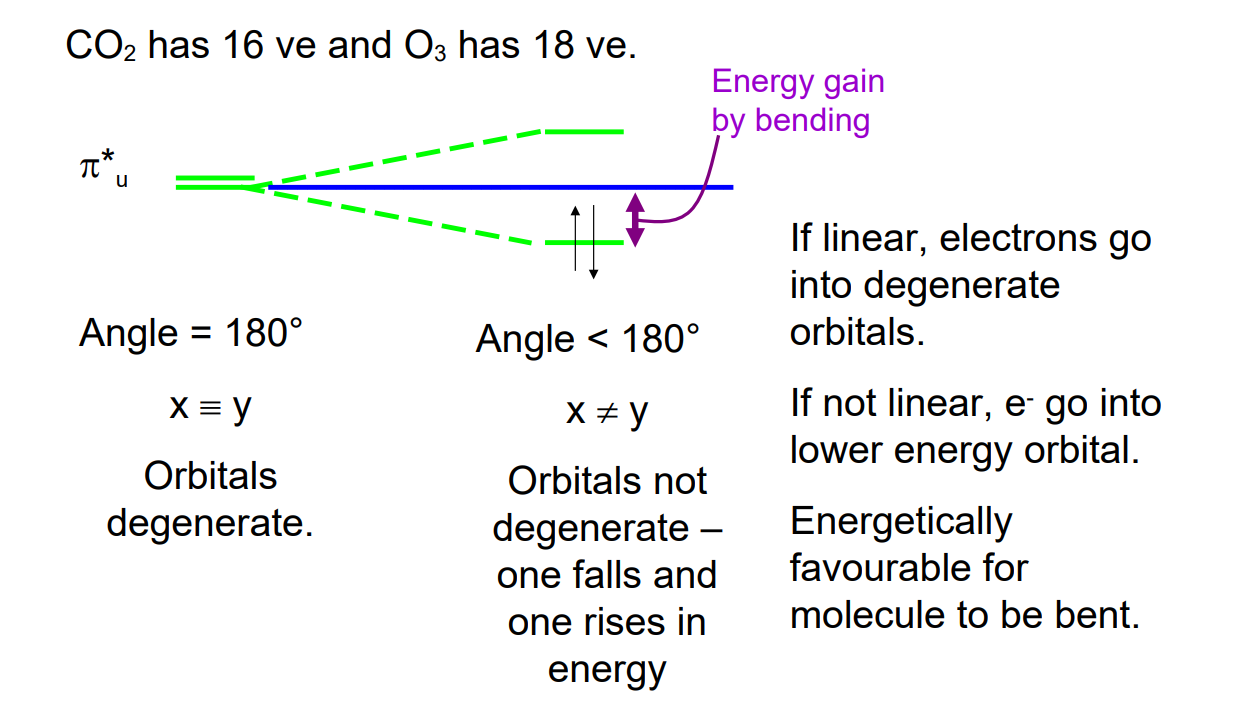
CO2 has 16 valence electrons, O3- has 18
When molecule is bent, the 𝝅* orbitals split into a more stabilised orbital, and an orbital that is destabilised, meaning they are no longer degenerate
Electrons will then fill the MO lower in energy, making the bent shape of the molecule more energetically favourable
How can we tell the shape of a triatomic molecule based on the number of electrons it has?

MO diagram for a bent triatomic link ozone

How is ozone excited and how can we show this on an MO diagram?
When the absorption of a wavelength of light matches a gap between energy level, an electron can be excited to higher energy levels

How can we hybridise orbitals to make an sp hybrid atomic orbital/HAO?
We can hybridise the 2s and 2pz orbitals to make two sp HAOs which point 180o away from each other
This leaves the 2px and 2py unhybridised

How can we form molecules containing triple bonds with HAOs?
Both atoms within a triple bond require sp hybridisation
The sp HAOs can overlap in a sigma bonding fashion to create one bond
sp hybridisation leaves the 2px and 2py atomic orbitals unhybridised
They can form two 𝝅 overlaps with the other atom to form two more bonds, creating a triple bond
How can we get sp2 hybridisation?
Hybridise the 2s and two 2p orbitals on an atom to form 3 sp2 hybrids pointing 120o away from each other
This leaves one unhybridised 2p orbital to form 𝝅 overlap
How can we make a double bond using sp2 hybridisation?
Both atoms within a double bond require sp2 hybridisation
One sp2 HAO from each molecule can overlap in a sigma fashion
The unhybridised 2p orbital can overlap in a 𝝅 fashion to form another bond, giving us a double bond
How can we make sp3 HAOs?
Hybridise the 2s orbital with all of the 2p orbitals to form four sp3 hybrids all facing 109.5o away from each other

For the molecule HCN, draw an MO diagram for a C-H bond

For the molecule HCN, draw an MO diagram for the σ C-N bond

For the molecule HCN, draw an MO diagram for the 𝝅 C=N bonds
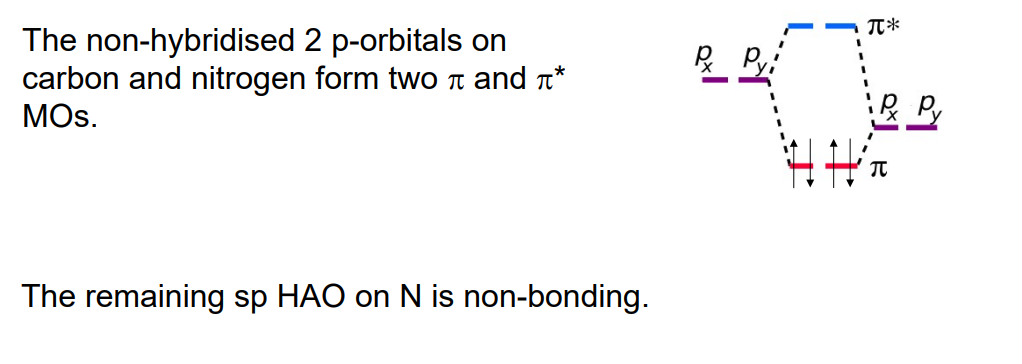
Order of MOs of an MO diagram using HAOs for HCN

HMO diagram for ethene (C2H4)
The 2s and two 2p orbitals are hybridised to give 3 sp3 HAOs on each carbon
These form the C-C σ bond and the four C-H bonds which all have bonding and anti bonding combinations
The one unhybridised p-orbital form a pi bonding and anti-bonding MO

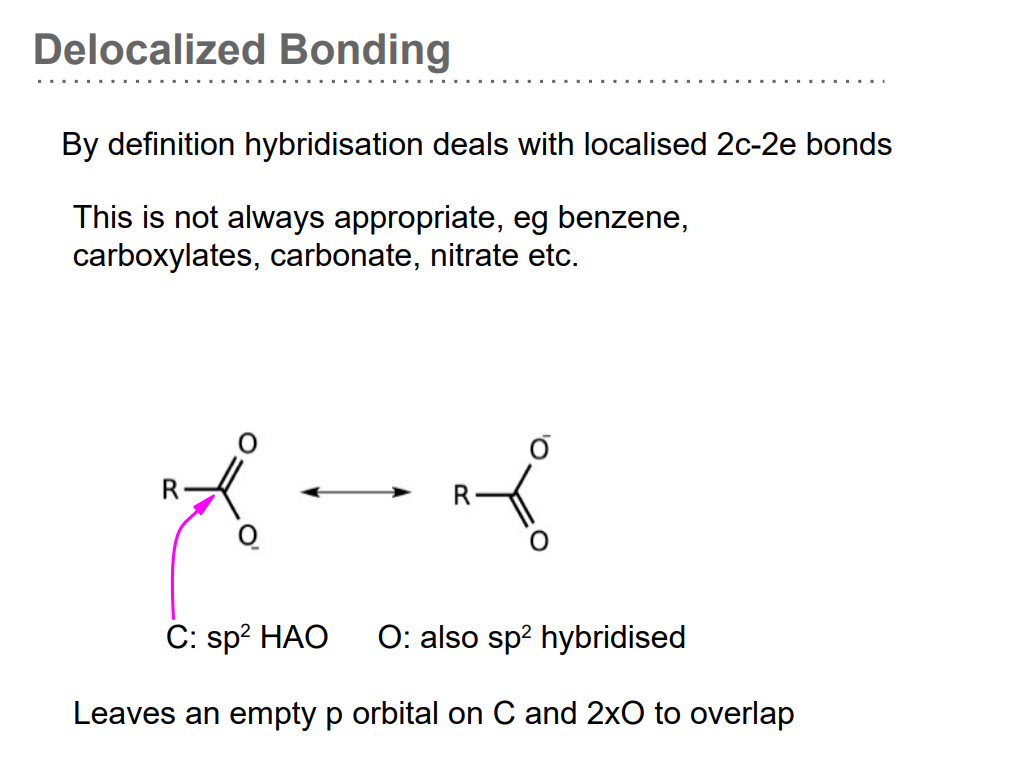
Construct diagrams showing the different combinations of 𝝅 bonds between the middle carbon and both oxygens.
All 3 p-orbitals can be in phase to give the bonding combination, or all out of phase to give the anti-bonding combination
The middle combination is non-bonding as regardless of the orientation of the lobes on the 2p orbital of the carbon atom, there is as much constructive as destructive overlap
A partial 𝝅 bond exists across all 3 molecules, meaning the bond is delocalised (electron density can move across the molecule)

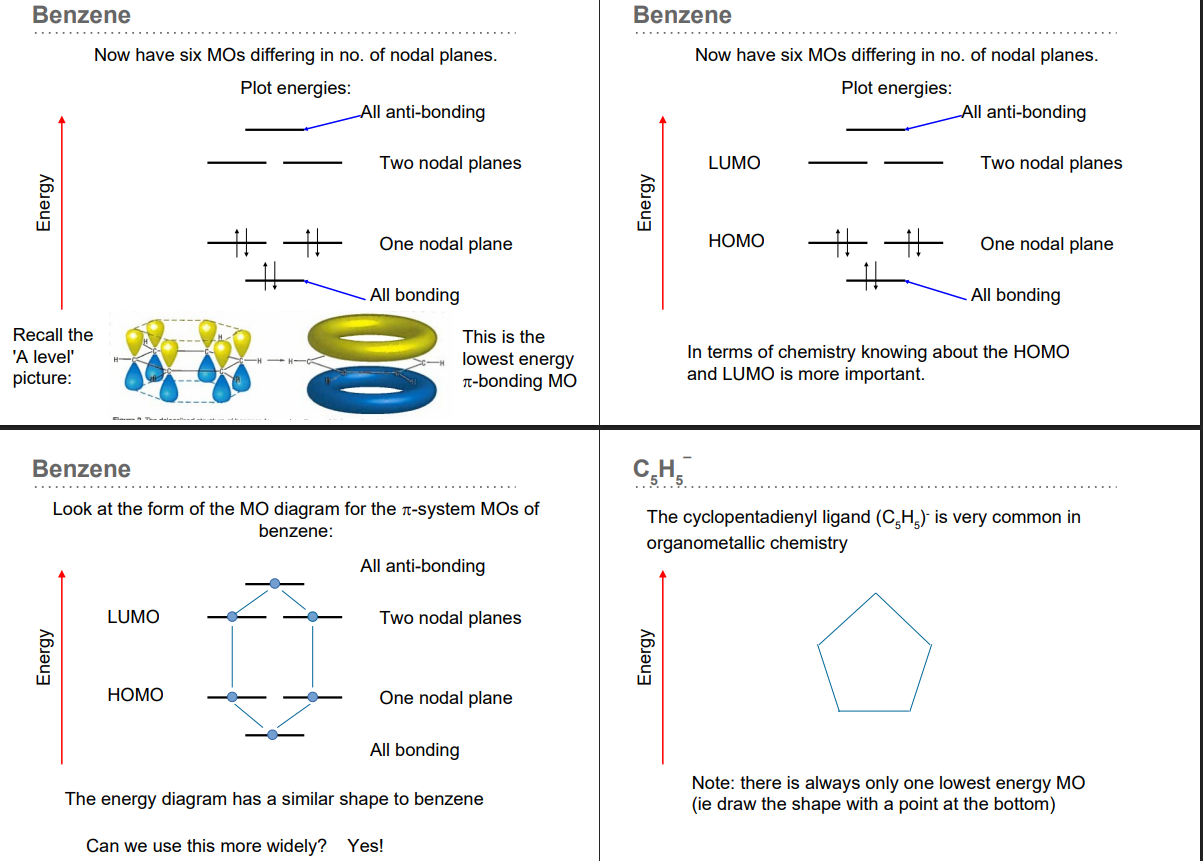
Diagram showing the different possible combinations of p-orbitals in benzene
Note that the carbons are sp2 hybridised

How can we easily plot and MO diagram for benzene and other cyclic molecules like it? (These MO diagrams only show 𝝅 bonding)
Place one point of the cyclic compound at the bottom - there is only ever one all-bonding MO at lowest energy
Draw orbital lines at each corner and fill with electrons
How can we construct an MO diagram for the π system of non-cyclic molecules like butadiene?
At the end of each carbon chain draw an x and then a dot for each carbon
Draw a sin wave for each combination of π overlaps for each carbon
As the number of waves/nodes increases, the energy of each MO also increases
This allows us to put these combinations in increasing order


According to this diagram, where would an electron attack butadiene?
It would attack the first or last carbon because they have the largest lobes of electron density
Comparison of MO diagram and HMO diagram of N2 - show bond order, HOMO and LUMO
Note that the oxygen as sp3 hybridisation because it is connected to 2 hydrogens and also has 2 lone pairs

Comparison of MO and HMO diagram of H2O - show bond order, HOMO and LUMO

For water, is the HMO or MO diagram more accurate?
PES excites electrons form the different MOs in a molecule
The PES spectrum is more accurate to an MO diagram of water that a HMO diagram
We can conclude that where possible, we should use MO diagrams as they are more accurate


Construct an MO diagram for XeF4 using a table
Consider the all in phase combination of F 2p orbitals (all lobes of the same phase pointing towards each other
With the Xe 5s orbital, they are form a constructive overlap if the 5s orbital is in phase, and a destructive overlap if the 5s orbital is out of phase giving a bonding and anti-bonding combination
Using the Xe 5p orbital, the combinations including 2px/y orbitals will be degenerate
For these if we keep the same all in phase combinations of F 2p orbitals, one of the 2px/y orbitals will overlap destructively with the 5px/y orbital of Xe, and the other lobe will overlap constructively, giving us a bonding and anti-bonding combination for each type of orbital which will be degenerate (so 4 in total, two bonding, two anti-bonding)
The last two MOs we have to figure out are non-bonding
The 5pz orbital of Xe does not have the same symmetry as the 2p orbitals of F as they lie on it’s nodal plane, so this MO is non bonding
Also, there is one non-bonding combination of F 2p orbitals
To count up, we have 8 atomic orbitals, 5s-2p overlaps give us 2 MOs, 5p-2p overlaps give us 4 MOs, and we have two non-bonding MOs giving us 8 MOs in total


Construct a HMO diagram of XeF4
XeF4 has 4 bonding pairs and 2 non-bonding pairs
We need 6 HAO’s on XeF4
At most we can only have 4 sp3 HAOs so we need to add two d orbitals to make 6 sp3d2 HAOs

Comparison of MO and HMO diagram for XeF4

Show the different combinations of overlap of 2s orbitals in Li2, Li3 and Li4

Draw an MO diagram for the 1-dimensional metal Lin where n is a large number

Diagram showing an combinations of 2s orbitals and MO diagrams for two dimensional Li4 and Li9

What is meant by the band structure of metals and what does this mean for how electrons can move in metals?
There a many degenerate sets of orbitals with very small energy gaps in between them when orbitals of the same type in a metal are combined together
This means electrons are delocalised across the entire structure of the metal

Why do many metals have incomplete bands
Because in their terminal orbital, some elements don’t fully fill that orbital like Li which has only 1 electron in it’s 2s orbital
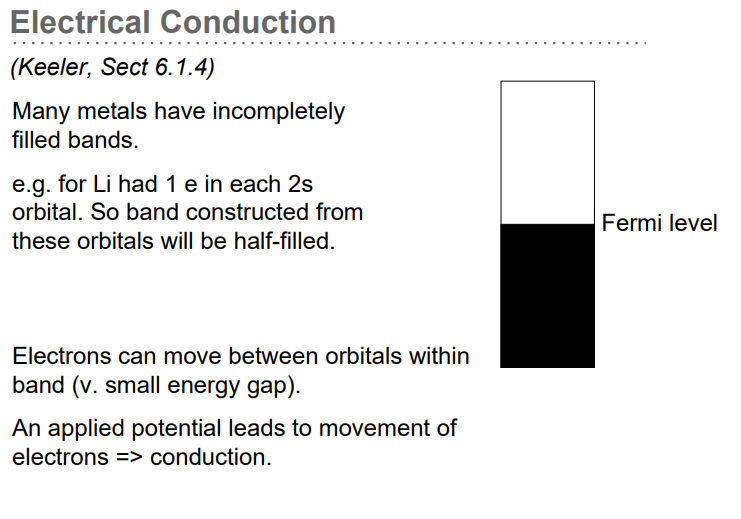
Why can metals conduct electricity
The bands of many metals are incomplete as they don’t have enough electrons to fill all of the bands
The band structure of metals allows electrons to move between degenerate orbitals with very small gaps in energy
Applied potential leads to the movement of electrons which generates a current

How can the overlap of s2 and 2p bands cause a material to conduct electricity?
If the gap in energy between 2s and 2p bands is small enough then their bands can overlap
Electrons are able to move between degenerate orbitals in these bands and an applied potential leads to the movement of these electrons which generates a current

How can we tell if a 3D structure is an insulator or conductor from their band structure?
Material like diamond have a filled band and too large an energy gap between bands in order for electrons to be able to move and produce a current
Therefore diamond is a conductor
In a material like silicon, the energy gap is small enough that electrons can actually be excited to a higher band and this movement of electrons can produce a current
Therefore silicon is called a semiconductor (to distinguish from metallic conductors)

Process showing electrophilic addition of Br2 to ethene?

Using the MO diagram of Br2, explain how the first step of electrophilic addition with ethene occurs where the Br2 bond breaks
The Br2 accepts two electrons from the pi overlap causing its LUMO to be filled
This causes the bond order to be reduced to 0, so the Br—Br bond breaks
