Surgical management of benign and cystic lesions
 Call Kai
 Learn
Learn Practice Test
 Spaced Repetition
 Match
Match Flashcards
 Knowt Play
1/43

There's no tags or description
Looks like no tags are added yet.
Name | Mastery | Learn | Test | Matching | Spaced | Call with Kai | Chat |
|---|
No analytics yet
Send a link to your students to track their progress
44 Terms
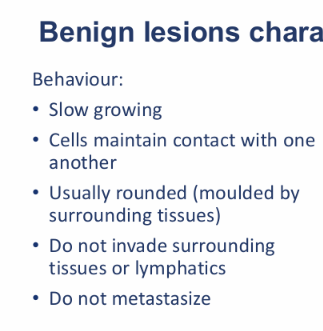
Benign lesion characteristics:
behaviour? (5)
Slow growing (can be faster under influence of hormones)
Cells maintain contact with one another
Usually rounded (moulded by the surrounding tissues)
Do not invade surrounding tissues or lymphatics
Do not metastasize
Effects of benign lesions? (4)
Excessive accumulation of cells
Pressure atrophy - adjacent parenchyma (working cells) undergoes pressure atrophy, more resistant connective tissue produced a fibrous capsule
Obstruction
Can produce hormones if growing within endocrine organ
Atrophy (get smaller)

Indication for removal a benign/cystic lesions? (8)
Pain
Function
Aesthetics
Continual growth
Pressure on adjacent structures
Damage to adj structures including root resorption
Weakening structures (fracture mandible e.g)
Infection
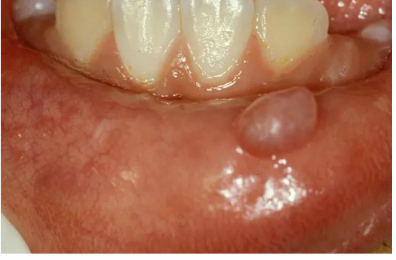
What is this?
Mucocele
Describe its presentation? (4)
Sessile (broad based)
Fluid filled
Transparent blue
Raised
History:
Often a history of what?
more common site/pt?
Why does it appear?
Often history of trauma
More common in children
Lower lip - most common
Associated with traumatised minor salivary glands duct
Indication for removal? (3)
Disruptive of eating, pt self-conscious of appearance, can be uncomfortable


What is this?
Vascular abnormality - haemangioma

Presentation of haemangioma in the picture
Sessile
Pale blue
Dorsum of the tongue - right side
3 mm in diameter
Blanches on pressure
History of haemangioma? (3)
Occasionally swells and becomes painful
History of tongue biting
Duration > 1 years
Indication of removal of haemangioma? (3
Self-conscious about appearance
Disrupts eating and or speech
Pt concerned and requests reassurance with diagnosis


What is this?
Fibro epithelial polyp

Describe the lesion in the image?
Right buccal mucosa, pedunculated
keratotoic appearnce
soft
8 mm diameter
History of polyp? (3)
History of check biting/trauma
Slow growing
interferes with eating
Indication of removal?
Interferes with pts eating
Self-conscious about appearance


Excising lesions - what shape is the excision and why?
Elliptical
As the two sides can be brought together in a straight line - get healing by primary intention rather than secondary intention which gives rise to scar tissue
Ensures it can be closed with no gapping
Complete excision is made by cutting around the lesion
Excision is for what lesions?
Superficial smaller lesions (Found within the oral epithelium and lamina propria)
What is used for suturing?
Resorbable sutures - 4.0 or 5.0

Incision, dissection and excision: appropriate for what lesions?
Appropriate for a benign lesion that is within the submucosa
What lesion could this be?
Mucocele - (minor salivary gland cyst)
How is the removal carried out?
A straight incision can be made over the lesion, and it can then be dissected out
Increased risk associated with deeper layer excision

Pre-prosthetic surgery may be for what?
Dentures
Why might pre-prosthetic surgery be needed?
Palatal tori
Fibrous ridge and/or tuberosity

Different types of laser excision?

How does laser work?
Beam hits tissues
Temperature rises proteins denature and thrombosis
At 100 degrees water boils, steam ruptures cells and tissue vapourised
The temperature can start to rise in adj desiccated tissues
Tissue blackens, carbonisaiton

ADV of lasers? (4)
Dry surgical field
Reduction of blood loss
Fibre-optic delivery
Reduction in post-op oedema, pain and fibrosis
Dis of laser? (3)
Cost
Complexity of requirement
No pathology specimen (as tissues are damaged)

What is cryotherapy?
how is it used?
This is good for what type of lesions?
Tissue denaturation using application of cold medium - liquid nitrogen direct or via probes
Freeze-thaw cycles
Good for fluid filled lesions e.g saliva or blood

How does cryotherapy work in more detail?
Direct or indirect application of liquid nitrogen
Series of freeze-thaw cycles - form an ice-ball
Intracellular ice formation - expansion of cell volume and disruption occurs on thawing
Repeated cycles of freeze thawing results in the reduction of the cell mass of the lesion (dehydration of cell, increase in conc of electrolytes, rise in osmotic pressure, lipids and proteins denatured)
Best if rapid freezes and slow thawing

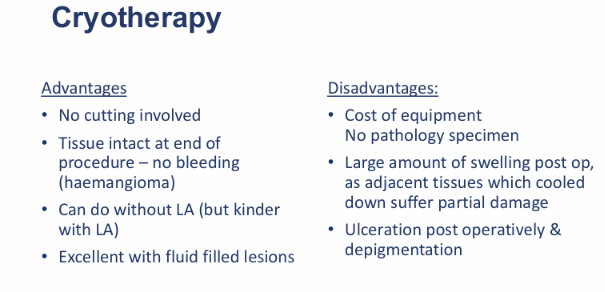
ADV of cryotherapy? (4)
No cutting
Tissues intact at end - no bleeding
can do without LA
excellent for fluid filled
DIS of cryotherapy?
cost of equipment
no Pathological specimen
post-op - swelling as adj tissues which cooled down suffer partial damage
ulceration post-op and depigmentation
What are cysts?

How do cysts expand?
Expansion via osmotic tension due to inflammatory process
Classification of cysts?
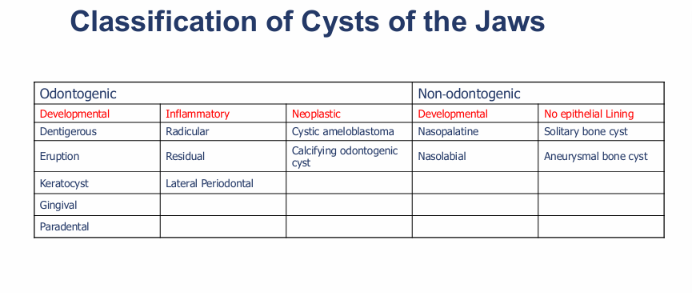

Aneurysmal bone cyst

Stafne bone cyst - normal anatomical variant , beneath alveolar nerve
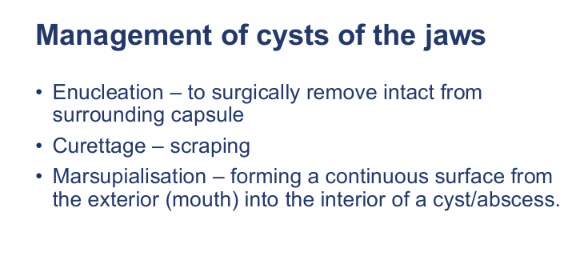
Management of cysts of the jaws?
Enucleation - Surgically remove intact from surrounding capsule
Curettage - Scraping
Marsupialisation - forming continuous surface from the exterior into the interior of a cyst/abscess
What is enucleation? what is it usually followed by?
successful tx is dependent on what?
Removal of lesion with the lining
Followed by closure
Complete removal of the cyst lining, and uneventful healing of oral wound without secondary infection of the underlying clot

enucleation

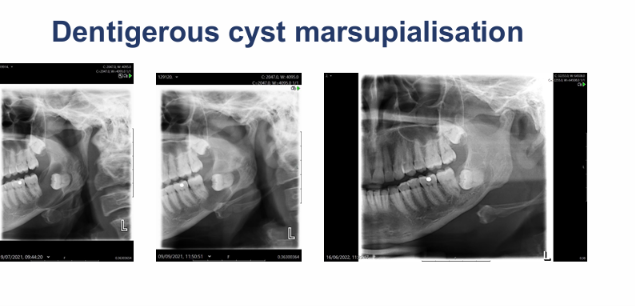
Marsupialisation - explain it?
success of tx is dependent on?
Decompression of the cyst by creating largest possible surgical window consistent with the surrounding anatomy
decompression relieves intracystic pressure
the cavity will then regress in size
first - incomplete removal of the lining and marsupialisation into the mouth or antrum
patient must keeps it clean


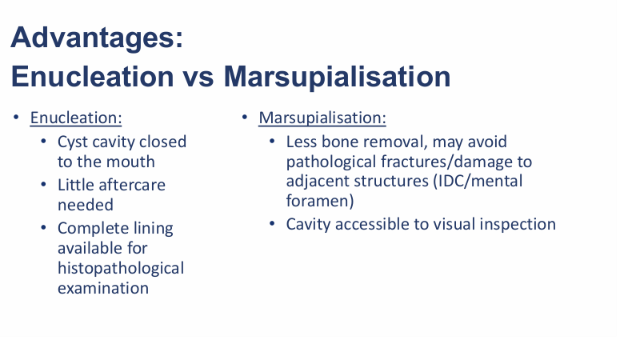
ADV of enucleation (3) and marsupialisation (2)?
Enucleation:
Cyst cavity closed to the mouth
little after care needed
complete lining available for histopathological examination
Marsuialisation:
Less bone removal, may avoid pathological fractures/damage to adjacent structures e.g IDC/mental foramen
Cavity accessible to visual inspection
DIS of enucleation (6) and marsupialisation (7)
Enucleation:
Large cyst removal weakens mandible - fracture risk
Primary closure prevents visual inspection of the cavity post-op
Apical of vital teeth interrupted, other structures damaged
haemorrhage
incomplete emoval
clot in the cavity can become infected
Marsupialisation:
pt needs to keep the area clean
Whole lining not available for histology
Bony infill may not occur
Orifice may close-up allowing cyst to reform
Need for further surgery
several visits to repack cavity as it shrinks and repairs
epithelial lining may be friable and difficult to suture
