Chapter 11 DNA Structure, Replication, and Organization
 Call Kai
 Learn
 Practice Test
 Spaced Repetition
 Match
 Flashcards
 Knowt Play
1/27

There's no tags or description
Looks like no tags are added yet.
28 Terms
What is the genetic (hereditary) material?
Dna - Genetic material of all living organisms
What was Griffith’s Experiments (1928)
Observation: A substance derived from killed infecting pneumonia bacteria could transform noninfective living pneumonia bacteria to the infective type
Transformation - Process of genetic change
Conclusion: Transforming molecule in dead S cells genetically changed R cells to virulent S form
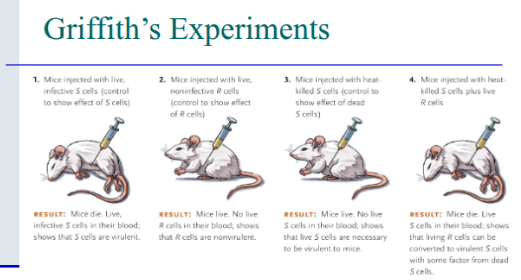
What is the transforming molecule in Griffith’s Experiments?
DNA is the transformation molecule the non-infectious r cells pick up dna from dead s cells and genetic recombination happens causing non-infectious r-cells to become infectious cells
What is Avery’s Experiments (1940) What is the transforming molecule in Griffith’s Experiments?
Used bacteria instead of mice
Destroyed protein - still had transformation
Destroyed DNA - NO transformation
Therefore DNA was the transforming molecule
What happened in Hershey and Chase’s Experiments (1952) Is DNA or protein the genetic material?
Used bacteriophage T2
Used 35S and 32P
Showed that bacteriophage DNA (not protein) enters bacterial cells to direct the life cycle of the virus
Conclusion: DNA is the hereditary molecule

DNA Structure Watson and Crick Experiment (1953) What were they trying to discover
Discovered that a DNA molecule consists of two polynucleotide chains twisted around each other into a right-handed double helix
Each nucleotide of the chains consist of
Deoxyribose
A phosphate group
A base (adenine, thymine, guanine, or cytosine)
The double helix model Is made up of specifically
Deoxyribose sugars linked by phosphate groups → sugar-phosphate backbone
Two strands are held together by base pairs
Adenine-Thymine
Guanine-Cytosine
[Adenine-Thymine, Guanine-Cytosine] (Chargaff’s Rules)
Each full turn of double helix is 10 base pairs
Nucleotide Subunits of DNA
Sugar-Phosphate backbone
Phosphodiester Bonds
Phosphate at 5’ carbon of sugar
Hydroxyl at 3’ carbon of sugar

Rosalind Franklin DNA X-ray Diffraction
Means a helical structure
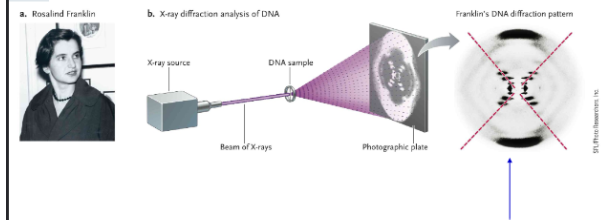
DNA Double-Helix Model has how many base pairs, what is the base pairing and how does it run?
10 Base pairs per turn
Complementary Base pairing
Antiparallel

How does DNA replicate
Semiconservative Replication
Two strands of parental DNA molecule unwind
Each is a template for the synthesis of a complementary copy

What is Meselson-Stahl Experiment (Does DNA replicate semiconservatively?)
Bacteria was put into a beaker with a medium with N15 which is heavy meaning the atomic mass is heavier then regular Nitrogen which they used to build there nitrogenous base so we can distinguish it as parental DNA which is then put in a new flask with N14 normal nitrogen and allowed one replication which is lighter than N15, then they put the sample into another flask which also had N14 and allowed another replication, they took a sample from each flask and centrifuged them to separate the DNA based on its mass DNA separated with two N14 on the top so the new DNA then the DNA in the middle is 15N and 14N which has both heavy and light nitrogen then the parental strand N15 N15 is on the bottom which falsifies the conservative model then on second replication they centrifuge again where on top is just new DNA N14 N14 and on the bottom is N15 N14 Parental and new. This falsifies the Dispersive model.
Conclusion: Results support semiconservative Replication
What are the Enzymes of DNA Replication and what do they do
Helicase - unwinds the DNA
Primase - synthesizes RNA primer (starting point for nucleotide assembly by DNA polymerases)
DNA polymerases - assembles nucleotides into a chain (at 3’ end), remove primers, and fill resulting gaps
DNA ligase - closes remaining single-chain nicks
Assembling a Complementary Chain
Functional groups participate with next nucleotide which in this case is a dinucleoside phosphate since the nitrogenous base is phosphate it is called dATP then when you remove 2 phosphates with hydrolysis energy is released which allows you to build phosphodiester bonds which is energy coupling .
Anexergonic reaction releases free energy and happens spontaneously, while an endergonic reaction absorbs free energy and is non-spontaneous
Energy coupling is a biological process where an energy-releasing (exergonic) reaction is linked directly to an energy-demanding (endergonic) reaction, using the energy from the first to drive the second

DNA Polymerase
DNA polymerase is an enzyme that synthesizes new DNA molecules by assembling individual nucleotides during DNA replication and repair
Builds New Strands
Works in One Direction
Requires a Starter
Proofreads and Repairs
Maintains Geonome Stability

Enzyme Activities
DNA helicase unwinds DNA another enzyme called Topoisomerase prevents overtwisting of the DNA, now that the two strands are separated the DNA we need to use Primase which synthesizes short RNA primer as a structure so DNA Polymerase has a base which as the Primase leaves DNA can bind to.

Assembling Antiparallel Strands
Leading template strand DNA is built towards replication fork until we get to the end of the chromosome this is called continuous DNA Replication.
As we build DNA from the Lagging Strand DNA it is discontinuous as it is away from the replication fork as more templates are being exposed as the DNA unwinds which are then glued down by Okazaki fragments
Two Antiparallel Strands in DNA strands
One template strand runs in a direction allowing new DNA strand to be made continuously in the direction of unwinding
Other template strand is copied in short lengths that run in the direction opposite to unwinding
-Discontinuous - replication produces short lengths (Okazaki Fragments) that are later linked together
Enzyme Activities 2
DNA helicase unwinds DNA Primases synthesize short RNA primers in the 5’ to 3’ dir of unwinding on the leading strand and in the opposite dir on the Lagging Strand Topoisomerase prevents twisting ahead of replication fork.
DNA polymerase 3 adds DNA nucleotides to the RNA primer, continuing 5’-3’ direction of synthesis
DNA helicase continues to unwind
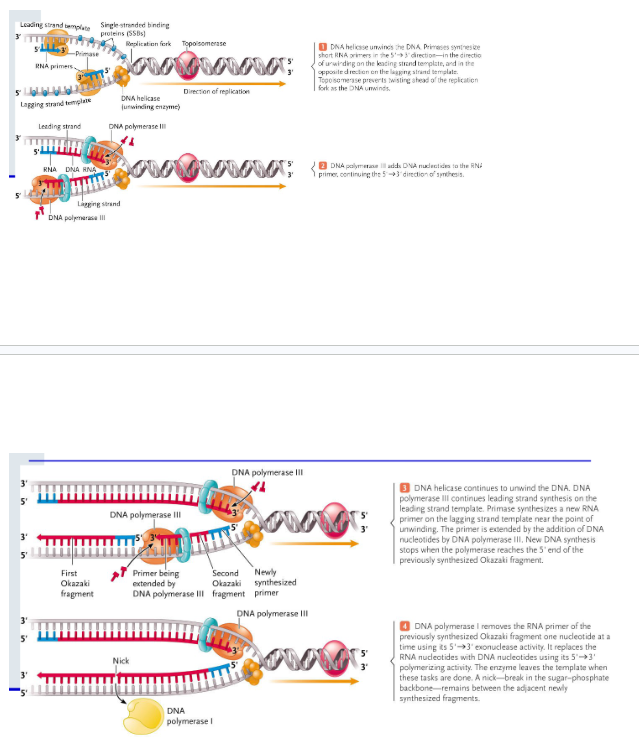
What happens in DNA Synthesis
Begins at sites that act as replication origins
Only activated once during S phase
Proceeds from the origins as two replication forks moving in opposite directions
Origin of Replication
Where replication starts on the DNA is called the replication bubble (ori) DNA is then replicatied away from ori until you get to the very end of the chromosome there is only one ori site in prokaryotes but multiple ori sites in eukaryotes as we have linear DNA vs Circular

What do Telomeres do and what is the enzyme
Ends of eukaryotic chromosomes
Short sequences repeated hundreds to thousands of times
Repeats protect against chromosome shortening during replication
Telomerase - enzyme that prevents chromosome shortening by adding telomere repeats
Why do we need telomeres?
1 Chromosome end after primer removal
2 Telomerase binds to the single stranded 3’ end of the chromosome by complementary base pairing between the RNA of teomerase and the telomere repeat
3 Telomerase synthesizes new telomere extension DNA using telomerase RNA as the template
4 Telomerase moves to 3’ end of newly synthesized telomere DNA
5 Telomerase synthesizes more new telomere DNA using telomerase RNA as the template
6 Telomerase leaves the extended template strandd and a primer is added by primase
7 New end of the chromosome after rplication telomere becomes shorter can be extended out by telomerase but as we age telomerase get slower so telomeres the shorter then cellular sensance kicks in so they stop replicating
8 Short single stranded region remains after primer removal
Protects our Genes

Mechanism That Correct Replication Errors
Proofreading depends on the ability of DNA polymerases to reverse and remove mismatched bases
DNA repair corrects errors that escape proofreading
What happens in Proofreading
If a replication error causes a base to be mispaired, DNA polymerase reverses and removes the most recently added base
The enzyme then resumes DNA synthesis in the forward direction
Proofreading by DNA Polymerase
What happens in DNA repair
DNA polymerase checks if any parts needs repair, DNA is the removed by nucleases where Resynthesis happens and DNA polymerase flls in missing gaps by reading undamaged completely strand as a template, then Sealing happens where DNA ligase glued the final phosphodiester backbone together restoring the normal double-helix structure.
DNA Repair Mechanisms
Set of DNA polymerase enzymes:
Recognize distorted regions caused by mispaired base pairs
Remove mispaired base region from the newly synthesized nucleotide chain
Resynthesize correctly using original template chain as a guide
Mismatch Repair
Cut incorrect nucleotides with enzyme nuclease which is then filled by DNA polymerase and the nicks left by DNA polymerase and nuclease is filled in with DNA Ligase