DNA Sequencing
 Call Kai
 Learn
 Practice Test
 Spaced Repetition
 Match
 Flashcards
 Knowt Play
1/15

There's no tags or description
Looks like no tags are added yet.
16 Terms
Principle of Sanger Sequencing: Chain Extension
Design a WHAT, WHAT to the template strand
Mix the primer with your WHAT
Raise the temperature until the DNA WHAT (H bonds between strands broken)
As temperature is lowered, primers WHAT to the template
Extend primer using WHAT activity to WHAT DNA
Principle of Sanger Sequencing: Chain Extension
Design a PRIMER, COMPLEMENTARY to the template strand
Mix the primer with your DNA
Raise the temperature until the DNA DENATURES (H bonds between strands broken)
As temperature is lowered, primers ANNEAL to the template
Extend primer using POLYMERASE activity to SEQUENCE DNA

Sanger Sequencing AKA Dideocy Sequencing
ddNTP = WHAT
dNTP = WHAT
Sanger Sequencing AKA Dideocy Sequencing
ddNTP = Dideoxyribonucleotide triphosphate
dNTP = Deoxyribonucleotide triphosphate

Sanger Sequencing: Original Method - All reactions contain
WHAT
WHAT
WHAT
WHAT
Sanger Sequencing: Original Method - All reactions contain
DNA Template
DNA Polymerase
Primers (lots of copies)
dNTPS (A, T, C, G)

Sanger Sequencing: Original Method - in the four separate reaction
WHAT
WHAT
WHAT
WHAT
Sanger Sequencing: Original Method - in the four separate reaction
ddATP
ddTTP
ddCTP
ddGTP

Sanger Sequencing: Original Method
When dNTP binds open -OH
Another open WHAT is added at WHAT
WHATis continuous
Sanger Sequencing: Original Method
When dNTP binds open -OH
Another open -OH is added at 3’
CHAIN EXTENSION continuous

Sanger Sequencing: Original Method
When ddTTP binds to open -OH
WHAT is added at 3’
DNAP cannot add any more WHAT
Chain WHAT
Result: Set of nested fragments of every possible length with a WHAT
Sanger Sequencing: Original Method
When ddTTP binds to open -OH
A-H is added at 3’
DNAP cannot add any more NTPs
Chain TERMINATES
Result: Set of nested fragments of every possible length with a 3’ ddTTP

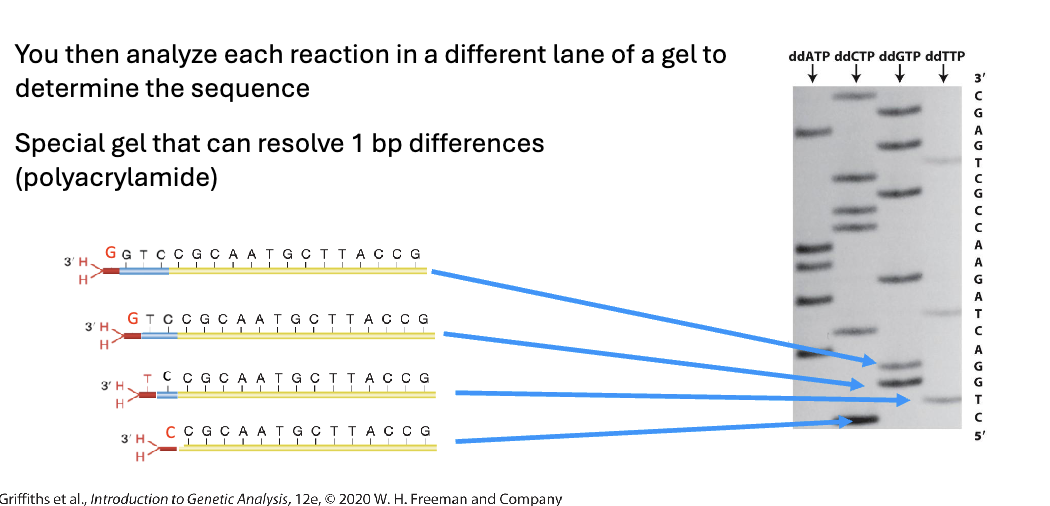
Sanger Sequencing: Original Method
You then analyze each reaction in a different lane of a WHAT to determine the WHAT
Special gel that can resolve 1 bp WHAT (WHAT)
Sanger Sequencing: Original Method
You then analyze each reaction in a different lane of a GEL to determine the SEQUENCE
Special gel that can resolve 1 bp DIFFERENCES (POLYACRYLAMIDE)
Sanger Sequencing: Modern Method
In modern Sanger sequencing, the ddNTPs are each WHAT tagged
The reaction occurs in a WHAT with all the WHAT
The result is then run on a single lane where nucleotides are identified based on the WHAT tag
The process is WHAT
Sanger Sequencing: Modern Method
In modern Sanger sequencing, the ddNTPs are each FLUORECENTLY tagged
The reaction occurs in a SINGLE TUBE with all the ddNTPs
The result is then run on a single lane where nucleotides are identified based on the ddNTP tag
The process is AUTOMATED

Benefits of Sanger sequencing:
Highest WHAT of sequencing methods
For many smaller applications, it’s WHAT and practical
Benefits of Sanger sequencing:
Highest FIDELITY of sequencing methods
For many smaller applications, it’s COST-EFFECTIVE and practical
Issues with Sanger sequencing:
Sequencing on a genomic scale is WHAT and WHAT
Reads max. WHAT bp long
Issues with Sanger sequencing:
Sequencing on a genomic scale is SLOW and EXPENSIVE
Reads max. 900 bp long
Next-generation sequencing
Massively parallel sequencing, where the whole genome is broken into fragments and sequenced at once
Benefits of next-gen sequencing:
High WHAT of reads (millions compared to <100 for Sanger)
Much WHAT per-bp cost
Benefits of next-gen sequencing:
High VOLUME of reads (millions compared to <100 for Sanger)
Much LOWER per-bp cost
Issues with next-gen sequencing:
Higher WHAT rates (less fidelity) compared to Sanger sequencing
High DNA WHAT and WHAT needed
WHAT reads (99 – 1000 bp)
Issues with next-gen sequencing:
Higher ERROR rates (less fidelity) compared to Sanger sequencing
High DNA CONCENTRATION and PURITY needed
SHORT reads (99 – 1000 bp)
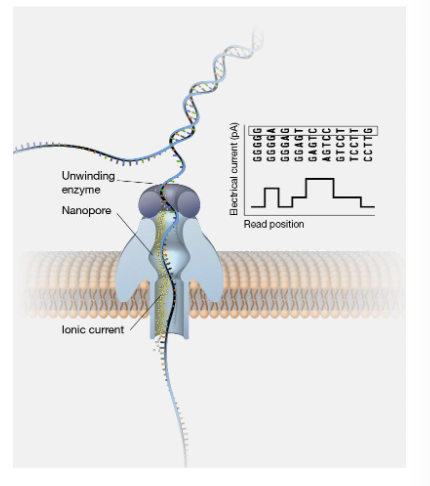
Third-generation sequencing
Long-read or whole molecule DNA sequencing

Benefits of third-gen sequencing:
Generates WHAT reads (10 kb – 4 Mb!)
Makes genome assembly WHAT
Benefits of third-gen sequencing:
Generates ULTRA-LONG reads (10 kb – 4 Mb!)
Makes genome assembly STRAIGHTFORWARD

Issues with third-gen sequencing:
Higher WHAT (but improving)
Needs careful DNA WHAT and WHAT prep
More WHAT per-bp compared to next-gen
Issues with third-gen sequencing:
Higher ERROR (but improving)
Needs careful DNA EXTRACTION and LIBRARY prep
More EXPENSIVE per-bp compared to next-gen