Materials Exam 3
 Call Kai
 Learn
 Practice Test
 Spaced Repetition
 Match
 Flashcards
 Knowt Play
1/34

There's no tags or description
Looks like no tags are added yet.
35 Terms
Stress vs strain
Stress: Force/Area measured in pascals
Strain: DL/L
Shear Stress and shear strain
Sheart stress = shear modulus * shear strain

Young’s Modulus
Slope of the linear portion of the stress strain curve.
If nonlinear curve, it can be tangent

Elastic Strain and Deformation
Elastic strain: When the strain is reversible (loading, unloading)
Elastic Deformation: Temporary deformation of materials shape that is reversing after removing the force or load
STRAIN IS REVERSIBLE AND INDEPENDENT OF TIME

Poisson’s ratio
- Lateral strain / longitudinal strain
X or Y strain/ Z strain
Yield Strength
Max stress that can be applied before it starts to plastically deform (permanently deform)
Usually at end of linear region)
METALS HAVE A 0.2% offset

Ductility
Degree of plastic behavior before fraction

Resilience
Area under linear region until the yield strength
Elastic energy that can be stored in a unit volume → elastic response
Toughness
Energy required to deform a unit volume to failure
AREA UNDER ENTIRE STRESS STRAIN CURVE
Overview mechanical properties

True stress and strain

Hardness
materials resistance to localized plastic deformation
Elastic vs plastic behavior
Plastic is actual deformation slippage on a plane
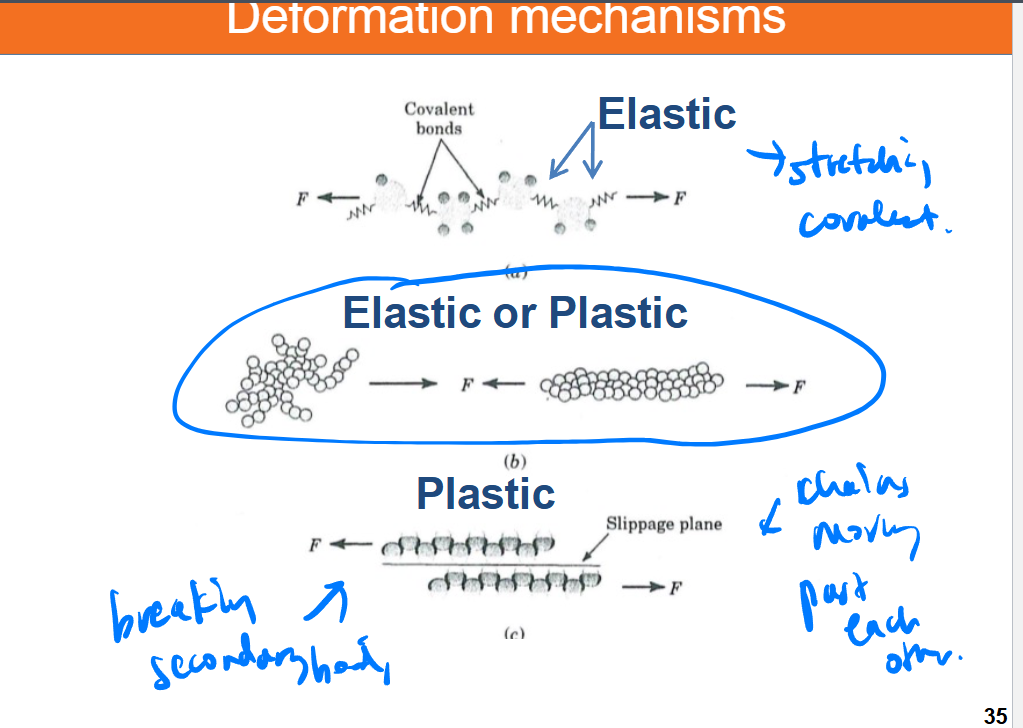
Crystalline vs amorphous (elastic) polymer

Time-dependent strain

Creep Rate

Adsoprtion vs absorption
Adsorption: Molecules cling to surface
Absorption: Molecules penetrate into bulk material
Surface energy vs surface tension
High surface energy is hydrophilic

Charge charge interactions and hydrophobicity

Surface feature identification techniques
Scanning electron microscopy (SEM)
Atomic Force Microscopy (AFM)
Light microscopy
Composition Measuring techniques
X-ray photoelecton spectroscopy (XPS)
Attentuated total internal reflectance fourier transform infrared spectroscopy (ATR-FTIR)
Secondary ion mass spectrometry (SIMS)
TEM
Transmission electron microscopy
Beam passes through sample and can measure samples with thickness from 2-200 micrometers
Just looks at electron dense, not thickness
Scanning electron microscopy
Beam scans SURFACE
Gives an image of surface
AFM
Atomic Force Microscopy
Gains topographical info by small probe on surface.
Gives roughness info i think
XPS`
X-ray photoelectron spectroscopy
Gives info about superficial atomic layers composition
ATR-FTIR
Attenuated Total Internal Reflectance Fourier Transform Infrared spectroscopy
EM radiation pass through low density sample and analyze the surface characterization to monitor changes in surface composition
SIMS
Secondary Ion Mass Spectrometry
Characterize surface region of materials. Primary ions
Measures outer layer characterization
Protein interactions with biomaterials
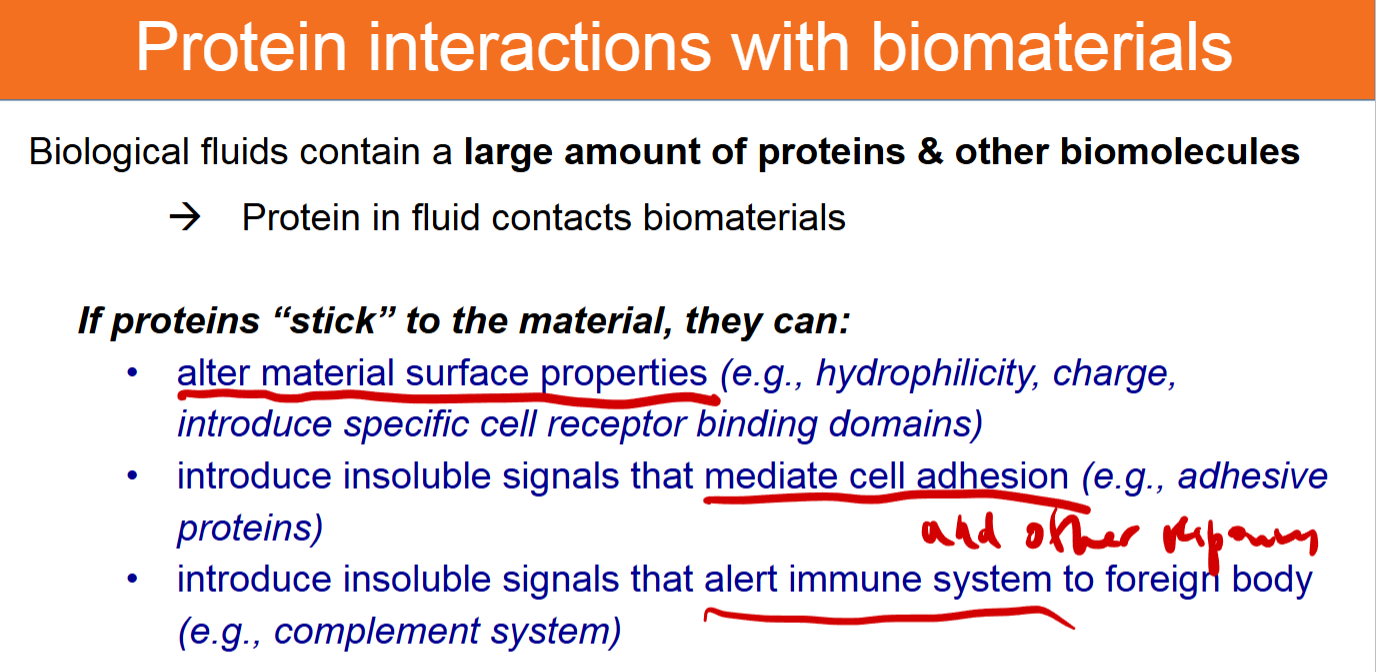
What drives protein adsorption
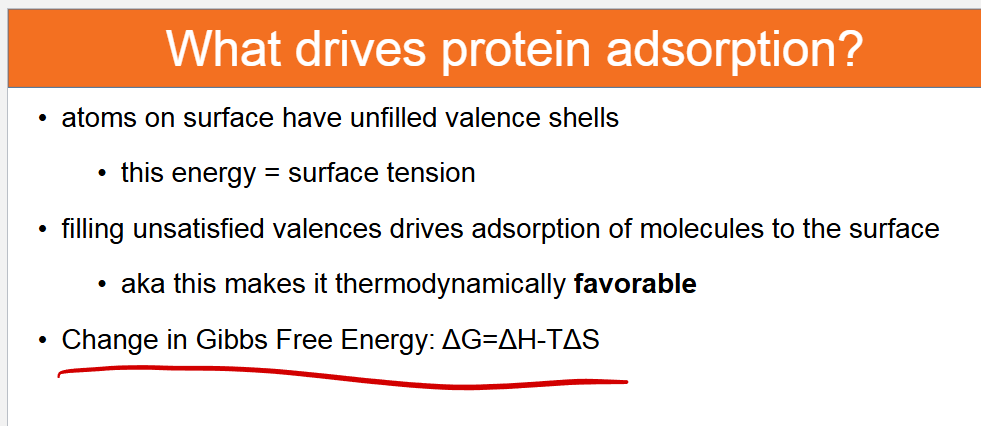
Thermodynamics of protein adsorption

3 Steps of protein adsorption kinetics

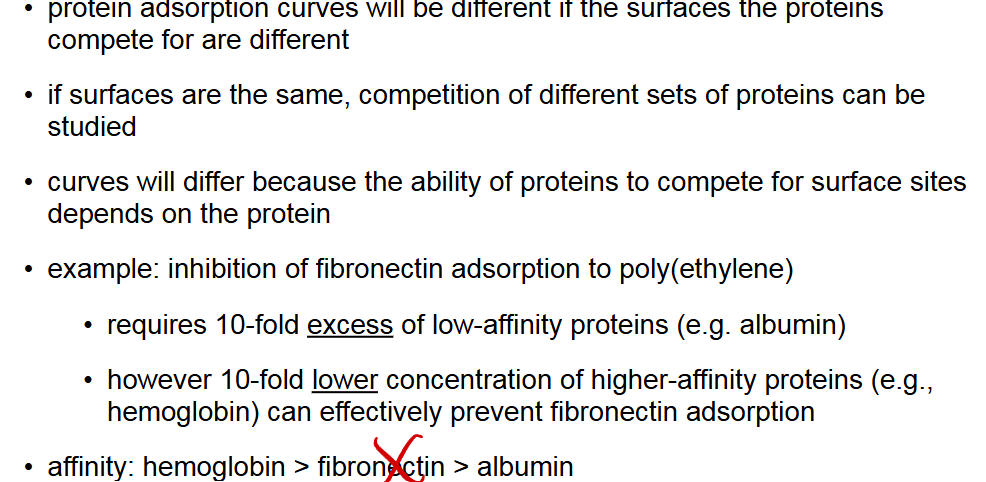
10 fold concentration of lower and higher affinity proteins rule in vroman effectiveness
Easily denatured proteins adsorption
Because they denature, their conformation changes and allow more contacts. ADSORB MORE THAN STABLE PROEINS
Cadherins, selectins, and integrins

Cell adhesion: What is it
Link between cytoskeleton and ECM
