Unit 2 Review: All terms
 Call Kai
 Learn
 Practice Test
 Spaced Repetition
 Match
 Flashcards
 Knowt Play
1/28

There's no tags or description
Looks like no tags are added yet.
29 Terms
ATP
Adenosine Triphosphate - an immediately available source of energy cells use to do work

Carbon dioxide
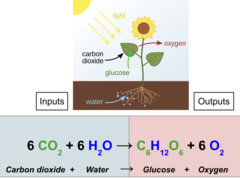
CO2 - Plants use carbon dioxide to make glucose during photosynthesis.

cellular respiration
the process of breaking glucose to create ATP

Chemical energy
energy stored in chemical bonds
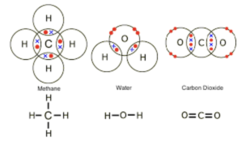
Chloroplast
an organelle in the plant cell that converts light energy into chemical energy via the photosynthetic process.

glucose
sugar molecule made of: 6 Carbons, 12 Hydrogens, and 6 Oxygens
Glucose = stored chemical energy

Light energy
A form of electromagnetic radiation that travels in waves and can be seen by the human eye. Light is made of many photons ("particles") moving in different waves of energy (seen as different colours)

mitochondria
an organelle in a cell that produces ATP. This is where cellular respiration takes place.

Oxygen
O2
Photosynthesis
the process by which green plants and certain other organisms transform light energy into chemical energy.
Water
H20

Chlorophyll
green pigment in a chloroplast that absorbs light energy during the light reactions of photosynthesis

Organic compound
a compound made by living organisms that contains carbon - hydrogen bonds

Inorganic compound
a compound that exists separately from living organisms and does not contain a carbon - hydrogen bond

Stoma (stomata)
a hole-like structure found in leaves and stems of plants. Stomata control the rate of gas exchange between the plant and the atmosphere by opening and closing.

starch
a string (polymer) of glucose molecules

carbohydrate
a biomolecule (organic compound) made of simple or complex sugars. Carbohydrates supply energy to the body, such as sugar and starch.

biomolecule
a chemical compound found in living organisms

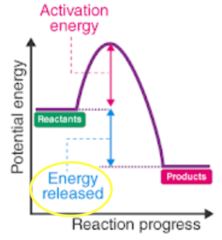
activation energy
the minimum amount of energy that must be provided to break covalent bonds in reactants so that a chemical reaction occurs.

active site
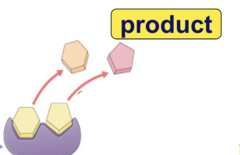
a space in the enzyme that fits the substrate shape exactly. Or: the part of the enzyme where substrate molecules bind and a chemical reaction takes place

catalyst
a molecule that lowers the activation energy required for reactions

endothermic
a chemical reaction where the reactants absorb heat energy from the surroundings to form products. (it 'sucks up' heat from the area around it)

enzyme
a protein that acts as a biological catalyst by accelerating chemical reactions
exothermic
a chemical reaction where the reactants releases energy (heat) to the surroundings (it gives off heat to the area around it)
product
a substance that is formed from a chemical reaction
reactant
a substance that takes part in and undergoes change during a reaction

substrate
a molecule that an enzyme reacts with (the reactant in the reaction the enzyme helps)

What is the chemical equation for photosynthesis? (What are the inputs and outputs?)

What is the chemical equation for cellular respiration? (What are the inputs and outputs?)
