Lec 6 - How does the immune system see?
 Call Kai
 Learn
 Practice Test
 Spaced Repetition
 Match
 Flashcards
 Knowt Play
1/49

There's no tags or description
Looks like no tags are added yet.
50 Terms
What are the 5 paradigms of the immune system?
sensing, specialization, reaction, regulation, memory
We have something called innate sensing, what is that?
Who was the first scientist to come up with the concept of antibodies?
Paul Ehrlich! proposed the first major theoretical model for how they worked (the side-chain theory) around 1900.
Who was Frank MacFarlane Burnet?
another scientist who came up with the “self/non-self discrimination hypothesis”
He republished a famous booked called “The Production of Antibodies” where the immune system doesn’t attack our own cells cuz it recognizes what “self” is!

In 1989, what 2 scientists further refined the self vs non self recognition concept?
Charles Janeway and Ruslan Medzhitov! They suggested that the immune system looks for pathogens based on receptors that they have and that we don’t! Pattern Recognition Receptors (PRRs)

So Charles Janeway and Ruslan Medzhitov had come up with the concept of Pattern Recognition Receptors (PRRs). Did they ever find it?
nope, in 1997 they found a human molecule that activated the immune system called Toll-Like Receptors (TLRs).
(don’t memorize the pic)


fun fact: what is the origin of “Toll-Like Receptors” as a name?
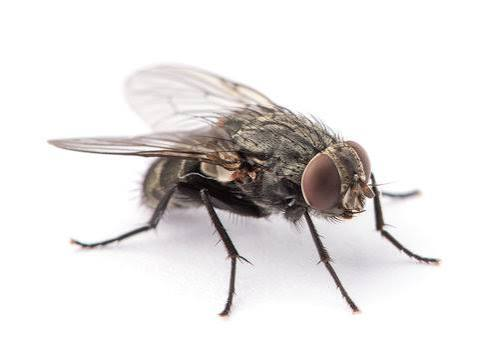
Janeway and Medzhitov found a human molecule (TLRs) that looked similar to the fly molecule “Toll”
“toll” = “cool!” in german cuz the fly scientists thought it was cool

In 1994, Polly Matzinger came up with the “Danger Hypothesis”. What is it?
“Danger Hypothesis” = immune system is always searching for evidence of something dangerous and will only respond when danger is HAPPENING (i.e., extends beyond pathogens).
So we don’t have a receptor for every pathogen out there, but we can …..
So we don’t have a receptor for every pathogen out there, but we can respond to almost every kind of pathogen out there.

The immune system has Pattern Recognition Receptors (PRRs) that recognize the following:
major structures
unusual nucleic acids
unusual carbohydrates
Give me further examples of each.
major structures (we don’t have cell walls nor flagella really so PRRs will look for these)
unusual nucleic acids (double stranded RNA, single stranded DNA, unusual ends to DNA, unusual methylation, nucleic acids in unusual locations)
unusual carbohydrates (unusual glycan modifications, carbs we don’t make)
What are the 4 types of PRRs we’ll discuss? What do they each look for?
Toll-Like Receptors (TLRs)
C-type Lectin Receptors (CLRs)
NOD-like Receptors (NLRs)
RIG-I-like Receptors (RLRs)

What do TLRs look for?
toll like receptors look for conserved bacterial + viral products outside cell and hidden in endosomes inside the cell

What do CLRs look for?
C-type Lectin receptors look for unusual carbs (which fungal pathogens usually have)

What do NLRs look for?
NOD-like receptors look for bacterial products in cytosol

What do RLRs look for?
RIG-I-like receptors look for viral nucleic acid sensors in cytosol
How many TLRs do humans have?
Humans have 10 toll like receptors.


T/F: Humans have 10 toll-like receptors (TLRs).
true!
How do PRRs know where to localize to?
PRRs localize to where their ligands will be found.
What are the ligands PRRs are recognizing called?
PAMPs! pathogen associated molecular patterns


So PRRs know where to localize to because they’re looking for where their ligands will be found.
ex. for TLRs, they’re detecting for bacteria that are found outside the cell.
Can TLRs detect viral nucleic acids inside the virus?
no cuz theyre INSIDE the virus. rem. TLRs can detect viral products outside cell and in endosomes

So TLRs can’t detect viral nucleic acids hidden inside the virus, so when do they get to detect viruses?
once the virus is destroyed and the DNA/RNA inside the endosomes comes uncovered!
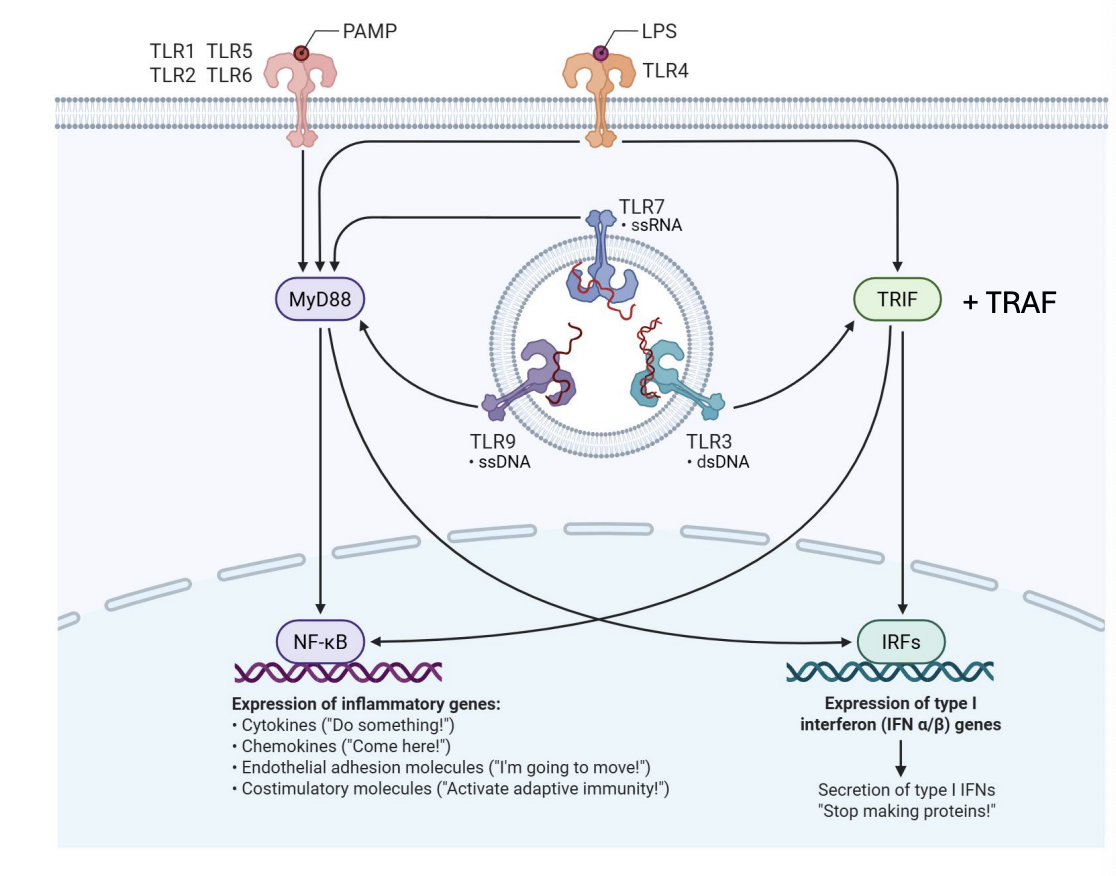
TLR signalling is very well understood but we don’t need to memorize it. What are the 2 signalling adaptors for TLRs that we need to know?
2 signalling adaptors for TLRs: MyD88 and TRIF!

TLR signalling is very well understood but we don’t need to memorize it. What is the protein that drives pro-inflammatory responses? What is the protein that drives interferon responses?
NF-kB drives pro-inflammatory responses
IRFs drive interferon responses
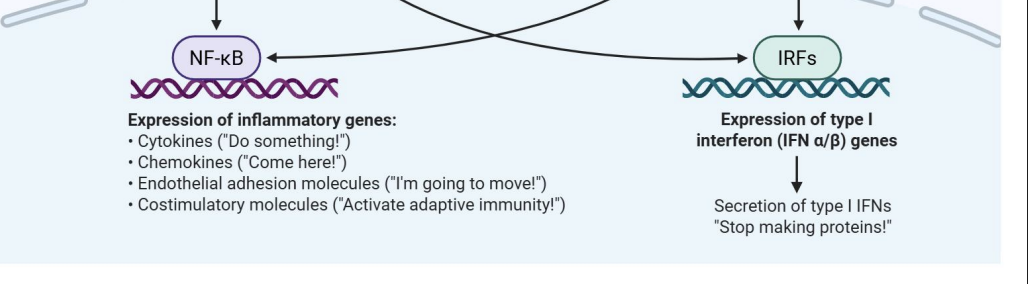
What do interferons do again?
interferons = signaling proteins your immune system makes to stop viruses from spreading and to activate immune cells
CLRs are numerous. Rem. they detect unusual carbs.
CLRs = C-type Lectin Receptors. What is Lectin?
lectin is a type of protein found in most plants that can bind to carbohydrates

T/F: Lectins bind carbs.
true!
So CLRs detect unusual carbs (sugars) on cells to distinguish what is self vs non self. What is an example of something they could detect?
ex. fungi have cell walls that have unique carbs that we don’t make. so CLRs can detect this.
also other species add diff carbs to their proteins as secondary modifications than we do! ex. look at all the mannose in the right side of the pic!


So CLRs detect unusual carbs (sugars) on cells to distinguish what is self vs non self.
What is an example of something they could detect?
ex. fungi have cell walls that have unique carbs that we don’t make. so CLRs can detect this.
ex. also other species add diff carbs to their proteins as secondary modifications than we do! look at all the mannose in the right side of the pic!
….
What do both TLRs and CLRs do?
they both activate NF-kB to drive inflammatory response (cytokines, chemokines, etc)

Unlike TLRs, what do CLRs do?
Hint: gobble gobble
CLRs are HIGHLY PHAGOCYTIC! they induce the cell to eat and destroy their targets

How many NLR (Nod-like receptors) genes are there?
there are ~22 NLR genes!
Where are NLRs found?
in the cytosol! i.e., NLRs are cytosolic

This image shows NOD1 or NOD2 receptor detecting bacterial peptidoglycan (shed from bacteria) —> activating NF-kB —> drives ….
This image shows NOD1 or NOD2 receptor detecting bacterial peptidoglycan (shed from bacteria) —> activating NF-kB —> drives inflammation
T/F: RLRs are also cytosolic, like NLRs are.
true!
What do RLRs sense again?
viruses!
How do RLRs sense viruses in the cytosol (what are they looking for)?
RLRs are looking for uncapped RNAs!


Look at the image. RLRs (RIG-I) looks for uncapped RNA (thus a virus) and triggers a cellular chain reaction to produce interferons that will fight infection!
…
MDA5 (an RLR) looks for what kind of RNA?
long dsRNA
LGP2 (an RLR) looks for what kind of RNA?
dsRNA
What are DAMPs?
Damage Associated Molecular Patterns (DAMPs)!
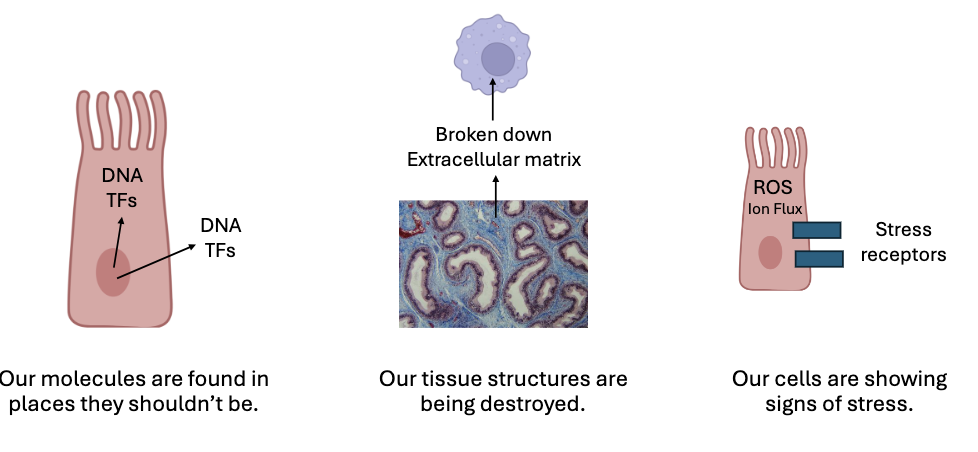
Examples of Damage Associated Molecular Patterns (DAMPs)?
molecules found in places they shouldn’t be
tissue structures like ECM being destroyed
cells showing stress
T/F: DAMPs, like PAMPs, are also sensed through PRRs.
true!
DAMPs, like PAMPs, are also sensed through PRRs.
Which PRR detects when molecules like RNA and DNA are found outside the cell (not where it should be)?
TLR3,7,9
DAMPs, like PAMPs, are also sensed through PRRs.
Which PRR detects a secreted stress factor HMGB1 (a DNA-bound transcription factor)?
TLR4

If (which PRR?) binds to our own dsRNA or improperly processed RNA —> this is an indicator of a (what?) cell!
If RIG-I binds to our own dsRNA or improperly processed RNA —> this is an indicator of a STRESSED cell!

DAMPs, like PAMPs, are also sensed through PRRs.
Which PRR detects degradation products (hyaluronan fragments, fibrinogen, etc) of our ECM?
TLR4
DAMPs, like PAMPs, are also sensed through PRRs.
Which PRR detects cellular disturbances?
an NLR called NLRP3

An NLR called NLRP3 detects cellular disturbances. If an infected cell gets too stressed, NLRP3 will activate ______________ (inflammatory cell death).
Hint: think pyrotechnics
An NLR called NLRP3 detects cellular disturbances. If an infected cell gets too stressed, NLRP3 will activate PYROPTOSIS (inflammatory cell death).
What is pyroptosis?
Inflammatory cell death!
NLRP3 will create a bunch of cytokines and they’ll all be released upon cell death —> Immune cells sense the cytokines and mount a large response to clear the pathogen —> inflammation!

Other receptors (not PRRs) that monitor factors like pH, temperature, osmolarity, ATP levels etc:
…
