Biology Molecules
 Call Kai
 Learn
 Practice Test
 Spaced Repetition
 Match
 Flashcards
 Knowt Play
1/91

There's no tags or description
Looks like no tags are added yet.
92 Terms
What are the elements present in the largest proportions in living organisms?
carbon, oxygen, hydrogen, nitrogen, phosphorus and sulfur
What do most of the oxygen and hydrogen in living organisms exist as?
Water
What is in a water molecule?
Each hydrogen atom shares a pair of electrons with the oxygen atom, forming a covalent bond
What charge does the hydrogen and oxygen have in a water molecule?
Hydrogen has a slightly positive charge, Oxygen has a slightly negative charge
What does polar mean?
Molecules with an uneven distribution of charge i.e. water
What does the polar nature of water result in?
The formation of hydrogen bonds between adjacent water molecules. (That extend between the oxygen on one water molecule and a hydrogen atom on another)
What are the properties of Hydrogen bonds
Not strong and relatively easily broken
How do molecules with charged groups dissolve in water?
Molecules with charged groups, such as glucose or amino acids, and ions dissolve in water with polar water molecules readily forming clusters around them
What are the values of water as a solvent?
The fact that most of a cell’s reactions take place in a aqueous solution
Its ability to act as a transport medium in living organisms
The different effects it has on hydrophilic and hydrophobic molecules (e.g. lipids are hydrophobic and do not dissolve in water)
Explain how water acts as a solvent?
Water molecules are charged and so surround the ions and other charged molecules, separating them in solution
What type of molecules will not dissolve in water?
Molecules that lack a charged group i.e. non-polar molecules (e.g. lipids) will not dissolve in water
What type of energy can break hydrogen bonds easily?
Heat
What is the optimum pH of the stomach enzyme pepsin?
2
What are Buffers?
Buffers are chemicals or substances that resist changes to pH and ensure that a particular environment maintains a particular pH, e.g. include hydrogencarbonate ions and blood proteins such as albumin
What are Ions
Ions are atoms or groups of atoms that have an electrical charge due to the number of protons and electrons not balancing
Atoms of metals and Atoms of non-metals
Metals tend to loose electrons - so positively charged
Non- Metals tend to gain electrons - so negatively charged
What are the biologically important inorganic ions?
calcium, iron, magnesium, potassium, nitrate, phosphate, hydrogencarbonate
What is calcium essentials in?
In plant calcium pectate is an essential component of the middle lamella of plant cell walls
Essential component of bones and teeth in animals
Essential in blood clotting and muscle contraction
What is Iron important in?
Is part of the haem group in haemoglobin
Important constituent of electrons carriers in respiration
What is magnesium essential in?
Essential in giving chlorophyll its light- absorbing properties
What is potassium important in?
Important in maintaining electrical gradients across neurons
What is nitrate a component of?
Amino acids, nuceic acids and chlorophyll
What is phosphate important in?
as phospholipids, phosphate is an important component of cell surface membrane
Major component of Adenosine Triphosphate (ATP) and nucleic acids
What is hydrogencarbonate important in?
Important as a natural buffer
What are examples of organic molecules?
Carbohydrates, proteins, lipids
What is polymerisation?
Sub-units called monomers, which join together to form larger polymers
What do carbohydrates contain?
Carbon, hydrogen, oxygen (ration of H: O is 2:1)
What are the three main types carbohydrates are divided into?
Monosaccharides
Disaccharides
Polysaccharides
What are monosaccharides?
Basic carbohydrate monomers i.e. single sugars
Biologically important monosaccharides contain three (trioses), five (pentose) or six (hexose) carbon atoms
What are disaccharides?
Disaccharides are double sugar formed from two monosaccharide monomers
What are polysaccharides?
Polysaccharides are complex molecules usually consisting of many monosaccharide monomers
What is glucose and what is its formula?
Glucose is a hexose monosaccharide, formula C₆H₁₂O₆
What is a-glucose the basic sub-unit of?
Complex polysaccharides such as starch and glycogen

What is B-glucose the constituent of?
Constituent monomer of cellulose.
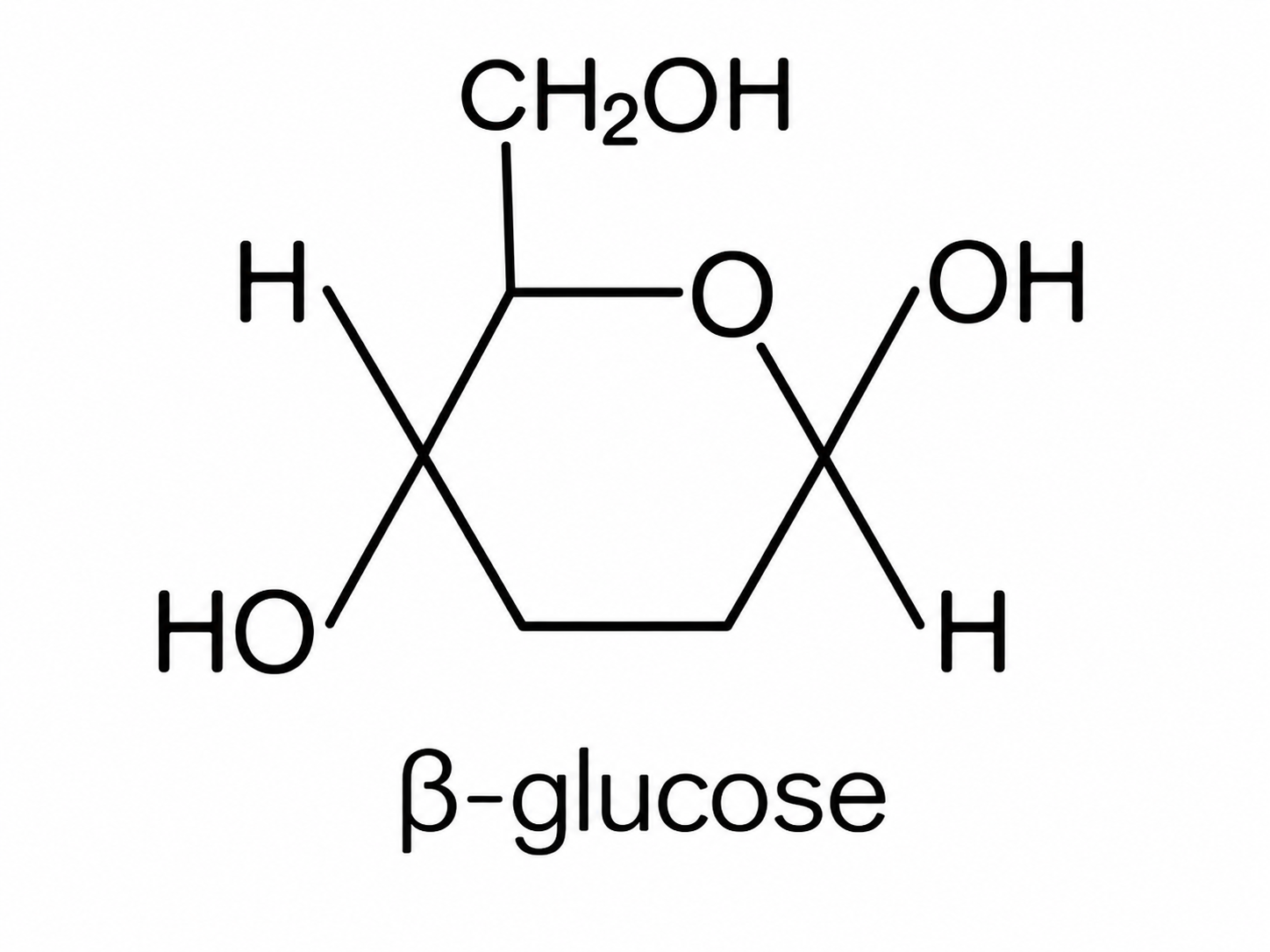
What forms when further small changes to the B-glucose is made?
The hexose sugar fructose.
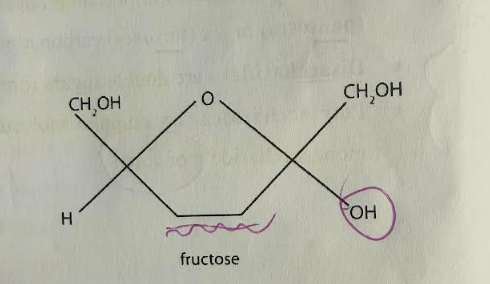
What is the general formula for a monosaccharide?
CₙH₂ₙOₙ
What are hexose monosaccharides, such as glucose important in?
Energy sources in living organisms
What does being isomers of each other mean?
Substances such as the monosaccharides, which have the same molecular formula, but different structural formula.
How are disaccharides formed?
Disaccharides are formed when when 2 monosaccharides, usually hexoses, react together in a chemical reaction known as condensation reaction.
Reversible reaction, disaccharide molecule can be broken down into its constituent monosaccharide monomers in a hydrolysis reaction (hydrolysis reactions are important in the digestion of food)
What is lost during condensation reaction and what is gained during hydrolysis reaction?
One molecule of water
What is a glycosidic bond?
What is the bond described as being?
The bond that is formed between two hexose sugars in the formation of a disaccharide is called a glycosidic bond
α-1,4 glycosidic bond
The formation and breakdown of the disaccharide molecule maltose

What is the general formula of disaccharides?
C12H22O11
What are the 2 important disaccharides?
Maltose - formed when two a-glucose are linked through a condensation reaction
Sucrose - formed when an a-glucose molecule condenses with a fructose molecule
How is maltose formed?
What forms when maltose is further digested?
Maltose is formed when starch is digested - the maltose requires further digestion to form to form the monomer glucose.
How is sucrose important in plans?
Sucrose is the form in in which carbohydrates is transported through phloem in plants
How are polysaccharides formed?
Through condensation reactions joining a large number of monomers together to make complex polymers
What is the general formula for a polysaccharide
(C₆H₁₀O₅)ₙ
What are the properties of polysaccharides?
Not sweet
Insoluble in water
What are the important polysaccharides?
Starch, glycogen and cellulose
What is starch and what is it made of?
Starch is a polymer of α-glucose. It consists of a mixture of two types of chains: amylose and amylopectin.
What are the two types of chains in starch?
Amylose and amylopectin.
What is amylose?
In amylose, α-glucose molecules are linked by α-1,4 glycosidic bonds, forming long unbranched chains.
What shape do amylose chains form and what holds them in place?
The chains are coiled to form a spiral, with the spirals held in place by hydrogen bonds.
Why do amylose chains form a coiled configuration?
Bulky side groups cause the α-glucose molecules to lie at different angles.
Why is amylose unbranched?
Only α-1,4 glycosidic bonds are involved.
What percentage of starch is formed from amylose?
Approximately 20%.
What is amylopectin?
A component of starch in which α-glucose monomers are linked by α-1,4 glycosidic bonds, with α-1,6 glycosidic bonds forming side branches.
How do side branches form in amylopectin?
α-1,6 glycosidic bonds form side branches.
How often may branches occur in amylopectin?
As often as one branch every ten α-glucose monomers.
What percentage of starch is normally amylopectin?
About 80%.
How do amylose and amylopectin differ structurally?
Amylose is unbranched, with only α-1,4 glycosidic bonds; amylopectin is branched, with α-1,4 and α-1,6 glycosidic bonds.
Where and in what form is starch commonly stored in plants?
Starch is commonly stored as solid grains and can often be seen in electron micrographs of plant chloroplasts.
Why is starch a good storage carbohydrate?
Very compact, so contain rich store of glucose in small space
Insoluble, so will not affect the water relations of the cell (if significant quantities of carbohydrates were stored as glucose this would cause a lot of water to enter by osmosis)
Being a large molecule it can be retained in the cell and will not easily pass through the cell membrane
The branching nature of amylopectin creates many terminal ends that are easily hydrolysed. This aids in the rapid enzymatic breakdown of starch into its constituent glucose molecules at times of high respiratory demands.
Why is the compact structure of starch important?
Amylose and amylopectin are compact (aided by the coiled configuration), containing a rich store of glucose in a small space.
Why is it important that starch is insoluble?
It will not affect the water relations of the cell. Storing much carbohydrate as glucose would cause water to enter by osmosis.
Why is the large size of starch important?
It can be retained in the cell and will not easily pass through the cell membrane.
How does amylopectin branching help when respiratory demand is high?
Branches create many terminal ends that are easily hydrolysed, aiding rapid enzymatic breakdown of starch into its constituent glucose molecules at times of high respiratory demands
How may starch molecules differ between plants?
Differ in the relative amounts of amylose and amylopectin (e.g. 20/80)
Number of glucose molecules contained in each
Where is glycogen found and what form is it stored as?
It is the storage carbohydrate of animal and fungal cells, stored as small granules.
What monomer and bonds make up glycogen?
Chains of α-glucose monomers, with α-1,4 and α-1,6 glycosidic bonds.
How is glycogen structurally similar to amylopectin?
Both contain chains of α-glucose monomers with α-1,4 and α-1,6 glycosidic bonds.
How is glycogen structurally different from amylopectin?
Glycogen chains are shorter and more branched than amylopectin chains.
Where is glycogen stored in mammals?
In liver and muscle cells.
Why is glycogen suitable for storage in cells?
It is compact and insoluble, therefore not affecting cell water relations.
Why can glycogen be hydrolysed rapidly?
It has no unbranched chains and shorter chains than amylopectin, giving proportionally more terminal ends.
Why is extra branching in glycogen important for animals?
Being more branched creates many terminal ends that glucose can be more rapidly hydrolysed from glycogen. This is important since animals have relatively high rates of respiration (metabolism) and so use up glucose quickly
What is the function of cellulose?
It is a structural polysaccharide
What monomer and bond make up cellulose?
β-glucose monomers joined by β-1,4 glycosidic bonds.
How are adjacent β-glucose molecules arranged in cellulose?
Alternate molecules are rotated through 180°.
Why are alternate β-glucose molecules rotated through 180°?
It is a necessary consequence of the different structure of β-glucose compared with α-glucose.
What are the two effects of flipping alternate β-glucose molecules?
The unbranched chains are straighter
Hydrogen bonds can form cross-linkages between adjacent chains (due to the oxygen and the side groups being available on both side of the chains)
Why are cellulose chains straight?
The bulky -CH₂OH side groups alternate between above and below the unbranched chain.
Why can hydrogen bonds form between adjacent cellulose chains?
Oxygen and side groups are available on both sides of the chain following the inversion of alternate β-glucose molecules.
What are cellulose microfibrils?
Groups of many cellulose molecules (chains).
How are cellulose microfibrils arranged in plant cell walls?
They are orientated into many planes in a lattice structure (to further increase its tensile strength)
Why are cellulose microfibrils arranged in a lattice structure?
To further increase the tensile strength of plant cell walls.
Give two structural differences between amylose and cellulose.
Amylose is a polymer of a-glucose, cellulose is a polymer of B-glucose
Amylose is helical, cellulose forms straight, unbranched chains
Alternate B-glucose are inverted in cellulose, a-glucose are not inverted in amylose
How do the glycosidic bonds of amylose and cellulose differ?
Amylose has α-1,4 glycosidic bonds; cellulose has β-1,4 glycosidic bonds.
How does cellulose structure suit its function?
Straight chains form hydrogen-bonded microfibrils, arranged in a lattice structure to give tensile strength to plant cell walls.