MODULE 3 LESSON 1: Schools of Taxonomic Thought
 Call Kai
 Learn
Learn Practice Test
 Spaced Repetition
 Match
Match Flashcards
 Knowt Play
1/46

There's no tags or description
Looks like no tags are added yet.
Name | Mastery | Learn | Test | Matching | Spaced | Call with Kai | Chat |
|---|
No analytics yet
Send a link to your students to track their progress
47 Terms
Phylogenetics
conjecture
_____________ is the unraveling of evolutionary history.
Sometimes it is considered a controversial area in biology.
The controversy arises because, although some groups are well defined, phylogenetic relationships for most groups of organisms remain largely conjectural.
Nonetheless, the situation has improved significantly over the last decade.
A ____________ refers to an opinion or conclusion that is based on incomplete information.
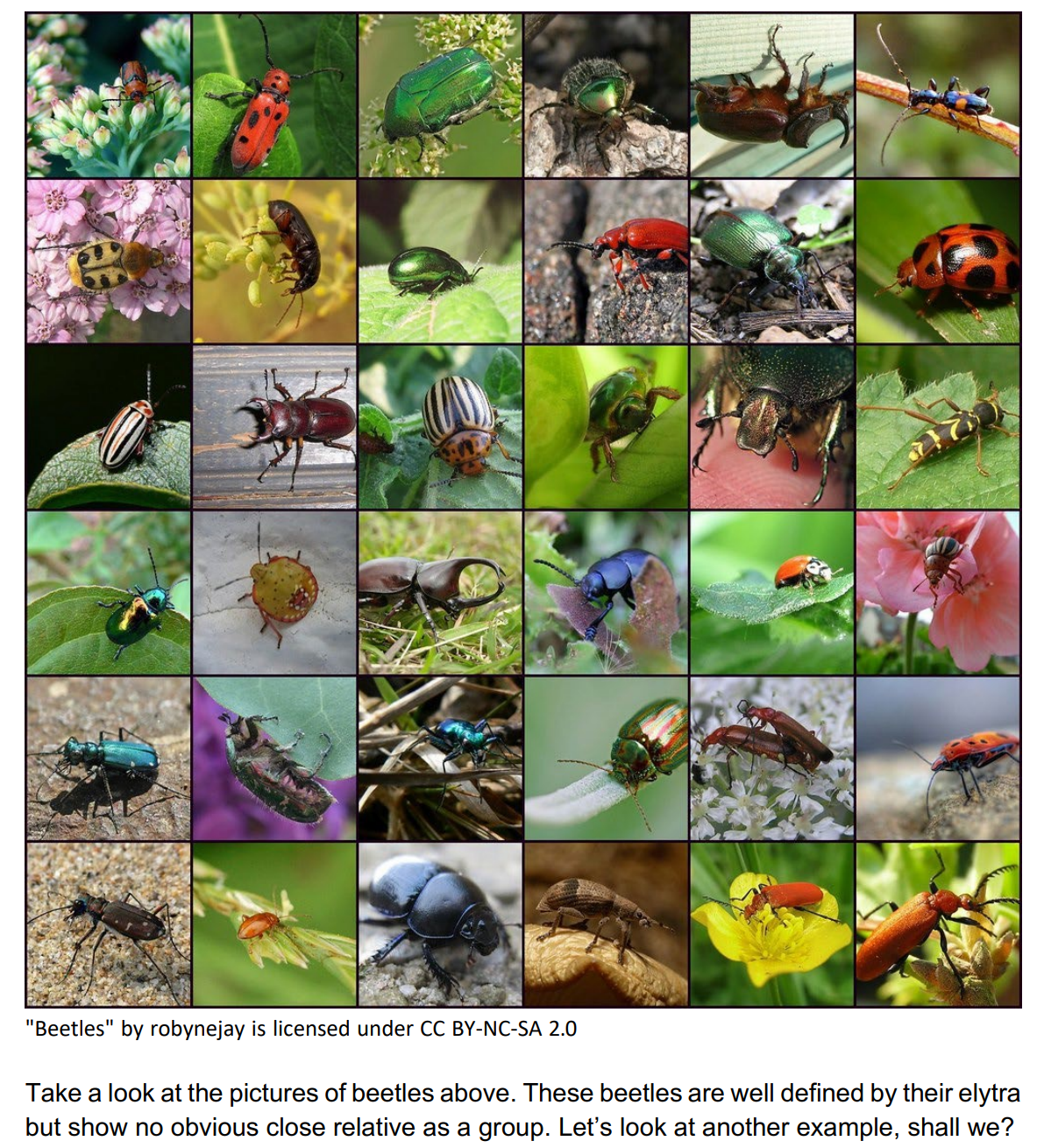
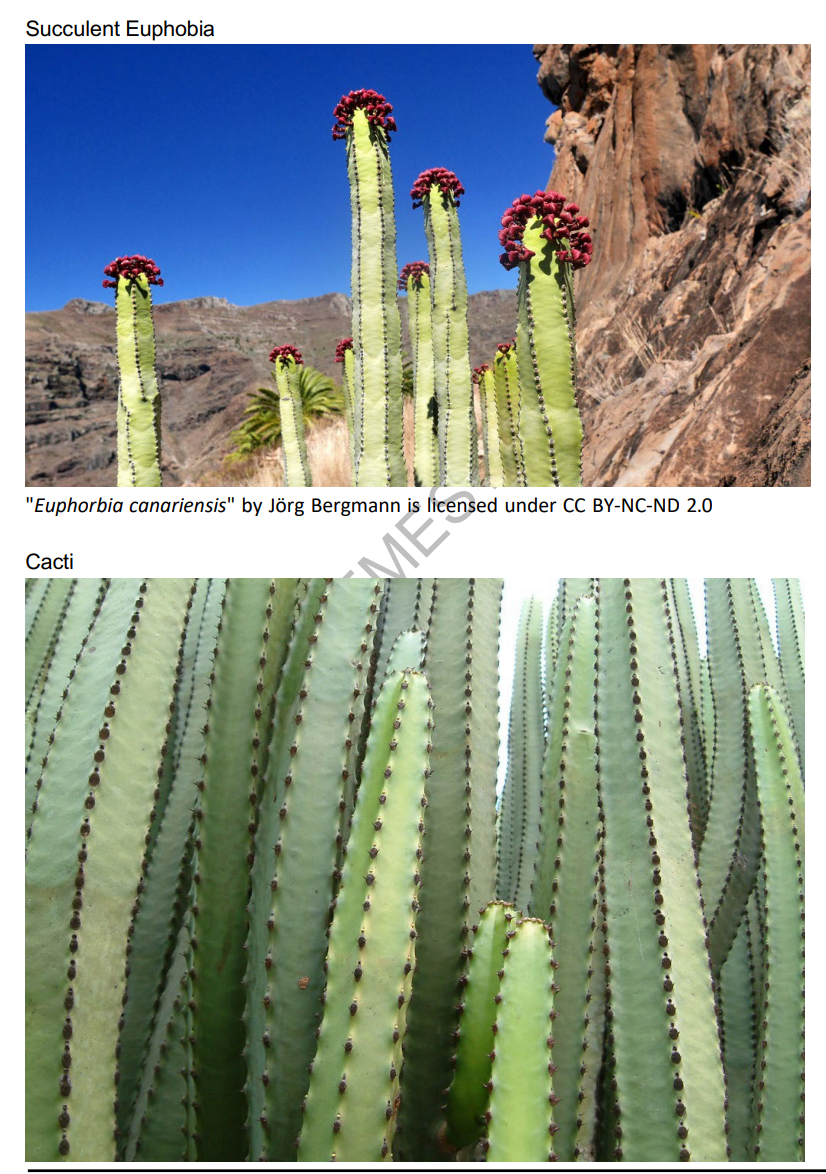

Even in plants like Cycas spp., cacti, and succulent euphorbias, superficial resemblance is misleading as an indication of relationship of groups. The reason is, resemblance does not always indicate evolutionary relationships, because although similarity may arise from relatedness, it can equally arise through the phenomenon of homoplasy.
In early phylogenetic analyses, such conjectures are of two main types, representing extremes.
One would be a group that is well-defined and very easily recognized by the possession of one or a few very distinct features but that same feature(s) make it difficult to determine which other group(s) would be their close relative(s).
The other extreme, represent groups that resemble each other rather closely but are actually only remotely related.
Homoplasy
_________________ is similarity resulting from convergent or parallel evolution of structures, by either chance or selection for similar functions.

For example, the wings of the bird and wings of a butterfly demonstrates homoplasy. They are similar in that they are both used in flight but are different in that these wings were not derived from a common ancestor.
homology
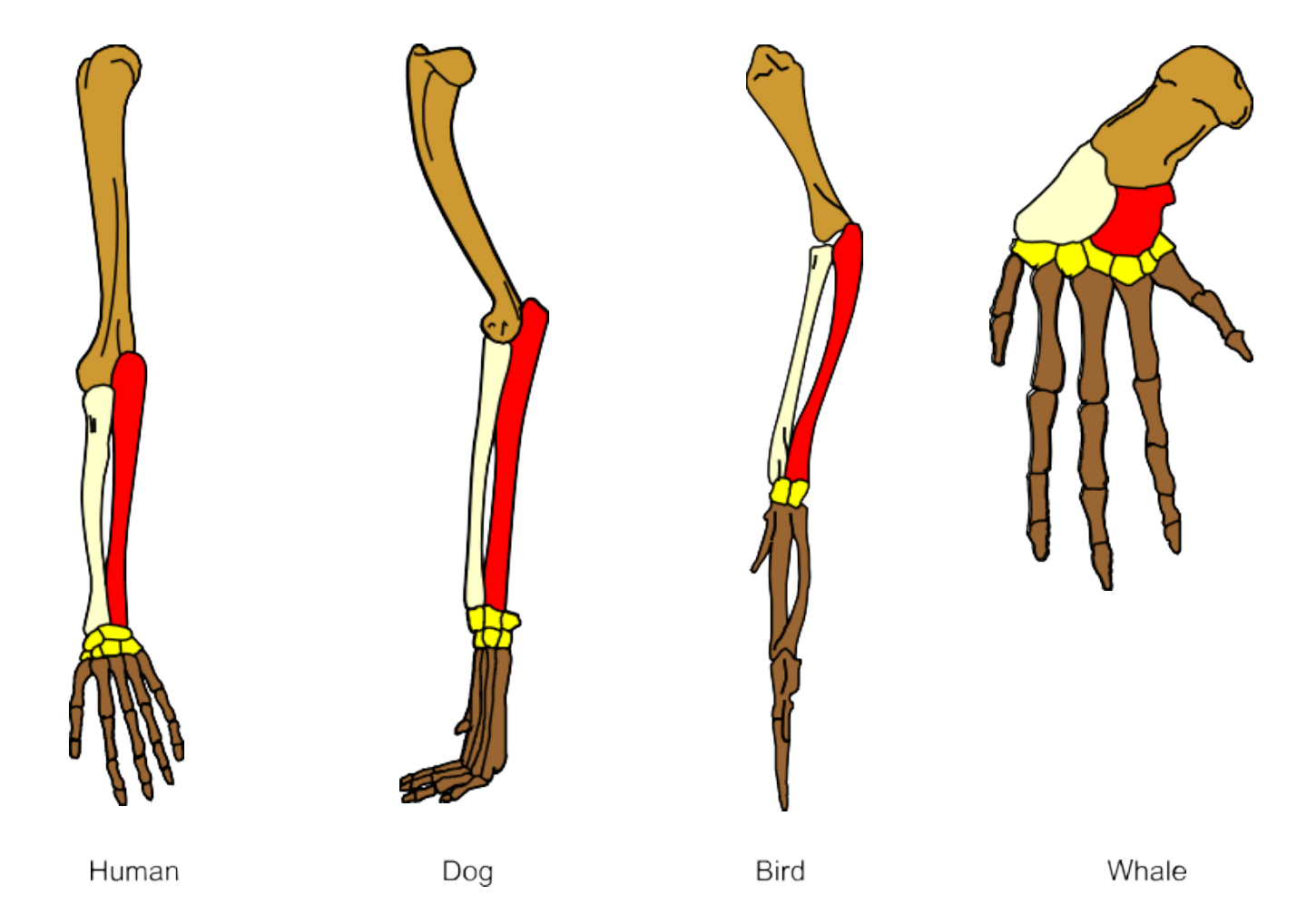
On the other hand, _______________ is similarity as the result of common ancestry. Only homology can provide information regarding phylogeny. The example below shows homology in the fore limbs of human, bats, birds, cats, dolphin or whale.
Phylogeny
systematics

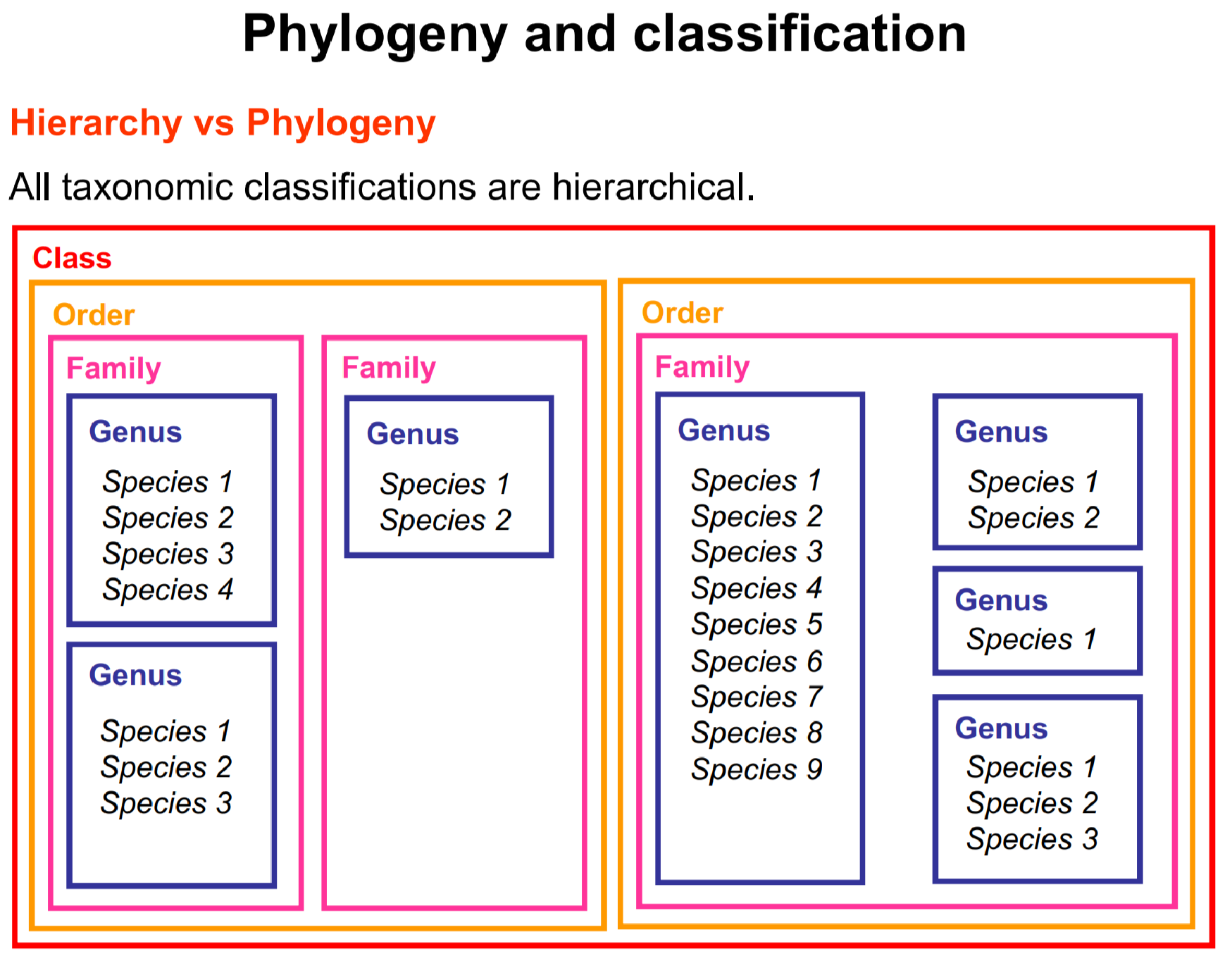
_____________ is the evolutionary history of a species or group of related species.
The discipline of ___________ classifies organisms and determines their evolutionary relationships,
Systematists use fossil, molecular, and genetic data to infer evolutionary relationships.
phylogeny

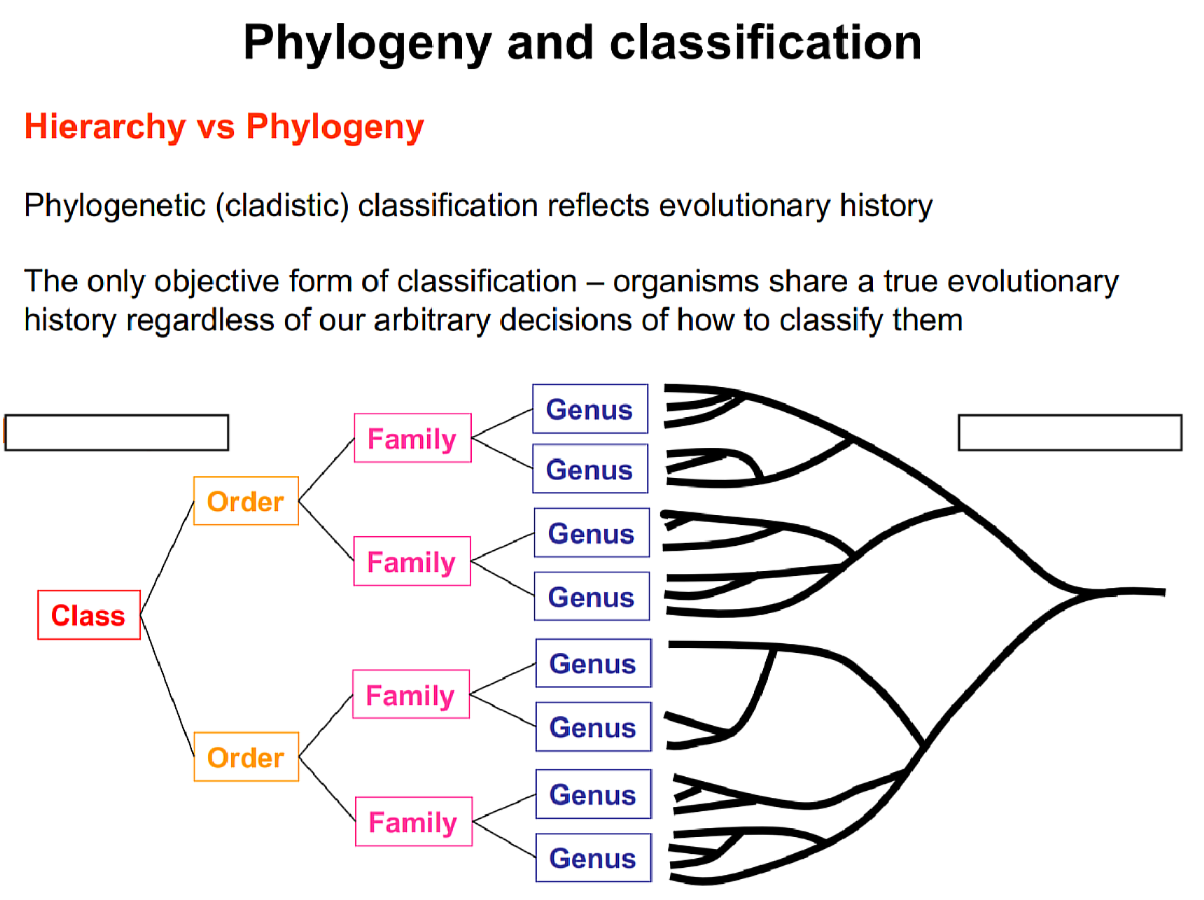
What is a _______________?
Branching diagram showing relationships between species (or higher taxa) based on their shared common ancestors



Phenetics
Schools of Taxonomic Thought: Phylogenetic Methods
____________ - applies numerical taxonomy to arranging groups into genera & higher ranks
Cladistics
Schools of Taxonomic Thought: Phylogenetic Methods
____________ - focuses on shared derived characters to group taxa
Evolutionary classification or evolutionary taxonomy (phyletics)
Schools of Taxonomic Thought: Phylogenetic Methods
________________________________ - incorporates genealogical relationship between groups with evolutionary distance
Phenetics
____________- (from Greek phainein' - to show)
relies on estimates of overall similarity
Phenetics
usually derived from morphology, but sometimes from behavior & other traits, and increasingly from molecular evidence
PHENETICS


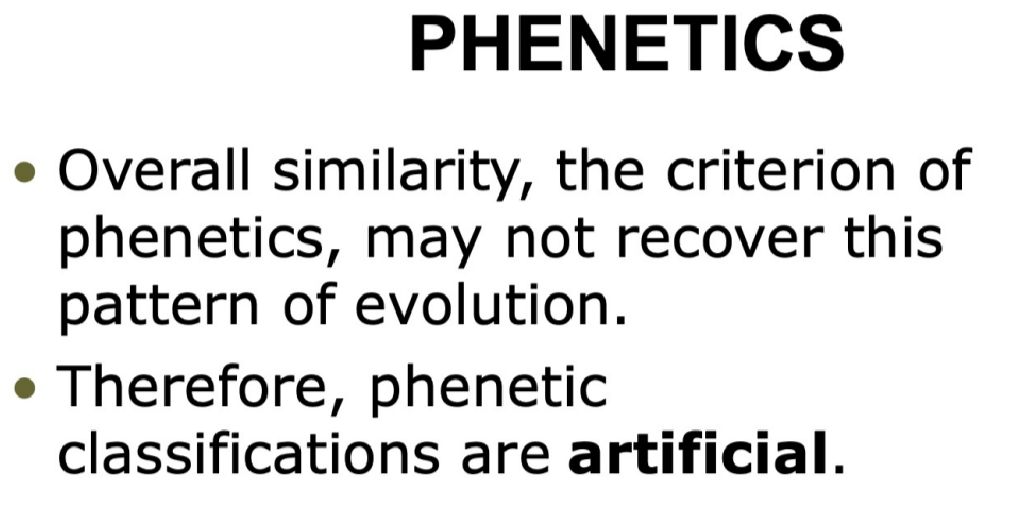
artificial
Claim: "evolution is unknowable; the best that we can hope for are patterns
of resemblance ... “
Others: the ______________ pattern revealed — as good an estimate of phylogeny as can be obtained
Because phenetics may not recover the pattern of evolution resulted from evolutionary processes, its phenetic classifications are ____________
Cladistics
_____________ groups organisms by common descent
clade
A _________ is a group of species that includes an ancestral species and all its descendants
It can be nested in larger clades, but not all groupings of organisms qualify as clades
Willi Hennig
synapomorphies
descent; modification

Cladistic methods (________________ 1966)
Based on shared, derived characters = _______________
Similarity is not enough – requires similarity reflecting ___________ with ____________
Requires characters that can be assigned a particular character state
monophyletic

A valid clade is _____________, signifying that it consists of the ancestor species and all its descendants
paraphyletic

A ____________ group consists of an ancestral species and some, but not all, of the descendants.
polyphyletic

A _______________ grouping consists of various species with different ancestors.
ancestral
plesiomorphy
symplesiomorphy
derived
apomorphy
synapomorphy
Characters
____________ - from primitive ancestor
____________ - primitive/ancestral characters
_____________ - shared ancestral character
__________ - from recent ancestor
_____________ - advanced/derived character
______________ - shared derived character
Plesiomorphy
Apomorphy
Symplesiomorphy
Synapomorphy

Terminology
________________ - Character state found in ancestor of group
_________________ - Derived character state in descendants of group
_________________ - Shared, ancestral character state
__________________- Shared, derived character state (indicates homology)

Take this phylogenetic tree and fill in the blanks:
Blue” and “square” are _________________
“Small size” is an _________________ for A
“Red” is a _________________ for A + B
“Circle” is a _________________ for A + B + C …but a _________________ for A + B


simplicity/complexity
fossils/fossil records
outgroup
outgroup
How do you know the state of the character?
____________/______________ of the character
through ___________/_____________
___________ method ---
___________- distantly related taxon
ancestral
derived
How do you know the state of the character?
simplicity/complexity of the character state---
simpler structures - ___________
more complex -- ____________
ex. lungs of frogs vs. lungs of birds
regression or reduction
derived
ancestral
derived; ancestral
How do you know the state of the character?
simplicity/complexity of the character state---
however, simple structures may evolve from complex structures. (_________________)
eyelessness in cave fishes - ____________
presence of eyes in most fishes -- ______________
corolla tube (_________) ; free petals (_____________)
ancestral
extant
scales (400 MYA) vs. feathers (195 MYA)
scales feathers
How do you know the state of the character?
fossils -- character in the older fossils will be ____________ compared with the characters in the younger fossils
It is absent in the fossils but present in the _________ taxa
________ in fishes, reptiles, legs of birds ancestral compared with ____________ (of birds)

How do you know the state of the character?
outgroup - taxon distantly related to any member of the lineage
outgroup method - presence of characters (ancestral); if a charac
homology
Basis of similarities among characters
_____________ - resemblance in characters in different taxa due to a common origin
homologous
Basis of similarities among characters
similar ancestral characters in different taxa are always ______________
homologous; common ancestor
Basis of similarities among characters
Similar derived characters present in different taxa may be _____________ only if the character can be determined to be originating from a _____________________.
homology


Basis of similarities among characters
_________________
arm of chimpanzee and arm of man
hand and arm of man, flipper of seal, wing of bat and wing of bird-- structurally similar in bone though may perform different functions
homologous
Basis of similarities among characters
Any feature shared by two or more species that is inherited from a common ancestor is said to be __________________.
divergent
Basis of similarities among characters
Differences in homologous characters in 2 related taxa - ____________ evolution
divergent evolution
Basis of similarities among characters
trend in evolution resulting in differences in evolutionary pathways followed by 2 descendant lineages from their ancestor
analogy
Basis of similarities among characters
___________ - resemblance in structure/appearance in unrelated taxa due to similarity in function
Analogous

Basis of similarities among characters
_____________ structures - products of convergent evolution
convergent evolution
Basis of similarities among characters
______________ - a trend in evolution that produces resemblance in features of unrelated taxa due to exposure to similar environmental conditions
selection pressures
Basis of similarities among characters
Why Analogous Structures Exist.
Analogous structures evolve as a result of similar ______________________. These two animals are both burrowing mammals and are not closely related.

placental mole and the southern marsupial mole from Australia
Both have large claws for digging, thick skin in the nose area for pushing dirt around and an oval body which moves easily through tunnels
homologous; analogous
Basis of similarities among characters
While the bones found in the wings of birds and bats are ______________, the wing itself is _____________.
The wing structure did not evolve from the same ancestor.
homoplasy

Basis of similarities among characters
______________ - resemblance in structure of distantly related taxa because they are sameforming.
Similarity in characters is due to having followed similar developmental plans and not due to inheritance from a common ancestor
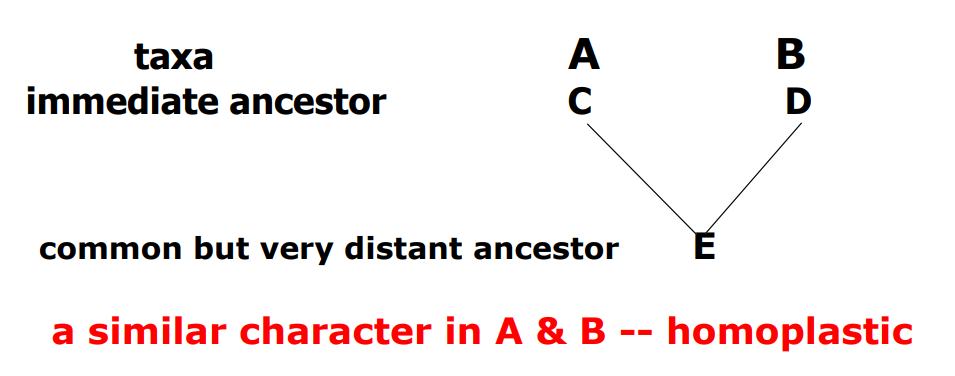
homoplastic; parallel
Basis of similarities among characters
The 2 unrelated taxa with the similarity in character inherited similar developmental plans (that resulted in the character) from a common but very distant ancestor
_______________ characters - _____________ evolution
Homoplasy
Basis of similarities among characters
____________ - similarity resulting from convergent or parallel evolution of structures, by either chance or selection for similar functions.
e.g., the wings of a bird and the wings of a butterfly demonstrate homoplasy. Similar since they are both used in flight but are different in that these wings were not derived from a common ancestor
parallel evolution

Basis of similarities among characters
_________________ - a trend in evolution that produces resemblance in features of unrelated taxa or distantly related taxa that have followed the same or similar developmental plans.

Evolutionary systematics
a.k.a. classical evolutionary systematics/taxonomy, evolutionary taxonomy
also uses estimates of derived similarity, but unlike cladistics,
estimates of the amount of evolutionary change are included with the branching pattern in order to produce a classification.
Evolutionary systematics


emphasizes distinctness
grants higher taxonomic status taxa separated by 'gaps'
may be due to accelerated morphological innovation in a lineage, &/or by extinction of intermediate linking forms.