✔️✔️✔️25 - Liver, Pancreas, & Spleen 🟢
 Call Kai
 Learn
 Practice Test
 Spaced Repetition
 Match
 Flashcards
 Knowt Play
1/70

There's no tags or description
Looks like no tags are added yet.
71 Terms
LECTURE 25 POWERPOINT INFORMATION
LECTURE 25 POWERPOINT INFORMATION
Right medial
Right lateral
Quadrate
Left medial
Left lateral
Caudate
What are the lobes of the liver?
between right medial and quadrate lobes
Where is the gall bladder located?
Between left medial and quadrate lobes
Where is the falciform ligament located?
papillary & caudate
What are the 2 processes of the caudate liver lobe?
Gall Bladder
Cystic duct
Hepatic ducts
Bile duct
Major duodenal papilla
What structures make up the biliary system?
right
The [right/left] triangular ligament courses from the right crus of the diaphragm to the right lateral lobe of the liver
left
The [right/left] triangular ligament courses from the left crus of the diaphragm to the left lateral lobe of the liver
ligaments
The _____ of the liver hold it in position
coronary ligament
Courses between the diaphragm and liver around the caudal vena cava and hepatic veins
boomerang
The pancreas in dogs and cats is shaped like a _____
near pylorus
Where is the body of the pancreas located?
within mesoduodenum
Where is the right lobe of the pancreas located?
within deep leaf of greater omentum
Where is the left lobe of the pancreas located?
major duodenal papilla
The pancreatic duct empties at the _____
smaller; absent
The pancreatic duct is [ smaller/larger] than the accessory pancreatic duct in the dog and sometimes _____
cats
The pancreatic duct is always present in [dogs/cats]
minor duodenal papilla
The accessory pancreatic duct empties at the _____
larger
The accessory pancreatic duct is [smaller/larger] than the pancreatic duct in the dog
20
The accessory pancreatic duct is only present in ~_____% of cats
within the superficial leaf of the greater omentum
Where is the spleen located?
gastrosplenic
What ligament is associated with the spleen?
LECTURE 25 PRACTICE QUESTIONS
LECTURE 25 PRACTICE QUESTIONS
C) Gall bladder
Which lobe of the liver is located between the right medial and quadrate lobes?
A) Left lateral lobe
B) Right lateral lobe
C) Gall bladder
D) Caudate process
B) Liver
The caudate process is part of which organ?
A) Pancreas
B) Liver
C) Spleen
D) Gall bladder
C) Where it joins the hepatic ducts
Where does the cystic duct become the bile duct?
A) After it leaves the liver
B) At the entrance of the gall bladder
C) Where it joins the hepatic ducts
D) At the major duodenal papilla
C) Duodenum
What structure does the bile duct empty into?
A) Stomach
B) Gall bladder
C) Duodenum
D) Jejunum
B) Digestion and regulation of blood glucose
What is the primary function of the pancreas?
A) Storage of bile
B) Digestion and regulation of blood glucose
C) Production of red blood cells
D) Absorption of nutrients
C) Pancreatic duct
Which pancreatic duct is smaller in dogs and sometimes absent?
A) Accessory pancreatic duct
B) Major pancreatic duct
C) Pancreatic duct
D) Minor pancreatic duct
B) Minor duodenal papilla
The accessory pancreatic duct empties into the duodenum at which location?
A) Major duodenal papilla
B) Minor duodenal papilla
C) Duodenum's entry point
D) Caudal duodenal flexure
C) Coronary ligament
Which ligament courses between the diaphragm and the liver around the caudal vena cava?
A) Falciform ligament
B) Right triangular ligament
C) Coronary ligament
D) Gastrosplenic ligament
B) In the superficial leaf of the greater omentum
Where is the spleen primarily located?
A) In the deep leaf of the greater omentum
B) In the superficial leaf of the greater omentum
C) Near the pylorus of the stomach
D) Adjacent to the pancreas
C) Gastrosplenic ligament
What connects the stomach and spleen?
A) Falciform ligament
B) Coronary ligament
C) Gastrosplenic ligament
D) Mesogastrium
A) Mesoduodenum
The right lobe of the pancreas is located within which structure?
A) Mesoduodenum
B) Greater omentum
C) Lesser omentum
D) Parietal peritoneum
B) Filtration of blood and bile production
What is the primary role of the liver?
A) Hormone production
B) Filtration of blood and bile production
C) Nutrient absorption
D) Blood cell production
B) Falciform ligament
Which ligament helps hold the liver in position?
A) Round ligament
B) Falciform ligament
C) Gastrohepatic ligament
D) Mesocolon
B) Falciform ligament
What connects the right and left lobes of the liver?
A) Round ligament
B) Falciform ligament
C) Hepatic ducts
D) Coronary ligament
B) Pancreas
Which organ is NOT part of the biliary system?
A) Gall bladder
B) Pancreas
C) Hepatic ducts
D) Bile duct
A) Entry point for vessels and nerves
What is the function of the splenic hilus?
A) Entry point for vessels and nerves
B) Site of bile secretion
C) Point of attachment for ligaments
D) Digestive enzyme production
D) All liver lobes contribute
Which lobe of the liver is responsible for producing bile?
A) Quadrate lobe
B) Caudate lobe
C) Right lateral lobe
D) All liver lobes contribute
C) Connecting the liver to the diaphragm
What is the role of the falciform ligament?
A) Supporting the gall bladder
B) Dividing the liver lobes
C) Connecting the liver to the diaphragm
D) Supporting the spleen
B) At the major duodenal papilla
Where does the major pancreatic duct empty?
A) At the duodenal flexure
B) At the major duodenal papilla
C) Into the bile duct
D) Into the stomach
C) Lateral
What is the anatomical relationship of the spleen to the stomach?
A) Dorsal
B) Ventral
C) Lateral
D) Medial
LECTURE 25 IMAGES
LECTURE 25 IMAGES
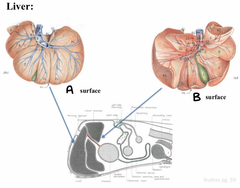
parietal surface
A

visceral surface
B
right lateral lobe
A
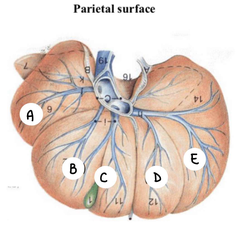
right medial lobe
B

quadrate lobe
C

left medial lobe
D
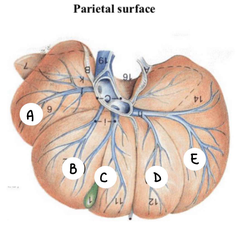
left lateral lobe
E
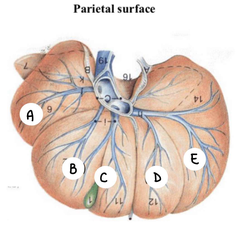
left lateral lobe
A

left medial lobe
B
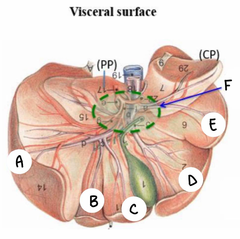
quadrate lobe
C

right medial lobe
D

right lateral lobe
E

porta hepatis
F

gall bladder
A
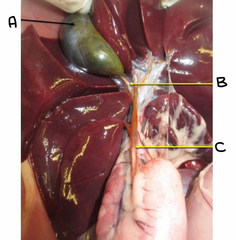
cystic duct
B

bile duct
C

left triangular ligament
A

right triangular ligament
B

coronary ligament
A/B

pancreas
What is this structure?

pancreatic duct
A
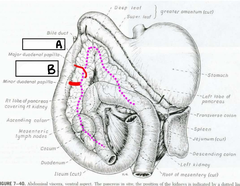
accessory pancreatic duct
B

left lobe of pancreas
A

right lobe of pancreas
B

descending duodenum
C

fundus of stomach
D
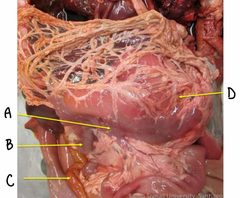
hilus of spleen
What is this structure?
