622 11/10 GLA pt 3 HIV and Opportunistic Infections
 Call Kai
 Learn
 Practice Test
 Spaced Repetition
 Match
 Flashcards
 Knowt Play
1/72

There's no tags or description
Looks like no tags are added yet.
73 Terms
6 Factors that Affect the Immune Response to HIV Infection
mutation rate
antigneicity
loss of CD4 T cells
immune exhaustion
immunosenesence
immune response
Mutation Rate
factor that affects the immune system response to HIV infection, rapidly changing epitopes can escape immune cell evasion
Antigenicity
factor that affects the immune system response to HIV infection, intracellular molecules can “hide” from the immune response and thet also may have non-immunogneic antigens
Loss of CD4+ T Cells
factor that affects the immune system response to HIV infection, depletion devistates the ability fo the immune system to respond to pathogens
Immune Exhaustion
factor that affects the immune system response to HIV infection, constant chronic activation of immune cells can lead to their dysfunction
Immunosenescence
factor that affects the immune system response to HIV infection, depending on the age of the pt
elderly lose some immune function as a normal part of aging, so they may already be at a disadvantage
Immune Response (Simple)
factor that affects the immune system response to HIV infection, inflammation can also bring in more immune cells that HIV is able to infect exacerbating the infection
opsonization of viral particles by antibodies may increase uptake of virus into additional cells to further infection even more
2 Phases of Immune Response to HIV
phase 1 during acute infection
(clinical latency - asymptomatic)
phase 2 during chronic infection
Phase 1 of Immune Response to HIV
during acute infection, anti-HIV immunity is mediated by anti-HIV antibodies and HIV-specific CD8+ T cells
the immune system maintains an edge over HIV and symptoms are mild or absent
Phase 2 of Immune Response to HIV
chronic infection leads to loss of immune control, HIV replication outpaces the immune system, additional immune cells become infected
increasing depletion of CD4+ T cells leads to secondary infections and increased HIV replication
chronic present of viral antigens leads to additional CD8+ T cell dysfunction through immune exhaustion
What additional immune cells become infected during phase 2 of the immune response to HIV?
CD8 T cells, macrophages, dendritic cells, neutrophils
Late Phase of HIV Infection
without treatment the immune response is entirely depleated
minimal immunity
T Cell Exhaustion Diagram

Why is it crucial that HIV affect CD4+ T cells?
CD4+ cells support the action of the entire immune system through innate cells, CD8+ t cells, and antibody production fo B cells
without the cytokines they produce, you affect a large swath of the immune response
CD4+ T Cells Review Chart
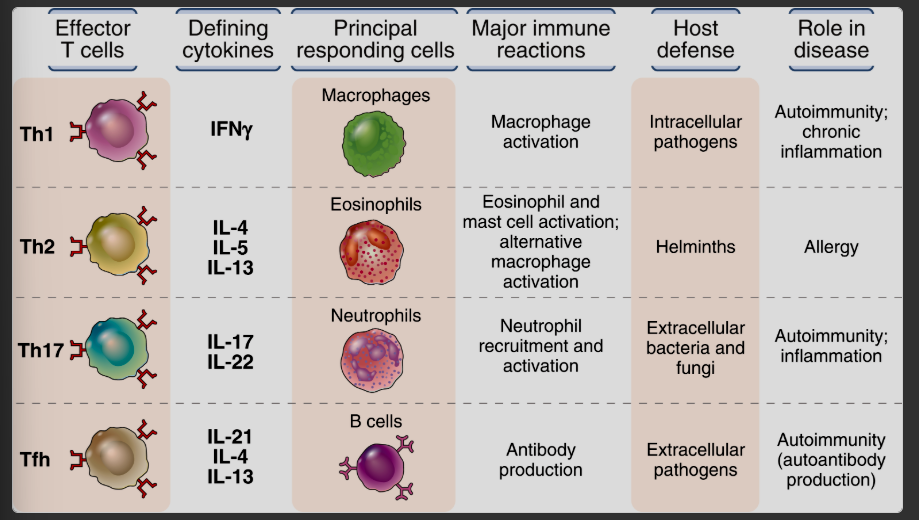
Immune Functions of Cytokines Released by CD4+ T Cells
support class switching
support T cell dependent activation
What cytokine does class switching to IgA and what is the function of IgA?
TGF-b
IgA is enriched in anti-inflammatory mucosal environments like the lungs, GI, and genitourinary tract
What cytokine does class switching to IgE and what is the function of IgE?
IL-4
IgE is secreted during allergic responses and parasitic infections
What cytokine does class switching to IgG and what is the function of IgG?
IFN-y
most abundant in serum, activates complement, opsonization, can cross placenta
T-Independent B Cell Activation
no CD4+ T cells, B-1 cells or marginal zone B cells
reduced isotype switching, immunological memory, affinity maturation, and response against protein antigens
Opportunitstic Infections
as immunity wanes during HIV infection, the pt becomes more susceptible to other infections that can cause significant morbidity and mortality
Secondary Immunodeficiency
acquired immunodeficiency
ex: HIV, malnutrition, stress, sleep deprivation, drugs, asplenia, aging
3 Secondary Immunodeficiencies that Add to Malaise of HIV Patients
malnutrition
stress
aging and immunosenescence
Malnutrition
secondry immunodeficiency that impacts HIV pts, HIV can increase the resting metabolic rate to support upregulation of immune system
net protein loss, hyperglycemia, increase in resting metabolic rate/nutritional needs
Malnutrition and Infection
while malnutrition can lead to increased susceptibility to infection, infection can also lead to an exacerbate malnutrition

Malnutrition and HIV
HIV pts have increasing nutritional requirements because of high metabolic demand, but are typically very ill due to AIDS and can have a decreased appetite due to nausea and diarrhea from secondary GI infections
as malnutrition increases, the immune system falls further into a dysfunctional state
Stress
secondry immunodeficiency that impacts HIV pts, you can get sick after periods of mental stress, due to neuro-endo-immuno lopp
Neuro-Endo Immuno Loop
increased cortisol due to stress can diminish the immune response over time
after prolonged exposure to stress hormones, as in chronic stress, the immune response is diminished
Aging and Immunosenescence
secondary immunodeficiency that impacts HIV pts, waning and changing response of immune system with age
immune system skews toward inflammation more often and loss of lymphocyte and granulocyte functionality (inflamm-aging)
3 Lymphocytes
T cells
B cell
NK cells
4 Granulocytes
neutrophils, eosinophils, basophils, mast cells
How does immunosenescence impact the elderly?
it is one of the reasons elderly pts get sick more often, may not have strong responses to vaccination, and take longer to recover from otherwise mild illness
Elite Controllers/Long-Term Nonprogressors
pts that are able to naturally control HIV infection
less than 1% of HIV pts can maintain an undetectable viral load in the absence of any therapies
Which co-receptors facilitate HIV infection of cells?
CCR5 and CXCR4
What makes elite controllers work?
lack of functional CCR5 due to homozygous polymorphism in CCR5 gene
sometimes MHC alleles may confer some resistance
Why would a vaccine (exposing the body to the pathogen without causing symptoms) for HIV be bad?
it would provide HIV with more target cells to infect
the increased presence of antibodies working as opsonins could facilitate uptake of HIV into additional host cells
Who should be tested for HIV?
pt with clinical presentation of fever, lymphadenopathy, sore throat, rash, or mono-like illness with negative mono test
Eclipse Period
interval from exposure until HIV RNA first becomes detectable
roughly 10 days, no test can detect infection
HIV Transmission
sexual contact, IV drug use, vertical transmission, occupational exposure
Window Period of HIV
time between infection and when a given test can detect it
person tested in this window may test negative despote being infected and highly infectious
3 Things We Can Detect to Diagnose HIV
HIV RNA
p24 antigen
antibodies
How long is HIV RNA detectable?
10 days
How long is p24 antigen detectable?
2-3 weeks
How long are HIV antibodies detectable?
3-6 weeks
HIV Test After Known Exposure
HIV RNA test should be performed and testing repeated, even with a negative test
negative antigen/antibody testa and HIV RNA test at least 12 weeks excludes infection from that exposure
Who is routine (opt-out) HIV screening recommended for?
pts 13-64 by CDC
pt 15-65 by USPSTF
ELISA
best initial HIV test, detects p24 capsid antigen for HIV-1 and IgM/IgG antibodies for HIV-1 and HIV-2
ELISA in Established vs Acute Infection
very sensitive and specific in established infection, but can be negative in acute infection
if acute is suspected but test is negative, do HIV RNA testing
What to do if ELISA is positive?
confirmation test with HIV-1/HIV-2 antibody differentiation immunoassay
if differentiation assay is negative or indeterminant, an HIV-1 RNA test is performed
When should antibody or antigen/antibody testing for HIV diagnosis not be used?
in infants younger than 18 months, because transplacentally acquired maternal IgG antibodies can persist for up to 18 months
RNA Test for HIV
positive indicates acute HIV infection
negative indicates a false-positive screeing test
Flowchart for HIV Lab Tests

HIV PCR Viral Load
detects amt of viral RNA circulating in pts plasma
can detect viral RNA in the blood as early as 10 days post-exposure, before p24 antigen becomes detectable and before antibodies appear
What do the results of a HIV PCR Viral Load mean?
higher load = worse prognosis
2 Other Uses of HIV PCR Viral Load
monitor drug effectiveness
diagnose HIV in infants and children younger than 18 months (positive result most be comfirmed with repeat testing)
What is the most accurate HIV diagnostic test in acute window period?
HIV RNA PCR
Complete Blood Count in Early HIV
may be normal or show mild leukopenia
Complete Blood Count in Chronic/Untreated HIV
lymphopenia, anemia, thrombocytopenia
Lymphopenia
in cbc of chronic/untreated HIV, progressive decline in CD4 T cells
Anemia
in cbc of chronic/untreated HIV, can be anemia of chronic disease or medication side effect
Thrombocytopenia
in cbc of chronic/untreated HIV, HIV-associated thromocytopenia, ITP-like
Complete Blood Count in Advanced AIDS
severe lymphopenia, pancytopenia (bone marrow suppression form HIV itself, opportunistic infections, or meds like zidovudine)
3 Ways to Diagnose AIDS
confirmed HIV with a CD4 count <200 cells/uL or <14%
presence of AIDS-defining illness (regardless of CD4 count)
confirmed HIV + AIDS defining illness
HIV Once Inside Cell Overview

HIV Genotyping
examines the viral genetic structure for mutations in reverse transcriptase, protease, and integrease genes that confer resistance to ART
When should you perform HIV genotyping?
at entry into care to detect transmitted resistance in RT and protease, treatment should not be delayed while awaiting results
for confirmed virologic failure (viral load >200 copies/mL), performed while the pt is still taking the failed regimen
Integrase Testing
added to HIV genotyping when integrase resistance is suspected or HIV was acquired after long-acting carbotegravir PrEP
What is the use of HIV genotyping results?
guide selection of antiretrovirals, since resistance patterns vary
Patient on ART Whose Viral Load is Above 200 copies/mL on Repeat Testing
next best step is genotypic resistance testing while the pt is still taking the failed regimine
poor adherence is most commo cause of virilogic failure and should always be assessed
What is the best screening test?
4th-generation antigen/antibody immunoassay (HIV-1 p24 antigen plus IgM/IgM antibodies to HIV-1 and HIV-2
What is the best initial test?
4th-generation ELISA (p24 + Ab)
Confirmatory Test for Reactive Screen
HIV-1/HIV-2 antibody differentiation immunoassay
HIV Lab Tests Summary
