03neural conduction and synaptic transmission
 Call Kai
 Learn
 Practice Test
 Spaced Repetition
 Match
 Flashcards
 Knowt Play
1/36

There's no tags or description
Looks like no tags are added yet.
37 Terms
[A] What is the resting membrane potential of a neuron, and how are electrical charges distributed intracellularly versus extracellularly?
The resting membrane potential is typically -70 mV (can also be between -65 to -70 )
Intracellularly (inside the cell): Always negatively charged relative to the outside.
Extracellularly (outside the cell): Positively charged relative to the inside.
Result: The neuronal membrane is polarized.

How is the resting membrane potential measured?
Measured using a microelectrode placed intracellularly (inside the cell) and a reference electrode extracellularly (outside the cell).
[A] What are Autoreceptors, and what is their functional role?
Autoreceptors are presynaptic receptors (at the pre-synaptic membrane) that bind to the neurotransmitter that is released by the presynaptic terminal.
Often G-protein receptors that trigger secon messenger effects
They act as a negative feedback loop to inhibit further neurotransmitter synthesis and/ or release.

[A] How are ions distributed extracellularly versus intracellularly in a resting neuron (resting Membran potential)?
Extracellular (Outside): Na+ (sodium), Ca^2+, Cl- (chloride).
Intracellular (Inside): K+ (potassium), Protein anions (A-).
[A] What two passive forces drive ion movement across the neuronal membrane?
Concentration gradient: Ions move down concentration gradients via diffusion (dissolved ions distribute evenly).
Electrostatic pressure: Opposite charges attract.

[A] What is the functional difference between Voltage-gated channels and Ligand-gated channels? (Ion channels-different mechanisms)
Voltage-gated channels: Open and close in response to changes in the level of membrane potential.
Ligand-gated channels: Triggered by specific neurotransmitters (e.g., serotonin)
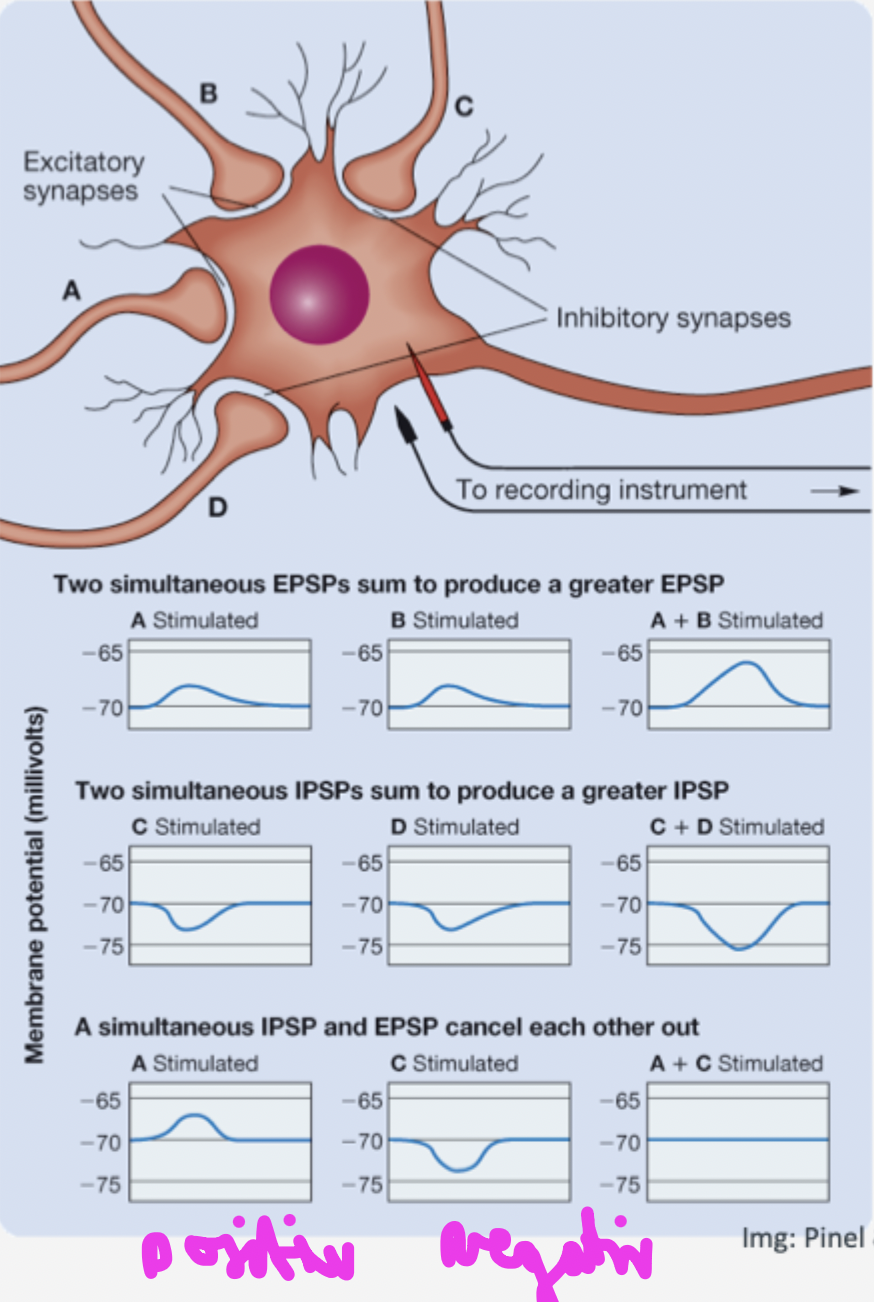
[A] Differentiate between Excitatory Postsynaptic Potentials (EPSPs) and Inhibitory Postsynaptic Potentials (IPSPs)
EPSPs: Depolarisations that decrease the resting membrane potential, increasing the likelihood that the neuron will fire
IPSPs: Hyperpolarisations that increase the resting membrane potential, decreasing the likelihood that the neuron will fire

[A] What is Spatial Summation?
The integration of postsynaptic potentials (EPSPs or IPSPs) elicited simultaneously at different locations on the neuronal membrane. Two simultaneous EPSPs sum to produce a greater EPSP; two IPSPs sum to produce a greater IPSP; a simultaneous EPSP and IPSP cancel each other out
[A] What is Temporal Summation?
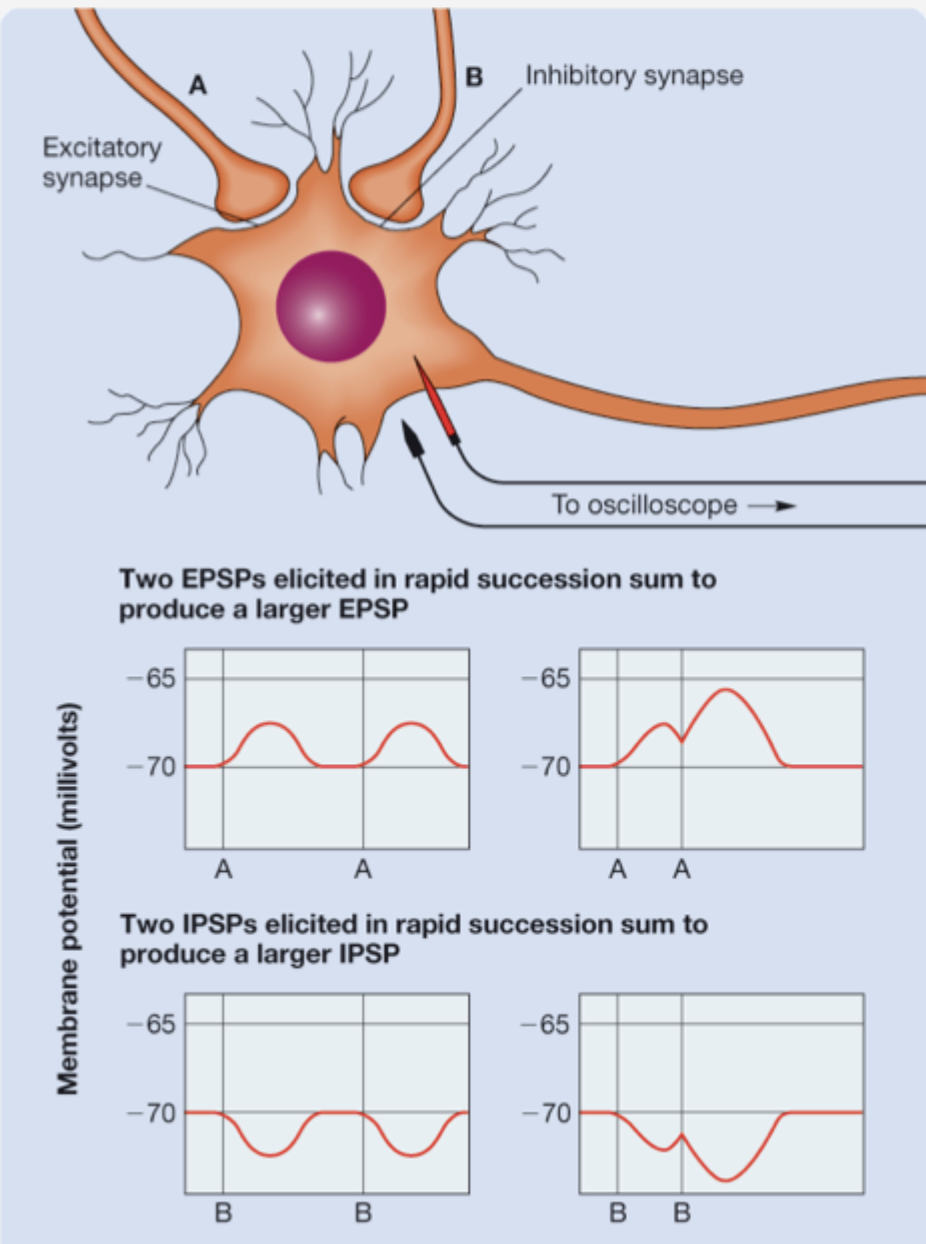
The integration of postsynaptic potentials elicited in rapid succession at the same location on the neuronal membrane to produce a larger signal
[A] What are the Absolute and Relative Refractory Periods due to hyperpolarization
Absolute Refractory Period (1–2 ms after start of Ap): Neuron cannot respond to any other stimuli; APs travel only in one direction.
Relative Refractory Period: rate of neural firing is related to the intensity of the stimulation
[A]What are the characteristics of action potentials?
Firing Limits: AP lasts 1 ms; up to 1000 APs per second per neuron
Ion channels open/close in response to changes in level of membrane potential along membrane of axon
Conduction AP along axon = nondecremental
AP along axon membrane conducted more slowly than postsynaptic potentials
[A]What are the characteristics of axonal conduction, and what is Orthodromic Conduction? (Exam Question!)
Conduction: Nondecremental along the axon; quicker in axons with larger diameter.
Orthodromic Conduction: Transmission of an Action Potential from the axon hillock down to the terminal buttons.

[A] What is Saltatory Conduction, and where do ions pass through the axonal membrane?
Saltatory Conduction: Signal conducted passively and rapidly from node to node along a myelinated axon.
Nodes of Ranvier: Gaps between adjacent myelin segments where ions can pass through the axonal membrane
Ion can pass through axonal membrane only at nodes of Ranvier
[A] Differentiate between Directed and Nondirected Synapses, and name the main anatomical types of directed synapses.
Directed synapses: Site of release and site of reception are in close proximity (Types: Axodendritic, Axosomatic, Axoaxonic).
Nondirected synapses: Site of release is at some distance from site of reception

[A]What is Exocytosis, and how is it triggered at the terminal buttons? (Exam Question!)
Definition: Transportation of neurotransmitter molecules outside the cell into the synaptic cleft.
Trigger: AP arrives at terminal buttons → Voltage-gated Ca^2+ channels open → Ca^2+ inflow into cytoplasma causes synaptic vesicles to fuse into synaptic cleft and release neurotransmitter = Exocytosis
Neurotransmitters diffuse across synaptic cleft → bind to receptors of postsynaptic neuron

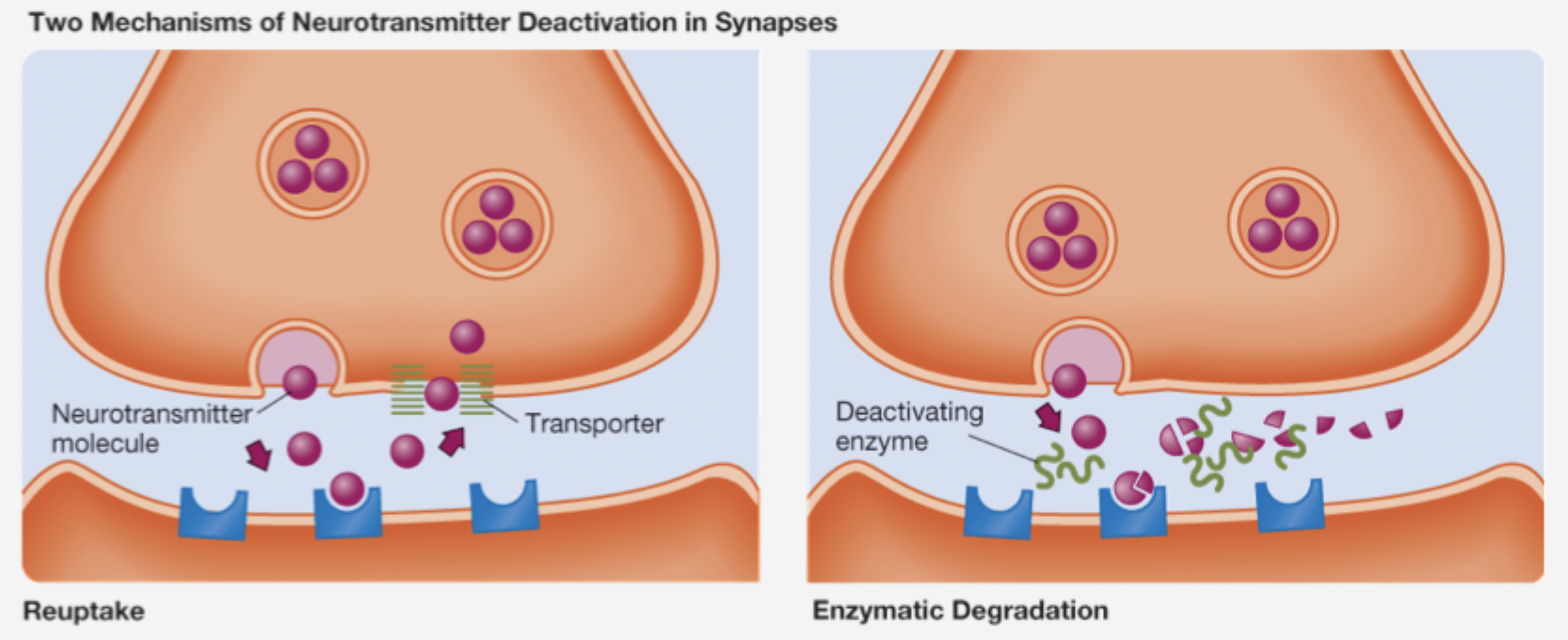
[A] What are the two mechanisms of Neurotransmitter Deactivation in the synaptic cleft?
Reuptake: Transporters draw intact neurotransmitter molecules back into the presynaptic button.
Enzymatic Degradation: Deactivating enzymes break down neurotransmitters in the synapse

[A]What are the primary postsynaptic effects of Glutamate, GABA, and Glycine?
Glutamate: Most prominent excitatory neurotransmitter (produces EPSP)
GABA: Most prevalent inhibitory transmitter in the brain (produces IPSP)
Glycine: Inhibitory transmitter in motor neurons (produces IPSP)
Different types of neurotransmitters
Small-Molecule Neurotransmitters:
Amino acids: Glutamate, Aspartate, Glycine, GABA
Monoamines: Catecholamines (Dopamine, Epinephrine, Norepinephrine) & Indolamines (Serotonin)
Acetylcholine
Unconventional: Soluble gases (Nitric oxide, Carbon monoxide) & Endocannabinoids (Anandamide)
Large-Molecule Neurotransmitters: Neuropeptides (Pituitary, Hypothalamic, Brain-gut, Opioid, Miscellaneous peptides)

[A] Where is Acetylcholine produced, what is its postsynaptic effect, and what functions is it linked to?
Production: Produced by motor neurons in the spinal cord and brain stem, ANS (autonomic NS), and CNS (central NS)
Postsynaptic effect: EPSP (excitatory)
Linked functions: Learning, memory, attention, and the sleep-awake cycle
[A] Name the three major Dopamine Systems, their origin and target pathways, their primary functions, and associated clinical conditions.
Nigrostriatal System:
Pathway: Substantia nigra → Basal ganglia
Function: Motor control & movement coordination
Clinical Condition: Parkinson disease
Mesolimbic System:
Pathway: Ventral Tegmental Area (VTA) → Striatum
Function: Reward system → pleasure & addictive behavior
Clinical Condition: Schizophrenia
Mesocortical System:
Pathway: Ventral Tegmental Area (VTA) → Prefrontal cortex
Function: Cognitive control

[C]What is the LC-NE System, what are the functional roles of Norepinephrine and Epinephrine, and what is their postsynaptic effect?
LC-NE System: Locus Coeruleus - Norepinephrine System
Norepinephrine Functions:
Alarm reaction of the body
Attention
Reduced pain recognition
Euphoric behavior
Learning and memory
Epinephrine Function: Released in arousal/fear or stress conditions
Postsynaptic Effect: EPSP (Excitatory)

[A]What is the neuropathological cause of Parkinson's Disease and which dopamine system is affected?
Degeneration of dopaminergic neurons in the Substantia Nigra.
System: The Nigrostriatal Dopamine System (projecting to the basal ganglia, responsible for motor control and movement coordination)
[A]Which neurological disease is caused by the destruction of myelin sheaths, and how does it affect neural transmission?
Disease: Multiple Sclerosis (MS) — an autoimmune disease where the myelin sheath surrounding axons is destroyed
Effect: Disrupts saltatory conduction along myelinated axons
[A] How are Monoamine neurotransmitters classified into Catecholamines and Indolamines, and what are their precursor amino acids?
Catecholamines (synthesized from Tyrosine):
Dopamine
Norepinephrine
Epinephrine
Indolamines (synthesized from Tryptophan):
Serotonin
[A]What is the difference between Electrical and Chemical Communication between neurons, and what is the sequence of signal transmission?
Electrical Communication: Action Potential creates a Postsynaptic Potential (PSP) in a neighboring neuron via current flow across gap junctions
Chemical Communication: Slower, but more selective and precise; message is delivered by neurotransmitter which diffuses over the synaptic gap
Sequence: Electrical → Chemical → Electrical

[A]Under what two conditions do ions flow down their concentration gradient during diffusion?
concentration gradient: random motion of Na+
Diffusion Definition: Random motion causing dissolved ions to distribute evenly
Condition 1: Channels in the membrane are permeable to specific ions.
Condition 2: A concentration gradient exists across the membrane

[A]What is the Equilibrium Potential (Eion) in selectively permeable membranes, and how is it reached?
Mechanism (e.g., for K+ ions):
No net movement of ions when separated by a phospholid membrane
K+ ions move across the membrane down their concentration gradient
K+ ions move back into the cell due to electrostatic pressure
Equilibrium Definition: Reached when diffusional forces (concentration gradient) and electrical forces (electrostatic pressure) are balanced, resulting in a steady charge between the two sides

[A]How is the resting membrane potential / electrochemical gradient kept steady? (Exam Question!)
Closed Na⁺ channels: Maintained by a semipermeable membrane where Na⁺ channels remain closed at rest
Sodium-Potassium Pump (Na⁺/K⁺ pump): Actively transports 3 Na⁺ ions OUT of the cell for every 2 K⁺ ions IN.
Maintains the ion concentration gradients across the membrane; helps maintain the resting membrane potential (~-70mv) and maintains the conditions necessary for signal transmission → (Sie erhält die Voraussetzung für die Signalübertragung aufrecht = das Ruhepotential der Membran -70mv)

[B]What is Electrostatic Pressure and what is its basic rule regarding ion movement?
Definition: One of the two passive forces (along with the concentration gradient) that causes ions to move through ion channels.
Basic Rule: Electrostatic pressure: opposite charges attract

[A]What is an action potential and what principle applies to an action potential?
A massive but momentary reversal of the membrane potential and it follows the All-or-none response principle
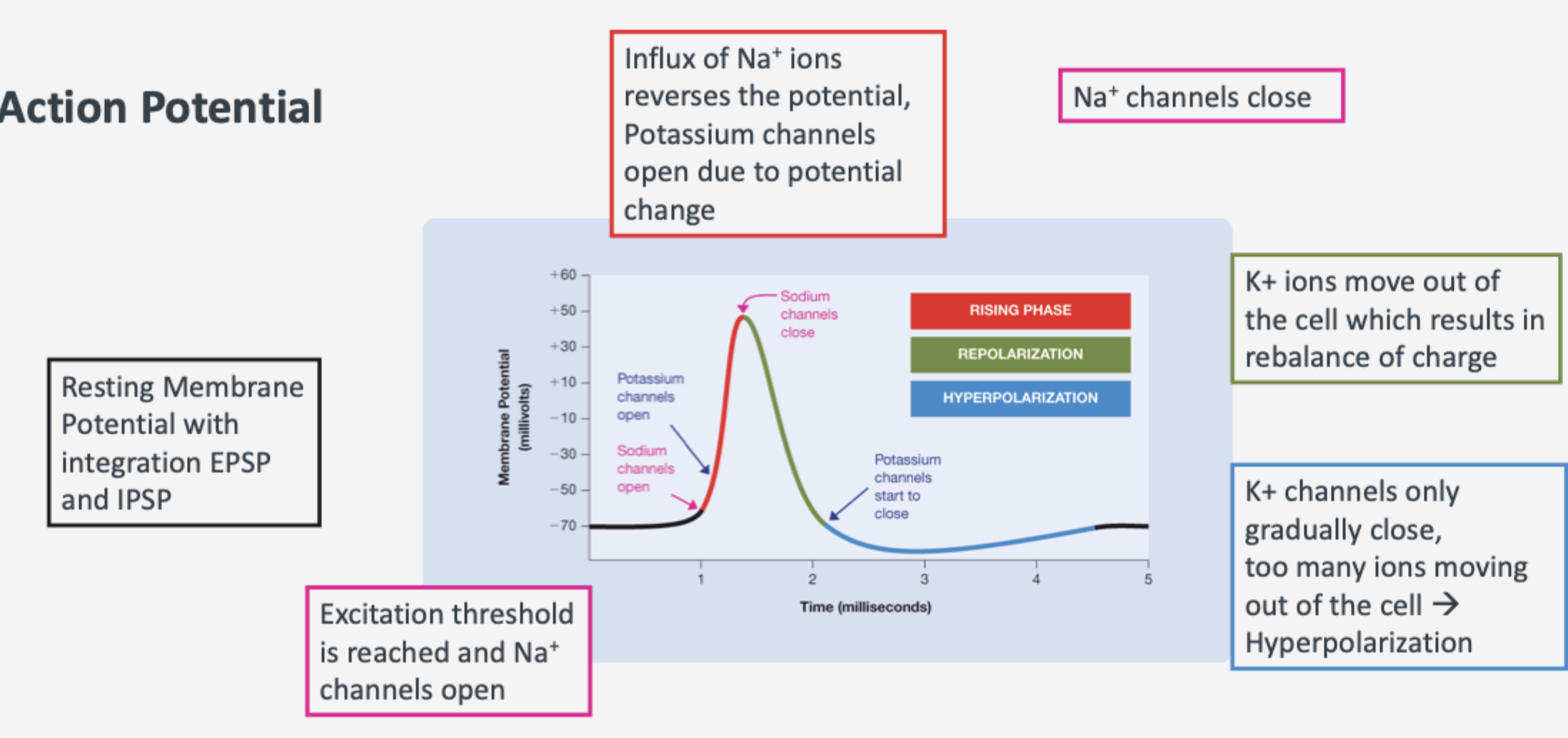
[A]What happens before an action potential?
Resting membrane potential with EPSPs and IPSPs integrated
When the excitation threshold is reached, Na⁺ channels open

[A]What happens during depolarization (rising phase) and why do Na+ ions move into the cell?
Na⁺ channels open.
Na⁺ ions enter the cell → reverses the potential, Potassium channels open due to potential change
The membrane potential becomes more positive
move into the cell coz: due to the concentration gradient
The negative internal charge also attracts positively charged Na+ ions
[A] What happens at the peak of the action potential?
The membrane potential is reversed (approx. +50 mV)
Na⁺ channels close
K⁺ channels open due to the potential change
[A] What happens during repolarization and why do K+ ions move out of the cell?
Na⁺ channels are closed.
K⁺ channels are open.
K⁺ ions move out of the cell.
The membrane potential becomes negative again
Move out coz: Due to the AP the outside is now negatively charged. This creates pressure for K+ to move out of the cell

[A] What happens during hyperpolarization?
K⁺ channels close delayed through this too many K⁺ ions can leave the cell
The membrane potential becomes temporarily more negative than the resting potential.
[A] How does the action potential end?
K⁺ channels gradually close
The membrane potential returns to the resting potential of approx. −70 mV
[B]Why does blocking neurotransmitter deactivation (reuptake or enzymatic degradation) lead to a signal-enhancing (agonistic) net effect at the synapse?
Blockade: The drug blocks the removal process (reuptake transporter or degrading enzyme).
Entrapment: The neurotransmitter cannot be removed and remains in the synaptic cleft.
Accumulation: The neurotransmitter accumulates and repeatedly binds to postsynaptic receptors.
Net Effect: The signal at the postsynaptic neuron is prolonged and amplified (Agonistic effect).
Addiction context: Feelings of reward and addiction are primarily mediated by increased dopamine release in the mesolimbic system.