TEAS The Integumentary System SE
 Call Kai
 Learn
 Practice Test
 Spaced Repetition
 Match
 Flashcards
 Knowt Play
1/65

There's no tags or description
Looks like no tags are added yet.
66 Terms
🧴 Integumentary System =
Your Body’s Protective Cover
Think:
“INTEGUMENTARY = EVERYTHING COVERING YOU”
It includes:
🧴 Skin
💇 Hair
💅 Nails
💦 Sweat glands
🛢 Sebaceous (oil) glands
🛡 What does it DO?
The easiest way to remember:
“P-S-S” → Protect, Stabilize, Sense
🛡 Protect → keeps harmful substances/germs from getting inside
🌡 Stabilize → helps control body temperature → homeostasis
✋ Sense → lets you feel things like touch, pain, heat, and cold
🧠 What is the skin?
The skin is an organ — actually, it's the largest organ in your body.
Why?
Because it's made of different tissues working together to perform jobs.
Think of your skin like a body shield 🛡:
Outside → skin → protects what's inside
It helps:
Keep bad stuff OUT
Keep important water IN
Help control temperature
Let you feel your surroundings
⭐ TEAS MUST-KNOW
Integumentary system =
skin + hair + nails + glands
Skin = largest organ
Main jobs = protection + temperature regulation + sensation
🔥 Super easy memory trick
Think:
“Skin = Shield + Thermostat + Sensor”
🛡 Shield = protection
🌡 Thermostat = temperature control
👋 Sensor = sensation
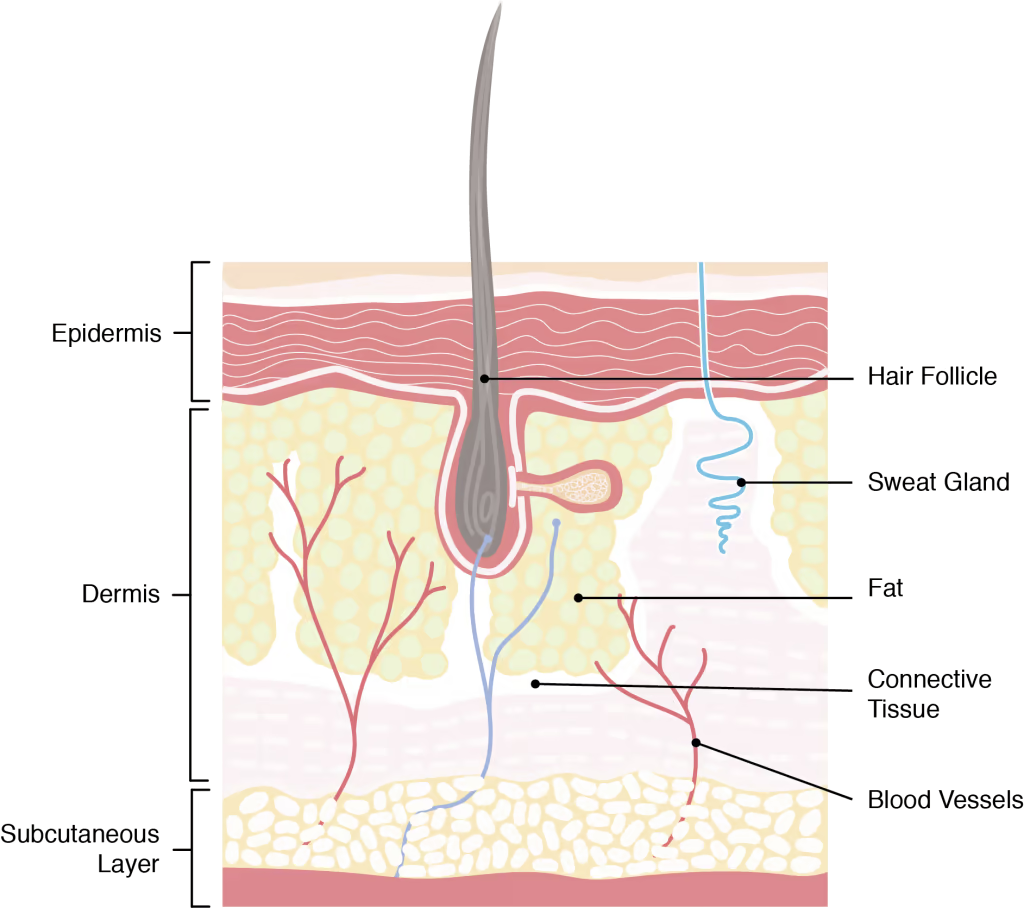
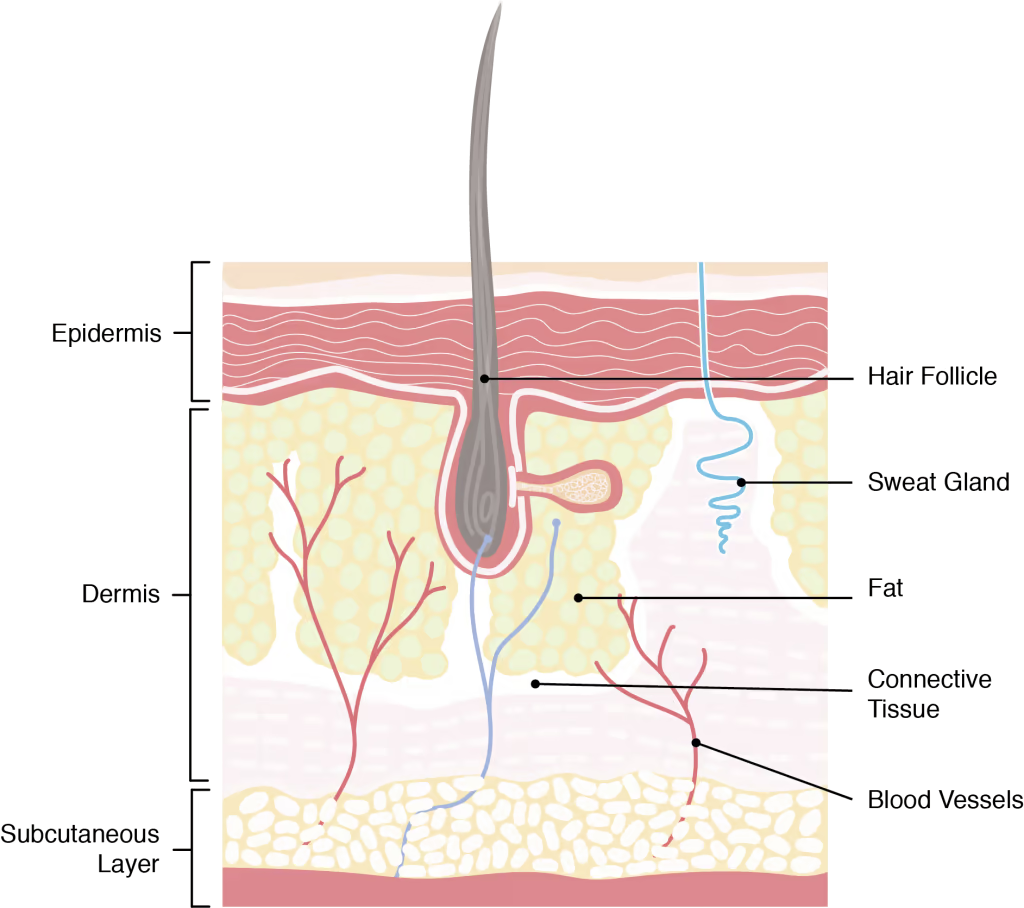
🧴 First: The 3 main skin regions
“E-D-S” = Outside → Middle → Bottom
Layer | Where? | Easy job |
|---|---|---|
Epidermis | 🥇 Top/outside | Protection |
Dermis | 🥈 Middle | Blood vessels, nerves, glands, hair follicles |
Subcutaneous tissue | 🥉 Bottom | Fat + insulation/cushioning |
🧠 Easy trick:
“E-D-S = Every Day Skin”
Or just remember:
Epi = Exterior = OUTSIDE


🥇 EPIDERMIS =
YOUR OUTER SHIELD 🛡
The epidermis is the outermost layer.
Its main job is:
PROTECT!
It helps protect you from the outside world and helps prevent water loss.
What's it made of?
The epidermis is mostly keratinocytes.
Think:
Keratinocytes → Keratin → Tough skin
Keratin is a tough protein that helps make your skin strong and waterproof.
🔥 Memory trick:
KERATIN = KEEPS skin tough
So:
Keratin → tough + waterproof
🎨 The important epidermis cells
You only need to connect each cell to its main job:
1-2
1. 🧱 Keratinocytes = PROTECTION
These are the main cells of the epidermis.
They make keratin.
KERATINOCYTE → KERATIN → TOUGH SKIN
2. 🎨 Melanocytes = COLOR
These make melanin, which gives skin its color and helps protect against UV radiation.
🧠 Trick:
MELANOCYTE = MELANIN = COLOR
Think “MELANIN = pigment.”
🎨 The important epidermis cells
You only need to connect each cell to its main job:
3-4
3. ✋ Merkel cells = TOUCH
Merkel cells help detect touch.
🧠 Trick:
MERKEL = ME feeling something
Not the prettiest trick 😂, but it works!
4. 🛡 Langerhans cells = IMMUNE DEFENSE
These help with the skin's immune defense.
🧠 Trick:
LANGERHANS = LOOKS for invaders
They're basically part of the skin's security system.
🚨 TEAS QUICK MEMORIZATION
Know these four:
Know these four:
K → Toughness
M → Color
M → Touch
L → Immune defense
Or:
🧱 Keratinocytes = Tough
🎨 Melanocytes = Color
✋ Merkel = Touch
🛡 Langerhans = Defense
⭐ If you see this on the TEAS:
“Which epidermal cells produce melanin?”
👉 Melanocytes
“Which cells produce keratin?”
👉 Keratinocytes
“Which cells help detect touch?”
👉 Merkel cells
“Which cells help defend against pathogens?”
👉 Langerhans cells
One last SUPER important thing:
Epidermis =
NO blood vessels.
The epidermis gets nutrients from the dermis underneath it.
So picture it like:
OUTSIDE
⬇
🛡 EPIDERMIS = protection
⬇
🩸 DERMIS = blood vessels, nerves, glands, hair
⬇
🧈 SUBCUTANEOUS = fat/cushion
INSIDE


🧴 Epidermis =
4 or 5 layers
Think of the epidermis like a factory conveyor belt 🏭:
NEW cells are made at the bottom → move upward → become older → eventually reach the surface and are shed.
So the bottom = young/new and the top = old/dead.

⭐ The 5 layers — memorize TOP → BOTTOM
From outside → inside:
Stratum Corneum 🥇
Stratum Lucidum
Stratum Granulosum
Stratum Spinosum
Stratum Basale 🥉
🧠 BEST MEMORY TRICK:
“Come, Let’s Get Sun Burned”
C = Corneum
L = Lucidum
G = Granulosum
S = Spinosum
B = Basale
Say it quickly:
🗣 COME → LET'S → GET → SUN → BURNED
That's your order TOP → BOTTOM.

🥇 1. STRATUM CORNEUM vs lucidium
🥇 1. STRATUM CORNEUM =
DEAD/TOUGH OUTER SHIELD
This is the top layer.
Think:
🛡 CORNEUM = CORNER/outer cover
The cells here are old, dead, and packed with keratin.
Main idea:
Protection + waterproofing
2. STRATUM LUCIDUM = EXTRA LAYER
This layer is found ONLY in thick skin.
Where?
👣 Soles of feet
🖐 Palms of hands
Why?
Because these areas get lots of friction.
🧠 Trick:
LUCIDUM = “LOOKS extra” → extra layer
You don't need to overthink what it does for TEAS. Just remember:
Lucidum = thick skin = palms + soles

3-4
3. STRATUM GRANULOSUM = GETTING HARDER
The cells are moving upward and becoming more keratinized.
Think:
Granulosum = GRANULES
Cells contain granules involved in making the skin tougher and more waterproof.
For TEAS, mainly remember its place in the order.
4. STRATUM SPINOSUM = STRONG
This is a thicker layer where cells are connected strongly to each other.
🧠 Trick:
SPINOSUM → STRONG
Think of the cells holding onto each other.
Again, the order is more important than memorizing every microscopic detail.

. STRATUM BASALE
= BOTTOM + NEW CELLS
This is the deepest layer of the epidermis.
This is where new skin cells are produced.
Think:
BASALE = BASE
The base = bottom.
🔥 This is also where you find important cells like melanocytes.

🚨 THE BIG PICTURE
Look at the image like this:
OLD / DEAD ⬆
🛡 CORNEUM
✨ LUCIDUM ← only thick skin
🔵 GRANULOSUM
💪 SPINOSUM
🌱 BASALE ← NEW cells
YOUNG / NEW ⬇
So cells basically:
Start at the BASE → move UP → become older → reach the CORNEUM → eventually shed.
⭐ TEAS MUST-KNOW
If you only memorize 5 things, memorize these:
1. Corneum = top
2. Basale = bottom
3. Basale = new cells
4. Lucidum = only palms + soles
5. Come Let's Get Sun Burned = order
🔥 One-line review:
“New cells start at the BASE, move UP through the layers, become tougher, and end at the CORNEUM.”
4 vs. 5 layers — SUPER EASY
🖐 Palms + 👣 soles
5 layers
Because they need extra protection from friction.
🦵 Most other skin
4 layers
Because they DO NOT have the lucidum layer.
🧠 TEAS trick:
“Thick skin gets LUCIDUM.”
Palms + soles = thick skin = 5 layers
🧴 The Skin Cell Journey
1-3
Think:
MAKE → MOVE → KERATIN → DIE → SHED
That's the whole thing!
🌱 1. BASALE = MAKE NEW CELLS
At the stratum basale (bottom layer), cells constantly divide by mitosis.
Why?
👉 To make new skin cells.
🧠 Trick:
BASALE = BASE = where new cells are BORN
⬆ 2. NEW CELLS MOVE UP
Once new cells are made, they slowly move up toward the surface.
Think of an escalator:
🌱 Bottom = new cells
⬆⬆⬆
🧴 Top = old cells
🧱 3. THEY MAKE KERATIN
As the cells move upward, they produce keratin.
Remember:
KERATIN = TOUGH + WATERPROOF
The cells basically become filled with keratin.

🧴 The Skin Cell Journey
4-5
☠ 4. AT THE SURFACE → CELLS DIE
When they reach the top, they become filled with keratin and die.
Don't let this sound scary 😂 — this is normal skin cell turnover.
The dead cells become part of the:
🛡 STRATUM CORNEUM
The stratum corneum is the outer protective layer and helps make the skin waterproof.
🍂 5. OLD CELLS SHED
Eventually, those dead cells fall off/shed.
Meanwhile...
🌱 NEW cells are being made at the bottom.
So your skin is constantly replacing old cells with new ones.
🧠 THE BEST MEMORY TRICK
“BASE → UP → KERATIN → DEAD → SHED”
Say it like a story:
🌱 BASE makes them
⬆ They move UP
🧱 Make KERATIN
☠ DIE at the surface
🍂 SHED off
That's the entire paragraph!
🚨 TWO TEAS FACTS TO LOCK IN
❌ Epidermis does NOT have:
🩸 Blood vessels
🧠 Nerve endings
Those are in the dermis underneath.
🧴 Epidermis DOES:
Make new cells through mitosis
Produce keratin
Form the protective stratum corneum
Constantly shed and replace old cells
BASALE = BIRTH 🌱
KERATIN = TOUGH 🧱
CORNEUM = COVER 🛡
SHED = OLD CELLS LEAVE 🍂
Where are new epidermal cells produced?
👉 Stratum basale
What protein makes the skin tough and waterproof?
👉 Keratin
What happens to epidermal cells when they reach the surface?
👉 They fill with keratin and die
What happens to old skin cells?
👉 They are shed and replaced by new cells
🧴 DERMIS =
THE WORKING LAYER
Remember:
EPIDERMIS = OUTER SHIELD 🛡
DERMIS = WORKING LAYER ⚙
The dermis is directly underneath the epidermis.
🩸 What's inside the dermis?
Unlike the epidermis, the dermis has:
🩸 Blood vessels → bring oxygen/nutrients
🧠 Nerve endings → let you feel things
💇 Hair follicles
💦 Sweat glands
🛢 Oil (sebaceous) glands
⭐ Biggest TEAS distinction:
EPIDERMIS = NO blood vessels or nerve endings ❌
DERMIS = HAS blood vessels + nerve endings ✅
🧠 Memory trick:
“DERMIS = DOES more.”
It has the blood + nerves that the epidermis doesn't.
✋ What can the dermis help you feel?
Because of its nerve endings, the dermis helps detect:
✋ Touch
🔥 Heat
🧊 Cold
😣 Pain
🧠 Trick:
“Dermis = Feel it.”
If a TEAS question asks where skin sensations are detected → think dermis.
🧵 What is the dermis made of?
It's mostly tough connective tissue.
It contains collagen fibers that connect the dermis to the epidermis.
Think:
🧵 Collagen = strong support
🤸 Why can your skin stretch?
The dermis has elastic fibers.
These allow the skin to:
STRETCH → then return toward its normal shape
This is especially useful when the body needs to stretch, such as during pregnancy.
🧠 Trick:
ELASTIC = STRETCH
🧴 The dermis has TWO regions
You don't need to make this complicated.
1⃣ Papillary region
Top part of the dermis, closer to the epidermis.
2⃣ Reticular region
Deeper/thicker part of the dermis.
🧠 Just remember:
P = Papillary = Pretty close to the top
R = Reticular = lower/deeper
👶 vs. 👵 Aging
Young skin:
More elastic fibers → more elastic skin
Older skin:
Fewer elastic fibers → less elastic, thinner skin
So:
👶 Young = MORE elastic
👵 Older = LESS elastic
🧠 Memory trick:
“Young = stretchy, old = less stretchy.”
As we age, things like cell division and blood circulation decrease, contributing to thinner, less elastic skin.
🚨 TEAS CHEAT SHEET
dermis
What? | Remember |
|---|---|
Dermis location | Under epidermis |
Blood vessels? | ✅ Yes |
Nerve endings? | ✅ Yes |
Sensation? | Touch, pain, heat, cold |
Connective tissue? | ✅ Yes |
Collagen | Strong support |
Elastic fibers | Stretch |
Papillary region | Upper dermis |
Reticular region | Deeper dermis |
Young skin | More elastic |
Older skin | Less elastic |
🔥 ONE SENTENCE TO MEMORIZE:
“The dermis is the thick working layer under the epidermis that contains blood vessels and nerves and helps skin feel and stretch.”
If you remember DERMIS = BLOOD + NERVES + FEEL + STRETCH, you've got the most important TEAS points from this section.

🧴 First: Hair Follicles
A hair follicle is basically the little pocket where a hair starts growing.
Think:
FOLLICLE = HAIR'S HOME 🏠
The hair grows from the follicle and eventually comes out through the skin.
💦 1. SWEAT GLANDS
Sweat glands make sweat.
Sweat contains:
💧 Water
🧂 Salts
🗑 Some wastes
Their ducts travel toward the skin surface and open as pores.
There are TWO types you need to know:

🔥 APOCRINE =
STRESS SWEAT
Think:
APOCRINE = ANXIOUS
These are mainly around:
📍 Armpits
📍 Groin
They are connected to hair follicles.
They become active around puberty.
They release sweat when you're experiencing things like:
😰 Stress
😨 Anxiety
Their sweat contains proteins + fats.
🧠 BEST TRICK:
APO = ANXIOUS
So when you're nervous before a test and get sweaty → think APOCRINE.

🌡 ECCRINE =
COOLING SWEAT
Think:
ECCrine = EXIT heat
These glands are found all over your body, especially:
🧠 Forehead
🧍 Neck
🖐 Palms
👣 Soles
They are NOT attached to hair follicles.
Their biggest job:
🌡 COOL YOUR BODY DOWN
When you're too hot → eccrine glands produce sweat → sweat helps cool you.
🧠 BEST TRICK:
ECCrine = Exercise/heat = COOL DOWN
🚨 APOCRINE vs ECCRINE
🔥 Apocrine | 🌡 Eccrine | |
|---|---|---|
Main idea | Stress | Cooling |
Location | Armpits + groin | All over |
Hair follicle? | ✅ Connected | ❌ Not connected |
Puberty? | Becomes active around puberty | Works earlier |
Main purpose | Stress-related sweating | Temperature control |
APOCRINE = ANXIOUS 😰
ECCrine = COOLING 🥵➡😌
🛢 2. SEBACEOUS GLANDS =
OIL
Sebaceous glands make:
SEBUM = OIL
They're usually attached to hair follicles.
Sebum helps:
🛢 Keep skin and hair from drying out
💧 Waterproof skin/hair
🦠 Help fight microbes
🧠 Trick:
SEBACEOUS = SEBUM = OIL
Think:
Sebaceous → Sebum → Skin oil
🧈 3. HYPODERMIS =
FAT CUSHION
Now go below the dermis.
That's the:
HYPODERMIS
It contains lots of adipose tissue = fat.
Think:
HYPODERMIS = FAT PADDING 🧈
Its big jobs:
🔥 Insulation → helps keep body temperature stable
🔋 Energy storage → stores energy
🛏 Cushioning → helps protect the body underneath

🧠 BEST WAY TO SEE THE WHOLE SKIN
Think of your skin like a 3-story house:
🏠 FLOOR 1 — EPIDERMIS
🛡 Protection
🏠 FLOOR 2 — DERMIS
🩸 Blood + nerves + glands + hair
🏠 BASEMENT — HYPODERMIS
🧈 Fat + insulation + energy
🔥 TEAS CHEAT CODE
Hair:
Follicle = hair's home
Sweat:
APOCRINE = ANXIOUS 😰
ECCRINE = COOLING 🌡
Oil:
SEBACEOUS = SEBUM = OIL 🛢
Bottom:
HYPODERMIS = FAT 🧈
⭐ Final 5-word cheat code:
APO = STRESS
ECC = COOL
SEB = OIL
FOLLICLE = HAIR
HYPO = FAT
Which gland is associated with stress and the armpits?
👉 Apocrine
Which gland helps cool the body?
👉 Eccrine
Which gland produces sebum?
👉 Sebaceous
What is sebum?
👉 Oily substance that helps prevent skin/hair from drying out
Where is fat/adipose tissue found beneath the dermis?
👉 Hypodermis
What does the hypodermis help with?
👉 Insulation + energy storage + cushioning
🛢 Sebaceous glands =
oil glands
Found almost everywhere
❌ NOT on palms or soles
🧴 Make sebum (oil)
👤 Face + scalp/head = most sebum
🧠 Trick:
“Palms & soles = NO oil glands.” ✋👣
And remember:
Sebaceous → Sebum → OIL 🛢

💅 Hair & Nails =
Keratin
First, remember:
HAIR + NAILS + SKIN → KERATIN
Keratin = tough protein that makes them strong.

💅 NAIL PARTS — SUPER EASY
Think of your nail like a little house 🏠.
1-3
1. 🧱 Nail plate = HARD nail
This is the part you normally see.
Nail plate = the hard main part of the nail
🧠 Plate = the nail you see
2. ✂ Free edge = part you CUT
This is the part that sticks past your fingertip.
Free edge = overhang = cut it
🧠 FREE = sticking FREE past your finger
3. 🛏 Nail bed = SKIN UNDER the nail
The nail bed is the skin underneath the nail plate.
Bed = underneath
🧠 Like your bed is underneath you → nail bed is underneath the nail.

💅 NAIL PARTS — SUPER EASY
Think of your nail like a little house 🏠
4-6
4. 🌙 Lunula = WHITE HALF-MOON
This is the little white/half-moon shape you can see near the base of some nails.
🌙 LUNULA = little moon
This one is SUPER easy.
5. 🛡 Cuticle = DEAD SKIN at the base
The cuticle is a layer of dead skin cells around the base of the nail.
Cuticle = dead skin barrier
🧠 Think: “Cuticle = where nail care/cutting happens.”
6. 🌱 Matrix = WHERE NAIL GROWS
The matrix is underneath the cuticle.
It contains:
🩸 Blood vessels
🧠 Nerves
Most importantly:
Matrix = nail growth area
🧠 Trick:
MATRIX = MAKES the nail
⭐ SUPER EASY DIAGRAM
Think front → back:
FREE EDGE ✂ → NAIL PLATE 💅 → LUNULA 🌙 → CUTICLE 🛡 → MATRIX 🌱
And underneath:
NAIL BED 🛏
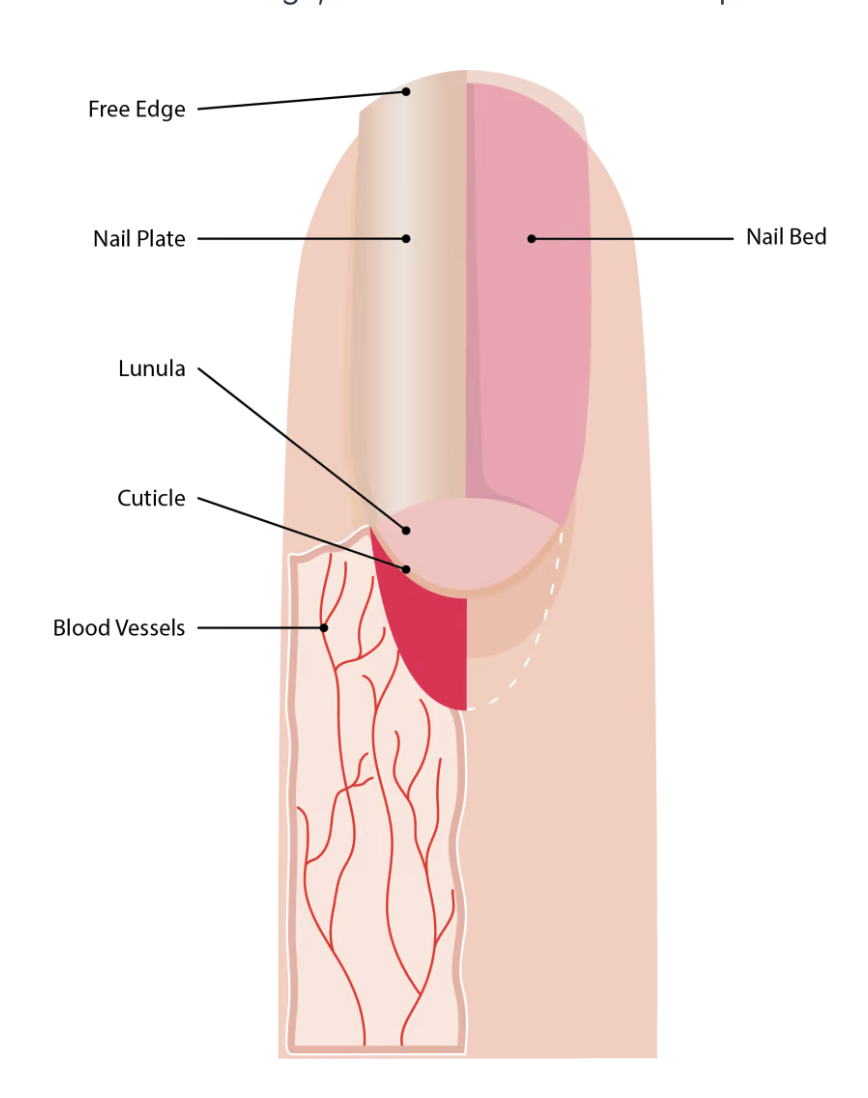
nail easy parts
Part | Think |
|---|---|
Nail plate | Hard nail |
Free edge | Part you cut |
Nail bed | Skin underneath |
Lunula | White half-moon 🌙 |
Cuticle | Dead skin |
Matrix | Nail growth + blood vessels/nerves |
🔥 3 BIG ONES TO MEMORIZE
🌙 LUNULA = MOON
🌱 MATRIX = MAKES NAIL
✂ FREE EDGE = CUT
And don't forget:
Hair + nails = keratin! 💅🧑🦱
👀 Eyelashes + eyebrows
Their job is to protect your eyes from:
💧 Water
🟤 Dirt
🌫 Irritants
👃 Nose hairs
They trap dust and microorganisms before they can travel deeper into your respiratory system.
🧠 Easy memory trick:
“Hair = FILTER + PROTECT” 🛡
👀 Eyes → keep stuff OUT
👃 Nose → trap stuff BEFORE it gets in
⭐ TEAS cheat:
Nose hairs = filter the air.
Eyelashes/eyebrows = protect the eyes.

💇 HAIR =
DEAD KERATIN
First:
Hair = dead, keratinized cells
🧠 Remember:
HAIR → KERATIN → TOUGH
Hair also helps with insulation, especially on the head.
🌱 The 4 Hair Parts
Think of a plant 🌱:
SHAFT → ROOT → BULB
with the FOLLICLE = the pocket holding it.

HAIR
1-2
1. 🖤 HAIR SHAFT = WHAT YOU SEE
The shaft is the hair sticking outside your skin.
SHAFT = SURFACE
🧠 S = Shaft = Seen
2. 🌱 HAIR ROOT = UNDER THE SKIN
The root is the part underneath the skin.
It is attached to the follicle.
ROOT = UNDERGROUND
Just like a plant root is underground. 🌱

HAIR
3-4
3. 🏠 HAIR FOLLICLE = HAIR'S HOME
The follicle is the little tube/pocket surrounding the root.
Its job is to hold/anchor the hair root.
FOLLICLE = hair's HOME 🏠
4. 🧅 HAIR BULB = GROWTH AREA
The bulb is at the deepest part.
It contains basal cells that actively divide to make new hair cells.
BULB = where hair GROWS
🧠 Think:
BULB → BIRTH of new hair cells 🌱

⭐ LOOK AT THE PICTURE LIKE THIS
OUTSIDE SKIN
🖤 SHAFT ← you see this
⬇
🌱 ROOT ← underneath skin
🏠 FOLLICLE ← holds the root
🧅 BULB ← makes new cells/growth
DEEPER SKIN
🔥 BEST MEMORY TRICKS-R-F-B
Shaft = Seen
Root = Runs underground
Follicle = Frame/holds hair
Bulb = Birth/growth
👵 AGING
As you get older:
Hair + nails → become thinner
That's really all you need from that part.

🚨 TEAS CHEAT SHEET
Hair =
keratin + insulation
Shaft = outside/visible
Root = underneath skin
Follicle = holds/anchors hair
Bulb = actively dividing cells → hair growth
⭐ If you remember ONE sentence:
“The shaft is seen, the root is below, the follicle holds it, and the bulb grows it.”
Insulation = helping keep your body temperature stable. 🌡
For hair:
💇 Hair helps keep heat from escaping your body too quickly.
Think of it like a blanket 🧣:
🥶 Cold → helps keep warmth in
🌡 Overall → helps with temperature control
🧠 TEAS trick:
Insulation = “keeps heat IN.” 🔥
So:
Hair → insulation → helps keep you warm.
☀ Skin Cancer =
UV damages DNA
The main story is:
UV → DNA damage → mutations → uncontrolled growth → cancer
🧠 Think of it like this:
☀ Too much UV
⬇
🧬 Damages DNA
⬇
❌ Mutations happen
⬇
🔄 Cells may grow out of control
⬇
🎗 Cancer
☀ Where does UV come from?
Main sources:
☀ Sunlight
🛏 Tanning beds
⭐ TEAS:
UV exposure = biggest risk factor for skin cancer.
🧬 What happens to the DNA?
Normally, your body can repair damaged DNA.
But if the damage isn't repaired:
Mutations build up → cells can become cancerous.
Cancer cells can then multiply uncontrollably and form tumors.
🚨 METASTASIS =
SPREADING
This is a VERY important word.
Metastasis means:
Cancer cells move from the original location to another part of the body and form new tumors.
🧠 Trick:
META = MOVE
So:
METASTASIS = cancer MOVES/spreads
☀ UVA vs. UVB — EASY!
🟣 UVA = goes deeper
UVA → reaches the dermis
Think:
A = Away/deeper
UVA can contribute to skin cancer.
🔴 UVB = burns the surface
UVB → mainly affects the epidermis
UVB is strongly associated with:
🔥 Sunburn
🧬 DNA damage
🎗 Skin cancer
🧠 BEST TRICK:
UVA = A little deeper
UVB = BURNS
That's it!
skin cancer cheat sheet
Concept | Remember |
|---|---|
Biggest risk factor | ☀ UV exposure |
UV does what? | Damages DNA |
DNA damage can cause | Mutations |
Cancer cells | Grow uncontrollably |
Metastasis | Cancer spreads |
UVA | Goes deeper → dermis |
UVB | Epidermis + sunburn |
“UV damages DNA. Mutations can cause cancer. Metastasis means cancer spreads.”
And:
“UVA = deeper, UVB = burns.” ☀🔥
🎗 3 Types of Skin Cancer
Think:
B → S → M
Basal → Squamous → Melanoma
And remember them with this:
🟢 Basal = BASIC / least aggressive
🟡 Squamous = SPREADS more
🔴 Melanoma = MOST dangerous
1⃣ Basal Cell Carcinoma
Where?
👉 Stratum basale
What cells?
👉 Basal cells
Important:
👉 Most common
👉 Rarely spreads
🧠 TRICK:
BASAL = BASE
Basal cells are at the base of the epidermis.
And:
Basal = usually doesn't travel
So think:
B = Base + Basic/most common + Barely spreads
2⃣ Squamous Cell Carcinoma
Where?
👉 Stratum spinosum
What cells?
👉 Squamous cells / keratinocytes
Important:
👉 Second most common
👉 More aggressive than basal
👉 Can metastasize
🧠 TRICK:
SQUAMOUS = SPINOSUM
They both start with S.
And remember:
Squamous = can Spread
🔥 S = Spinosum + Spread
3⃣ Malignant Melanoma 🚨
What cells?
👉 Melanocytes
Remember:
MELANOMA → MELANOCYTES
Melanocytes make melanin, so melanoma can appear as a dark patch.
Most important:
🚨 MOST DANGEROUS
It can metastasize/spread.
🧠 Trick:
MELANOMA = MEGA DANGER
And:
Melanocyte → melanin → pigment → melanoma
⭐ THE TEAS CHEAT SHEET
3 cancer cells
Cancer | Think | Danger |
|---|---|---|
Basal cell | 🥇 Base | Rarely spreads |
Squamous cell | 🌀 Spinosum | Can spread |
Melanoma | 🎨 Melanocytes/pigment | 🚨 Most dangerous |
🔥 BEST MEMORY TRICKB → S → M
Basal = Bottom/base
⬇
Squamous = Spinosum + Spreads
⬇
Melanoma = Melanocytes + Most dangerous
One sentence:
“Basal is at the BASE, Squamous can SPREAD, and Melanoma is the MOST dangerous.”
🚨 If TEAS asks:
Most common? →
Basal cell carcinoma
Rarely spreads? → Basal cell carcinoma
Affects keratinocytes in stratum spinosum? → Squamous cell carcinoma
Can metastasize? → Squamous + melanoma
Most dangerous? → Malignant melanoma
Involves melanocytes? → Melanoma
Associated with pigment/dark patch? → Melanoma 🎨
Metastasize = cancer spreads. 🚨
It means cancer cells leave where they originally started and travel to another part of the body, where they can form new tumors.
🧠 Easy trick:
META = MOVE
So:
Metastasize = cancer MOVES/spreads. 🦠➡🫁
Example:
Skin cancer starts in the skin → cells spread to another organ → it has metastasized.
🧴 INTEGUMENTARY SYSTEM — SUPER EASY1⃣ What is it?
Integumentary = skin + hair + nails + glands
🧠 Trick:
“Your body’s COVERING.” 🛡
2⃣ Skin = BIGGEST ORGAN
Main jobs:
🛡 Protect
🌡 Control temperature/homeostasis
✋ Sense touch, pain, heat, cold
🧠 Trick:
Skin = Shield + Thermostat + Sensor
3⃣ 3 MAIN SKIN LAYERS
E → D → H
Epidermis = OUTSIDE 🛡
Dermis = WORKING layer 🩸🧠
Hypodermis/subcutaneous = FAT underneath 🧈
🧠 Trick:
E-D-H = Exterior → Details → Heavy fat
Or simply:
Top → Middle → Bottom
Epidermis → Dermis → Hypodermis
4⃣ EPIDERMIS =
PROTECTION
Remember:
Epidermis = OUTSIDE
It has 4 or 5 layers.
⭐ Order TOP → BOTTOM:
C → L → G → S → B
“Come Let's Get Sun Burned” ☀😂
Corneum
Lucidum
Granulosum
Spinosum
Basale
🚨 MOST IMPORTANT:
Basale = BASE = makes NEW cells 🌱
Corneum = TOP = dead/keratinized cells 🛡
Lucidum = only thick skin → palms + soles 🖐👣
5⃣ DERMIS =
BLOOD + NERVES
Unlike the epidermis:
🩸 Blood vessels = YES
🧠 Nerve endings = YES
So you can feel:
✋ Touch
🔥 Heat
🧊 Cold
😣 Pain
🧠 Trick:
DERMIS = DOES more
It has blood vessels, nerves, glands, hair follicles, etc.
6⃣ GLANDS =
SWEAT + OIL💦 ECCRINE = COOLING
Found all over the body.
Eccrine = COOL you down 🌡
😰 APOCRINE = STRESS
Mainly armpits + groin.
Apocrine = ANXIOUS
🛢 SEBACEOUS = OIL
Makes sebum.
Sebaceous → Sebum → OIL
❌ Not on palms or soles.
8⃣ SKIN CANCER ☀
UV radiation → DNA damage → mutations → possible cancer
Three main types:
🟢 BASAL
Base
👉 Most common
👉 Rarely spreads
🟡 SQUAMOUS
Spinosum
👉 Can spread/metastasize
🔴 MELANOMA
Melanocytes
👉 Most dangerous
🧠 SUPER TRICK:
B = Base
S = Spinosum + Spread
M = Melanocytes + Most dangerous
And:
Metastasize = cancer MOVES/spreads 🚨
👵 AGING
As we age:
Skin → thinner/less elastic
Hair → thinner
Nails → thinner
🧠 Think:
“Age = less elasticity + thinner accessories.”
🚨🔥 YOUR 30-SECOND TEAS REVIEW
Say this out loud:
Integumentary = skin, hair, nails, glands.
Skin = biggest organ.
Epidermis = protection.
Dermis = blood + nerves + feeling.
Hypodermis = fat + insulation.
Eccrine = cooling. Apocrine = stress. Sebaceous = oil.
Hair and nails = keratin.
Basal = base, Squamous = spread, Melanoma = most dangerous.
UV damages DNA and can cause skin cancer.
🧠 THE ULTIMATE MEMORY LINE:
“TOP protects, MIDDLE feels, BOTTOM stores fat; SWEAT cools, OIL moisturizes, KERATIN toughens.”