PT 780 - Outcomes Research Studies
 Call Kai
 Learn
 Practice Test
 Spaced Repetition
 Match
 Flashcards
 Knowt Play
1/41

There's no tags or description
Looks like no tags are added yet.
42 Terms
What is outcomes research?
Study of impact of clinical practice as it occurs in "real world"
What does outcomes research focus on?
"End results" experienced by individuals following care
Not efficacy or effectiveness of interventions
What measures does outcomes research focus on?
Person-level measures = activity limitation, participation restrictions and quality of life
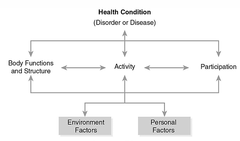
The ICF model comes from which organization?
WHO (world health organization)

What is the body functions part of the ICF?
Physiological functions of body system
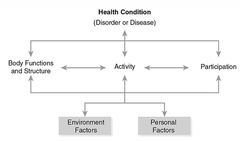
What is the body structures part of the ICF?
Anatomical parts of body such as organs, limbs, and components of these

What is the impairments part of the ICF?
Problems in body functions or structure such as significant deviation or loss

What is the activity part of the ICF?
Execution of a task or action by an individual
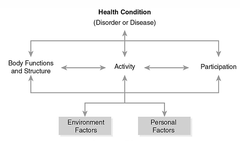
What is the participation part of the ICF?
Involvement in a life situation

What is the activity limitations part of the ICF?
Difficulties an individual may have in executing activities

What is the participation restrictions part of the ICF?
Difficulties an individual may experience in involvement in life situations

What is the environmental factors part of the ICF?
Make up the physical, social, and attitudinal environment in which people live and conduct their lives

A performance based measure is captured through what? And is objective or subjective?
Through a PT's examination
Objective
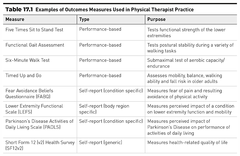
A self report measure is captured through what? And is objective or subjective?
Through patient's perception of status
Subjective

Outcomes research is what type of study design?
Non-experimental study design
Which study design is best for controlling bias, but excessive control can overshadow clinical relevance?
Experimental design (RCTs)
Which study design is more vulnerable to bias, but may be more clinically relevant?
Quasi-experimental designs

Which study design is most vulnerable to bias, but may be most clinically relevant?
Non-experimental

Is there purposeful manipulation of subjects in outcome research?
No purposeful manipulation of subject (non-experimental)

Outcomes research design is comparable to what other research?
Prognostic factors research design

Outcomes research is prospective or retrospective?
Usually retrospective with secondary data previously collected during patient care activities
Are outcomes research cross-sectional or longitudinal?
May be cross-sectional or longitudinal

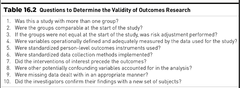
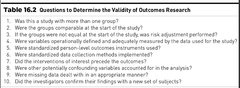
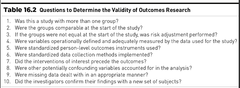
Questions to determine the validity of outcomes research.

What does, was this a study with more than one group, address?
Allows comparison to show meaningful improvement (Preferred but not required)

What does, were the groups comparable at the start of the study (have similar sociodemographic, clinical, and prognostic characteristics), address?
Potential differences among groups that may influence study
(limited due to non-random assignment)
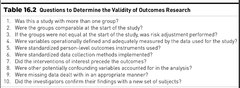
What does, if groups were not equal at start was risk adjustment performed, address?
Potential differences among groups that may influence study results
(variety of methods)
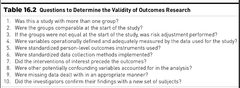
What does, were variables operationally defined and adequately measured by data used for study, address?
Construct validity of measures

What does, were standardized person-level outcomes instruments used, mean?
Were instruments reliable and valid, and meaningful to patients
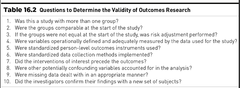
What does standardized outcomes address?
Reliability and validity of instruments
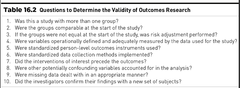
What does person-level outcomes address?
Meaningful to patients (performance/self report)
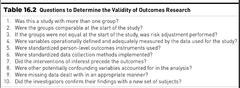
What does, were standardized data collection methods implemented, address?
Bias due to difference in data collection methods
(prospective offers control, retrospective doesn't)

What does, did interventions precede the outcomes, address?
Temporal order for cause and effect connections
(longitudinal may support causal inferences if sequence of intervention and outcome is established (also dose-response))

What does, were other potentially confounding variables accounted for in the analysis, address?
Influence of extraneous variables

What does, were missing data dealt with in an appropriate manner, address?
Statistical power (ex. imputation)
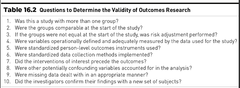
What does, was the study repeated on a second set of subjects, address?
Reproducibility of results
What are additional considerations when assessing credibility of outcomes research?
Detailed description of:
- clinical setting
- inclusion criteria
- exclusion criteria
- protocol for interventions
What are tests of differences for outcomes research?
Effect sizes
MCID
What are predictive models for outcomes research?
Regression analysis
Odds ratio
Risk ratio

If a 95% CI for effect size includes 0 is it significant or not?
No difference (not sig.)
If a 95% CI for ratios includes 1 is it significant or not?
Not significant (50/50 probability)
When examining if you should use an outcomes study evidence you ask?
Is study high quality?
Are results important?
Is intervention available, practical and safe?
Was patient represented?
Patient or client values and preferences
What are patient or client values to consider when selecting evidence?
Risk of injury
Benefits > risk
Cost (money, time, personal)
Confidence in PT and intervention
Belief in scientific evidence
Previous experience