lecture 2
 Call Kai
 Learn
 Practice Test
 Spaced Repetition
 Match
 Flashcards
 Knowt Play
1/73

Earn XP
Description and Tags
qualitative data collection
Name | Mastery | Learn | Test | Matching | Spaced | Call with Kai | Chat |
|---|
No analytics yet
Send a link to your students to track their progress
74 Terms
1. Qualitative Data Collection
In-depth interviews as a research method
how many / what quantity etc.
→ can't do interviews to get needed data
Designed to answer questions about processes, meaning, attitudes and understandings.
Not designed to answer questions about prevalence, central tendencies, how much, how many.
Standardization and reproducibility are generally lower than in structured methods, but this does not in itself imply lower data quality.
Usually use non-probability sampling methods.
Usually audio recorded, transcribed, and coded (by hand or using qualitative data analysis software).
Usually last between 30 minutes and 2 hours, depending on the research question, population and type of interview.
ADDITIONAL SIMPLE EXAMPLE (not from the slide)
A researcher conducts in-depth interviews with 15 university students to understand why they experience stress and how they deal with it.
The interviews last approximately one hour, are audio recorded, transcribed, and analyzed to identify common themes.
Key point: In-depth interviews help researchers understand people's experiences, attitudes, and motivations, rather than measure how many people think or behave in a certain way.
Features of in-depth interviews
Greater interest in the interviewee’s (emic – insider’s) point of view – used when we want to understand HOW people understand and explain their behaviour, experiences, beliefs, perceptions and emotions – DEPTH.
Rambling or going off at tangents is encouraged, since it shows what interviewee sees as relevant and important
Interviewers can depart from schedule or guide, ask new questions, follow-up interviewees’ replies, vary order and wording of questions
Flexibility – response in direction in which research is going
Or, used when we need to explore an issue on which there is limited previous data
Market research: new products, new campaigns
Public opinion & political campaign research
ADDITIONAL SIMPLE EXAMPLES (not from the slide)
1. Emic (insider’s) point of view:
A researcher interviews employees to understand how they personally experience workplace stress, rather than assuming what causes it.
2. Flexibility:
During an interview, a student unexpectedly mentions problems with their manager. The researcher asks additional questions about this issue, even though they were not originally planned.
3. Limited previous data:
A company develops a completely new product and conducts in-depth interviews to understand how consumers feel about it before launching it.
Key point: In-depth interviews focus on understanding people's personal perspectives in detail. They are flexible and particularly useful when little is already known about a topic.
Advantages of in-depth interviews
people open more than you'd expect
Depth: In-depth interviews can provide important insights and rich, detailed accounts of participants’ experiences and perspectives.
Disclosure: A one-to-one setting may facilitate greater willingness to disclose personal experiences and views than group methods.
Quality of data: Skilled interviewers can probe for greater detail. Questions can be added or adapted during the interview when needed.
ADDITIONAL SIMPLE EXAMPLES (not from the slide)
1. Depth:
A researcher interviews students about their university experiences and receives detailed explanations about their feelings, challenges, and motivations.
2. Disclosure:
An employee may feel more comfortable discussing workplace bullying in a private interview than in a focus group with other employees.
3. Quality of data:
During an interview, a participant mentions feeling stressed at work. The researcher asks additional questions to understand exactly what causes the stress.
Key point: In-depth interviews provide detailed information, encourage participants to share personal experiences, and allow researchers to ask follow-up questions.
Interviews – Example: Value of interviews for a start-up
eŠola: used to be just an IT company providing software for primary and secondary schools in Slovenia.
Business idea: “eAssistent”, an application that would deliver grades and other information about children’s performance in school to parents.
Value of interviews vs. other methods:
understanding mistrust between parents and children, and parents and school
how to best understand the “pain” that some parents experience
better understanding of the needs, concerns and circumstances that may influence whether parents would use or pay for the service
☒ interviews do not tell us how many parents will actually purchase the service!
For more information on the value of in-depth customer feedback and the complete methodology to the lean startup, see e.g.: Blank, S. (2013), Ries, E. (2011).
ADDITIONAL SIMPLE EXAMPLE (not from the slide)
A start-up interviews parents to understand their concerns about monitoring their children's grades. Interviews help explain WHY parents might use the app, but not HOW MANY would actually buy it.
Disadvantages of in-depth interviews
Time-consuming: It can take a lot of time to get access to participants, get their trust, set- up the interviews, etc.
Analysis can be challenging: Qualitative data can be ambiguous, resulting in a more difficult analysis, particularly for less experienced analysts.
Interviewing requires a high level of training and skill: It is important to have well-trained, highly-skilled interviewers conducting this type of interview. Using less skilled interviewers increases the possibility of bias.
Small numbers: The number of interviews is generally smaller than in surveys, but there is no universal “correct” number. It depends on the research question, heterogeneity of the population, type of analysis, research design and the information power of the sample.
ADDITIONAL SIMPLE EXAMPLE (not from the slide)
A researcher conducts 15 interviews with employees about workplace stress. Finding participants, conducting interviews, and analyzing their detailed answers takes considerable time. An inexperienced interviewer may also ask leading questions, introducing bias.
Types of in-depth interviews
1. Structured interview
Interviews are administered by predefined protocol.
All interviewees are asked the same questions.
Questions are asked exactly and in same order.
2. Semi-structured interview
Questions generally follow an interview guide.
The interviewer can ask additional questions in response to interesting or unexpected answers.
3. Unstructured interview
Interviewer only has list of topics of issues, style of questioning is usually informal.
Phrasing and sequencing of questions vary from interview to interview.
ADDITIONAL SIMPLE EXAMPLES (not from the slide)
Structured: A researcher asks every student the same five questions in exactly the same order.
Semi-structured: A researcher prepares five questions but asks additional questions when a student mentions something interesting.
Unstructured: A researcher discusses students' university experiences without following a fixed list of questions.
Key difference: Structured = fixed questions; Semi-structured = guided but flexible; Unstructured = informal and highly flexible.


Interviews – Preparation
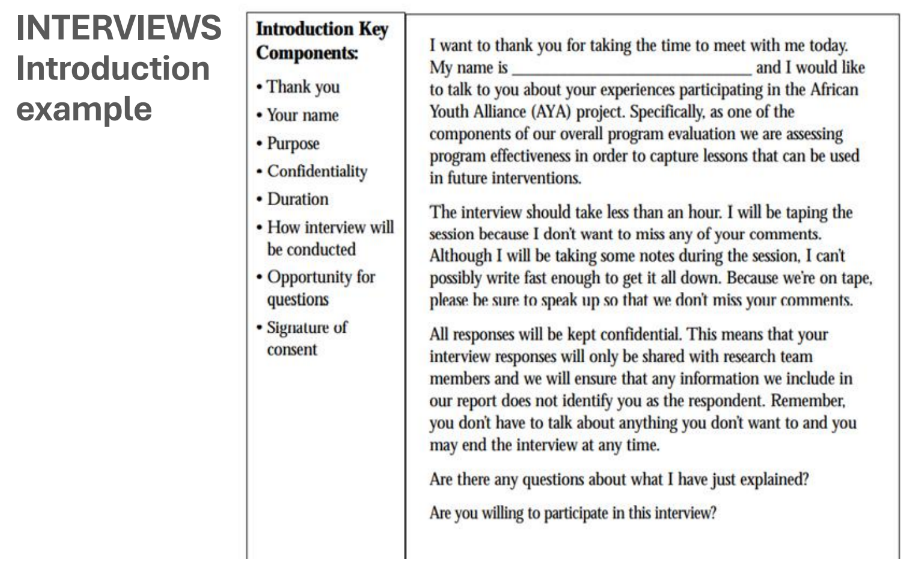
You will need to prepare an interview guide, (it’s called a “guide”, not a questionnaire!), which may be a part of a broader interview protocol.
The introduction to the interview should include: the purpose of study, ethics, procedure (e.g. audio recording), participant questions..
Sometimes given to respondents as a printed “information sheet” hand-out (are informed about all of the details)
All ethics issues: asking for consent to participate in the study and how the participant’s data can be used → more on this later
Sometimes written and signed consent (in two copies), sometimes verbal consent (audio-recorded)
Record a “facesheet” or background info about respondent: age, gender, position in company, number of years employed, etc
Prepare the interview questions!
ADDITIONAL SIMPLE EXAMPLE (not from the slide)
A researcher prepares an interview guide to study employee satisfaction. Before starting, they explain the purpose of the study, ask for consent to record the interview, and collect basic information about the participant's age and job position. They then begin asking the prepared interview questions.
Interviews – The Interview Questions
Semi-structured in-depth interview questions should be:
Structured enough that the interview is not just rambling, is organized, and allows you to actually answer your research questions
Flexible enough that you can depart from questions – think of them as topics of conversation (broad sets of questions, not a list of specific questions!).
We usually also include “prompts” or “probes” – follow-up questions we can use if needed
ADDITIONAL SIMPLE EXAMPLE (not from the slide)
A researcher interviews students about university stress. They prepare questions to keep the conversation organized but can ask additional questions if a student mentions something interesting.
Prompt/probe example: “Can you tell me more about that?”
Interviews – The Interview Questions
Should be clearly connected to the RQs and grounded in the theory and literature review!
What are the main theories, debates in the literature? Do articles speak about challenges and opportunities faced by managers? Trends expected in digitalization?
Your questions should arise from the literature review – make sure you are not “reinventing the wheel”, but be open enough that they will allow you to add something new
Think of “end use strategizing” – where do you want to be at the end of the process, when you write up the chapter?
Will you be making comparisons across industries? Across gender of managers? Size of company? Country? Make sure your questions (facesheet!) will allow you to make these comparisons!
The structure and organization of your questions is important – it will make it much easier to analyze the data later!
ADDITIONAL SIMPLE EXAMPLE (not from the slide)
A researcher investigates how managers deal with digitalization. They use previous research to prepare interview questions and collect background information about each manager's industry and company size so they can compare responses later.
Interviews – Good interview protocols 1
Begin with routine questions to create comfort and talking. Keep sensitive and complex questions for later in the interview, once you have established rapport.
Try make transitions smooth and logical (“you were telling me about your friends from school, do you have any friends who don’t go to your school?”)
Don’t ask questions with right or wrong answers that may make the respondent worried about not being smart or well-informed (don’t ask “how do you feel about the government’s new tax policy?”)
End the interview by asking the respondent if they have anything they want to add about the topic, and explain what happens next (Will you give them a copy of the thesis? Will it be published in an article?)
ADDITIONAL SIMPLE EXAMPLE (not from the slide)
A researcher interviewing students about university stress starts with easy questions about their studies, gradually moves to more personal experiences, and finishes by asking whether they would like to add anything.
Interviews – Good interview protocols 2
Ask open-ended questions (“Can you tell me about how you came to the US?”) and don’t ask too many closed-ended questions (“Tell me about the election” is better than “Did you vote?”)
Ask follow-up questions (“Can you tell me a bit more about that” “Can you explain a bit more what you mean by that” “How so” “In what way”)
Ask for examples or stories (“Can you give me an example of when you felt discriminated against?” “Tell me about your favorite high school teacher?”)
Watch for wording (“Welfare” versus “Assistance to the poor”)
Ask indirect questions: e.g., in 3rd person (“Do you have any friends who think X? What did they mention are the reasons they think so?”)
ADDITIONAL SIMPLE EXAMPLE (not from the slide)
Instead of asking “Do you like your university?”, ask “Can you describe your experience at university?” and follow up with “Can you give me an example?”
Interviews – Best practices for leading interviews
Make sure the environment is comfortable for the respondent (privacy concerns, distractions, etc.).
Listen carefully.
Don’t interrupt the respondent unnecessarily – come back to issues you want more detail on once the respondent has finished her/his thought (“you were saying that your father obtained your visas, can you tell me a bit more about how he got them?”)
Keep the conversation flowing but don’t be shy to take a moment and look through your interview schedule from time to time to make sure you are covering all the topics you wanted to cover.
Balance: while you should be a good listener, you can’t afford to be a totally passive receiver either: you’ll go into the interview with questions you want answers and topics you want addressed; you’ll need to subtly direct conversation to get at these.
Take all answers neutrally, do not agree or disagree with the respondent, take sides, approve/disapprove of their answers, or disclose your opinion.
ADDITIONAL SIMPLE EXAMPLE (not from the slide)
A researcher interviews an employee in a quiet, private room. They listen without interrupting, gently guide the conversation back to relevant topics when necessary, and remain neutral even if they disagree with the employee's opinions.
Interviews – After the interview
Take notes right away on any thoughts and ideas you had during the interview.
Transcribe the interview as soon as possible.
Verify any information if needed (e.g., if the respondent says the organization has mandatory vaccination policies – check this with the organization).


Interviews – Expert interviews
Experts: have aggregated and/or specific knowledge about a specific issue, so interviewing them might give us quicker insight into processes, strategies etc than interviewing individual people.
An expert is a person who is responsible for the development, implementation or control of solutions/strategies/policies, or has privileged access to information about groups of persons or decision processes.
E.g., school psychologist knowledgeable about most common learning issues among children, company CEOs who knows most about difficulties with supply chains.
Often used in exploratory phase of research, to find out how we should proceed with the rest of the research, but could also be the main source of data.
Expert opinions are NOT neutral – they should not be treated as neutral carriers of “objective facts”. Their accounts are also shaped by their professional, institutional or organizational position.
ADDITIONAL SIMPLE EXAMPLE (not from the slide)
A researcher interviews a company's CEO to understand supply chain problems. The CEO can provide detailed information quickly, but their opinions may be influenced by their position in the company.

Focus groups as a research method
Method of interviewing involving more than one, usually at least 4 participants (up to 8, max. 10).
Accent is upon interaction within the group: how participants elaborate on, challenge and question one another, and jointly construct, negotiate or differentiate positions.
Researcher interested in the ways in which individuals discuss a certain issue as members of a group, rather than simply as individuals.
Starting to be used more widely: now used from marketing to political research.
ADDITIONAL SIMPLE EXAMPLE (not from the slide)
A company brings together 6 customers to discuss a new product. Participants share opinions, disagree, and build on each other's ideas, while the researcher studies their group interaction.
Focus groups – More insight than interviews?
Individual might qualify or modify a view once hears other people’s opinions, or voice agreement to something he would not have thought about– things that wouldn’t emerge out of an individual interview.
In conventional interviews, interviewees are rarely challenged – might say inconsistent things, or untrue things etc. – in focus groups, individuals will often argue and challenge each other’s views.
The expression of contrasting views allows the researcher to observe how people justify, defend, modify or adapt their views in interaction with others.
Focus groups represent the most commonly used research method in market research.
ADDITIONAL SIMPLE EXAMPLE (not from the slide)
A group of customers discusses a new product. One customer initially likes it, but after hearing others' concerns about its price, they change their opinion.
The researcher can observe how participants challenge and influence each other's views, which might not happen in individual interviews.
Focus Groups – How to organize a focus group 1
How many participants?
Typical size is 4 to 10 members, although over 8 difficult to manage
Difficult to control for “no shows” other than over-recruiting
Smaller groups better when topics are controversial or complex
Who?
Think about whether you want strangers (stratifying criteria) or natural groups? How will the relationships between participants influence what they are willing to share: homogenous or heterogenous groups?
✓ Homogeneity in characteristics relevant to a sense of safety or shared experience does not necessarily mean homogeneity of opinions.
ADDITIONAL SIMPLE EXAMPLE (not from the slide)
A researcher organizes a focus group with 6 university students to discuss exam stress. They choose students with similar university experiences (homogeneous group), but the students may still have different opinions about exams.
Focus Groups – How to organize a focus group 2
When/where?
Timing and place that is convenient for participants
But, silent enough that the recording will be audible (or preferably in professional focus group room)
Offer food, drinks, etc.
How?
Think about how you will get participants – will you invite specific people, or publish a “call for participants” where you define the kinds of characteristics you are looking for (e.g., smokers, 25-50 years old)
Think about what could motivate participants to participate. A reward?
Focus Groups – How to lead a focus group: the role of moderators
Introduction: similar to an interview:
Explanation of the purpose of the research, letting participants know about audio/video recording, how data will be used, obtaining consent, giving information sheets.
Setting up the rules for the focus group: not interrupting, speaking in turn, etc.
Must be careful to include all participants in discussion – both shy and outspoken ones – necessary to intervene if one participant is particularly assertive
“Feel the room” – ask participants to raise hands? Go one by one around the table?
Like with interviews, the moderator must stay neutral.
Focus Groups – Online focus groups
Used when we need populations who are spread across the country/world – or otherwise hard to recruit people (e.g., doctors).
Good in case of travel/budget restrictions.
Can be difficult to handle technological issues – good to have 1 additional person handling all non-content issues.
More difficult to establish a “natural”/relaxed environment.
As opposed to live focus groups, online focus groups allow the moderator to chat 1-on-1 with individual participants simultaneously if needed.
Focus Groups – Limitations
Less control over proceedings than in individual interview
Artificial atmosphere
Data difficult to analyze –huge amount of data, inaudible elements
Difficult to organize – numerous people need to show up at a particular time and place.
Problem of group effects: reticent speakers, those who hog the stage; “group think” – potentially biased results because of group influence
Less suitable when the group composition or relationships between participants may inhibit disclosure or create risks, e.g. intimate topics, participants in hierarchical relationships, or strong interpersonal conflict.
ADDITIONAL SIMPLE EXAMPLE (not from the slide)
During a focus group about workplace satisfaction, one employee dominates the discussion, while others are afraid to disagree with their manager. This can lead to groupthink and biased results.



Interviews & Focus Groups – Time and financial considerations
Preparation and organization: access to participants, recruitment, scheduling, ethics approval, preparation and piloting of the interview/focus-group guide.
Data collection: time for interviews/focus groups, travel or room costs, possible participant compensation.
Transcription: manual transcription is very time-consuming; AI-assisted transcription can greatly accelerate the process but requires checking
Data preparation: anonymization, secure storage, organization...
Analysis: coding and analysis require substantial time; software (e.g. MAXQDA, NVivo, ATLAS.ti) can facilitate the process but is not essential.
Additional costs: professional transcription, translation, software licences, equipment.
✓ The largest cost of qualitative research is often researcher time.
✓ When using AI tools for transcription, check data protection, confidentiality and how recordings are stored.
ADDITIONAL SIMPLE EXAMPLE (not from the slide)
A researcher conducts 15 interviews with employees. Besides the interviews themselves, they must spend time recruiting participants, transcribing recordings, organizing data, and analyzing responses. AI can speed up transcription, but the researcher must check its accuracy and protect participants' privacy.
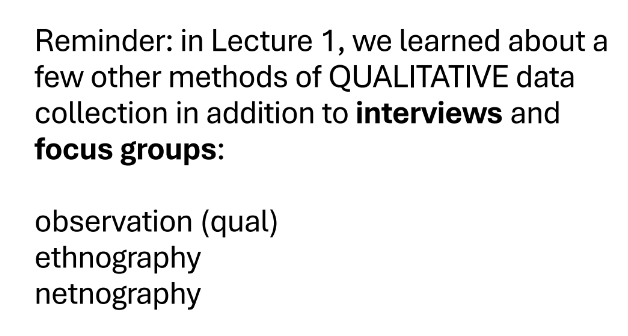
2. Secondary qualitative data
Qualitative Data – Examples (Review)
✓ Qualitative data may be textual, visual, audio or audiovisual and are generally not pre-reduced to numerical measurements.
Primary:
Transcripts of interviews and focus groups, that we collected on our own
Secondary:
Archival data, documents, annual reports
Text of magazines, blogs, books
Audio and visual data
Google street view, maps
Photographs, pictures, drawings, graffiti
Published transcripts of interviews from previous studies
Posts on various social media, etc.
Qualitative Data – Secondary qualitative data – NOTE!
Some secondary qualitative data we discuss today is later further analyzed qualitatively (e.g. with thematic analysis)
Tourist brochures
Travel reviews
Graffiti
While other secondary qualitative data we discuss today is later analyzed quantitatively (e.g. computational text analysis, topic modeling).
Disney movies
Political debate
Facial structure of CEOs
Instagram images, X tweets
We will cover this difference and choices in methods of analysis in detail in Week 3!
ADDITIONAL SIMPLE EXAMPLE (not from the slide)
A researcher studies existing hotel reviews:
Qualitative analysis: Identifies common themes in guests' experiences.
Quantitative analysis: Counts how frequently certain words or topics appear in reviews.
Key difference: The original data can be qualitative, but the method used to analyze them can be either qualitative or quantitative.
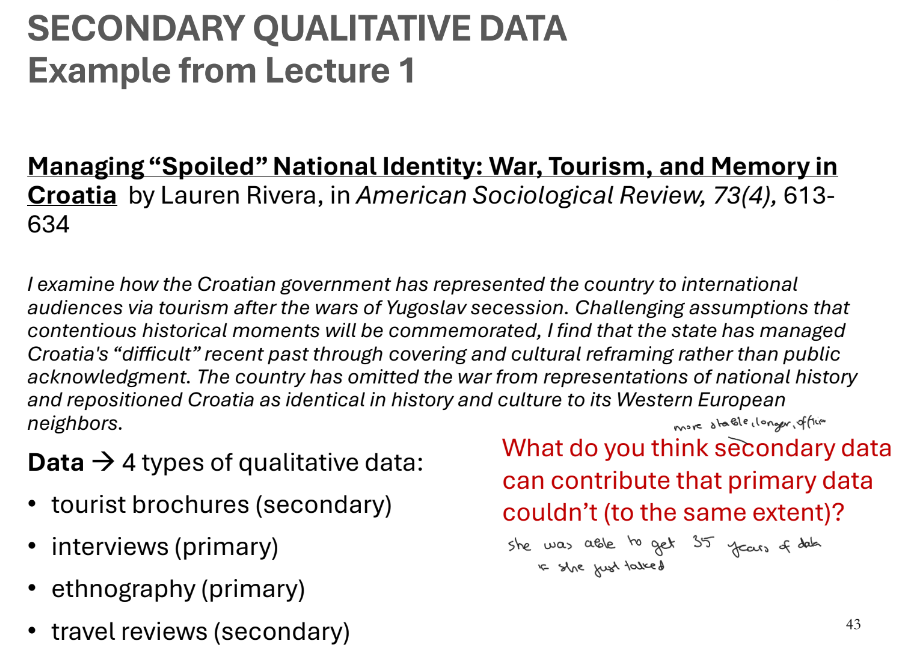


Secondary Qualitative Data – Other sec. qual. data
In addition to images, tweets, company reports... (large volumes of data), other types of qualitative data can be transformed into quantitative data which is then be further quantitatively analyzed:
Facial structure from photographs (FWHR, symmetry, smile intensity)
Spatial layout of offices (could code for privacy, collaboration, presence/absence)
Nonverbal behavior from business negotiation videos (gesture frequency, posture)
Clothing and formality from manager photos (tie presence, color tone)
Logo design from corporate logos (color complexity, shape symmetry etc)
ADDITIONAL SIMPLE EXAMPLE (not from the slide)
A researcher analyzes 500 company logos and counts the number of colors used in each logo. The original data are qualitative (images), but they are transformed into quantitative data (number of colors) for statistical analysis.

3. Sampling
Sampling = selecting a smaller group from a larger population.
1. Probability sampling (Random selection)
Everyone has a known chance of being selected.
Simple random: Randomly select 100 students.
Systematic random: Select every 10th student.
Stratified random: Divide students by gender, then randomly select from each group.
Cluster random: Randomly select 5 classes.
Multi-stage: Randomly select universities, then classes, then students.
2. Non-probability sampling (Non-random selection)
Participants are selected without random sampling.
Quota: Select 50 men and 50 women.
Purposive: Select people with specific knowledge.
Snowball: Participants recommend other participants.
Convenience: Survey people who are easiest to reach.
Purposive sampling subtypes:
Extreme case: Unusual cases.
Max heterogeneity: Very different people.
Max homogeneity: Very similar people.
Typical case: Average cases.
Critical case: Particularly important cases.
Theoretical: Select based on emerging theory.
Key difference: Probability = random selection with known selection probabilities. Non-probability = selection without known probabilities.

Sampling – Probability sampling
researcher has no effect on who enters the sample and who doesn't
you know what's the probability of each unit
Each element of the target population has a known and non-zero probability of being included in the sample.
Only with probability samples can we use statistical inference (from the sample to the population), which is the basis for the calculation of confidence intervals (we precisely define the risk of error).
Condition for implementation: the existence of a sampling frame (i.e. a list of all units in the population such as population register/Census, business register, list of enrolled students) or other procedures that ensure the possibility of selection (e.g., spatial sampling).
Units are selected by some objective, random mechanism (e.g. random number generator).
The entire sampling process is independent of the researcher.
Types: simple random sampling, systematic sampling, stratified sampling, cluster sampling, multistage sampling...
ADDITIONAL SIMPLE EXAMPLE (not from the slide)
A researcher uses a university's student list and randomly selects 100 students using a random number generator. Every student has a known chance of being selected.
Sampling – Probability sampling types
Simple random sampling: any of the possible subsets of n distinct elements from the population of N elements is equally likely to be the chosen sample.
Systematic sampling: we take every k-th element after a random start.
Stratified sampling: after classifying the population into subpopulations (strata), we select separate and independent random samples from each of the strata. We divide all firms into 4 strata (micro, small, medium and large) and sample each stratum.
Cluster sampling: when a population consists of (naturally occurring) groups of elements (clusters), we sample clusters, thus all elements in selected clusters. All pupils cluster in primary schools, so we sample schools, thus the sample consists of all pupils in selected schools.
Multi-stage sampling: involves two or more stages of cluster sampling in sample selection. regions – schools – classes – pupils
Kalton, G. (1983). Introduction to survey sampling. Sage.
ADDITIONAL SIMPLE EXAMPLES (not from the slide)
Simple random: Randomly select 100 students from a university list.
Systematic: Select every 10th student after a random start.
Stratified: Divide students by year of study and randomly select students from each year.
Cluster: Randomly select 5 schools and include all pupils from those schools.
Multi-stage: Randomly select regions, then schools, then classes, then pupils.
Sampling – Non-probability sampling
Sampling distribution is not based on statistical reasoning.
Relevant lists of the population (or sampling frames) often do not exist or are not available.
As the likelihood of inclusion in the sample for any population unit is unknown, also the risk of error in reasoning or generalizing to the entire population is unknown.
We therefore describe the sample carefully and acknowledge that it is not statistically representative.
Non-probability samples do not permit statistical generalization to the population with a known sampling error.
Other forms of generalization or transfer may nevertheless be possible, e.g. analytical/theoretical generalization or assessment of transferability to related contexts.
ADDITIONAL SIMPLE EXAMPLE (not from the slide)
A researcher interviews 20 vegetarians recruited through friends. Because participants are not randomly selected, the researcher cannot statistically generalize their opinions to all vegetarians in Slovenia.
Non-probability sampling in qualitative research
Convenience
Purposive
Quota
Chain/Snowball
Theoretical
ADDITIONAL SIMPLE EXAMPLES (not from the slide)
Convenience: Interview students who are easiest to reach.
Purposive: Select experienced managers because they have relevant knowledge.
Quota: Interview 10 men and 10 women.
Chain/Snowball: One participant recommends other participants.
Theoretical: Select new participants based on findings emerging during the research to develop a theory.
Convenience sampling
We choose the units that are most easily accessible (can be completely haphazard).
Higher risk of a biased selection.
Sometimes also includes self-selection, for example when publishing an invitation to participate in an interview / focus group online.
ADDITIONAL SIMPLE EXAMPLE (not from the slide)
A researcher interviews students from their own class because they are the easiest to reach.
Self-selection example: A researcher posts an online invitation, and students voluntarily decide to participate.
Purposive (judgmental) sampling
Units are deliberately selected according to predefined criteria because they are particularly relevant to the research question.
They are not selected because they are easiest to access, but because of their characteristics, experiences or position.
Researchers may purposively select typical cases, critical cases, maximum-variation cases, extreme cases, confirming/disconfirming cases, or particularly homogeneous or heterogeneous cases.
This can also include expert selection, where a knowledgeable expert identifies units considered particularly relevant or characteristic for the purpose of the research.
ADDITIONAL SIMPLE EXAMPLE (not from the slide)
A researcher wants to understand how experienced managers handle workplace conflicts. They deliberately select managers with at least 10 years of experience because their knowledge is relevant to the research question.
Quota sampling
We choose the units according to convenience, but in addition we take into account predefined quotas according to certain characteristics (e.g., half men, half women or one third small enterprises, one third medium-sized enterprises, one third large enterprises, etc.).
The researcher can select units freely only within the predefined quotas. Quotas constrain the composition of the sample and may reduce some forms of selection bias, but do not eliminate selection bias.Quota samples can be improved by first applying a probability sampling technique (if possible), followed by applying quotas.
Similar to stratified sampling (probability sampling) (see Lecture 4!)
ADDITIONAL SIMPLE EXAMPLE (not from the slide)
A researcher needs 100 participants: 50 men and 50 women. They select people who are easiest to reach until each quota is filled.
Chain sampling
The researcher identifies additional units through recommendations or referrals from participants already included in the sample.
It is useful when studying a population that is difficult to identify or locate, or for which no suitable sampling frame exists.
This may include marginalized or hard-to-reach populations (e.g. homeless people, former prisoners), people involved in illegal activities, but also ordinary groups with specific characteristics or practices (e.g. vegans, e-bike owners, users of a particular technology).
Referrals are particularly useful when members of the population know one another or are otherwise difficult to identify.
ADDITIONAL SIMPLE EXAMPLE (not from the slide)
A researcher interviews one vegan, who recommends two other vegans. Those participants then recommend more people to interview.
Theoretical sampling
Data collection, coding and analysis take place simultaneously → iterative process.
Particularly characteristic of the grounded theory approach. (more in Lecture 3)
Decisions about how to extend the sample are made during the research process in order to develop the emerging theory.
Selection of subsequent units/cases is guided by concepts and relationships emerging during analysis.
Individuals and groups are selected according to their expected contribution to further theoretical development.
ADDITIONAL SIMPLE EXAMPLE (not from the slide)
A researcher interviews students about exam stress. During analysis, they discover that working students experience different types of stress, so they decide to interview more working students to develop their theory.
Sampling – Differences between non-probability approaches
massively wrong on exam 8 pp.
Key question: Why did we select these particular units?
PURPOSIVE → Who is particularly informative for our research?
informative selection
We select units because they have characteristics, experiences, or knowledge relevant to the research question.
Example: We interview employees who have direct experience using AI at work.
QUOTA → What composition of the sample do we want to ensure?
what structure
We define in advance the categories and the number or proportion of units in each category; units within categories are not selected randomly.
Example: We want to include 10 managers and 10 regular employees.
CONVENIENCE → Who can we most easily access?
We include units primarily because they are the easiest for us to access.
Example: We study shopping habits and interview shopping-centre visitors who are there during data collection and willing to participate.
✓ What matters is the logic of selection, not the characteristics of the unit in themselves.
why were people chosen?
ADDITIONAL SIMPLE EXAMPLE (not from the slide)
Imagine a researcher studying university students:
Purposive: Select students with experience using AI for studying.
Quota: Select 10 first-year and 10 second-year students.
Convenience: Interview classmates who are available.
Key difference: Purposive = relevance; Quota = predefined composition; Convenience = accessibility.
Sampling – Same population or setting → different selection logic
CONVENIENCE: A researcher studies stress among university students. She approaches students leaving the university library because they are the easiest for her to access.
Why these students? Because they are accessible.
PURPOSIVE: A researcher studies stress during the transition to university. She deliberately recruits first-year students who moved away from home to attend university, because they have an experience particularly relevant to the research question.
Why these students? Because they have a relevant experience.
A nursing home is selected because it is nearby and easy to access → CONVENIENCE
A nursing home is selected because of a research-relevant characteristic (e.g. unusually high staff turnover) → PURPOSIVE
✓ A population or setting is not inherently “convenience” or “purposive” – what matters is the logic of selection.
ADDITIONAL SIMPLE EXAMPLE (not from the slide)
A researcher studying employee satisfaction selects:
Convenience: Employees from a nearby company because they are easy to reach.
Purposive: Employees who recently experienced a company restructuring because their experiences are relevant to the research.
Key difference: Convenience = accessibility; Purposive = relevance to the research question.
Sampling – Combining sampling approaches
The same study can use several non-probability sampling approaches.
Example: We study employees' experiences of using GAI in companies.
Purposive: we include only employees who use GAI at work.
Quota: we decide in advance to include 10 managers and 10 other employees.
Snowball: we ask the first interviewees to connect us with other employees who meet the criteria.
✓ We describe the sampling approach according to how units were actually selected and recruited.
✓ The methods section should clearly describe the entire process of selecting and recruiting units.
ADDITIONAL SIMPLE EXAMPLE (not from the slide)
A researcher studies students who use AI for studying.
Purposive: Select only students who use AI.
Quota: Include 10 first-year and 10 second-year students.
Snowball: Ask participants to recommend other students who use AI.
SAMPLING
Combining sampling approaches - Example

Sampling – Planning sample composition
If theory, previous research or our research questions suggest important differences between groups, we can take these dimensions into account when planning the sample.
Example: In a study of digital transformation, we want to enable comparisons according to:
company size (small / medium / large)
position of interviewee (manager / employee)
Small company | Medium company | Large company | |
|---|---|---|---|
Managers | |||
Employees |
✓ The aim is to ensure that the sample enables comparisons that are important for the research question.
✓ These dimensions were selected before data collection. A later sample-description table may include additional characteristics (e.g. gender or age) that did not necessarily influence selection into the sample.
ADDITIONAL SIMPLE EXAMPLE (not from the slide)
A researcher wants to compare how managers and employees experience digital transformation in small, medium, and large companies.
They plan the sample to include participants from all six categories so they can compare the different groups.
Sampling – Sample size in qualitative research
There is no universal rule for the appropriate number of units/interviews.
Sample size depends on:
the research question and research design
the heterogeneity of the population
the type and depth of the data collected
the type of analysis
planned comparisons between groups
A common criterion is saturation (information redundancy): additional units no longer provide important new information, themes or insights relevant to the research question.
✓ The sample should be large enough to capture relevant diversity, but not so large that it prevents in-depth, case-oriented analysis.
✓ A larger sample does not automatically mean better qualitative research.
ADDITIONAL SIMPLE EXAMPLE (not from the slide)
A researcher interviews students about exam stress. After 15 interviews, participants keep mentioning the same problems, and no important new themes appear. This may indicate saturation.
Sampling – Sample description table
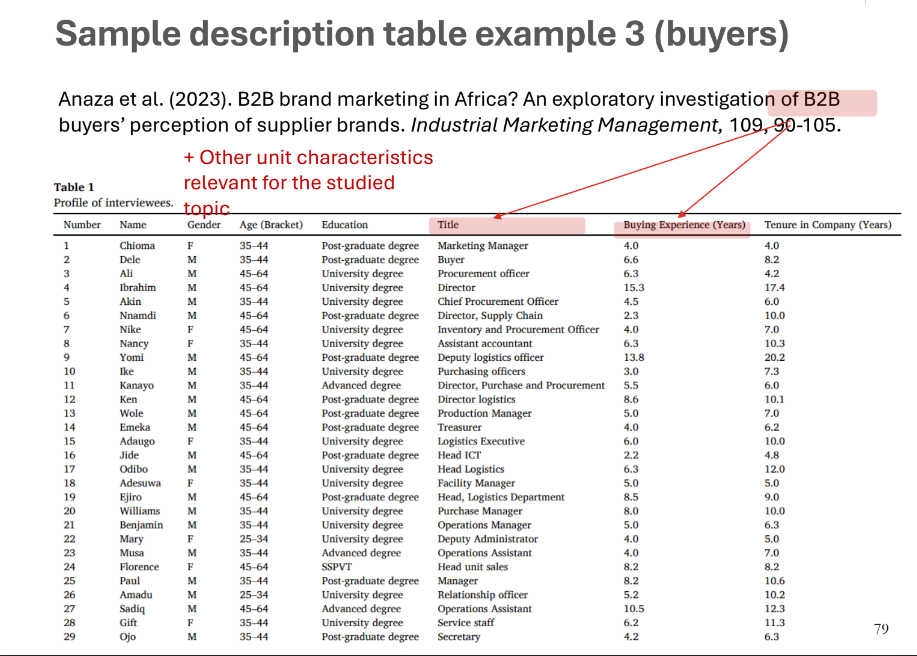
In qualitative research, we must provide information on sampling procedure with the same rigor as in quantitative studies. This usually means including a sample description table.
Include a table of participants/units, either grouped or listed individually, with relevant characteristics (e.g., gender, years worked in company, industry, etc. – whatever dimensions are relevant to your study).
ADDITIONAL SIMPLE EXAMPLE (not from the slide)
A researcher interviews 15 employees and creates a table showing each participant's gender, job position, years of experience, and industry.



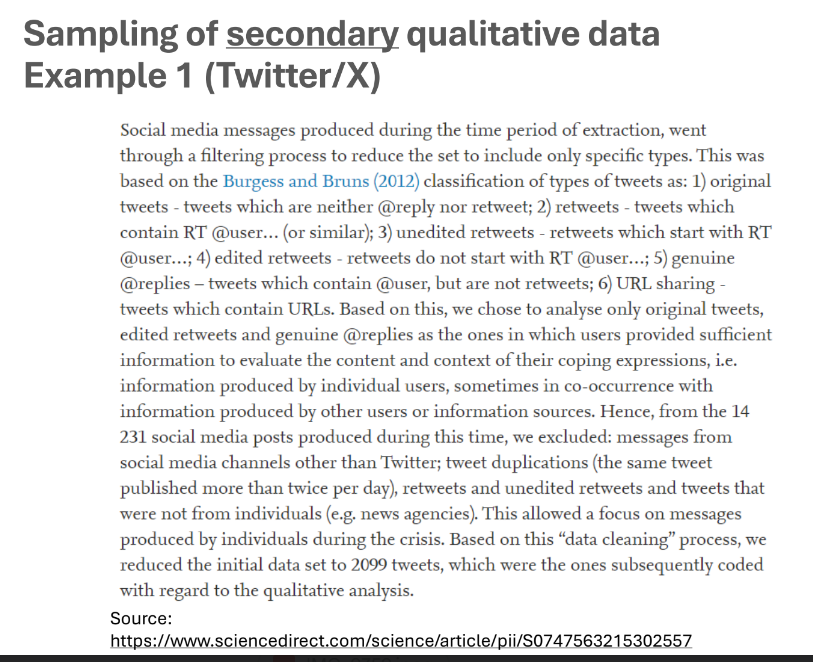
Sampling – Sampling of secondary qualitative data
✓ Must be done with same rigor as for quantitative data! What is the target population/corpus? What is the sampling frame, if one exists? What sampling approach is used?
All news content or just newspapers?
Local, national or global media?
Everything in the chosen media or just content relating to some specific topic?
If so, how do you draw a line around the topic to determine what is in and what is out?
Determining the coding units: number of lines? Length of time..?
✓ Must be explicitly stated in the methodology section of your article, usually in a table! (e.g., how many graffiti, textbooks, women, men; ages; professions; or how many texts by year, etc. – whatever variables are relevant to your study, total sample size)
ADDITIONAL SIMPLE EXAMPLE (not from the slide)
A researcher analyzes newspaper articles about climate change published in Slovenia between 2020 and 2025.
They define which newspapers, years, and topics to include, explain how articles were selected, and report the total number of articles analyzed.
Sampling – Sampling of secondary qualitative data
How do we select units from a large qualitative corpus?
If we have a large, clearly defined corpus (e.g. articles, posts, photographs, reports), we have several options:
Analyse all units, e.g. all available annual reports of FTSE 350 companies, 2012–2021
Use probability sampling when we have a defined population/corpus and want to select a smaller sample:
randomly select 1,000 from 20,000 newspaper articles → simple random
after a random start, select every 20th article → systematic
randomly select the same number of posts from each year, 2015–2025 → stratified
Use non-probability sampling when we deliberately select material with particular relevant characteristics:
e.g. only company posts discussing climate targets → purposive
ADDITIONAL SIMPLE EXAMPLE (not from the slide)
A researcher wants to analyze 10,000 Instagram posts about sustainability.
Analyse all units: Study all 10,000 posts.
Probability sampling: Randomly select 500 posts.
Non-probability sampling: Select only posts discussing sustainable packaging.


4. Research Ethics
Research Ethics – Rigorous checks in place
Institutional Review Boards (IRB) and Human Subjects Review boards
At University of Ljubljana: Committee for Ethics in Research Dealing with Human Subjects (KERL)
At the School of Economics and Business: Committee for Ethics in Research
At the level of the Republic of Slovenia: Committee of the RS for Ethics in Medicine
Frequently at multiple stages – adds time!
Mandatory informed consent forms (sometimes can be done verbally; for minors, parental consent forms)
GDPR requirements
ADDITIONAL SIMPLE EXAMPLE (not from the slide)
A researcher wants to interview university students about sensitive personal experiences. Before collecting data, they obtain the necessary ethics approval, explain the study to participants, obtain informed consent, and protect their personal information according to GDPR requirements.
Research Ethics – Rigorous checks in place
At the University of Ljubljana, obtaining ethical approval for research is still largely opt-in (apart from PhD theses), which means it is not required, but is recommended
This is different from medical research, which must always undergo ethical approval from the country-level committee for ethics in medicine
BUT, ethical approval may also be required for social science research, for example by certain academic journals, for EU-funded research projects, and for doctoral dissertations at the University of Ljubljana.
At most foreign universities researchers are not allowed to begin doing their research before they have received approval from the ethics committee!
Sometimes, in addition to the university research ethics committee, you also need approval from the Ministry of Education (for research in schools), the company office in charge of such studies, etc.
ADDITIONAL SIMPLE EXAMPLE (not from the slide)
A researcher wants to interview students in a Slovenian school. They may need approval from the relevant university ethics committee and additional permission from the school or education authorities before starting the research.
Research Ethics – Data collection (ESRC 6 principles for ethical research)
ESRC 6 principles for ethical research:
Research should aim to maximize benefit for individuals and society and minimize risk and harm
The rights and dignity of individuals and groups should be respected.
Wherever possible, participation should be voluntary and appropriately informed.
Research should be conducted with integrity and transparency.
Lines of responsibility and accountability should be clearly defined.
Independence of research should be maintained and where conflicts of interest cannot be avoided they should be made explicit.
Source: UK Research and Innovation (2021). Framework for research ethics.
https://www.ukri.org/councils/esrc/guidance-for-applicants/research-ethics-guidance/framework-for-research-ethics/our-core-principles/
ADDITIONAL SIMPLE EXAMPLE (not from the slide)
A researcher interviews employees about workplace stress. Participation is voluntary, personal information is protected, potential harm is minimized, and the researcher reports findings transparently without allowing the company to influence the results.
Research Ethics – Controversial studies
Well known problematic studies:
Tuskegee syphilis study 1932-1972
Milgram experiment 1960s
Stanford prison study 1970s
Read more
In popular news:
Humphreys, “Tearoom Trade”
Goffman, “On the Run”
→ Why may qualitative research pose particular ethical challenges?
ADDITIONAL SIMPLE EXAMPLE (not from the slide)
A researcher secretly observes people discussing sensitive personal experiences without obtaining their consent. This creates ethical concerns about privacy, informed consent, and potential harm.
Why qualitative research can be ethically challenging: Researchers often collect detailed personal information, develop close relationships with participants, and study sensitive topics, which can make confidentiality and informed consent more complicated.

Research Ethics – At all points during the research process
Before data collection
Obtain required ethics approval and permissions.
Plan informed consent, data protection and risk management.
Pay particular attention to vulnerable groups and power relationships.
During recruitment and data collection
Ensure participation is voluntary and appropriately informed.
Avoid unnecessary deception.
Be attentive to power imbalances, distress and unexpected disclosures.
Respect participants’ boundaries and right not to answer.
During analysis
Protect privacy and confidentiality.
Be reflexive about your positionality, relationships with participants and influence on interpretation.
Do not selectively report only findings that support your expectations.
When reporting
Do not fabricate or falsify data, evidence or findings.
Avoid plagiarism and misrepresentation of authorship.
Do not disclose information that could identify or harm participants.
ADDITIONAL SIMPLE EXAMPLE (not from the slide)
A researcher interviews employees about workplace bullying. Before the interviews, they obtain consent and explain how the data will be protected. During the interviews, participants can refuse to answer questions. Afterwards, the researcher anonymizes the data and reports findings accurately without revealing participants' identities.

Research Ethics – Dealing with ethics in interviews and focus groups
Two key elements:
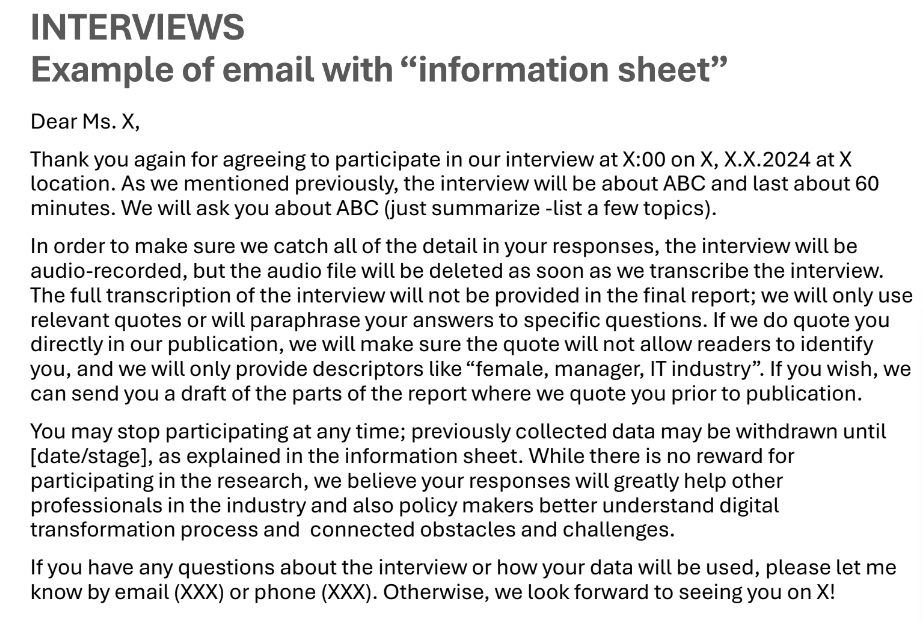
Information about the research: usually written in an “information sheet”, which we give to participants ahead of the interview, or at the very beginning of the interview
Written or verbal consent (“informed consent”), You need to make sure the participant understands (“informed”) and agrees (“consent”) to:
the purpose of the research and its potential benefits/harms, including what they will be asked to do/what is expected of them/what the interview will look like;
how their interview data (audio file and transcript) and quotes will be used, stored, and reported;
how their identity or any identifiers will be used (or not) during the research process and in the final publication;
agree to participate in the interview under these conditions (and are aware that they can withdraw at any time)
ADDITIONAL SIMPLE EXAMPLE (not from the slide)
Before interviewing employees, a researcher gives them an information sheet explaining the study and how their data will be used. Participants then give informed consent and understand that they can withdraw at any time.



Research Ethics – Verbal vs. written consent
Verbal consent:
✓ May be more appropriate when:
literacy rates are low
when working with young children (plus written consent from parents)
in cultures where verbal agreement is seen to take precedence
where participants may associate signing a form with being deprived of their rights in some way
online interviews
Ideally, audio record verbal consent
Replace information sheet with verbal description
ADDITIONAL SIMPLE EXAMPLE (not from the slide)
A researcher conducts an online interview. Before starting, they verbally explain the research and ask the participant for consent, which is audio recorded.
Research Ethics – Anonymity and confidentiality
Anonymity: the researcher cannot link the data to an individual participant.
Pseudonymization: direct identifiers (e.g. name) are replaced by a code or pseudonym, but the individual can still be identified using additional information.
Confidentiality: the researcher knows or can determine the participant’s identity but undertakes not to disclose it.
✓ Interviews and focus groups are generally not anonymous. The researcher knows whom they interviewed; the data are usually subsequently pseudonymized and treated confidentially.
Example:
I know the participant is Anna → not anonymous
In the transcript I label her Participant 07 → pseudonymized
I store the key “Participant 07 = Anna” securely and separately → confidentiality
ADDITIONAL SIMPLE EXAMPLE (not from the slide)
Anonymity: A survey collects responses without names or identifying information, so the researcher cannot identify respondents.
Pseudonymization: A researcher replaces a participant’s name with “Participant 01” but keeps a separate identification key.
Confidentiality: A researcher knows the participant’s identity but does not reveal it to others.
Research Ethics – Incentives?
reward cannot be above the threshold of changing mind about participating / bribing to participate
Gifts or incentives can be an appropriate way to motivate participation and express appreciation for participants’ time.
BUT the amount and form of compensation must not create undue pressure to participate.
Participants may be reimbursed for expenses and/or offered appropriate compensation for their time.
Particular care is needed with vulnerable groups and large differences in economic circumstances.
Compensation and its conditions must be clearly explained before consent is obtained.
ADDITIONAL SIMPLE EXAMPLE (not from the slide)
A researcher offers participants €10 for a one-hour interview to compensate for their time. However, offering €500 could create undue pressure to participate, especially for people in financial difficulty.
Informed consent in surveys
We also have to explain all the mentioned elements in surveys!
the purpose of the research and why/how the data will be used.
researcher contact information.
description of the survey (how long will the survey be, what questions will it contain).
whether it will be possible to identify participants in the answers, and how the data will be stored
how long the data will be kept...
Instead of (written or verbal) informed consent, all elements are described in the INTRODUCTION in the questionnaire
by clicking on "I agree" or "I understand, open the survey", the participant indicates that s/he understands (is informed) and wants/gives his consent to participate in the survey.
✓ With surveys, obtaining ethical approval is less complicated than for in-depth interviews, because they are usually less invasive (quicker, less effort required) and are usually anonymous.
ADDITIONAL SIMPLE EXAMPLE (not from the slide)
Before starting an online survey about student satisfaction, participants read information about the study, data privacy, and their rights. By clicking “I agree”, they give informed consent to participate.


Research Ethics – Ethics in digital environments
Publicly available data: consent is often not required for use of publicly accessible online content, but researchers should consider the context, sensitivity of the content and users’ expectations of privacy.
Closed/private communities: content from closed groups, forums or profiles generally requires permission for access and/or participant consent; joining a group does not automatically constitute permission to conduct research.
Anonymization: removing a username may not be enough, a verbatim quotation can often be traced back to its author using a search engine. For sensitive material, consider paraphrasing quotations.
Copyright: publicly posted photographs, videos and text are not automatically free to reproduce in publications.
AI and external tools: do not upload interviews, transcripts or other personal data to external AI tools unless there is an appropriate legal/ethical basis and adequate data protection.
Extra caution: children, vulnerable groups, health data, political views, illegal activities and other sensitive material require greater protection even when posted publicly.
ADDITIONAL SIMPLE EXAMPLE (not from the slide)
A researcher analyzes Reddit discussions about mental health. Even if posts are publicly available, they should protect users’ privacy, avoid identifiable quotations, and be especially careful with sensitive information.