Puder Dicephalon P.E.
 Call Kai
 Learn
 Practice Test
 Spaced Repetition
 Match
 Flashcards
 Knowt Play
1/15

There's no tags or description
Looks like no tags are added yet.
16 Terms

If the structure highlighted is lesioned what would typical symptoms look like?
Contralateral body with display signs of spastic paresis, loss of somatosensation (loss of pain/temp. and tactile/vibratory/position sense.


A 64-year-old man is brought to the emergency department after suddenly developing difficulty speaking and weakness on one side of his body. He has a history of poorly controlled hypertension and hyperlipidemia. On neurological examination, protrusion of the tongue reveals deviation toward the right side along with fasciculations and atrophy. Motor examination shows contralateral (left-sided) spastic paresis affecting the upper and lower extremities, along with impaired vibration and position sense on the left side.
A lesion of which of the following anatomical structures is most responsible for this patient’s right-sided tongue deviation?
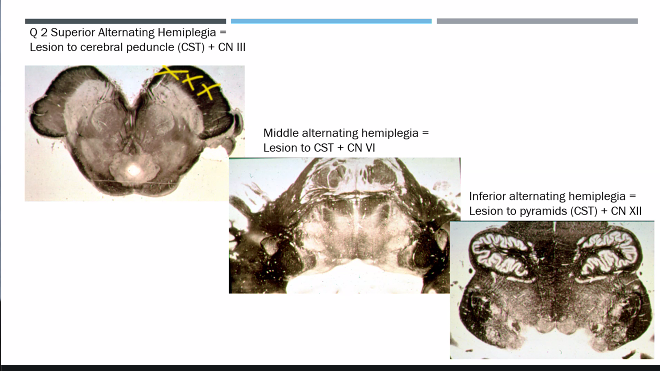
Inferior Alternating Hemiplegia. Affects the corticospinal tracts and CN XII (hypoglossal nerve). Found in the Medulla.


What is the function of the hypothalamus?
Maintain homeostasis
A patient can move their left and right eye to the right side but has trouble moving their left eye to the left corner but their right eye moves fine medially. What is the name of this syndrome?
Superior Alternating Hemiplegia. a.k.a. Weber’s Syndrome or Medial Midbrain Syndrome. Suggests lesions to the cerebral punduncle (CST) and CN III


Where is the structure and What is the function in the image?
Grouping of cell bodies whose axons go to different areas of the cortex. “The gateway to the Cortex”

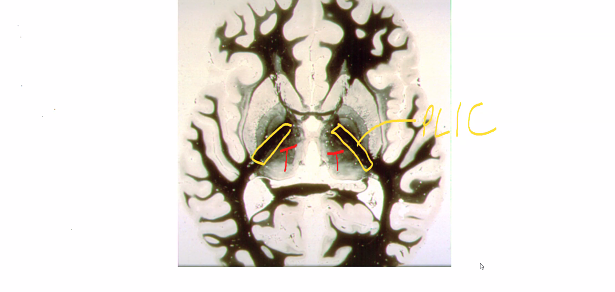
What is the structure highlighted and what is its function?
Posterior limb of the internal capsule. It contains axons of the 3 major body pathways: Voluntary Motor, Anterolateral, Posterior Columns/Medial Lemniscus
What area of the diencephalon is lesioned as a result of contralateral face spastic paresis, lost of somatosensation (pain/temp., tactile/vibratory/position)
Genu of the internal Capsule

What is the name of the structure in blue?

A patient can move their left eye to the right side (medially) but has trouble moving their right eye to the right corner but their right eye moves fine medially. What is the name of this syndrome?
Middle Alternating Hemiplegia. Affects the corticospinal tract and CN VI (abducens nerve) in the Pons.


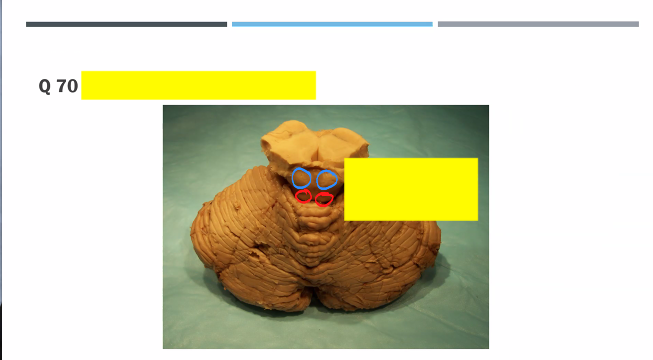
What is the name of the structure in red?

What is the function of the Genu of the Internal Capsule?
Contains axons of the major face pathways
What is the function of the anterior limb of the internal capsule?
Part of the limbic system.