[PCOL2-MID-01-PT2] DRUGS FOR HEART FAILURE
 Call Kai
 Learn
Learn Practice Test
 Spaced Repetition
 Match
Match Flashcards
 Knowt Play
1/41

Earn XP
Name | Mastery | Learn | Test | Matching | Spaced | Call with Kai | Chat |
|---|
No analytics yet
Send a link to your students to track their progress
42 Terms
Diastolic
Systolic
What are the two (2) Types of Heart Failure?
Hint: D&S Heart Failure
Diastolic/Filling Problem
This type of heart failure occurs when the heart contracts normally, but the ventricles do not relax properly or are stiff and less blood enters the heart during normal filling.
x filling; ✓ contraction
Thick, stiff heart muscle
Systolic/Pumping Problem
This type of heart failure is when the left ventricle heart muscle doesn’t contract with enough force.
x contract; ✓ filling
Thin, weak heart muscle
Heart Failure with Preserved Ejection Fraction
Diastolic Heart Failure is also referred to as?
Ventricular Relaxation
Systolic Heart Failure has something to do with?
Heart Failure with reduced Ejection Fraction
Systolic Heart Failure is also referred to as?
Info
Diastolic Failure:
Hypertrophy
Stiffening
Loss of adequate relaxation necessary in reducing filling and cardiac output
Normal ejection fraction
Significantly reduced stroke volume
Info
Systolic Failure:
Reduced mechanical pumping (contractility)
Reduced ejection fraction (<45%)
Hypertension
Aging
Diastolic Failure:
How does the heart develop stiffness or thickening?
Hypertrophy
This means increased size of cells.
Myocardial Injury
When we say heart failure, we expect that there is a?
Hint: Injury
Renin-Angiotensin-Aldosterone System (RAAS)
Baroreceptor
When the body sensed the low level of cardiac output, it will activate these two (2):
Activation of Neurohumoral System, increasing the sympathetic activity.
Info
Angiotensin II has an effect to the Angiotensin II Type 1 Receptor (AT1R), resulting to vasoconstriction (AngII) or facilitate the release of aldosterone.
Na & H2O Retention
When there is a release of aldosterone, what is the effect?
Info
Compensatory Mechanisms During Heart Failure:
Considered as a vicious cycle.
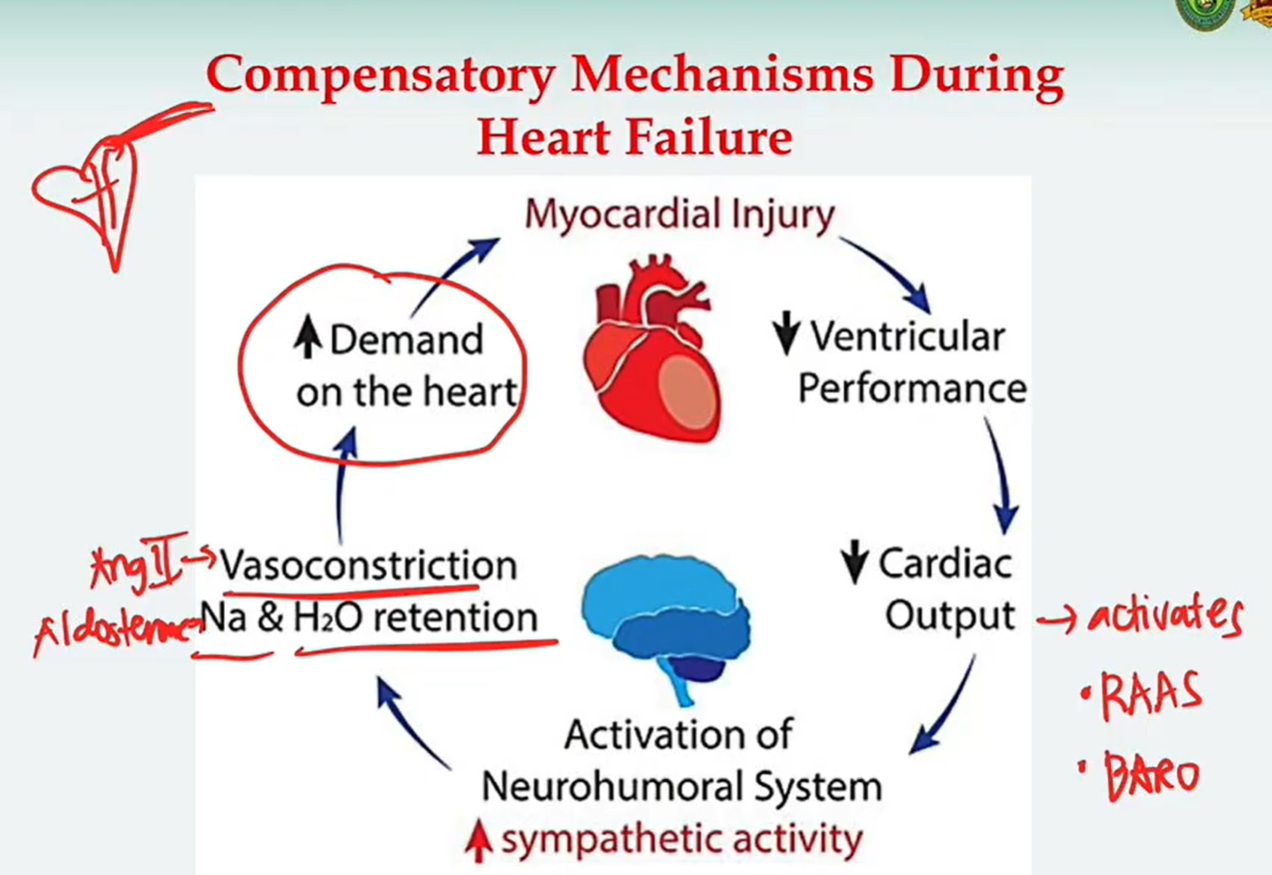
Renin-angiotensin-aldosterone system (Angiotensin II)
Endothelin release
Sympathetic stimulation (NE, EPI)
What are the three (3) destructive compensatory mechanisms (heart failure)?
Endothelin release
This compensatory mechanism is a potent vasoconstrictor.
Natriuretic Peptides (Brain Natriuretic Peptide)
This is the only protective compensatory mechanism (heart failure); produced by the ventricles.
Remodeling
Other Compensatory Mechanism:
Dilation and other structural changes that occur in the stressed myocardium.
Ex. Hypertrophy, Dilation of Chambers, Changing of Shape of the Ventricles, Fibrosis, etc.
Hypertrophy
This is the enlargement of myocardial cells due to death of some cardiac muscles caused by ischemia (MI) and release of caspases.
New York Heart Association
NYHA stands for?
Class I
Identify the NYHA Class:
No limitation of physical activity. Ordinary physical activity does not cause undue breathlessness, fatigue, or palpitations.
Class II
Identify the NYHA Class:
Slight limitation of physical activity. Comfortable at rest, but ordinary physical activity results in undue breathlessness, fatigue, or palpitations.
Class III
Identify the NYHA Class:
Marked limitation of physical activity. Comfortable at rest, but less than ordinary physical activity results in undue breathlessness, fatigue, or palpitations.
Class IV
Identify the NYHA Class:
Unable to carry on any physical activity without discomfort. Symptoms at rest can be present. If any physical activity is undertaken, discomfort is increased.
American College of Cardiology
American Heart Association
ACC/AHA stands for?
Stage A
Identify the ACC/AHA Class:
Patients at high risk for heart failure but without structural heart disease or symptoms of heart failure.
Ex. Hypertension, diabetes mellitus, obesity, CAD (post-MI or revascularization), peripheral vascular disease, CVA, family history, exposure to cardiac toxins
No heart failure but high risk
Stage B (Pre-HF)
Identify the ACC/AHA Class:
Patients with structural heart disease but without signs and symptoms of heart failure.
Ex. Prior MI, left ventricular hypertrophy or reduced LVEF, asymptomatic valvular disease
Stage C (Symptomatic)
Identify the ACC/AHA Class:
Patients with structural heart disease with prior or current symptoms of heart failure.
Ex. Known structural heart disease and dyspnea, fatigue, reduced exercise tolerance
Class I-IV
What is the NYHA Class of Stage C (ACA/AHA)?
Stage D (Advanced/Refractory HF)
Identify the ACC/AHA Class:
Patients with refractory heart failure requiring specialized interventions.
Ex. Marked symptoms at rest despite maximal medical therapy, with recurrent hospitalizations
Class III-IV
What is the NYHA Class of Stage D (ACA/AHA)?
Info
Heart Failure: The heart fails to meet the demands of the body.
Components (Pathophysiology):
Reduced contractility (weak heart)
High workload (stressed heart)
Info
Pharmacologic Goals in the Treatment of Heart Failure
Increase the force of myocardial contraction (Inotropic drugs)
Decrease workload of the heart (Unloader drugs)
Digoxin
Pharmacologic Goals in the Treatment of Heart Failure:
Positive Inotropes — Cardiac Glycosides?
Dobutamine
Pharmacologic Goals in the Treatment of Heart Failure:
Positive Inotropes — Beta-receptor stimulants?
Inamrinone (formerly called Amrinone)
Milrinone
Pharmacologic Goals in the Treatment of Heart Failure:
Positive Inotropes — Bipyridines (PDE3-inhibitor)
Diuretics
ACE inhibitors, ARBs and related agents
Vasodilators
Beta blockers
Pharmacologic Goals in the Treatment of Heart Failure:
Without Inotropic Effects (Unloader Drugs)
Hint: DAV-B
They are the first-line therapies for chronic heart failure.
Info
Unloader drugs decreases the pre-load and after load.
Istaroxime
Other Positive Inotropic Drugs:
Investigational steroid derivative
Inhibits Na+K+ ATPase (responsible for Ca2+ extrusion) and facilitates sequestration of Ca2+ by the Sarcoplasmic Reticulum
Levosimendan
Other Positive Inotropic Drugs:
Sensitizes the troponin system to calcium and inhibit phosphodiesterase; an example of calcium sensitizer.
Phosphodiesterase
Which enzyme does levosimendan inhibit?