Exam 3: Chromatography
 Call Kai
 Learn
 Practice Test
 Spaced Repetition
 Match
 Flashcards
 Knowt Play
1/46

There's no tags or description
Looks like no tags are added yet.
47 Terms
having a long A term shows
fronting
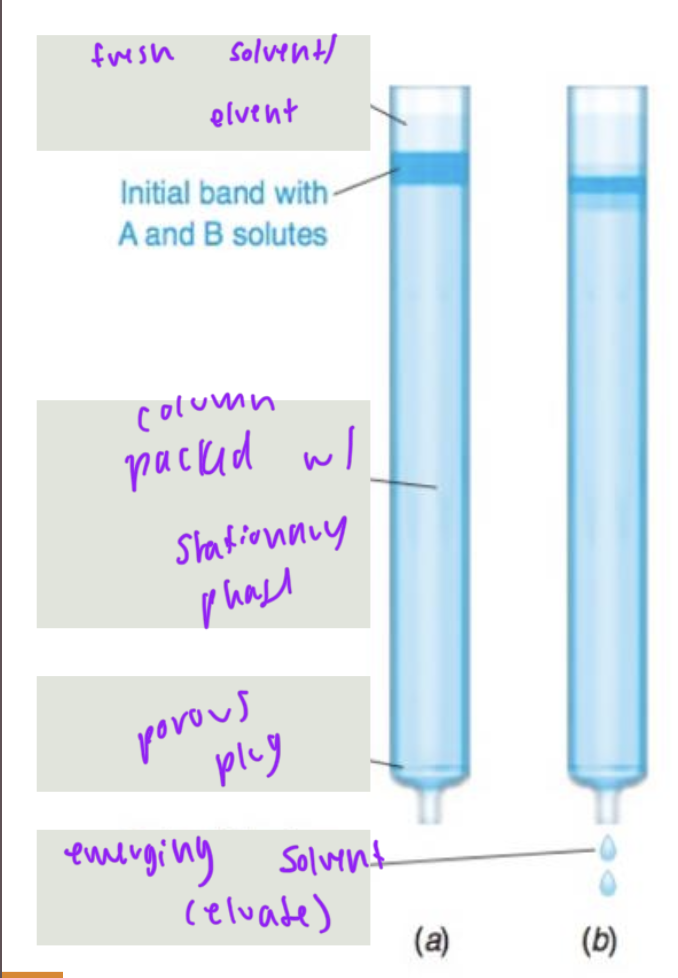
chromatography
separation of a mixture by passing through a medium in which components of diff properties of some sort travel at diff rates
eluent
fluid entering the column
eluate
fluid exiting the column
columns can be ______ or ______
packed or open tubular
adsoprtion chromatography
when the solute adsorbs to the surface of the column
the slower a solute adsorbs from the surface of the column, the longer its RT

partition chromatography
has open tubular column column
solute (liquid or gas) dissolves in the liquid stationary phase
solutes with higher affinity for the stationary stay in in longer, so have higher RTs
based on VDWs interactions between the solute (mobile phase) and stationary phase

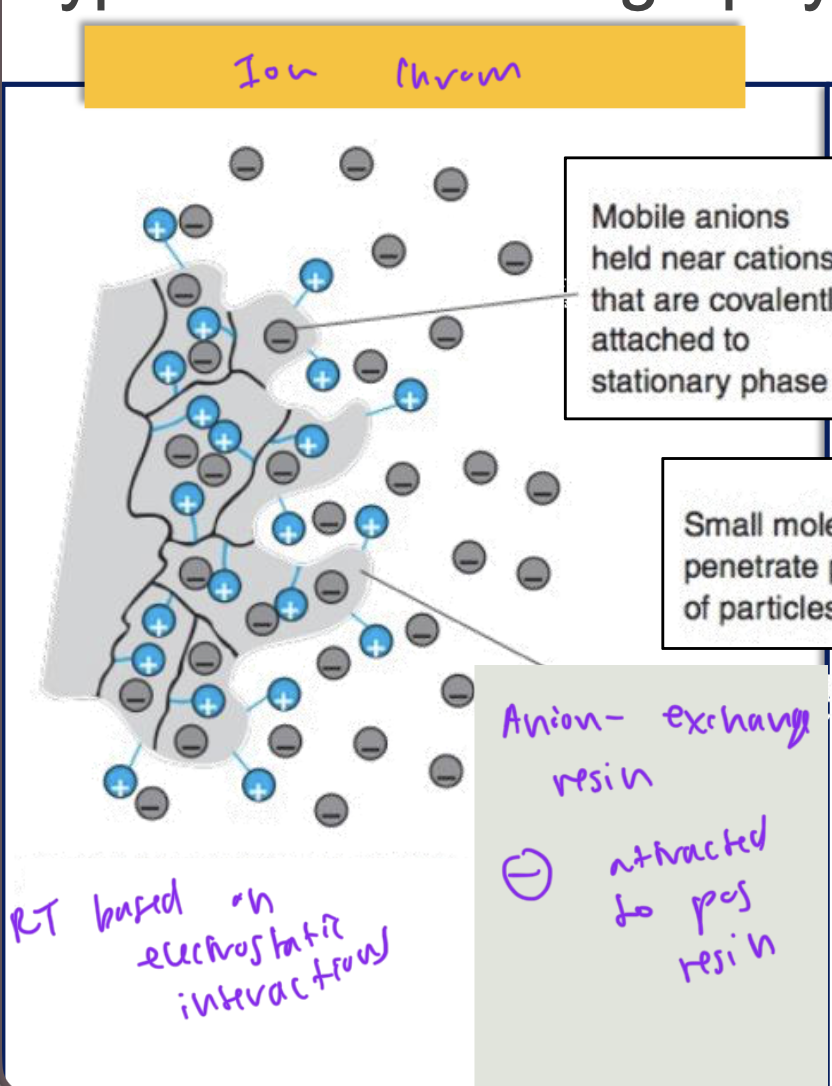
ion exchange chromatography
anion exchange resin- attracts cations, so anions move thru fastest
based on electrostatics
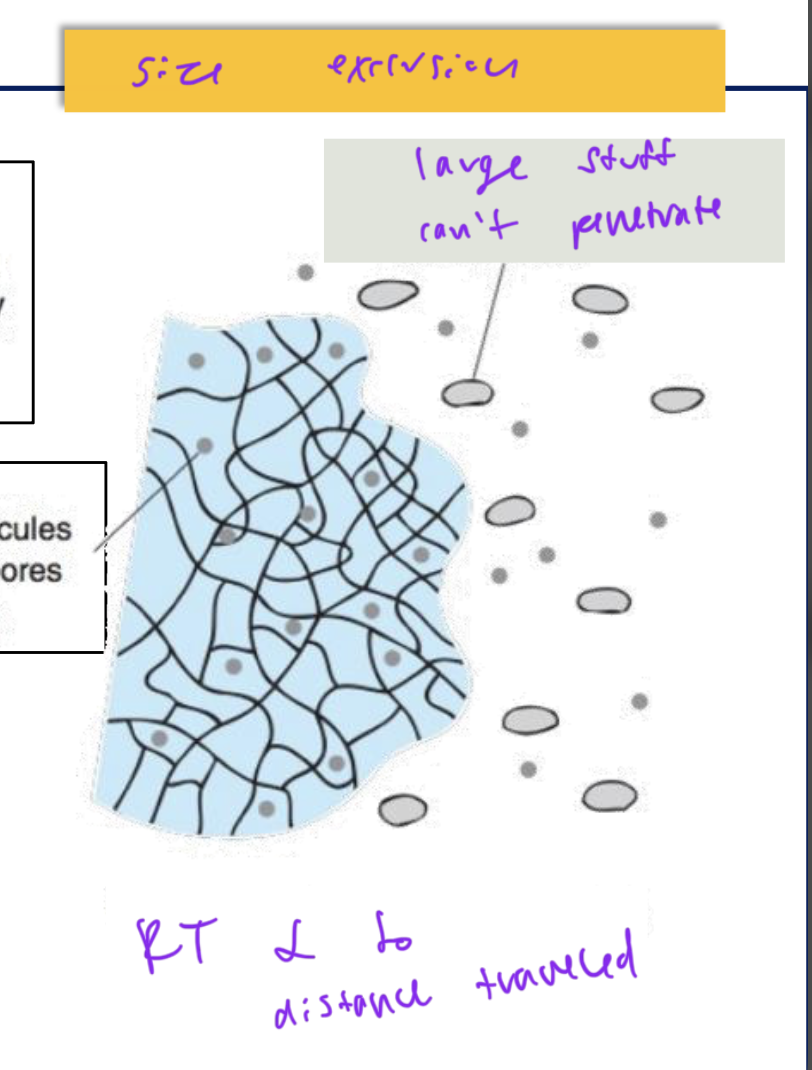
size exclusion chromatography
small stuff gets stuck in pores, so larger molecules move thru the fastest
affinity chromatography
stuff covalently binds to stationary phase, all else washes thru

chromatogram vs chromatograph
chromatogram: the data/spectra you get
chromatograph: instrument that does chromatography

3 main parts of chromatography
injector
column
detector
carrier gas is the mobile phase
dead time ™
time it takes the mobile phase (minimally interacting solute) to elute from the column

in GC, peak area is proportional to
retention volume
tr
retention time
total time it takes an analyte to elute from the column
tr’
=tr-tm
gives time it takes an analyte to elute-dead time, so gives relative retention
retention factor (k)
k= tr-tm/tm which = time solute spent in stationary phase/time spent in mobile phase
relative retention
alpha= tr’2/tr’1= k2/k1
where tr’2 is greater than tr’1
retention factor
k= CsVs/CmVm
where s is stationary and m is mobile phase
alpha closer to 1 means the two compounds have very similar retention
resolution is proportional to
peak separation (∆tr)
wav= average whole width (width at base of peak)
res= ∆tr/wav

FWHM =
2.35 sigma

ideal resolution has 6 sigma separation

brownian motion
random walk path of molecules
governed by:
Fick’s first law of diffusion
particle-motion Stokes-Einstein
Stokes Eq
solutes travel from
high to low conc in the column, causing band broadening
the column creates some volume of flux
ions move much faster than whole molecules, so have
higher diffusion coefficients
molecules that elute later have
broader peaks, because broadening is proportional to RT
also have more squat peaks, bc conc doesn’t change, but band broadens, so must also decr in height

diffusion mirrors a
Gaussian distribution
you want peaks that are
diffusion limited
plate height (H)
theoretical plate height (TPH)
height equivalent to a theoretical plate HETP
the length of the column required for equilibration of solute between the stationary and mobile phases
want small plate height, so you can fit more plates and get better res
N=L/H
number plates= length of column/height of each plate
N=16tr2/w2
where w=width at base of peak
Purnell Eq
shows us that resolution is proportional to square root of number of plates and square root of length of the column

ways to improve res on chroma
incr K (to incr RT)
incr alpha (selectivity coeficient, so can better differentiate between peaks)
incr N (incr number of peaks helps narrow peaks)

Why do we use small injections in chromatography?
to get narrower peaks bc lower volume present so less broadening
connective tubing can also cause broadening
so use narrow tubing to minimize turbulent flow
so want low dt (diameter of tubing)

Van Deemter Eq
at optimal flow rate, plate height is minimized, so that N (# plates) is very high
optimal flow rate is at nipple of the man boob
after optimal flow rate: equilibration C term dominates
before optimal flow rate, B term dominates
AT optimal flow rate, B and C terms contribute equally

Van Deemter Eq cont
H~~ A + B/ux + Cux
A: multiple paths/Eddy diffusion
B: longitudinal diffusion (all columns have some diffusion limited term (B))
C: equilibration time/mass transfer
diffusion broadening
takes place as a band travels thru a column and scales with column length
in packed columns: A, B, and C are all non-zero
in open tubular columns, only A=0 (a is Eddy diffusion)
in capillary electrophoresis, A and C=0
so, packed columns have the least longitudinal and diffusion broadening
C (mass transfer/equilibration time)
fast mass transfer= high mobile phase velocity
incr as diffusion coefficients incr
A (mult. flow paths/Eddy diffusion)
idea that there are multiple paths a molecule could tak eto travel in the column, so molecules will elute at diff times
is hard to change

plate height is most optimal/lowest when
B/ux=Cux
higher flow rates are in
open tubular columns
bc they lack A and C terms
ideal peaks are
truly Gaussian
fronting
tail in front
when the molecule prefers to stay in the stationary
B/A<1

tailing
when molecule wants to stay in the mobile phase, so bulk elutes fast (tail is behind)
B/A>1
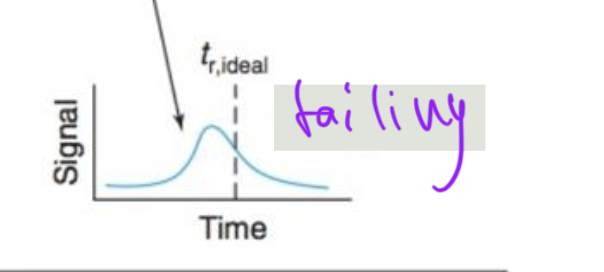
overloaded GC causes
fronting or tailing