Exam 3 Comprehensive Health Assessment IU Indianapolis
 Call Kai
 Learn
 Practice Test
 Spaced Repetition
 Match
 Flashcards
 Knowt Play
1/224

There's no tags or description
Looks like no tags are added yet.
225 Terms
accommodation
the process by which the eye's lens changes shape to focus near or far objects on the retina
cardinal fields of gaze
Tests CN III, IV, VI

cataracts
clouding of the lens
consensual reaction
pupillary constriction in the opposite eye
constriction/dilation of pupils
opening and closing of pupil
cornea
The clear tissue that covers the front of the eye

cover-uncover test
Cover one eye;
Watch the uncovered eye for a steady, fixed gaze.
Uncover the first eye and observe the uncovered eye for any movement
exophthalmos
abnormal protrusion of the eyeball
glaucoma
increased intraocular pressure
Hirschberg test
Corneal light reflex examination checking for ocular alignment
hyperthyroidism
excessive activity of the thyroid gland

hypothyroidism
A disorder caused by a thyroid gland that is slower and less productive than normal
inner and outer canthus
located at the medial and lateral portion of the eye

iris
a ring of muscle tissue that forms the colored portion of the eye around the pupil and controls the size of the pupil opening

myopia
nearsightedness
nystagmus
Involuntary rapid eye movements
palpebral fissure
opening between eyelids

PERRLA
pupils equal, round, reactive to light and accommodation
pinna
outer ear

peripheral vision
ability to see objects as they come into the outer edges of the visual field
presbyopia
impaired vision as a result of aging

pupil
opening in the center of the iris

Rinne test
hearing test using a tuning fork; checks for differences in bone conduction and air conduction

Snellen chart
used to measure visual acuity

strabismus
crossed eyes
thyroid
regulates metabolism

tonsils
masses of lymphatic tissue in the back of the oropharynx
visual acuity (distance)
ability of the eye to distinguish shapes and the details of objects at a given distance

visual acuity (near vision)
measurement of how well you can see close objects; usually 16-18 inches

trachea
windpipe

Weber test
Test done by placing the stem of a vibrating tuning fork on the midline of the head and having the patient indicate in which ear the tone can be heard.

Achilles reflex
Foot plantar flexing againist your hand is the normal response

Babinski reflex
is the upward movement of your baby's toes when you stroke the bottom of their foot. This reflex disappears by age 2. If the Babinski sign is still present during childhood or appears in adulthood, it may indicate an underlying central nervous system condition or injury.

brachioradialis reflex
is a deep tendon reflex that is elicited by tapping the biceps tendon, c5-c6

biceps reflex
is the same as brachioradialis reflex
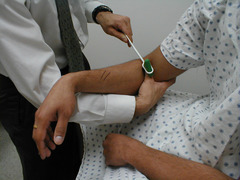
clonus
muscle spasm or twitching

Cranial nerve I
Olfactory - smell (sensory)

Cranial Nerve II
Optic - vision (sensory)

Cranial nerve III
oculomotor -motor eye movement (motor)
Cranial nerve IV
Trochlear - eye movement (motor)
Cranial Nerve V
Trigeminal - chewing face & mouth touch & pain (motor and sensory)

Cranial Nerve VI
Abducens - eye movement (motor)
Cranial Nerve VII
Facial - controls most facial expressions & secretion of tears & saliva & taste (motor and sensory)
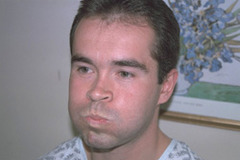
Cranial Nerve VIII
Vestibulocochlear - hearing and balance (sensory)

Cranial Nerve IX
Glossopharyngeal - taste & senses carotid blood pressure (sensory and motor)
Cranial Nerve X
Vagus - senses aortic blood pressure & slows heart rate & stimulates digestive organs & taste (sensory and motor)
Cranial Nerve XI
accessory - movement of head and shoulders (motor)

Cranial Nerve XII
Hypoglossal - tongue movement (motor)

dermatome
Area of skin supplied by a single spinal nerve
dysphagia
difficulty swallowing
dysphasia
difficulty speaking
gait
manner of walking

gag reflex
vomiting or retching that results when something is placed in the back of the pharynx. This is tied to the swallow reflex.
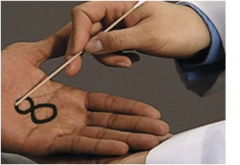
graphesthesia
ability to recognize writing on the skin purely by the sensation of touch
Moro reflex
Infant reflex where a baby will startle in response to a loud sound or sudden movement.

palmar grasp reflex
in response to stroking a baby's palm, the baby's hand will grasp. This reflex lasts a few months
patellar reflex
a reflex extension of the leg resulting from a sharp tap on the patellar tendon

plantar grasp reflex
reaction to stimulation of the sole of the foot that causes the toes of the feet to "grasp"

reflexes
specific patterns of motor response that are triggered by specific patterns of sensory stimulation
rooting reflex
a baby's tendency, when touched on the cheek, to turn toward the touch, open the mouth, and search for the nipple

Romberg test
assesses ability of vestibular apparatus in inner ear to help maintain standing balance

stereognosis
ability to recognize objects by feeling their form, size, and weight while the eyes are closed
sucking reflex
Reflex that causes a newborn to make sucking motions when a finger or nipple if placed in the mouth

triceps reflex
The triceps reflex is a deep tendon reflex that elicits involuntary contraction of the triceps brachii muscle. assess the sensory and motor pathways within the C7 and C8 spinal nerves

Oto
ear
Epistaxis
nosebleed
Vertigo
"Spinning sensation/Room spinning"
Dizziness
"Fainting feeling/Pass out Feeling"
Normocephalic
Normal sized head
Normal sized pupil
2-6 mm
Macrocephalic
abnormally large head
Microcephalic
abnormally small head
Stroke affects?
a lower end on one side of the face
Bells Palsy affects
entire side of a face
bells palsy affects cranial nerve?
7
Cover-uncover test is used to detect?
strabismus

Sclera
white of the eye

Conjunctiva
Delicate membrane lining the eyelids and covering the eyeball

Cornea
The clear tissue that covers the front of the eye

Pupils
the opening in the iris of the eye

Coloboma
A congenital defect of the eye; notch on the outer area of the lower lid.

PERLLA
pupils equal, round, reactive to light and accommodation
Ptosis
drooping

Exomphalos
outie belly button
Conjunctivitis
Pink eye
Patent
to open
Nasal drainage
Bloody
from trauma
Nasal drainage
watery
from allergies
Nasal drainage
purulent greenish yellow
infection
Nasal drainage
Foul smelling
foreign object
Mouth
edematous is a?
Allergic reaction
Leukoplakia
thickened, white, leathery-looking spots on the inside of the mouth that can develop into oral cancer
What is erythroplakia?
A clinical term used to describe an oral mucosal lesion.
How does erythroplakia typically appear?
As a smooth red patch or granular red and velvety patch.
The "ah" test what cranial nerve?
Vagus X
What is a common physical characteristic of a patient with hypothyroidism?
They may be overweight.
What is a common physical characteristic of a patient with hyperthyroidism?
They may be very thin.
Having a first degree relative with breast cancer increases chance of cancer
double the risk
white women have the highest rates of
new breast cancer
Men can have breast cancer too TRUE OR FALSE
TRUE