5.4 writing step by step
 Call Kai
 Learn
 Practice Test
 Spaced Repetition
 Match
 Flashcards
 Knowt Play
1/40

Earn XP
Description and Tags
5.4 writing step by step
41 Terms
The construction process of writing → three stages
design the document
write a first draft
edit the draft
keep stages separate
take breaks between them
ask for help
Design the document
Decide your purpose, your reader, your main message & the structure of the text.
Write a first draft
Put your ideas down in order, without stopping to polish every sentence.
Edit the draft
Revise the content & structure first, then the style, & finally spelling & format.
Organising your message →
SPQR → introduces one single message
The pyramid
SPQR & examples
Situation → Many first-year students feel very stressed during exams.
Problem →This stress is affecting their grades and well-being.
Question → what can the university do about it?
Response → offer a stress-management workshop before exams
The reader first recognises a familiar situation, then sees why it matters, & finally receives your answer.
Pyramid
the main message goes first, supported by a few key arguments, each backed by evidence.
the reader gets the most important idea first & can stop at any level without losing the point

Goal orientation
start by identifying the purpose → what you want to achieve with the document: OBS; do not confuse it with its subject.
The subject → what the document is about
Whatever you are writing about, you must be clear about what you want to achieve, & make that purpose as specific as possible.

after defined purpose, answer two questions:
What do I want the document to do? inform, explain, compare, propose or persuade
What do I want the reader to do? understand, approve, change a behaviour or reply
Plagiarism
presenting someone else’s words or ideas as if they were your own
academic offence whether done on purpose or by accident
How to avoid plagiarism?
Paraphrase ideas in your own words, put exact words in quotation marks, & always cite the source.
This is what references & citations are for
Plagiarism can be?
deliberate plagiarism
accidental plagiarism
Deliberate plagiarism
decide to present someone else’s work as yours.
This includes copying another student’s work
copying another person’s work from a book
a journal or a website
downloading a complete text from the internet.
Accidental plagiarism
You use another person’s words without acknowledging them through carelessness or lack of skill.
It happens:
when you do not know that you must not copy words directly
when you cannot yet express other people’s ideas in your own words
or when you do not know how to show that you are using someone else’s words or ideas.
APA format - basics

Sections of an APA paper
title page
abstract
main body
references
appendices
Title page
Title, author, affiliation, course, instructor & date.
Abstract
A brief summary of the whole paper.
Main body
Introduction
depending on the paper → literature review
method
results
findings
discussion
References
Every source cited in the text.
Appendices
Extra material, if needed.
Start each section on a new page using
using Insert › Page break
Do not press Enter repeatedly to move to the next page: as soon as you edit the text above, everything below will move out of place.
title page
first page of your paper
elements are centred & double-spaced
title should be concise & describe the main topic → avoid empty words such as “a study of”

Headings & levels
APA uses up to five levels of headings to structure a paper
Level 1 is used for the main sections
each lower level divides the one above it
Use only the levels you need → always in order; never jump from Level 1 to Level 3.

Title Case means
the main words start with a capital letter.
In APA, the introduction does not carry a heading “Introduction”: the title of the paper is repeated at the top of the first page instead.
APA style guidelines
Consistent spelling
Past tense
Possessivness
Numbers
Inclusive pronouns
Statistical symbols
Decimals
Abbreviations
Consistent spelling
Use one variety of English throughout: “colour” or “color”, never both.
Past tense
Use it for events at a specific moment in the past: “Apel (2011) found…”.
Possessivenes
Use the possessive ’s sparingly.
The “of” form is usually better.
Numbers
Write numbers under 10 in words & 10 and above in numerals, except statistics & measurements.
Inclusive pronouns
Avoid “he” or “she” for a generic person.
Rephrase, or use singular “they”.
Statistical symbols
Italicise symbols such as p, r, t, F, M & SD
Greek letters are not italicised.
Decimals
In English, use a point (3.5)
In Spanish, use a comma (3,5)
Abbreviations
Write the full term the first time, with the abbreviation in brackets.
APA grammar & their rule
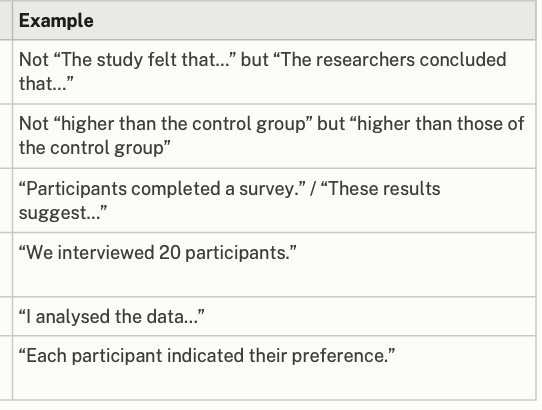
Anthropomorphism → do not give human qualities to things that do not have them
logical comparison → compare like with like
verb tense → past tense for the literature review, method, & results: present tense to discuss implications
active voice → prefer the active voice, use the passive when the action matters more than would who did it
first person → use “I” or “we” for your own actions, not “the author”
singular “they” → use “they” for a person whose gender is unknown or not relevant, or who uses “they”
Writing good paragraphs
format
length
purpose
flow
Format
Do not leave an extra blank line between paragraphs
Instead, indent the first line of each one with the Tab key
Length
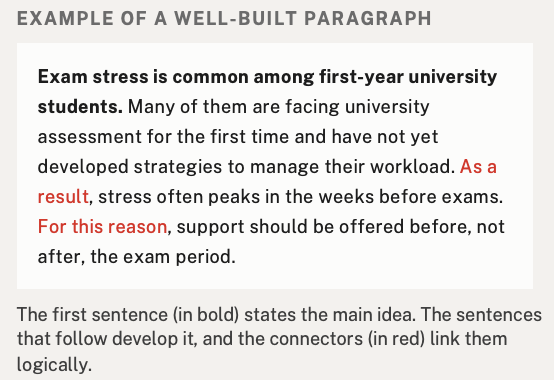
Avoid many very short paragraphs.
Each paragraph should develop one idea fully.
Purpose
Think about what you want the reader to understand after reading the paragraph.
Its objective should always be clear.
Flow
Make sure the transitions between sentences & paragraphs make sense, & use connectors correctly → do not write “firstly” if there is no “secondly” or “lastly”.
Tables & figures
share the same set-up
Above → write the number in bold (Table 1, Figure1), on the next line, the title in Italic Title Case
Below → add a note if needed, e.g., citation or explanation, number them in order, mention each one in the text (“as shown inTable 1”)
