Fatty Acid Oxidation & Peroxidation
 Call Kai
 Learn
 Practice Test
 Spaced Repetition
 Match
 Flashcards
 Knowt Play
1/21

There's no tags or description
Looks like no tags are added yet.
22 Terms
“Activated” Fatty Acid
Has an S-CoA group
There are three types of fatty acid oxidation:
alpha (α), beta (β), and omega (ω)
α-oxidation
Involves the breakdown of dietary branch-chained fatty acids (BCFA) that come from plants
Most likely site is peroxisomes in liver – detoxification mechanism compared ⍵ and β- oxidation (production of energy generating molecules)
Small membrane bound organelles – cytoplasm of all eukaryotic cells – contain oxidative enzymes- replicate themselves – high in liver as toxic by products accumulate in the liver and detoxify in the liver
Does not involve NADH and NADPH
Does not generate high energy Pi (ATP)

Β-oxidation
Main energy generating molecule synthesizing pathway
Β-oxidation is blocked – methyl group on 3 C position (β-C position)
However, shorten the FAs by 1 carbon to allow β- oxidation to proceed –remove α-C (next to –COOH)
Now this resulting FA undergo Β-oxidation
Dietary BCFAs
Primarily saturated FAs with a methyl branch or more on the C chain.
They can be mono, di, or multi-methyl BCFAs
Unexplored class of diary-derived fatty acids

α-oxidation – BCFA s – Health Benefits
Neonatal rat study: replace 20% wt of fat as BCFA:
alter GI microbial ecology,
change was towards the bacteria that utilize BCFAs and bacteria containing BCFAs.
Reduced incidence of Necrotizing enterocolitis (NEC), increased expression of anti-inflammatory markers: IL-10
NEC: premature/low birth wt newborns at risk
Histopathology- inflammation, tissue death and necrosis –bacterial invasion, cellular damage, cellular death, necrosis of colon and intestine. Bacteria and gut content leak to abdominal cavity – sepsis - life threatening.
Early diagnosis is difficult- damage intestine removal is needed sometimes absence of early diagnosis
IV feeding
BCFA- induce apoptosis in human tumor cells
α-oxidation – BCFAs
Ruminant milk and beef products: major dietary contributors. Not in poultry, not in fish
They are important: modulate biophysical properties of membrane – similar in function to cis double bonds FAs: maintain phase transition temp of membranes
Rare in internal human organs, high conc in skin and white waxy substance coating the skin of term newborns.
Healthy term newborn gut – important bioactive lipid in early human development – but under studied.
Term Newborn Intestine & BCFAs
Possible Source - Swallowed amniotic fluid during/end to the last trimester of healthy pregnancy
Placental transfer ...
Dietary BCFA fed to rat pups; appeared in serum, liver, incorporated to ileal PH fraction
Found in colostrum and mature milk
But not in formula milk
Adults diet: American diet; more BCFA than DHA (LC-PUFAs)
Refsum’s Disease
Rare genetic disease → deficiency in phytanoyl-coenzyme A hydroxylase
Accumulation of an α-oxidation intermediate (phytanic acid intermediates – that leads to neurological damage)
Absence of detoxification in hepatocytes – lead to accumulation in circulation and then must be crossing BBB resulting neurological defects
Β- oxidation vs α and ⍵- oxidation of FAs:
Β- oxidation: mitochondria: major contributor for cellular energy
α –oxidation of FAs : peroxisomes
⍵- oxidation of FAs – peroxisomes, ER
Transport of a fatty acid from cytosol to mitochondrion:
An “activated” fatty acid has its CoA group replaced with carnitine, allowing transport of the acyl group into mitochondria
The acyl-carnitine then has its carnitine group replaced with CoA
The acyl-CoA in mitochondria can undergo β-oxidation to ultimately yield ATP
108 gross ATP .....106 net ATP
Activation of FAs:
Enzyme thiokinase or acyl-CoA synthetases convert the fatty acids to fatty acyl-CoA
These enzymes are a family of three isoenzymes having activity against specific chain length fatty acids
There are 3 thiokinases each specific for short, intermediate and long carbon chains
Fatty acyl-CoA is formed by the formation of thioester bond between the carboxyl group of the fatty acid and the thiol group of coenzyme A
This reaction also involves use of energy, by breakdown of ATP to AMP + PPi and is an irreversible reaction – Cost 2 ATP
β-oxidation of fatty acids yields acetyl-CoA:
Add new Coenzyme: activation of FAs
Dehydration
Hydration
Oxidation
Add new coenzyme
Thiol attack: Remove 2-C units (Acetyl –CoA)
Repeat 7 cycles
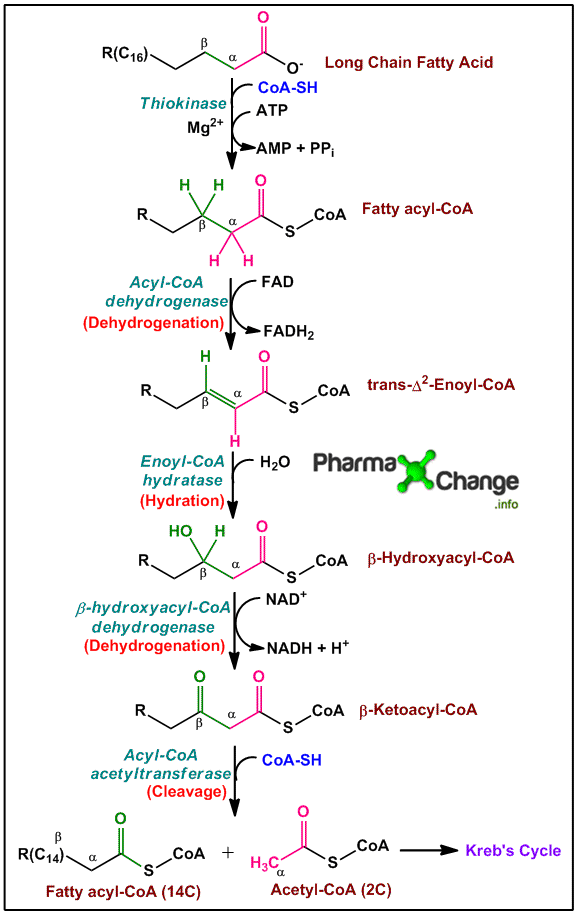
β-oxidation of palmitic acid – a C16 saturated fatty acid:
Dehydrogenation between the alpha- and beta-carbon
Hydration of the beta-carbon
Oxidation of the hydroxyl group on the beta-carbon
Thiol attack of the bond between the alpha- and beta-carbon
Palmitoyl-CoA (C16) + H2O + FAD + NAD+ + CoA-SH → Myristoyl-CoA (C14) + Acetyl-CoA + FADH2 + NADH + H+
TOTAL ATP: 28 + 8 + 12 + 60 = 108
NET ATP: 108 - 2 (for “activation”) = 106
Acetyl-CoA goes to the Krebs Cycle:
Leads to 3NADH+H+ + 1FADH2 + GTP(ATP)
FADH2 and NADH + H+ go to the electron transport chain
FADH2 →→ 1.5ATP; NADH+H+ →→ 2.5ATP
From Cx fatty acyl-CoA to C(x-2) fatty acyl-CoA:
One cycle β-oxidation (4 ATP):
1NADH+H+ →→ 2.5ATP
1FADH2 →→ 1.5ATP
One Acetyl-CoA Via TCA cycle:
1 Acetyl-CoA →→ 3NADH+H+ + 1FADH2 + GTP(ATP)
7.5ATP + 1.5ATP + 1GTP(ATP) = 10 ATP
TOTAL #ATP = 14

Fatty acid synthesis versus β-oxidation:
Fatty acid synthesis:
Condensation
Reduction of ketone to alcohol
Dehydration to form enoyl group
Reduction (or hydrogenation) of enoyl group
Beta-oxidation:
Dehydrogenation between alpha- and beta- carbon
Hydration of beta-carbon to introduce –OH
Oxidation of alcohol to ketone
Cleavage between alpha- and beta- carbon
ω-oxidation
Involves the oxidation of the terminal methyl group of a fatty acid- C far away from –COOH
Unlike β-oxidation, which occurs in mitochondria, ω-oxidation occurs in the smooth ER of hepatocytes (enzyme is in ER)
Though usually a minor process,
Typically ω-oxidation results in the formation of dicarboxylic acids (DCA)
From medium-chain fatty acids (10-12 carbons in length)
Increases β-oxidation rate as both –COOH ends can be “activated”
Final product of DCA oxidation is succinate
Essential for the synthesis of select eicosanoids (from 20 C PUFA- signaling molecules)
Process of ω-oxidation:
Hydroxylation of the methyl carbon at terminal end (away from –COOH)
Oxidation of the methyl hydroxyl into an aldehyde
Oxidation of the methyl aldehyde into a carboxyl group
Then β-oxidation
ω-oxidation: Step 1
Hydroxylation of the methyl carbon is carried out by a mixed function oxidase (MFO – a class of cytochrome P450 monooxygenase)
At least 5 different MFOs are responsible, each using NADPH
CYP4Ax and CYP4Fx
An MFO:
is a cytochrome P450 monooxygenase
ω-oxidation: Steps 2 & 3
Fatty omega-hydroxyacid → fatty omega-aldoacid
via alcohol dehydrogenase
NAD+ → NADH + H+
Fatty omega-aldoacid → fatty dicarboxilic acid
via aldehyde dehydrogenase
NAD+ → NADH + H+
The DCA undergoes β-oxidation:
The DCA can undergo β-oxidation following the “activation” of both ends with CoA
The final product is succinate (which can feed back into the Krebs cycle)