17. Nutritional interventions in clincial practice
 Call Kai
 Learn
 Practice Test
 Spaced Repetition
 Match
 Flashcards
 Knowt Play
1/30

There's no tags or description
Looks like no tags are added yet.
31 Terms
What are dietary fibers?
All carbohydrates that are not digested or absorbed in the human small intestine
What happens to dietary fibers in the small intestine?
Because they are not digested, they are fermented by the gut microbiota in the large intestine (or colon)
What is the solubility of fibers and name a soluble and an insoluble fiber?
Solubility = measure how well can fibers dissolve in water
Soluble fiber = pectin → water absorption in the intestine
Insoluble fiber = cellulose → bulking
What types of fibers are important for optimal stool formation?
Both soluble and insoluble fibers are important for optimal stool formation (frequency and consistency)
What is fermentability in dietary fibers and name a highly and a poorly fermentable fiber.
Fermentability: to what extent fibers can be fermented or degraded by the gut microbiota resulting in production of microbial metabolites (e.g. short-chain fatty acids)
Highly fermentable → insulin
Poorly fermentable → cellulose
What are some health benefits of dietary fiber?
Higher dietary fiber intake is associated with a lower risk of:
All-cause mortality
Mortality of coronary heart disease or cancer
Stroke
Type 2 diabetes
Coronary heart disease
Colorectal cancer
What is the Dutch recommendation of dietary fiber intake?
Recommendation in the Netherlands
3.4 grams of dietary fiber per megajoule per day
equals 14 grams per 1000 kilocalories per day
equals ~30 g/day for women and 40 g/day for men
Postoperative complications after colorectal cancer surgery
Anastomotic leakage: Connection between remaining part of colon is not healing well causing leakage.
Surgical site infections
Ileus: temporary stop of intestinal peristalsis
Pulmonary or cardiovascular problems
Urinary disfunctions or infections

Effect of low fat/high fibre diet before surgery on post-operative complications (observational study)
Was shown to reduce risk by 25% in observational study

Effect of low fat/high fibre diet before surgery on post-operative complications (animal study)
Mice studies by group of Alverdy (Chicago)
High-fat Western-type diet (WD) versus standard chow diet (SD: low fat/high fibre)
Higher risk of anastomotic leakage in mice with WD
Significantly improved anastomotic healing if WD-fed mice were exposed to a SD diet for 2 days before surgery
What are the main products of saccharolytic (fiber) fermentation?
(Can technically also be produced from amino acids)
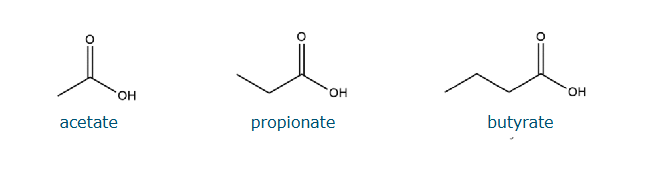
Short-chain fatty acids:
Acetate
Propionate
Butyrate
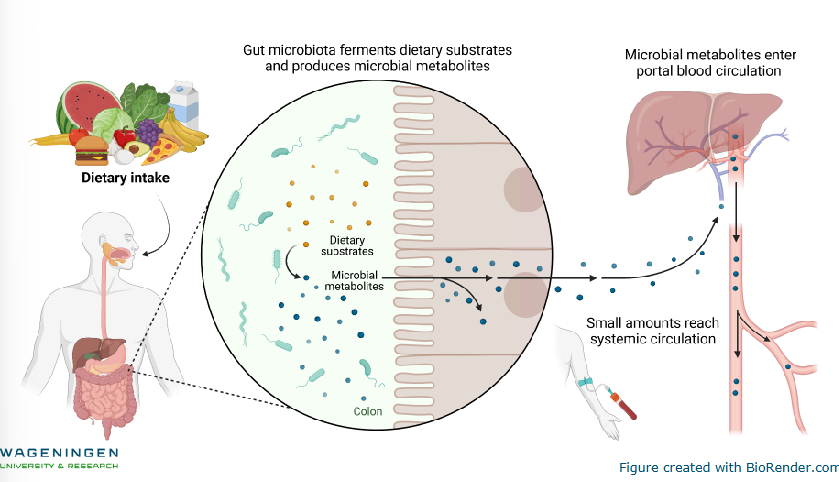
How do microbial metabolites enter the blood circulation?
What products are made when fermenting the amino acids: valine, leucine, isoleucine?
Branched short-chain fatty acids (BCFA): isobutyrate, isovalerate and a-methylburate
Biological function poorly studied
Marker of proteolytic (protein) fermentation by gut microbiota

Study: investigate associations between plasma levels of microbial metabolites and risk of postoperative complications
Microbial metabolites enter blood plasma
These microbial metabolites are SCFAs and BCFAs.
Which short chain fatty acids were associated with lower risk of complications?
Acetate and propionate
What food sources give SCFAs and BCFAs

What combination of SCFA and BCFA was least favorable?
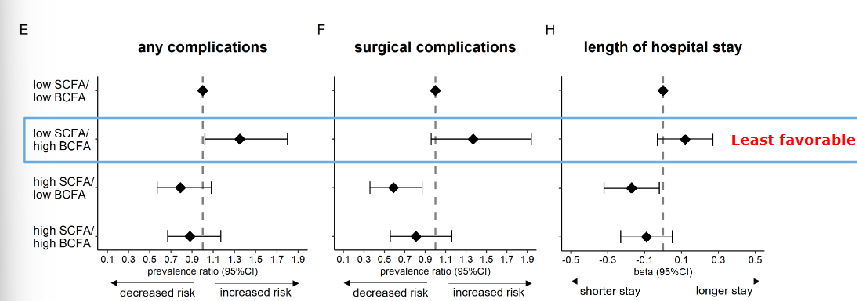
What combination of SCFA and BCFA was most favorable?

Therefore: the more plasma SCFA = lower risk of complications.
What are indole metabolites?
chemical compounds produced when gut bacteria or host cells break down the essential amino acid tryptophan.
Can be fermented into many different metabolites (see picture)

Which metabolite of tryptophan is (as what research shows right now) most beneficial?
IPA: Indole-3-propionate
But a lot of the metabolites are important
Study: indole metabolites in plasma (lower risk results)
high concentrations of IPA and IAM were associated with lower risk of complications

Which indole metabolites show a u-shaped effect curve?
ILA and IAld
Not too little or not too much is good.

Indole metabolites and hospital stay.
3IS increases hospital length stay
IPA reduces hospital length stay

Association between dietary intake & indole metabolites
In the absence of dietary fiber: Gut microbiota predominantly convert tryptophan into indole, which enters the liver and is transformed into 3-indoxyl sulfate (3IS). 3IS acts as a toxin and is associated with longer hospital stays.
In the presence of dietary fiber: Fiber acts as a metabolic steering mechanism for the gut microbiota. When fiber is present, microbial pathways shift away from producing indole/3IS and instead ferment tryptophan into protective metabolites like indole-3-propionate (IPA) and indole-3-acetamide (IAM).
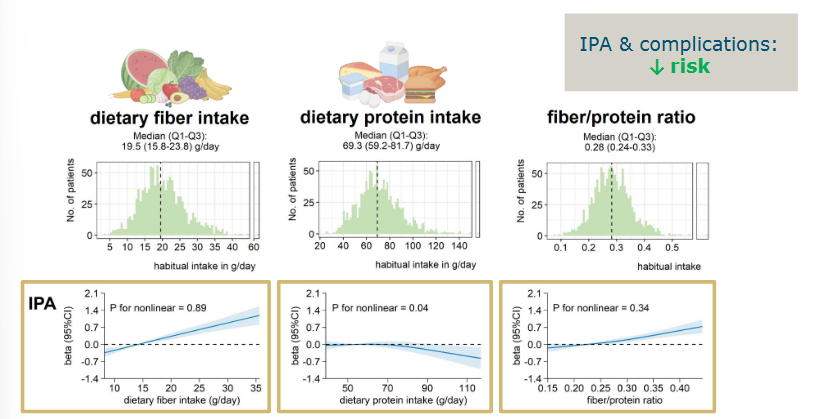
Influence of dietary fiber intake and dietary protein intake on IAM concentration

Influence of dietary fiber intake and dietary protein intake on IPA concentration
FiberUP-study
RCT in 54 patients with CRC scheduled to undergo surgery: Is it feasible to increase preoerative dietary fiber intake in CRC patients who undergo surgery?
Intervention group 1: Fiber-UP tool (FiberUP-study)

Intervention group 2: WholeFiber product (FiberUP-study)
Dried vegetable product (chicory) - rich in prebiotic fibers
2 sachets of 7,5g whole fiber per day
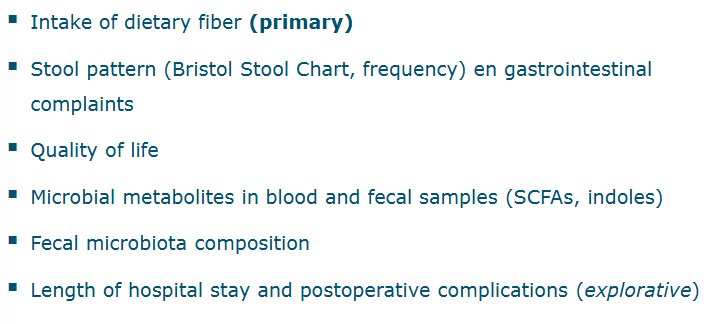
Outcomes that were studied in FiberUP-study
Challenges that come with nutritional intervention studies in clinical practice
Patients have their own individual treatment path = different intervention times.
Feasibility and burden on patients:
Recent diagnosis - psychological burden
They receive a lot of information about their disease, treatment, risk of recurrence, etc.
Programs in hosptial to improve preoperative lifestyle
Relatively short period before surgery
Recruitment of patients: need to get ethical approvement also in local hospitals. You can flyer in waiting rooms, through medical doctors (may cause indiret pressure on patients) or ask them personally.
Fecal sample collection is often picked up from patient’s home or if possible sent via post.
Blood sample colleciton is often combined with existing appointment and blood withdrawal is done in the hospital.
Colonic tissue is often collected during surgery. When tumor is removed, a little healthy part is taken with it to ensure everything is gone. This can be used as biopsy material.