Chapter 15: Invertebrate Dissections
 Call Kai
 Learn
Learn Practice Test
 Spaced Repetition
 Match
Match Flashcards
 Knowt Play
1/39

Name | Mastery | Learn | Test | Matching | Spaced | Call with Kai | Chat |
|---|
No analytics yet
Send a link to your students to track their progress
40 Terms

Dorsal side
The darker, “top” side of the earthworm

Ventral side
The lighter, “bottom” side of the earthworm

Metamers
The series of segments that compose the body of the earthworm

Prostomium
The small projection at the anterior end of the earthworm, covering the mouth
Is not a true segment

Perostomium
The first true segment of the earthworm, surrounding the mouth and prostomium

Anus
The last segment at the posterior end of the earthworm
Chaetae
Bristlelike protrusions on the body of the earthworm that provide traction to the earthworm
Nephridiopores
Openings that exist on each segment of the earthworm found anterior to the ventral setae, excreting waste taken up by the nephridia from the coelomic cavity
Nephridia
Excretory organs in the earthworm that excrete waste products through nephridiopores in the body wall
Intestine
Where the food passes through in an earthworm, lined by an absorbant tryphlosole and blood vessels
Dorsal pore
These exist on every segment of the earthworm posterior to segment 10, opening directly from the coelom near the folds between segments
These exude coelomic fluid during dessication
Oviducts
Openings that pass eggs from the earthworm on the ventral side of segment 14
Seminal receptacles
These exist on the lateral surface near the folds between segments 9, 10, and 11

Clitellum
The swollen series of segments containing large glands and functioning in reproduction
Releases a tube of mucus a few days after copulation that slides off the earthworm’s body and collects eggs and sperm to be left into the soil, where fertilization finally occurs after sealing to complete one worm
Can be used to identify the anterior end
Genital setae
Protrusions on the ventral surface of segment 15 that clasp two earthworms together during mating
Peristalsis
How an earthworm moves, through the combination of longitudinal and circular body muscles acting on the fluid-filled coelom
Cuticle
This covers the earthworm's body, forming a layer made up of the polysaccharide chitin which is secreted by the secreting and sensory epidermis
Coelom
The fluid-filled body cavity in earthworms, surrounded by circular and longitudinal muscles and lined by a membranous peritoneum
Divided into segments by septa
Hydrostatic skeleton
This is comprised of the body wall and coelom, providing peristaltic locomotion through circular and longitudinal muscular contractions
Esophagus
A passageway for what the earthworm has consumed as food, joined to the pharynx
Surrounded by esophageal glands, absorbing excess calcium from the blood
Enlarges at the posterior end to form the crop, as temporary storage
Crop
Where food is temporarily stored in the earthworm, after passing through the esophagus, before opening into the muscularized gizzard
Gizzard
A highly muscularized part of the earthworm’s digestive system, where food is ground up with the aid of soil particles
Seminal vesicles
Lobes within the earthworm’s sperm reservoirs that secrete fluid during reproduction
Seminal receptacles
Two pairs of openings on the earthworm’s body in segments 9 and 10 that receive sperm during fertilization
Serves to complete the female organs in earthworms, alongside the ovaries and oviducts
Copulation
A mutual exchange of sperm between two earthworms, where:
Ventral surfaces and anterior ends of the earthworms come in opposite directions
Mucus is secreted by the clitellum and adhered to by chaetae
Sperm is released from the openings and released into the seminal receptacles of the other worm, requiring 2 to 3 hours
Suprapharyngeal ganglia
Two swellings at the anterior end of the earthworm that function as primitive brains, attached to the ventral nerve cord and nerves for movement and control
Exoskeleton
The hard, external covering of the crayfish made of chitin and calcium carbonate, secreted by the hypodermis
Chromatophores
Cells containing pigment granules in the hypodermis of a crayfish, enabling color adaptation
Cephalothorax
The term for the head and thorax of the crayfish

Carapace
The single piece of exoskeleton covering the cephalothorax dorsally and laterally

Rostrum
The termination of a crayfish’s head in a spiny, pointed projection
Has several sensory organs close to it

Antennules
Located in front of the stalked, movable eyes, these act as balance organs using either gravity or a magnetic field

Antennae
Chemoreceptors located next to the antennules of the crayfish

Maxillipeds
Appendages surrounding the mouth of the crayfish that sometime bear gills and function in tearing food apart before being passed to the mandibles
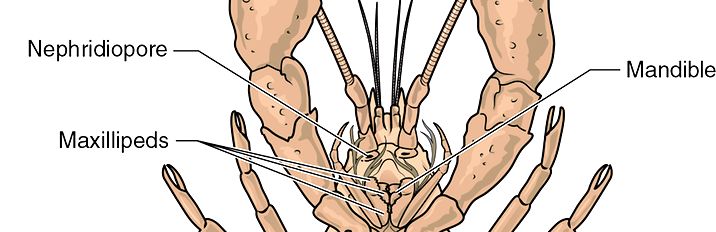
Mandibles
Appendages located beneath the maxillipeds, rolling food into the mouth and holding food torn by the maxillipeds
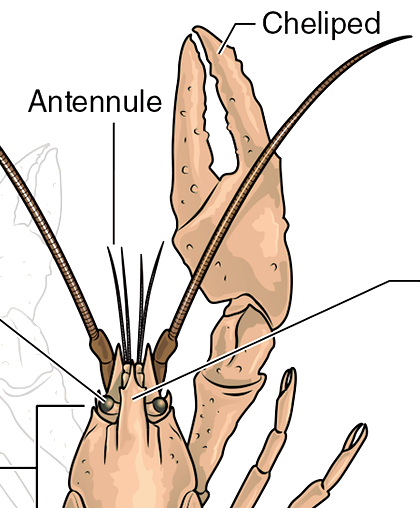
Chelipeds
The pincers of the crayfish, used for defense and predatory feeding

Periopods
The four pairs of walking legs in a crayfish, used for cleaning the body, handling food, and walking

Swimmerets
These are enlarged on male crayfish for sperm transfer; in females, they are elongated for carrying eggs except the first pair is reduced

Uropods
The swimmerets on the last segment of each tailfish gender that are greatly enlarged and flattened, forming a wide tail fan with the telson attached to the anus
Also are used in swimming
Green glands
The excretory organs of the crayfish, associated with the bladder and nephridiopores