APK3200 Conceptual Models of Human Movement
 Call Kai
 Learn
 Practice Test
 Spaced Repetition
 Match
 Flashcards
 Knowt Play
1/37

There's no tags or description
Looks like no tags are added yet.
38 Terms
Theories vs. Models

Conceptual model
-Consists of drawings such as boxes and arrows
-Boxes represent the structures, and arrows represent the flow of information.

Top-down processing
Uses higher-level cognitive processes (expectations and prior knowledge) to influence interpretation of incoming stimuli
Top-down processing allows…
individuals to make sense of ambiguous or incomplete sensory inputs by inferring missing details.
Bottom-up processing
The analysis of individual sensory stimuli or features → raw sensory information that builds up to higher-level understanding

You perceive this image as a B or 13. What kind of processing is this?
Top-down

You perceive this image as three horizontal lines and two vertical lines. What kind of processing is this?
Bottom-up
Executive
A conceptualized process that initiates goal-directed actions
Effector
Muscle(s) that are organized to carry out physical actions
Comparator and error detection
Deviation between desired and actual behavior
Two models of motor production
Closed loop model and open loop model
Closed loop model
-A model of slow (relative), deliberate movement that includes a self-correcting component
-Sufficient time for executive to compute error
- >300 ms or continuous movements

What happens if you don’t have time to correct error during movement execution?
Trial-trial adjustments → open loop model
Open loop model
-Used to control rapid, discrete movements
-No comparator included in motor production process
-Limited awareness
-<300ms

Is a tennis serve open or closed loop?
Closed
Is a baseball swing open or closed loop?
Closed
Is walking up stairs open or closed loop?
Closed
Is a boxing jab open or closed loop?
Open
Is chopping with a knife (each cut) open or closed loop?
Open
3 primary feedback loops
M1 = reflexive
M2 = somewhat reflexive
M3 = voluntary
Afferent nerves
Carry sensory information from body to brain (SAME)
Efferent nerves
Carry motor information from brain to body (SAME)
How many nerve fibers are efferent?
1/3
Final common pathway
The final output to a muscle travels through a shared route. → the sum of different flows of information - each with a different latency and a different type and amount of influence
Neural adaptation
How your nervous system adjusts its signaling and coordination to control muscles and process sensory information more efficiently → ex. first few weeks of strength training
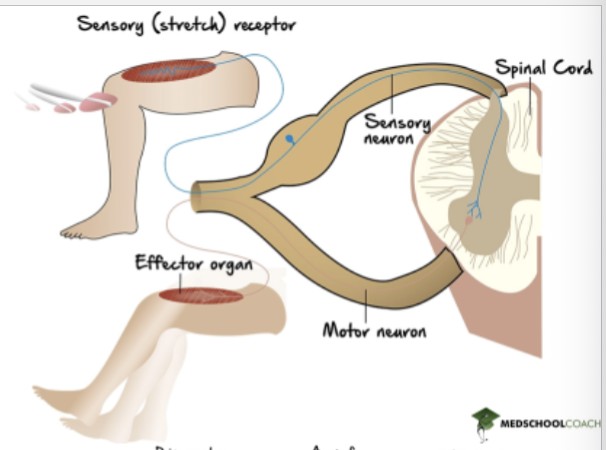
M1 Response
-The monosynaptic stretch reflex
-Simple and reflexive
-Muscle spindles > spinal cord (single connection) > muscle(s)
M2 Response
-The polysynaptic, functional stretch reflex or long-loop reflex
-More complicated, requiring complex information processing procedures
-Muscle spindles > spinal cord > cortex brain (multiple connections) > spinal cord > muscle(s)

Triggered reaction/response
-Coordinated response
-Too fast to be voluntary, too slow to be M2
→ BUT can be learned and become more automatic
-Motor behavior pattern is pre-triggered, needs a go signal or “trigger” to initiate
-Relatively arbitrary → only occur in elite athletes
-80-120 ms
In triggered reactions, it is believed that ____ is skipped.
response selection → action is preplanned
M3 Response
-Powerful, sustained, primarily voluntary response
-Founded on motor programs
-Most complex response, modifiable

Name each stage
M1, M2, triggered response, M3
Triggered reactions get rid of ____.
the M2 to M3 dip
Which responses are elicited?
M1, M2, triggered reactions
Which responses are emitted?
M3
Motor program
A set of motor commands that are pre-structured and defines the essential details of a skilled action; it selects which muscles will be activates, the order of the sequence of muscle activation, and the timing of muscle activation.
4 components of a motor program

Dynamic systems theory
Movement and coordination result from interactions of body systems, tasks, and environments rather than being strictly pre-programmed
