Art 311 Exam 2 Study Guide
 Call Kai
 Learn
 Practice Test
 Spaced Repetition
 Match
 Flashcards
 Knowt Play
1/107

There's no tags or description
Looks like no tags are added yet.
108 Terms
What is Romanticism?
Movement against convention and authority and the orderly, rational Enlightenment worldview. It valued emotion, imagination, free expression, and the exotic; it saw nature as God's dwelling place.
Did the Romantics reject reason?
No. They saw emotions as equally important to human experience.
Edmund Burke's "A Philosophical Enquiry into the Sublime and Beautiful" (1757)
Sublime = fear, uncertainty, obscurity, horror. Produced by danger, darkness, silence, vastness, pain, and infinity.
Key ingredients of Romantic art.
Key ingredients of Romantic art
The sublime.
Fear and horror caused by danger, darkness, silence, vastness, pain, and infinity
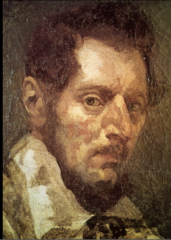
Who is the first great French Romantic painter?
Theodore Gericault

Théodore Géricault, The Raft of The Medusa (1818)
16 x 23 ft.
Originally titled Scene of Shipwreck.
Based on a real disaster that made headlines in France
How did Géricault prepare The Raft of the Medusa (1818-19)?
He used two eyewitnesses, wax models, a built raft, and many sketches.
Hired the ship's engineer for a scale model; interviewed him and the ship's physician.
Followed academic procedure, chose the moment they would be saved.

Francisco Goya's early career
Provincial training; moved to Madrid, worked with Mengs.
Designed ~60 tapestry cartoons for the Royal Tapestry Manufactory; made engravings after Velázquez; spent 2 years in Italy on his own; Academy professor
Goya's court appointments
Court painter in 1786 to Charles III;
Promoted in 1789 under Charles IV;
First court painter in 1799

Francisco Goya, La Cometa (c. 1777)
Early Goya tapestry cartoon.

Goya, The Family of Charles IV (1800)
Unflattering portrait of the royal family.

Goya, Third of May, 1808 (1814)
Spanish resistance to the French; painted after the French retreated.

Goya, Disasters of War series, 1810-20
Series of 82 etchings, many plates made during the war. Not published until 1863, 35 years after his death. Includes Brave Deeds Against the Dead (c. 1814).
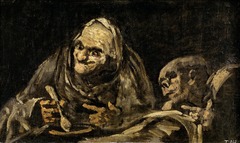
Goya, The Black Paintings of Quinta del Sordo, 1820-23
14 paintings from his farmhouse outside Madrid: violence, despair, evil.
Made by an aging, deaf, disillusioned artist. Foreshadowing Expressionists and Surrealists.

Goya, Saturn Devouring One of His Children (c. 1819-23)
Allegory for issues of power; he tries to change a prophecy.

Caspar David Friedrich
Most important German Romantic of his generation.
Cross in the Mountains (c.1807-8); Two Men Contemplating the Moon (c.1825-30), and a mysterious landscape.

American Romanticism: Transcendentalism
New England intellectuals: intuition surpasses reason; direct experience of Nature unites you with God; self-reliance. Nature as secular religion; painters pictorialized it.

Hudson River School
America's first true artistic fraternity. NYC landscape painters emerged c. 1850, led by English 'emigre' Thomas Cole.
Manifest Destiny: three themes
1. Special virtues of Americans and their institutions.
2. Mission to redeem and remake the West in the image of agrarian America.
3. Irresistible destiny to do it.
Early American art institutions
American Academy of Fine Arts, 1802 (Trumbull first president);
Pennsylvania Academy, 1805;
National Academy of Design, 1825;
American Art Union, 1838.

Thomas Cole: Early life
Born in industrial England, textile factory work as a teen; family emigrated.
Engraver training; no formal education. Discovered by John Trumbull.
Moved to NYC in 1825 (Erie Canal boom).
Early patron: Daniel Wadsworth
Thomas Cole: Europe and his circle of people
Europe, 1829- 32 (London, Florence, Rome, Naples). Saw and met Turner.
Circle: James Fenimore Cooper, William Cullen Bryant.
Founding member of the National Academy of Design and the Hudson River School. Teacher of Frederic Church.

Cole, Kaaterskill Falls (1827)
Passions of nature are evoked; scenes are not transcriptions.
The Native American figure stands for wilderness and the conditions of Native Americans.
Cole's "historical landscape"
Landscape gains interest with literacy and historical associations. Patrons bought historical or religious themes. Cole believed art had a high moral purpose.

Cole, The Course of Empire (1834 - 36)
Most ambitious series. An allegory of his pessimistic, cyclical view of history and a critique of Jacksonian democracy.

Cole, The Course of Empire 1, The Savage State (1834)
AKA The Commencement of Empire, Dawn breaks over a wild, untamed wilderness. Early nomadic humans hunt and fish in a landscape completely dominated by nature.

Cole, The Course of Empire 2, The Arcadian/Pastoral State (1834)
Morning light shows the birth of agriculture, simple architecture, and a peaceful village community living in balance with the land.

Cole, The Course of Empire 3, The Consummation of Empire (1835 - 1836)
Cole's largest work, the centerpiece.
At noon, the simple village has transformed into a sprawling, opulent Greco-Roman marble metropolis filled with a grand triumphal procession, wealth, and power. The empire at its height.

Cole, The Course of Empire 4, Destruction (1836)
Late afternoon brings sudden chaos, a naval battle, burning buildings, and the violent sacking of the city as order and morality collapse.

Cole, The Course of Empire 5, Desolation (1836)
A cautionary tale: at sunset and moonrise, the city is completely ruined, silent, and devoid of human life as vines, trees, and nature reclaim the valley.
Cole's 1840 statement on painting
Painting is not a mere amusement; its moral and intellectual influence is far greater than people realize.

Cole, The Voyage of Life (1842)
Patron: Samuel Ward, evangelical "new money" banker. Engraved and hugely popular. Shift from Claudian to Rosaesque landscape (Manhood).
Old Age has a more hopeful ending.

Cole, The Voyage of Life 1, Childhood (1842)
The start of life, innocence, and wonder. A guardian angel gently steers the vessel.
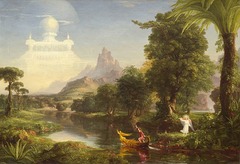
Cole, The Voyage of Life 2, Youth (1842)
Ambition, dreams, and youthful overconfidence. The child is now an enthusiastic young man taking control of the boat himself. The guardian angel stands on the riverbank, watching him go as rough waters loom ahead.

Cole, The Voyage of Life 3, Manhood (1842)
The severe trials, pain, and moral tests of maturity. With earthly strength failing, the man clasps his hands in prayer, and divine help remains his only hope.

Cole, The Voyage of Life 4, Old Age (1842)
The waters have grown calm, the end of earthly time; the hourglass has vanished. The guardian angel returns to guide the voyager into the golden light of heaven/eternity.

Cole, The Oxbow (1836)
View from Mount Holyoke after a thunderstorm. Comments on the domestication of the wilderness.

Joseph Mallord William (J.M.W.) Turner: Career
Associate of the Royal Academy (1799), Academician (1802); seen as a prodigy.
Style evolved from detailed landscapes to light, color, and atmospheric effects.

Turner, Hannibal Crossing the Alps (1812)
Human vulnerability before nature; political commentary on Napoleon's invasion of Italy.
Critical reception of late Turner
From the 1820s, critics called his color and paint handling the product of a deranged mind.
Late style: energetic brushwork, little descriptive detail, uncompromising modern subjects.

Turner, The Slave Ship (1840)
Abolitionist picture. Royal Academy's main exhibit during the first World Anti-Slavery Convention in London, 1840.

Turner, Rain, Steam, Speed (1844)
Great Western Railway. Turner was one of the few English painters to paint the Industrial Revolution ("railway mania"). The viewer finished it with imagination.
Industrial Revolution Context
Before it, the biggest cities had only hundreds of thousands; most people were rural.
- Brutal for the poor: bad housing, unclean water, little healthcare, inhumane hours.
- Constable and Turner painted at the same time.
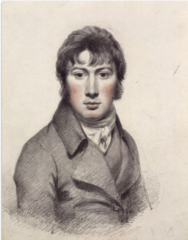
John Constable
An English Romantic landscape artist. Known principally for revolutionizing the genre of landscape painting.

Constable, The Hay Wain (1821)
A "six-footer." Nostalgic. Aimed to raise the landscape to the importance of history painting. Rural landscape as lost Eden: a moral space contrasting with urban ills.

Constable's methods
One of the first English artists to paint oil sketches outdoors. Paint carried in pig bladders (tube invented 1840). "The sky is the source of light in nature." Cloud Study (1822) was painted from 11 to noon.
Bourbon Restoration timeline
- Napoleon's failed 1812 Russia campaign; exiled to Elba 1814.
- Louis XVIII returned 1814, ruled to 1824; succeeded by Charles X, who abdicated in the July Revolution of 1830 (three days).
The Academy during teh Restoration
Louis XVIII restored the academy (abolished 1793 by the Arts Commune under David). 40 members.
École des Beaux Arts founded 1816. No women were ever full members. Salons dominated by David's followers until the early 1820s.
What is Orientalism?
Fascination with non-Western cultures (Turkey, Greece, Middle East, North Africa) emerging from colonialism. Claimed ethnographic accuracy but projected Western hopes and anxieties. Napoleon's 1798 invasion of Egypt spurred systematic study.

Jean-Leon Gerome
Traveled to North Africa 1856; Egypt in 1868. Paintings were made for Western audiences (male gaze), focused on "the other," and had little to do with reality.
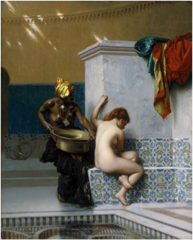
Jean-Leon Gerome, Moorish Bath (1870)
Staged exotic erotica. Expressed the 19th-century European bourgeois male's fantasy to escape social decorum and to control women who were agitating for equality.

Eugène Delacroix: Background
Great artist/writer. Father was a minister in Napoleon's government after working for the Revolution; maternal grandfather was the king's personal cabinetmaker.
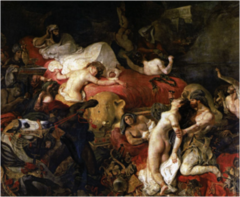
Delacroix, Death of Sardanapalus (1826)
Salon of 1827, based on a Byron poem. Blood is only in the bedsheets, "Rubensian" color.
Attraction and repulsion; critics said it was too much.
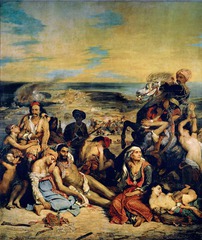
Delacroix, Massacre at Chios (1824)
Greeks sought freedom from the Ottomans from 1821.
Greece = birthplace of civilization, but Orthodox and "exotic," so also Oriental. In 1822, Chios fell from 120,000 to 1,800. Based on newspapers and eyewitnesses. Critics hated it.

Delacroix, Women of Algiers (1834)
He never saw the interior of a harem.

Delacroix, Liberty Leading the People (1830)
Contemporary history painting blends allegory (Liberty is not a real person) with real people. Notre Dame in the background. Commemorates the July 1830 revolution that overthrew Charles X and installed "populist" Louis-Philippe. Era of Hugo and Les Misérables.
American artists and slavery
Most American artists avoided the subject; those who tackled it made compelling work.

Eastman Johnson, Negro Life in the South, (1859)
About urban slavery. Novelty: elevated the subject (already in the popular press) to an ambitious Salon format with academic skill (Düsseldorf and Paris training). Praised as a quiet interior, not a whipping post: "a man is a man."
It features varied skin tones and subtle details (such as a white woman stepping over a threshold and hints of multiracial/mixed-race heritage), capturing the complex reality of urban slavery rather than a purely pastoral or rural southern myth.

Eastman Johnson, A Ride for Liberty, (c. 1862)
Family fleeing slavery on horseback across a battlefield. Father looks ahead (future), mother looks back (past), child looks down (present).

Winslow Homer and the Civil War
Embedded with Northern troops as an artist for Harper's Weekly; witnessed many battles.
Reconstruction and education
Freed people taxed themselves, donated labor, and housed teachers for schools. Harper's (1867): "The alphabet is an abolitionist." Homer, Taking a Sunflower to Teacher (1875), set in Virginia.


Winslow Homer, A Visit from the Old Mistress, (1876)
Power dynamics shift, but living conditions stay much the same. Cotton Pickers: cotton was still the major employer of African Americans.

Lilly Martin Spencer
She painted for 60+ years
- The only woman to succeed professionally in 1850s NYC and supported eight children and her husband.

Spencer, Kiss Me and You'll Kiss the 'Lasses, (1856)
Shows a working mother in command.
The painting's subject was as uncommon at the time as its independent female artist.

Spencer, Young Husband, (1854)
Possibly context for Kiss Me and You'll Kiss the 'Lasses (1856). The travails of early married life, depicts the husband stumbling down the street and attempting to hold on to the items in his overflowing basket, attracting gazes from at least one onlooker and suffering a public humiliation. A real social anxiety of the time: setting up a household and running it.

Spencer, Peeling Onions, (c. 1855)
Challenges mid-19th-century patriarchal "separate spheres" ideology by elevating female household labor, highlighting both the endurance and strength of working women.
Critic on Spencer
Wished she'd spend her talent on something more worth than "drooling disgusting naked babies," though better than murdering Shakespeare.

Emanuel Leutze, Washington Crossing the Delaware, (1851)
150x 255 in. Depicts Trenton attack on Dec 25, 1776. Big hit in the US and Germany.
However, the scene itself was fabricated and unrealistic.
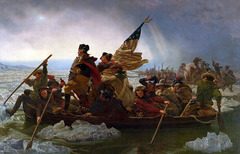
Historical errors in Washington Crossing the Delaware (1851)
- Flag didn't exist
- Going the wrong direction
-Not a night scene
- Wrong boats
- Washington couldn't keep that stance
- Face based on Houdon's sculpture.
The Barbizon School
A group of French painters who gathered in the village of Barbizon near the Forest of Fontainebleau to transform landscape art into Naturalist landscape, en plein air, with no ruins or picturesque structures.
Peasant imagery
Expressed the artist's attitudes toward urban-industrial change. Two types: heroic or threatening.

Jean-François Millet, The Sower, (1850)
Salon of 1850, positive reviews. Millet moved to Barbizon to escape Paris but didn't socialize with peasants. Also read as sowing seeds of discontent. 1848 brought universal male suffrage.

Jean-François Millet, The Gleaners, (1857)
Depicts three peasant women gleaning a field of stray stalks of wheat after the harvest. The painting is famous for featuring, in a sympathetic way, what were then the lowest ranks of rural society; it was received poorly by the French upper classes.

Rosa Bonheur
Trained by her father, Raimond, who believed in gender equality. An animal painter, never married but lived with her best friend. Won a gold medal in 1848 at the Paris Salon for her work, Cows and Bulls of the Cantal.

Bonheur, Cows and Bulls of the Cantal, (1848)
Won a gold medal in 1848 at the Paris Salon. Painted with Bonheur's signature anatomical precision and naturalism.

Bonheur, The Horse Fair, (1852-55)
Shows the horse market held in Paris. Bonheur sketched there twice a week, dressing as a man to discourage attention. Debuted at the Paris Salon of 1853, where it received wide praise.
Prostitution in the 19th-century cities
Over half came from clothing trades (seamstresses, laundresses). Most women in any job except domestic service participated. Stigmatized by the bourgeoisie (main clients), accepted by the working class. Syphilis was rampant; only women were incarcerated.

Gustave Courbet, Young Ladies on the Bank of the Seine, (1856-57)
"High-class" prostitutes; front woman in undergarments, sultry for male viewers. Size (5'8 " x 6'6 ") normally reserved for history painting.

William Holman Hunt, Awakening Conscience, (1853)
A mistress and her lover. It is a modern morality tale, the young mistress sees the error of her ways. Her transfixed stare is directed toward the sunlit garden outside the window, reflected in the mirror behind them, symbolizing a spiritual escape from her compromised life.

Dante Gabriel Rossetti, Found, (1854-55, unfinished)
A young country drover discovers his former sweetheart, who has fallen into destitution and urban prostitution. He attempts to lift her by the wrists while she recoils in shame against a brick wall, will she attempt suicide? Rossetti worked on the composition for nearly three decades. It was left unfinished at his death in 1882.
Middle-class working women
Peasant teens moved to cities; 40% of Europeans were domestic servants at some point (no fixed hours, time off, or protection; many were abused). The best-educated became teachers, tutors, and governesses.

Richard Redgrave, The Governess (1844)
The Governess is not a "member" of the family. The position of governess was one of the few professions open to middle-class women of modest means, but it was often a lonely and difficult life because the social status of a governess was ambiguous. She was not a servant in the usual sense, but nor was she on equal terms with the family who employed her.

Emily Mary Osborn, Nameless and Friendless, (1857)
Osborn was a leading painter tied to the women's rights campaign. This painting suggests that without the necessary connections, a woman artist stands little chance of finding professional success.
Poor working women
Seamstress: 100+ hour weeks, piece rates, near starvation; many driven to suicide, infanticide, prostitution. Laundresses earned more, worked outdoors, and could keep kids nearby.

Anna Blunden, Song of the Shirt, (1854)
Thomas Hood's poem "The Song of the Shirt" gives voice to a "weary and worn" seamstress as she longs for her youth in the countryside

Gustave Caillebotte, The Floor Scrapers, (1875)
Painting of the urban working class.
What is Realism?
Objective, unidealized view of everyday life. Response to industrialization and social discontent; strong social consciousness about class and gender.
Revolution of 1848 in France
Ended the July Monarch (1830-1848)
- Led to the creation of the Second Republic; universal male suffrage was established.
- Conservatives became fearful of the power of the working classes
- The ascent of Louis Napoleon (Napoleon III) by
1851 to the throne is evidence that the people
preferred the safety of an able dictatorship to the
uncertainty of the Revolution

Thomas Couture, Romans of the Decadence, (1847)
Displayed at the Salon of 1847. Critics read it as a disguised reference to the excesses of the rich bourgeoisie.
Gustave Courbet's philosophy
Create "a living art" of his own time; painting is concrete: "Show me an angel, and I'll paint one." Art must represent the tangible, contemporary world truthfully rather than idealizing or escaping into mythology, history, or romantic fantasy.
"When I stop being controversial, I'll stop being important." (The Desperate Man, 1844-45)

Courbet, The Desperate Man, (1844-45)
"When I stop being controversial, I'll stop being important." The work channels the 19th-century Romantic cliché of the "tortured, misunderstood genius"
Political context of 1848
Revolutions in Germany and France
- The Communist Manifesto was published in 1848; Marx's Das Kapital was published in 1867.
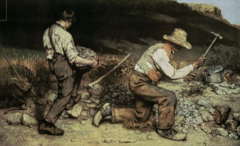
Courbet, The Stone Breakers, (1848)
The idea came from two men on the road near Ornans. Proudhon called it the first "socialist picture." Stonebreaking was a modern job (paving Paris), not traditional labor. Strong, oppressed workers seemed threatening to the middle class.

Courbet, Burial at Ornans, (1849)
10 x 22 ft; Showed at the Salon 1850-51. Critics say it's an "image of nothingness" with no poetry or grandeur.
- Funeral of his great-uncle; clergy, officials, local women (his family). Strong regional identity, a threat to the Parisian bourgeoisie.
- His "manifesto," submitted as a history painting.

Honore Daumier
Political caricaturist.

Daumier, Les Poires, (1831)
Turned King Louis-Philippe into a pear (poire = moron).

Daumier, Third Class Carriage, (1862-64)
Painting of class in modern Paris.
Second Generation Hudson River School Traits
- More transcriptive; art allied with science, nationalistic, and optimistic.
- America seen as a second Eden, God in the landscape.
- Influenced by John Ruskin's fidelity to nature.

Asher B. Durand
Trained as an engraver and a friend of Cole. One trip abroad from April 1840 to June 1841; painted Kindred Spirits (1849): Cole and Bryant in an imaginary landscape from Catskill studies.
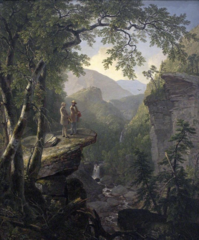
Asher B. Durand, Kindred Spirits, (1849)
Cole and Bryant in an imaginary, idealized landscape from the Catskill Mountain studies.