cell division and protein synthesis
 Call Kai
 Learn
 Practice Test
 Spaced Repetition
 Match
 Flashcards
 Knowt Play
1/81

There's no tags or description
Looks like no tags are added yet.
82 Terms
chromatin
DNA loosely coiled in the nucleus when a cell is NOT dividing
chromosome
DNA is tightly coiled into these structures when a cell is preparing to divide
DNA replication
before cell division, each chromosome is copied
sister chromatids
the identical halves of a replicated chromosome, joined at the centromere, that separate during cell division
Chromosome Theory of Inheritance
Genes are passed on from parent to offspring by means of chromosomes.
Each species has a ____ number of chromosomes
characteristic
sex chromosomes
determine the sex of an organism, last pair of chromosomes
male sex chromosomes
XY, Father can give either an X or Y to their offspring
female sex chromosomes
XX, Mother can give only an X to their offspring
autosomes
all other chromosomes that aren’t sex chromosomes. two copies of each autosome, 1 from each parent
how many chromosomes do humans have
total of 46, 44 autosomes and 2 sex chromosomes
haploid
(n) cells having only one set of chromosomes (ex: sperm and eggs)
diploid
(2n) cells having two sets of chromosomes (ex: somatic (body) cells)
mitosis
results in two new cells with genetic material identical to the original cell (diploid cells, 2n)
meiosis
results in new cells with half the number of chromosomes as the original cell
- Produces gametes, eggs (Females) and sperm (Male)
- Haploid cells (n)
cell cycle
the series of events that cells go through as they grow and divide

two parts of cell cycle
interphase and cell division
interphase
the period of the cell cycle between divisions. G1 phase, S phase, G2 phase
G1 phase
cell grows, increases its supply of proteins and organelles
S phase
DNA replication
G2 phase
cell grows, increases its supply of proteins and organelles
cell division
mitosis, cytokinesis
mitosis
division of the nucleus, Allows for the copied DNA to be distributed to the offspring cells
Divided into FOUR phases:
1. Prophase
2. Metaphase
3. Anaphase
4. Telophase
prophase
Chromatin condenses into chromosomes
Spindle begins to form and begins to attach to the
centromere of each chromatid
Nuclear membrane breaks down

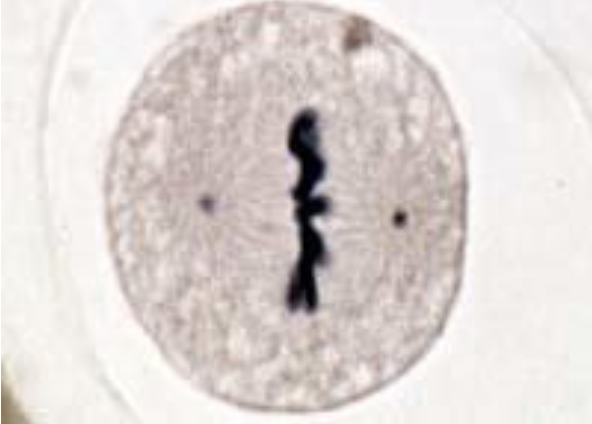
metaphase
Chromosome line up across the center of the cell
Each chromosome is connected to a spindle fiber at its center
anaphase
Sister chromatids separate into individual chromosomes and are moved apart

telophase
Chromosomes gather at opposite ends of the cell
Two new nuclear membranes begin to form

cytokinesis
the division of the cytoplasm, usually occurs at the same time as Telophase
result of cell division
two genetically identical cells
meiosis
produces gametes, haploid reproductive cells.
Males – sperm
Females - egg
Cells preparing to divide undergo:
1. Interphase
2. Cell Divisions:
Meiosis I
Meiosis II
meiosis I
produces two genetically different diploid cells

prophase I
each chromosome pairs with its homologous chromosome to form a TETRAD. crossing over occurs
crossing over
allows the exchange of genetic material between maternal and paternal chromosomes
metaphase I
spindle fibers attach to chromosomes and move them towards the metaphase plate
anaphase I
homologous chromosomes move toward opposite ends of the cell
Independent Assortment – results in genetic variation
telophase I and cytokinesis I
nuclear membranes form & cell separates into two diploid cells-Genetically different
meiosis II
Neither cell goes through a round of chromosome replication before entering Meiosis II. produces 4 genetically different haploid cells
gamete formation
In male animals, meiosis results in four equal-sized gametes called sperm.
In female animals, only one egg results from meiosis. The
other three cells, called polar bodies, are discarded.
difference between mitosis and meiosis
Mitosis produced two genetically identical diploid cells
Growth
Repair
Reproduction (Prokaryotes)
Meiosis produced four genetically different haploid cells
Reproduction (Eukaryotes)
karyotype
the number and appearance of chromosomes in a dividing cell.
Used to identify sex and study
chromosomal abnormalities such as:
Male (XY)/Female (XX)
Trisomy (Down Syndrome –Trisomy 21)
Monosomy (Turner Syndrome – Single X)
Chromosomal abnormalities occur as a result of _____ in Meiosis
non-disjunction
oogenesis
making of egg cells
spermatogenesis
making of sperm cells
discovery of DNA
Scientists:
-James Watson
-Francis Crick
-Maurice Wilkins
-Rosalind Franklin
Watson and Crick built a model that explained how DNA carried information and could be copied
nucleic acids
Made up of Carbon, Hydrogen, Oxygen, Nitrogen, Phosphorus, Sulfur
Monomers: Nucleotides
Made up of: Phosphate group, 5-carbon sugar, Nitrogenous base
Polymers: DNA and RNA
Used for: Storing genetic information (DNA); transmitting genetic information (RNA)
Found in: All cells (food)
DNA is made up of __ strand/s of ____.
two strands of nucleotides
A nucleotide of DNA is made up of:
Deoxyribose – 5
carbon sugar
Phosphate Group
Nitrogenous Base
kinds of bases in DNA
Adenine
Guanine
Cytosine
Thymine
DNA base pairing rules
Adenine (A) always pairs with Thymine (T)
Guanine (G) always pairs with Cytosine (C)
If there is 30% Adenine present in a cell., how much Cytosine is present?
20%
RNA is made up of __ strand/s of _____.
one strand of nucleotides
A nucleotide of RNA is made up of:
Ribose – 5 carbon sugar
Phosphate Group
Nitrogenous Base
kinds of bases in RNA
Adenine
Guanine
Cytosine
Uracil
RNA base pairing rules
Adenine (A) always pairs with Uracil (U)
Guanine (G) always pairs with Cytosine (C)
DNA
Function: Store genetic information
Found in: Nucleus
Structure:
Two (2) strands
Deoxyribose (sugar)
Thymine
Base-pairing:
A – T
C – G
RNA
Function: Transmit genetic information
Found in: Nucleus and Cytoplasm (Ribosome)
Structure:
One (1) strand
Ribose
Uracil
Base-pairing:
A – U
C - G
DNA contains:
all the instructions for making proteins within the cell (blue-print)
Eukaryotic DNA is located in the cells ___ inside _____.
nucleus inside chromosomes
Eukaryotic chromosomes contains DNA and protein, tightly packed together to form ___.
chromatin
before a cell divides, it duplicates its DNA in a process called ___
replication
what does replication ensure
that each resulting cell will have a complete set of DNA
The two DNA strands are separated, “unzipped” by ____.
DNA helicase
DNA polymerase
forms new strands by adding complementary bases to each original strand
Each new DNA molecule is made up of:
one new strand and one old strand.
result of DNA replication
Two new DNA molecules exactly identical to the original strand
proofreading DNA
DNA polymerase initially makes 1 in 10,000 base pairing errors
Enzymes proofread and correct these mistakes
After proofreading, the new error rate is 1 in 1 billion base pairing errors
mutation
the change hat occurs when there are mistakes in DNA replication
genes
coded DNA instructions that control the production of proteins
Genetic messages can be decoded by:
copying part of the nucleotide sequence from DNA into RNA. DNA → RNA → Protein
RNA contains:
coded information for making proteins
types of RNA
Messenger RNA (mRNA)
Ribosomal RNA (rRNA)
Transfer RNA (tRNA)
Messenger RNA (mRNA)
carries copies of instructions for assembling amino acids into proteins.
Ribosomal RNA (rRNA)
structural component of ribosomes
transferRNA (tRNA)
transfers each amino acid to the ribosome during protein construction
steps of protein synthesis
transcription and translation
transcription
produces mRNA by copying part of the nucleotide sequence of DNA
DNA is copied in the form of RNA
1. RNA polymerase binds to a gene, the two DNA strands unwind and separate.
2. Complementary RNA nucleotides are added and joined.
3. When RNA polymerase reaches the end of the gene (termination signal) both DNA and RNA are released.
genetic code
The genetic code is the “language” of mRNA
instructions.
The code is written using four “letters” (the bases: A,
U, C, and G).
codon
consists of three consecutive nucleotides on mRNA that specify a particular amino acid.
The three bases of a/n ___ are complementary to the three bases of a/n ___.
anti-codon, codon
translation
the decoding of mRNA into a protein.
The cell uses information from mRNA to produce
protein
Occurs on the Ribosomes
mutations
-A change that occurs within a gene or other segment of DNA on a chromosome
-Several different kinds of mutations
Frameshift Mutations: Insertion, Deletion
Point Mutations: Substitution