electricity
 Call Kai
 Learn
 Practice Test
 Spaced Repetition
 Match
 Flashcards
 Knowt Play
1/49

Earn XP
Description and Tags
so close yet so far
50 Terms
Like charges
repel
Opposite Charges
attract
Neutral objects have…
the same number of positive and negative charges
Neutral objects do not…
repel and attract other neutral objects
charge
number of protons - number of electrons
+ve charge
more protons than electrons
-ve charge
more electrons than protons
neutral charge
equal number of protons and electrons
an ion is a…
an atom with a +ve or -ve charge
Charge (Q)
is the rate of flow of electric charge through a conductor
measured in Couloumbs
proton charge
1.60 × 10^-19 C (positive charge version of electron)
Electrostatic induction
Charged objects attract uncharged (neutral) objects due to induced electric charge
Induction is a
temporary separation of some electrons from their atoms when an electrically charge object is placed near them
this charge disappears when the electrically charged object is removed
Insulators
do not conduct electricity as they have no free electrons or ions
can maintain an induced charge
includes non-metals, plastics, paper and ceramics
Conductors
conduct electricity because they have delocalised electrons
quickly dissipate their induced charge
moisture in the air can also dissipate induced charges
Why is water attracted to charge?
The oxygen atom is more electronegative than hydrogen
Electrons are pulled towards the oxygen atom
The oxygen atom is left with a small negative charge and hydrogen atom with a small positive charge
The charges are attracted and repelled by the charged ends of other water molecules dissolved ions and charged objects
A positively charged conductor is moved near a neutral conductor
Do they attract or repel?
They attract
Electrostatic induction occurs
The electrons from the neutral object are attracted to and thus move towards the positive charged conductor
A positively charged conductor is moved near a neutral conductor
If the positive charged conductor touches the neutral conductor, explain what happens to the charges in each object
electrons move from the neutral conductor to the positively charged conductor
This reduces the positive charge on the first conductor and leaves the second conductor with a positive charge.
Therefore they are both positive
Explain how a negatively charged balloon can attract neutrally charged hair
The negatively charged balloon induces a positive charge in the hair which is closest to the balloon
The negatively charged balloon and the positive part of the hair are then attracted to each other
Voltage Source
a voltage source forces -ve charge (electrons) to the negative terminal
it also strips electrons from the +ve terminal
therefore the negative terminal builds up an excess of -ve charge
and the positive terminal builds up an excess of positive charge
Connecting the terminals allows the the electrons to flow towards the +ve terminal
IN SHORT: electrons flow from negative to positive
Electrical Work
work is done when moving the negative charge to the negative terminal
repulsive force is overcome and the charge is moved through a distance
work done is stored as electrical potential energy (EPE)
Voltage
Voltage is the energy per unit charge that pushes charges through a circuit
1V gives 1C of charge 1J of EPE
Potential Difference
As an electron flows through a circuit element, it loses potential energy
The PD is the difference in potential energy per unit charge between two points on a circuit
Electric Current
DELETE
Conventional Current
current flows in the opposite direction to the flow of electrons
Alternating Current
flows in both directions
it does this because the voltage which pushes the current alternates direction
direct current
flows only in one direction
produced by solar cells and batteries
Resistance
is a material property that reduces current for a given voltage
the larger resistance the harder it is to push electrons through the circuit
as the flow of electrons is resisted, energy converts to other forms such as heat and light
Factors that affect resistance
material type, length of conductor (resistance increases with length), cross-sectional area (thicker wire has lower resistance), temp (increases resistance) and resistivity
Ohmic conductors
have constant resistance
(they have a linear V vs I graph)
Non-Ohmic Conductors
have a resistance that is dependent on current
non linear V vs I graph

Voltmeter
measures the potential difference across a resistor
high resistance device connected in parallel to the circuit element
does not draw current
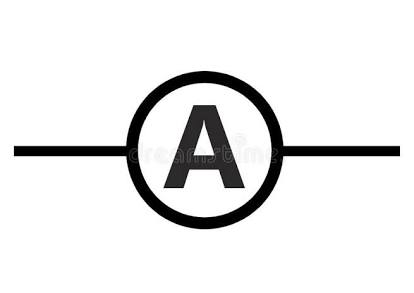
Ammeter
measures the current that flows through a resistor
low resistance device that is placed in series with a resistor in a circuit
Electromotive Force
is the voltage supplied by the battery or power source
Kirchhoff’s Current law
the sum of the currents entering a junction equals the sum of the currents leaving a junction
IT= I1+I2+I3
Kirchhoff’s Voltage Law
the sum of the potential difference from sources is equal to the sum of the potential difference used in a circuit
VT=Vd1+Vd2+Vd3
Thevenin’s Theorem
All circuits can be reduced to one source of emf that is equivalent to all the sources, and one load that is equivalent to all the loads
Series Circuits
each coulomb of electrons in the circuit are given a certain amount of electrical by the voltage source
each circuit component uses some of this PE
when the electrons return to the power source they have none left
(electrons have negligible KE)
What is the water analogy for an electric circuit?
Voltage = pressure/push
Current = flow rate
Resistance = restriction to flow
Battery = pump
Load = water wheel using the energy
Memory trick: Voltage PUSHES, current FLOWS, resistance SLOWS.
Electrical Distribution
Most of the electrical energy used in Perth is generated in the Collie and Muja power stations, 200km south of Perth
Once the electricity is generated by the power station, the AC voltage is stepped up (increased by transformers)
The high voltage electrical power is then transmitted to Perth along the high voltage power lines
Once in Perth the electrical power is stepped down to lower voltages by transformers
Transformers found on the street power poles reduce the voltage further to 240V
Transformer
is an electrical device that changes the voltage of an alternating current (AC) supply.
Explain why low currents are used to transmit electricity over long distances rather than high currents
Power = VI
Output V is high, current is lower
Power is lost in cable of resistance
P(loss)= I²R, so if I is low, P(loss) is low
Street Circuit
Three live wires at 11kV
One neutral wire at 0V
Household Circuit
In Aus, the electricity supplied to houses is 240V, 50Hz single phase
The electrical cable comes from the power lines to the main connection box which contains a fuse
The cable goes to the fuse box or switchboard
From there its distributed to the home
Active Connections
called live/hot
brings 240V AC at 50Hz to the home
has a main switch and seperate fuses for light/power and other main circuits
Neutral Connections
The neutral wire completes the circuit from the power station and is held at 0V
The neutral wire is connected to a bar called the neutral bar, which is connected back to the Earth via a metal stake
The neutral wire is also earthed at the substation
Earth Connection
safety device
connected to the metal casing of electrical appliances and to the Earth to produce a short circuit in case of faulty equipment
Double Insulation - no Earth
Some equipment and appliances are not connected to the Earth wire; their plugs have only active and neutral connections
They have 2 layers of double insulation
the insulation around the live wires
the non conductive plastic covering the device
Fuses and Circuit breakers
both break a circuit when the current reaches a limit (typically 8A for light circuits and 16A for power circuits
Fuse=melts, and circuit breaker flicks a magnetic switch
Fuse no reuse and circuit breakers switch can be reset
Both fuses and circuit breaker do not protect life but protect electrical equipment
Earth Leakage Systems
disconnect a circuit whenever the electric current in the active and neutral are different
an imbalance may indicate current leakage through the body of a person who is grounded accidentally
RCD’s disconnect quickly enough to prevent injury and death