SBI 3U1 Bacteria and Viruses Review
 Call Kai
 Learn
 Practice Test
 Spaced Repetition
 Match
 Flashcards
 Knowt Play
1/22

Earn XP
Description and Tags
Test on Tuesday October 20th 2026
23 Terms
1. Define the term bacteria.
Bacteria is a group of mostly unicellular microscopic prokaryotic organism
2. List three different ways in which bacteria can spread through a community.
sharing food/utensils
direct contact
airborne (particle transmission)
urine or fecal matter
contanimation
With the aid of a diagram clearly distinguish between the three main types of bacterial cells.

Complete the table found below.
Autrophic Bacteria
→ make your own food from raw materials
→ photosynthetic : undergo the process of photosynthesis
→ chemosynthetic : obtain energy needed to make food from chemicals in the environemnt
Heterotrophic Bacteria
→ cannot make their own food therefore obtain food from an outside source
→ parasitic : live in or on other organsims
→ saprophytic : live of waste or dead organic matter


Label the diagram found below

Study image illustrated below and then answer the following question. Explain how the presence of natural resource affect the growth pattern of bacterial cells.
A. Lag Phase
no net growth cells adapting therefore resources are not a factor.
#births = #deaths
B. Exponential growth
#births> #of deaths
because resources are in abundance
C. Stationary Phase
no net growth
colony of carrying capacity
resources only support a specifc number of colonies
D. Death Phase
colony is in rapid decline
resources are limited and are in decline
#births<# of deaths

7. With the aid of a diagram describe the process of binary fission.

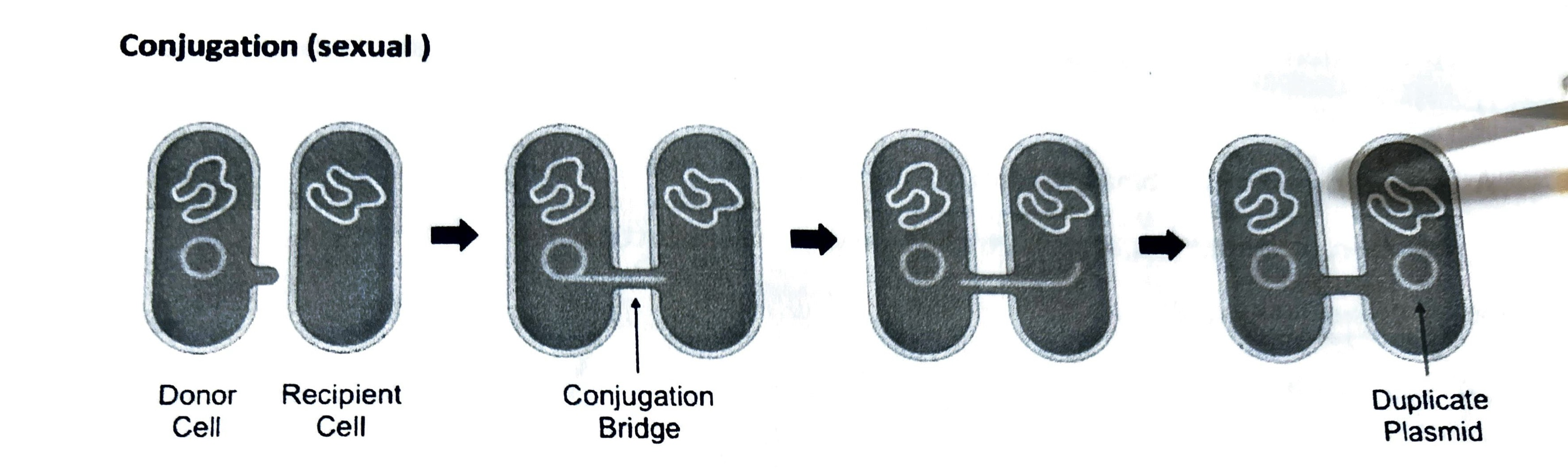
Explain how genetic information is transferred during conjugation.
Genetic material is transferred from a donor bacterial cell to a recipient cell via a pilus (bridge).
The donor cell uses a specialized protein tube called a pili to connect to the recipient cell’s wall.
The pili anchors the two cells together, allowing DNA to move from the donor to the recipient.
The recipient cell gains new genetic traits and now shares characteristics of the donor cell.
Saprophytic bacteria, nitrogen fixing bacteria and bioremediation all contribute to a healthy ecosystem. Explain the science behind this statement.
Saprophytic
breaks down organisms by releasing digestive enzymes into nutrients, which returns nutrients to soil
Example: Bacillus megaterium
Nitrogenifixing
transforms nitrogen from the atmosphere into a usable form for plants and animals
N2 → NO3
Bioremediation
destroys, transforms, an immobolizes environemntal contanimants
eg oil spills

The can of fruit illustrated below is on sale at the local grocery store. Is it advisable to
purchase and consume the contents of this can? Explain.
Do not purchase
contains harmful bacterial
will cause Clostridium botulinum, which will make you ill
Define the term antibiotic
Antibiotics are defined as a substance that is produced by a bacteria or fungi that destroy bacteria by preventing the cell from performing life functions.
Why would a doctor recommend including probiotics in a healthy diet?
Helps maintain health and prevent disease
May be used to treat ear, intestinal and urinary tract infections; reduce blood
cholesterol, prevent infections and maybe some cancers.
Explain why antibiotic resistance can lead to a global crisis.
bacteria passes on resistance, making harder to destroy
increase rate of disease spread
infection post surgery will be harder to treat
affect outcome of chemotheraphy
What factor(s) attributed the classification of viruses as nonliving?
do not satisfy the seven characteristics of life
Movement
Respiration
Stimuli
Growth
Reproduction ← virus only reproduce BUT require a host. they are parasites.
Excreation
Nutrition

With the aid of diagrams, describe the shape of each of the following viruses: polyhedral, spherical, tobacco mosaic and bacteriophage.
p.s polio is caused by polyhedral virus


Label the diagram found below.

Describe the steps of the lytic cycle.

Speculate as to why antibiotics are not prescribed for the common colony.
This is because antibiotics only kills bacteria, the common cold is caused by a virus. Antibitoics have no effects on viruses, so they will not cure a cold.
Is it possible to grow viral colonies on nutrient agar? Explain.
No it is not, viruses are not alive on their own and cannot reprouce without alving host. Nurtient agar only provides food for cellular life(like bacteria); it does not contain the living cells viruses need to replicate.
In terms of symptoms and outcomes describe the disease polio.
The symptoms were similar to flu-like symptoms: fever, headache, fatigue, sore throat, stiffness in the back etc.
Outcomes include
Nerve damage: the virus attacks and destroys nerve cells in the central nervous system.
Muscle Wasting & Paralysis: Destruction of these cells leads to muscle wasting and lifelong paralysis.
Respiratory Failure: If chest/respiratory muscles are paralyzed, patients cannot breathe on their own and require an "iron lung" tank respirator.
Severe Outcomes: Can result in permanent physical disability (needing braces or crutches) or death.
22. Clearly distinguish between the vaccines (to combat polio) developed by Sabin and Salk.
Salk’s Vaccone
Consists of dead polio viruses
It is injected into the bloodstream
Periodic booster shots are needed to maintain immunity
Hard
Expensive
Sabin’s Vaccine
Consists of live, weakened polio viruses that do not cause the disease
It is taken by being swallowed(orally)
It multiplies the intestines, provides longer-lasting immunity and does not require booster
cheaper
easier
What is the key difference between a pandemic and epidemic?
An epidemic is a local/regional disease outbreak ex. polio
A pandemic is a global disease outbreak ex. COVID-19.
What is the colour of Gram “+” and Gram “-”
Bacteria cells can also be classified by the colour produced when the bacteria is smeared on a slide, soaked in idene and then treated in iodine. If the resulting colour is blue to purple the bacteria gram is “+” and if the resulting colour is pink to red the bacteria is gram “-”