ECN118 Maths Differentiation
 Call Kai
 Learn
 Practice Test
 Spaced Repetition
 Match
 Flashcards
 Knowt Play
1/26

There's no tags or description
Looks like no tags are added yet.
27 Terms
What is the marginal product of labour?
The extra output a firm gains by adding one more unit of labour
Formula for gradient:
change in Y over change in X
How do you work out the gradient of a curve?
Using a tangent on the curve
What is diminishing marginal returns?
Occurs in short run where one factor of production is fixed.
At a certain point, employing an additional factor of production causes a relatively smaller increase in output
What is the derivative?

What is the square root of x?
0.5x
What is the power rule
Differentiation formula stating that if y=xn, then its derivative is dy/dx=nxn-1
What is the derivative of a constant (additive constants)?
A constant does not change with x, so its rate of change is equal to 0
What is the inverse function rule?
Rule stating that if y= f(x) and its inverse x= f-1 (y) exists, then
dx/dy= 1/dy/dx= 1/f’(x)
What does the ‘ mean in differentiation?
the derivative of…
What is the product rule?
The rule used when two expressions multiplied together
If y= f(x)g(x), then dy/dx= f’(x) g(x) + f(x)g’(x)
f= first expression
g= second expression
f’= derivative of first expression
g’= derivative of second expression
What is the first order derivative interpretation?
Principle that first derivative indicates the direction of change of a function
If f’ (x) > 0, f(x) tends to increase
If f’(x) < 0, f(x) tends to decrease
What is the formula for marginal cost?
change in total cost over change in output
What is marginal revenue?
The change in revenue when output changes
What is the formula for marginal revenue?
change in total revenue over change in quantity
What is the quotient rule?

How do you know when to you use the quotient rule?
when there’s a fraction in which a function of x is divided by another function of x
What is the chain rule?
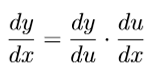
How to know when to you use the chain rule?
We use the chain rule when differentiating a 'function of a function'
What is the exponential rule?
y=ex
What is the logarithmic rule?
y=ln(x)
How to know when to use the product rule?
used when you need to find the derivative of two functions multiplied together
How to know when to use the inverse function rule?