ME115 - Week 2
 Call Kai
 Learn
 Practice Test
 Spaced Repetition
 Match
 Flashcards
 Knowt Play
1/30

Earn XP
Description and Tags
Interatomic Separation and Lattices/Unit Cells
31 Terms
Interatomic spacing
The natural spacing between the center of two atoms
Determined by the equilibrium between attractive and repulsive forces
Binding energy
The energy required to separate two atoms from their equilibrium spacing to an infinite distance away (Kcal/mol)
High binding energy will result in high strength materials (harder to separate atoms) and high melting points
Ionic bonds have the highest binding energies while Van der Waals bonds have the lowest.
IAE curves: Steep/narrow well
Describes the modulus of elasticity, atoms strongly resist small changes in interatomic spacing, this leads to a higher young’s modulus
IAE curves: Shallow/wide well
Atoms move along more easily, this leads to a lower young’s modulus since the material is more flexible
IAE curves: Asymmetric well
Atoms shift to a larger average spacing when heated, thus they will have a higher coefficient of thermal expansion (meaning that they expand more with less heat)This
This is because atoms are only at the exact bottom of the well when they are at zero kelvin, when heat is added the potential energy increases to the right. If the well is flatter/more shallow less energy is required to increase intermolecular spacing thus making it easier to make the object expand.
IAE curves: Symmetric and steep well
Average spacing between atoms changes less which leads to a lower coefficient of thermal expansion
Young’s modulus properties
A higher young’s modulus is like having a higher spring constant (Hooke’s law) which means that it resists deformation more (stiffer)
Thus a lower young’s modulus means that the material is easier to bend/deform
Stress
stress = force/area
Strain
strain = ΔL/L0 - this means that strain is the change in object length divided by the original length
Elastic strain - deformation is not permanent and is fully recoverable
Plastic deformation/strain - permanent deformation, object does not return to it's original shape once the load has been removed
Relationship between Energy vs. Atomic separation, melting temperature, boiling point, and CTE

Short-ranged order
Special arrangement of atoms over a short distance, only to the atoms nearest neighbors, e.g. polymers, inorganic glasses, amorphous materials
Long-ranged order
Special arrangement extents past 10nm, atoms/ions from a regular repetitive pattern, e.g. most metals and alloys, ceramics, semiconductors, some polymers, crystalline materials

Monoatomic gases
no order, e.g. argon gas
Amorphous materials
only short-ranged order, e.g. amorphous silicon, glasses, plastics
This happens because the processing doesn’t allow for large crystals to grow, this could either be because the crystals get tangled or because of rapid cooling that both don’t allow for proper crystal organization
Liquid crystals
short-ranged order and long-ranged order in small volumes, e.g. LCD polymers
Crystalline materials
Short and long ranged order
Single crystal: material consisting of only one large crystal, e.g. Si, GaAs
Polycrystalline: material consisting of many small crystals (grains) at different orientations, this creates grain boundaries, e.g. metals, alloys, most ceramics

Lattice
A collection of points that divide space into equally smaller sized segments. The surroundings of each point in a lattice (lattice point) are identical. Tells us the pattern of the crystal.
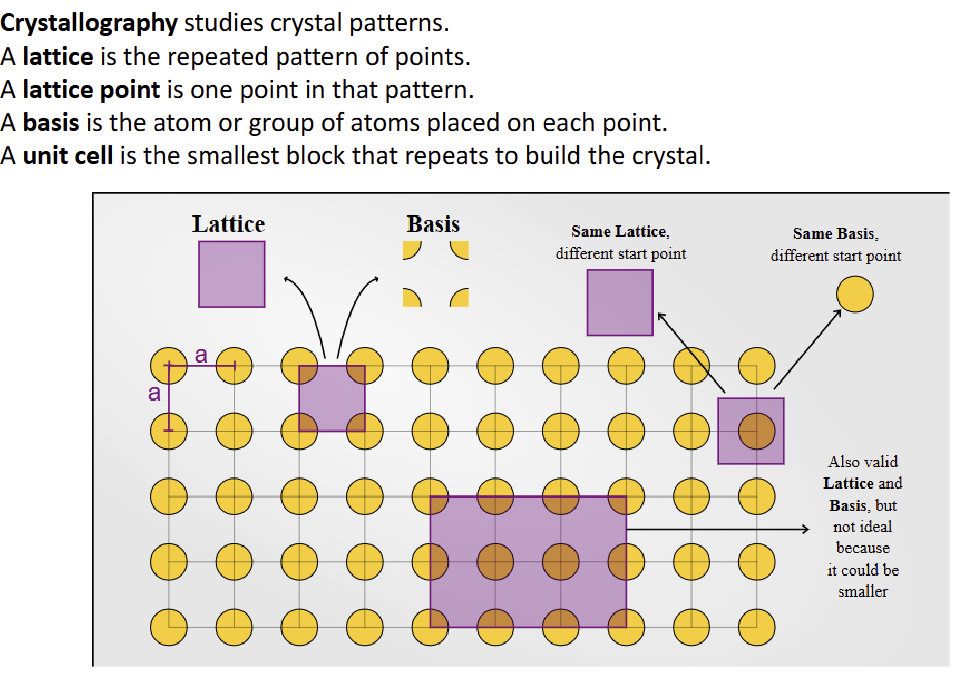
Basis
The actual atoms or group of atoms associated with every lattice point. This is what is going to be repeated in the lattice structure.
Unit cell
A same section of the lattice that still encloses the basic pattern of the lattice, if you repeat the unit cell in all directions then you will build the crystal (lattice + basis).
Every atom in the unit cell has to be chemically and physically the same.
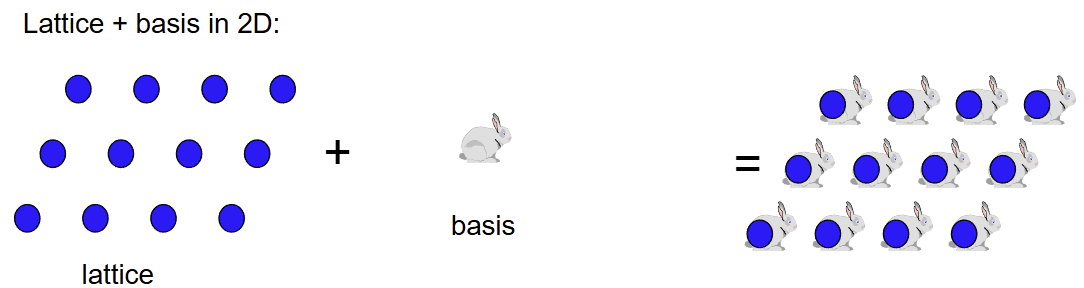
Simple metal
Lattice point + one metal atom
Ionic ceramic
Lattice point + a positive and negative ion pair
Complex crystal
A lattice point + several atoms in a specific arrangement
Types of lattice structures
Examples:
Copper and Nickle - FCC lattices + basis of one atom
Graphite - Hexagonal lattice + basis of one atom
Polymers - Several atoms associated with each lattice point

Lattice parameters
Describe the size and angles of the lattice structure

Body-centred cubic (BCC) lattice
2 atoms per unit cell, each corner atoms is 1/8 of an atom
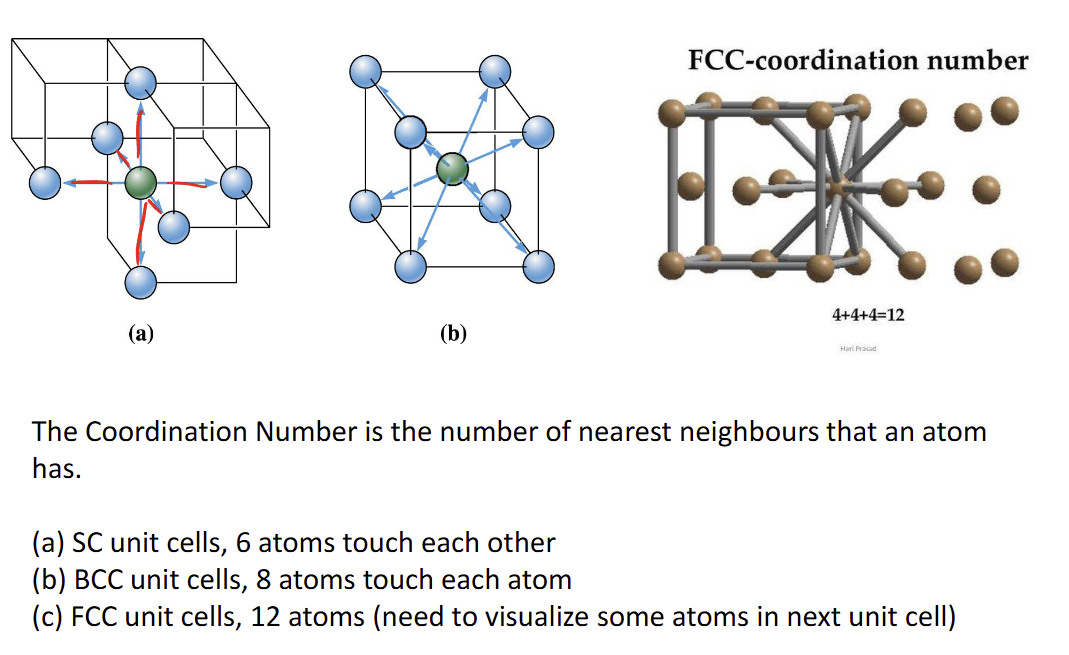
Coordination number of 8
a = 4r/√3 (relationship between the length of the unit cell and the radius of the atoms at the lattice points)
Face-centred cubic (FCC) lattice
4 atoms per unit cell, each corner atoms is 1/8 + ½ atoms for the faces
Coordination number of 12
a = 2√2*r
Simple cubic (SC) lattice
1 atoms per unit cell, each corner has ¼ of an atom
Coordination number of 6
a = 2r
Coordination number
The number of nearest neighbors an atom has
Atomic packing factor (APT)
The fraction of space in a unit cell that is occupied by the atoms. In order to calculate APF, we need to know the relationship between atomic radius r, and lattice parameter, a.
APT = [(# of atoms per cell)(volume of atoms)]/(volume of cell)
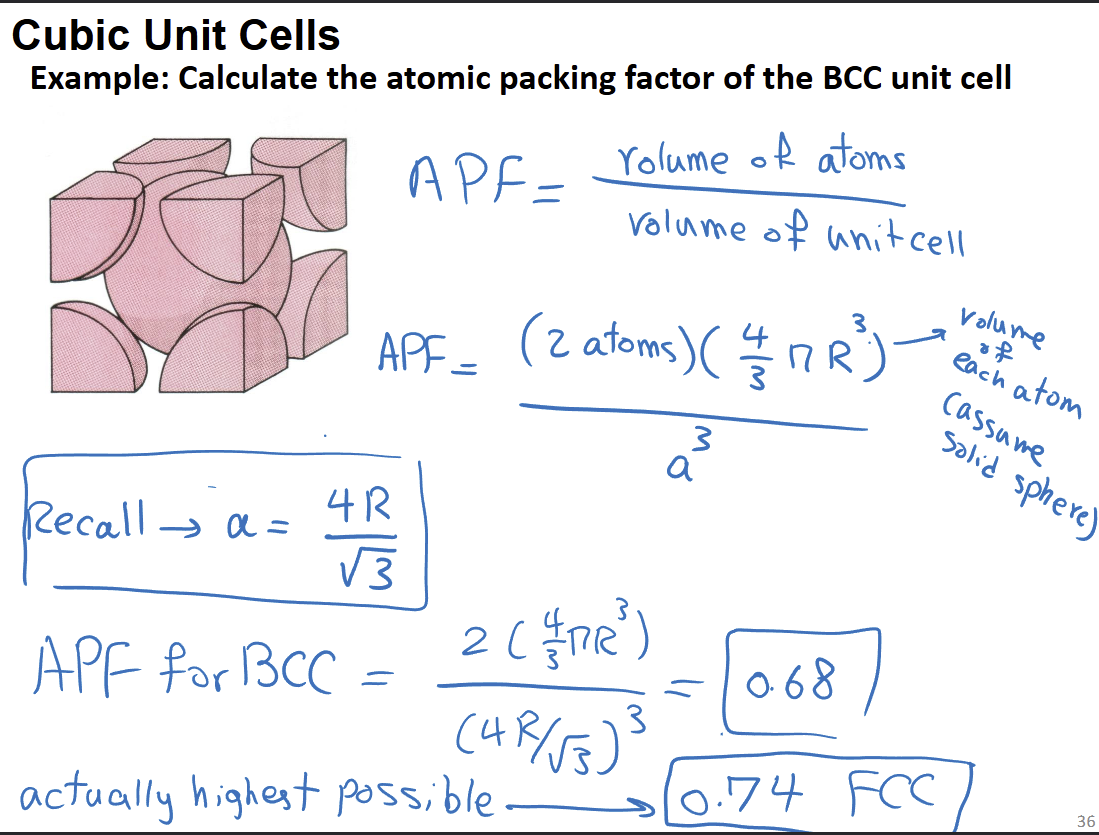
Close-packed directions
Directions in the unit cell in which atoms are in continuous contact. This is used to calculate the relationship between the radius r and the length of the unit cell a.

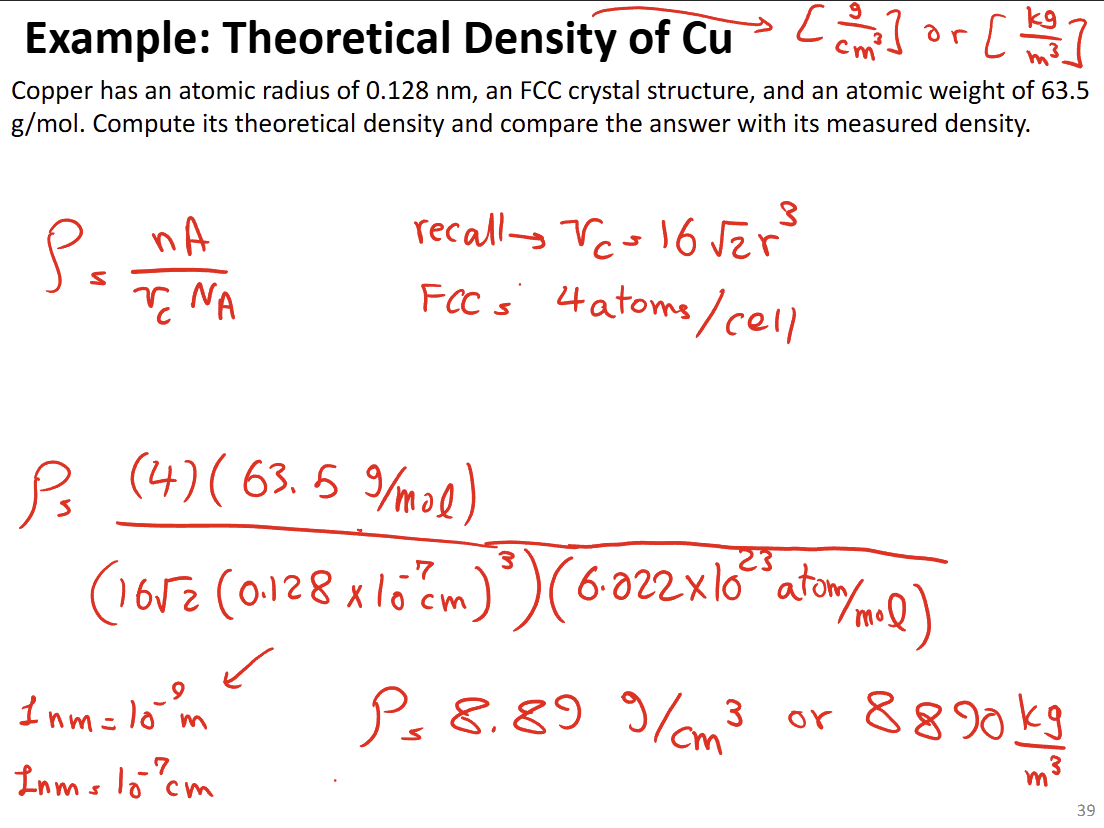
Theoretical density of a crystal structure
Using ATP it is possible to calculate what the density of a material could be without any imperfections.
ρ = nA/VN, where n = the number of atoms in the cell, A = the atomic weight (g/mol), Vc = the volume of the unit cell, NA = avagadro’s number (6.023 ×10^23 atoms/mol)