Risk and Uncertainty
 Call Kai
 Learn
 Practice Test
 Spaced Repetition
 Match
 Flashcards
 Knowt Play
1/36

There's no tags or description
Looks like no tags are added yet.
37 Terms
How does information affect the choices of an agent?
Agents do not haver perfect information on the consequences of their choices.
On what do agents’ choices depend?
Utility of each consequence, and preferences for risk
When does risk happen?
When the consequences of a decision are uncertain.
Agents choose among risky bundles considering
the set of outcomes, the probability distribution, and the set of payoffs.
What is an outcome?
One of the possible consequences of a risky decision.
What is a set of outcomes?
The finite set of all the possible outcomes of a risky decision.
How do we measure the likelihood of an outcome?
We give it a probability between 0 and 1. The sum of all probabilities of a risky decision is 1.
What is a probability distribution in risky decisions?
A probability distribution associates a probability to every outcome of a risky decision.
What is a payoff?
The monetary value (V) of an outcome.
Lottery
A risky bundle that is a set of outcomes with an associated probability distribution and with a set of associated payoffs.
Among what do agents choose when there is risk?
When there is risk, agents choose among lotteries.
Among what do agents choose when there is no risk?
Without risk, agents choose among degenerate lotteries: lotteries that assign probability 1 to an outcome.
What is the expected value of a lottery?
The weighted sum of the payoffs of each outcome using probability as weights. EV (Lottery) = P1 V1 + P2 V2 + … + PA VA
PA = probability of outcome A
VA = payoff of outcome A

What is a utility function when considering risk?
It describes the preferences of agents (including preferences for risk). It says that how much satisfaction you get from wealth: U(V) or U(W) = V^Pi
where Pi is a parameter describing your attitude towards risk.

Pi and your attitude towards risk
0 < Pi <1 = risk averse
Pi = 1 = risk-neutral
Pi > 1 = risk-loving
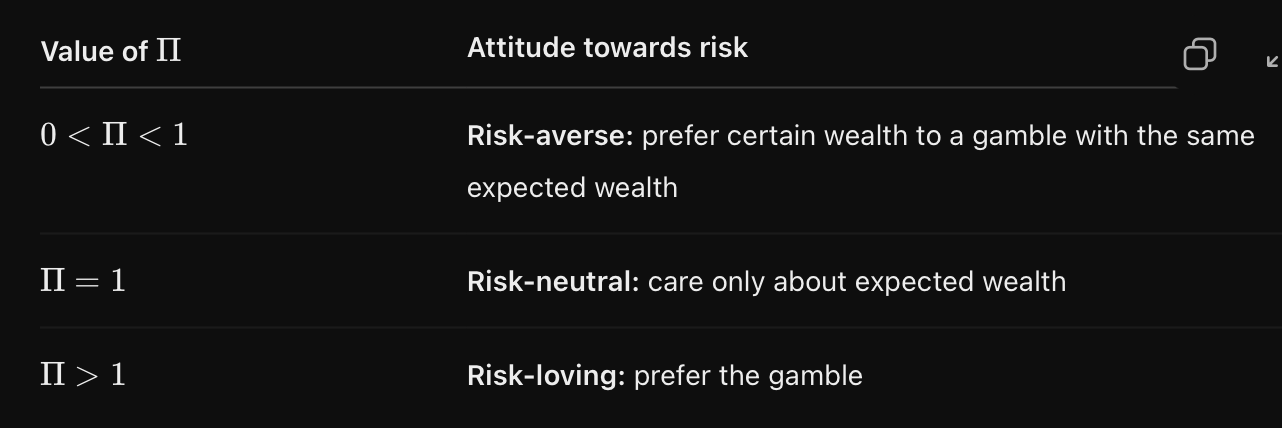
Expected utility of a lottery
The weighted average of the utilities of all outcomes, using probability as weights.
Types of agents when considering risk
Risk averse agents
Risk lovers
Risk neutral agents (indifferent if monetary value is the same, for them more monetary value is better regardless of risk)
Von Neumann and Morgenstern utility function
Calculates how attractive a risky option is to you before you know the outcome (“ex ante”). EV (lottery) = P1 x U (V1) + P2 x U (V2) + … + PN x U(VN). For each possible outcome, multiply its probability by the satisfaction it gives you, then add everything up. Expected money averages the euro amounts; expected utility averages the satisfaction from those amounts. Your slide labels the formula \(EV\), but \(EU\) is clearer here because it calculates expected utility.
Expected utility theorem
Agents choose the lottery with the highest expected utility
What is the Certainty equivalent?
The guaranteed amount of money you consider just as attractive as the lottery. Amount of money that, if provided with certainty, makes the individual different to the lottery.
U(CE) = EV(lottery)
CE compared to money for each type of agent
Risk-averse agents: CE is lower compared to EV
Risk-neutral agents: CE = EV
Risk-loving agents: CE is higher than EV
Why is the CE the maximum price an agent is willing to pay for a lottery ticket?
The intuition is that CE expresses the lottery’s value to you in money. Strictly, CE and maximum willingness to pay can differ because paying for the ticket changes your wealth, which can change how you value the risk.
Risk premium (RP) (of the lottery)
How much expected money you would give up to avoid the lottery’s risk. AKA the price agents subjectively associate to the risk contained in the lottery. RP = EV - CE
RP and risk aversion
Higher the risk premium, the higher the risk aversion, the lower the risk premium, the lower the risk aversion. The RP can be negative if you are risk-loving.
RP if you are risk-neutral
0
Does a risk-averse person prefer more predictable or less predictable payoffs?
A risk-averse person dislikes uncertainty, so they prefer more predictable payoffs when the expected payoff is the same (EV). The less variable the lottery, the closer the outcomes are to the mean of one another EU is higher, even if EV is the same.
EU v U
EU means average utility across the possible outcomes, whereas U(.) means the utility from receiving . amount for certain.
Full insurance
Makes your final wealth the same whether a loss happens or not.
Outcome:
Without insurance:
Loss, probability α, 0
No loss, probability, 1-α, W
With insurance:
Loss, probability α, B-P
No loss, probability, 1-α, W-P
Full insurance: B = W, so both outcomes give V_sure = W-P
Does full coverage insurance have any risk?
No, it takes all the risk
What does an insurer receive?
The premium P, but only pays compensation if a loss happens:
Outcome:
No loss, probability 1-α, profit = P
Loss, α, profit = P-W
Expected profit π of an insurer with full coverage
Compensation B = W. Therefore
Eπ =(1-α)P + α(P-W) = P - αW
αW is the insurer’s expected payout.
For expected profit to be nonnegative P-aW ≥ 0 => P ≥ aW
Fair versus unfair premium
Fair: P = aW - premium equals expected payout, giving zero expected profit in this simplified model
Unfair: P > aW - premium exceeds expected payout, profit is positive.
Horizontal supply curve - insurance
The horizontal supply curve at P = aW represents insurers supplying policies at their expected cost under perfect competition, assuming no other costs.
Who buys full coverage insurance?
A person compares their utility with full coverage insurance = U(W-P) with their utility without insurance = αU(0) + (1-α)U(W).
At a fair premium W-P = (1-α)W = EV_uninsured
So insurance gives the same expected money, with certainty:
A strictly risk-averse person prefers insurance.
A risk-neutral person is indifferent.
A strictly risk-loving person prefers remaining uninsured.
Why with fair insurance does this not mean everyone gets insured?
Even though EV_uninsured = W-P at a fair premium, which should make everyone indifferent, people compare utility, not just expected money, when deciding whether to buy insurance.
EU_uninsured = αU(0) + (1-α)U(W) = (1-α)U(W)
U_insured = U(W-P)
You are willing to buy if: U(W-P) ≥ EU_uninsured
Equality means you are indifferent.
Your utility curves are different, the more concave = more risk-averse (a preference for certainty), the more convex = more risk-loving (a preference for uncertainty), linear = indifferent
How does V_unfair insurance compare to EV_uninsured
V_unfair insurance < EV_uninsured = V_fair insurance
P_unfair > P_fair
Therefore V_unfair insurance < V_fair insurance
V_fair insurance = EV_uninsured
Without insurance, expected wealth is W-aW. With insurance, certain wealth is W-P.
Fair premium P = aW so certain wealth equals uninsured expected wealth
Unfair premium P>aW so certain wealth is lower than uninsured expected wealth.
A risk-averse person may accept that lower amount because it is certain.