Chromatin Organization of DNA
 Call Kai
 Learn
 Practice Test
 Spaced Repetition
 Match
 Flashcards
 Knowt Play
1/38

There's no tags or description
Looks like no tags are added yet.
39 Terms
Chromatin
DNA packaged with HISTONE proteins
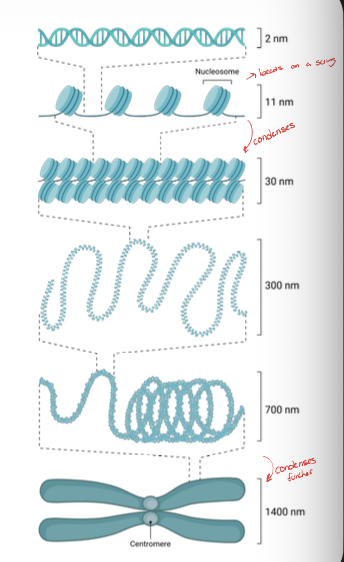
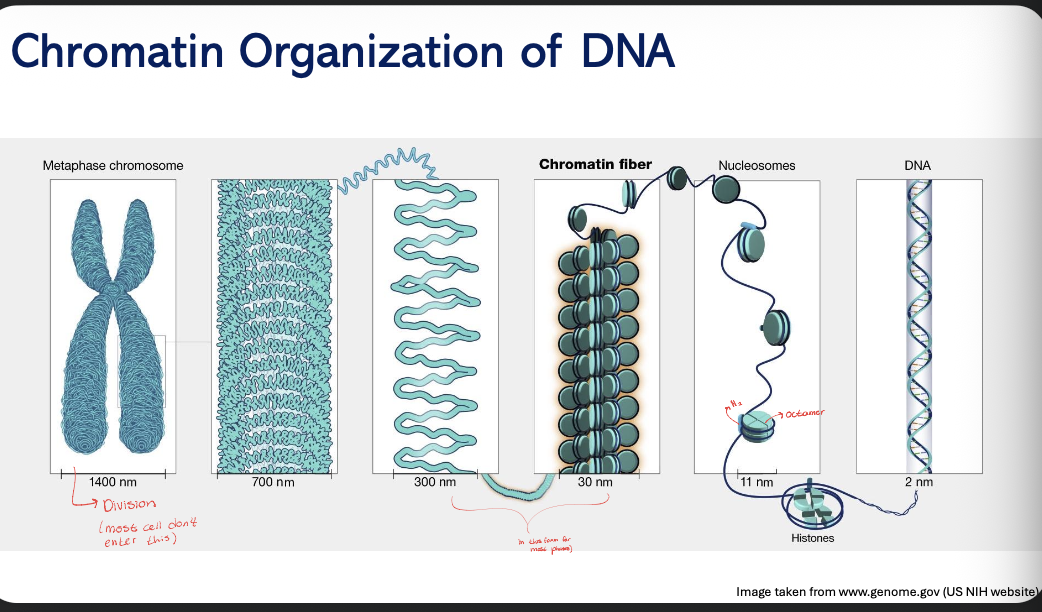
Compacts DNA to a WHAT of its linear size
Compacts DNA to a SMALL FRACTION of its linear size

The basic unit of chromatin is the WHAT
The basic unit of chromatin is the NUCLEOSOME
A nucleosome:
A core of WHAT proteins (octamer)
146 bp of DNA that wraps around the core WHAT times
A nucleosome:
A core of 8 HISTONE proteins (octamer)
146 bp of DNA that wraps around the core 1.7 times
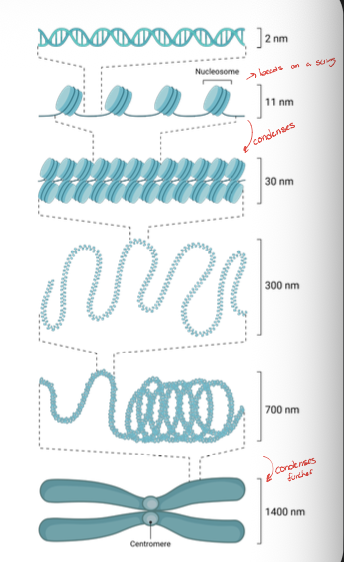
Chromosomes are complete segments of WHAT - becomes highly WHAT during cell division
Chromosomes are complete segments of CHROMATIN - becomes highly CONDENSED during cell division
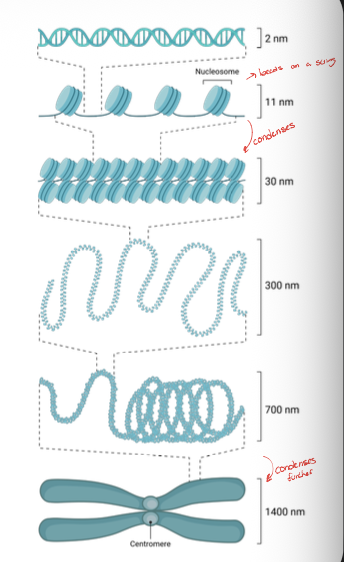
Core histones (make up nucleosomes)
Histones WHAT, WHAT, WHAT, and WHAT
20% of amino acids are WHAT and WHAT (basic residues)
Therefore, have overall WHAT - attract WHAT DNA
Have tails which interact with WHAT
Core histones (make up nucleosomes)
Histones H2A, H2B, H3 and H4
20% of amino acids are LYSINE and ARGANINE (basic residues)
Therefore, have overall POSITIVE CHARGES - attract NEGATIVELY CHARGES DNA
Have tails which interact with PROTEINS

Histone H1 is a WHAT histone
Histone H1 is a LINKER histone
Histone H1 binds DNA that links WHAT
Histone H1 binds DNA that links ADJACENT NUCLEOSOMES

What are the two chromatin compaction of DNA
WHAT
WHAT
What are the two chromatin compaction of DNA
Heterochromatin
Euchromatin
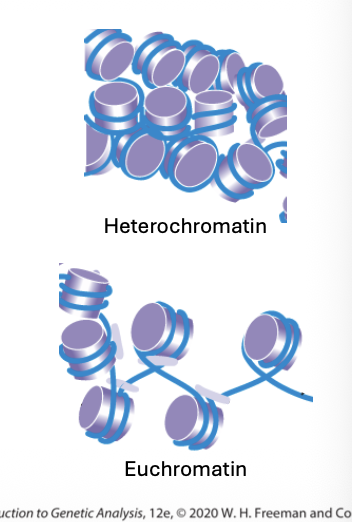
Heterochromatin is MORE WHAT, DNA is less WHAT to proteins (transcription WHAT)
Heterochromatin is MORE COMPACT, DNA is less ACCESSIBLE to proteins (transcription INACTIVE)
What are the two types of heterochromatin
WHAT
WHAT
What are the two types of heterochromatin
Constitutive heterochromatin
Facultative heterochromatin

Constitutive heterochromatin
Always more WHAT
Genes are WHAT expressed
Constitutive heterochromatin
Always more COMPACT
Genes are NEVER expressed

Facultative heterochromatin
Can revert to WHAT and back
Genes WHAT expressed
Facultative heterochromatin
Can revert to EUCHROMATIN and back
Genes COULD BE expressed

Euchromatin is WHAT, DNA is more WHAT to proteins (transcriptionally WHAT)
Euchromatin is LESS COMPACT, DNA is more ACCESSIBLE to proteins (transcriptionally ACTIVE)

How do we study the association of histone proteins and DNA
Chromatin Immunoprecipitation (ChIP)

What are the two forms of chromatin alterations
WHAT
WHAT
What are the two forms of chromatin alterations
Chromatin modification
Chromatin remodelling
chromatin remodeling
Physically WHAT, WHAT, or WHAT core histone proteins
Alters WHAT of DNA
chromatin remodeling
Physically REPOSITIONING, REMOVING, or REPLACING core histone proteins
Alters ACCESSIBILITY of DNA
Chromatin modification
WHAT
WHAT
Chromatin modification
Histone modification
DNA modification
Both forms of chromatin modification are WHAT
Both forms of chromatin modification are EPIGENETIC MODIFICATION
Epigenetic modifications are WHAT modifications to DNA that do not change the underlying WHAT
Epigenetic modifications are EXTERNAL modifications to DNA that do not change the underlying DNA SEQUENCE
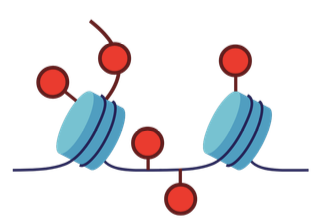
They play important roles in regulation of WHAT by making it more or less likely for a gene to be WHAT
They play important roles in regulation of GENE EXPRESSION by making it more or less likely for a gene to be TRANSCRIBED
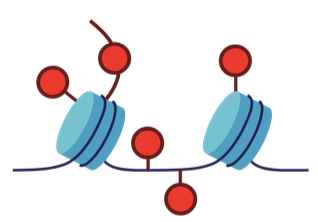
Despite not changing the DNA sequence, epigenetic modifications do change WHAT, and so they can be passed down when WHAT, called WHAT
Despite not changing the DNA sequence, epigenetic modifications do change CHROMATIN STRUCTURE, and so they can be passed down when CELLS DIVIDE, called EPIGENETIC INHERITANCE
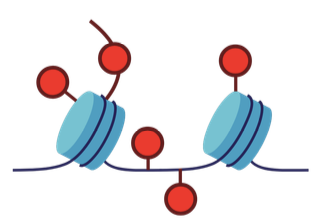
Histone Acetylation
The addition of an acetyl group to the WHAT of a histone protein
Primarily modifies the WHAT, just like other histone modifications
Histone Acetylation
The addition of an acetyl group to the LYSINE RESIDUE of a histone protein
Primarily modifies the TAIL, just like other histone modifications

What are the two types of histone acetylation
WHAT
WHAT
What are the two types of histone acetylation
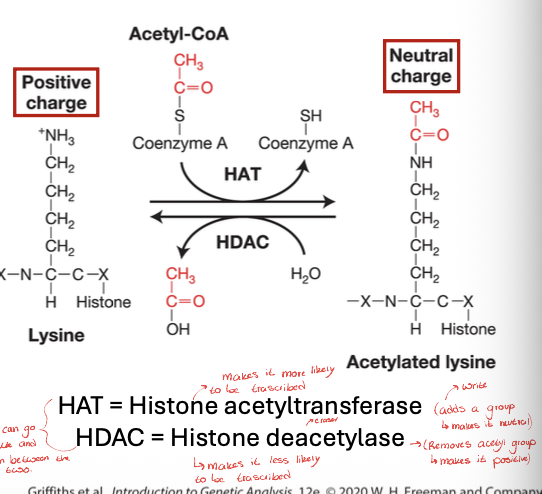
Histone acetyltransferase (HAT)
Histone deacetylase (HDAC)
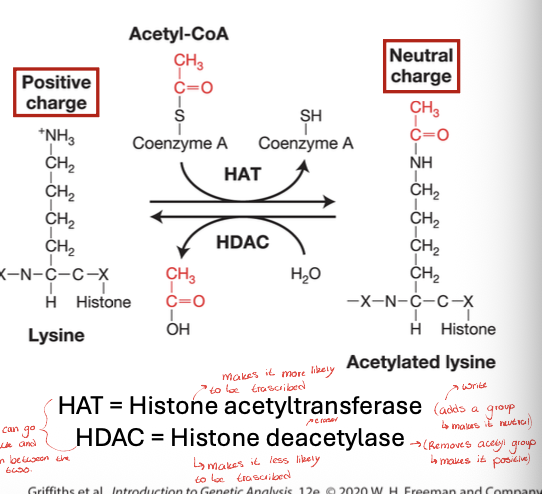
Histone acetyltransferase (HAT)
WHAT a acetyl group making it WHAT
Makes the DNA WHAT to be transcribes
Histone acetyltransferase (HAT)
ADDS a acetyl group making it NEUTRAL
Makes the DNA MORE LIKELY to be transcribes

Histone deacetylase (HDAC)
WHAT an acetyl group, making it WHAT
Make the DNA WHAT to be transcribed
Histone deacetylase (HDAC)
REMOVES an acetyl group, making it POSITIVE
Make the DNA LESS LIKELY to be transcribed
What are the two results of histone acetylation
WHAT
WHAT
What are the two results of histone acetylation
Reduces chromosome compaction
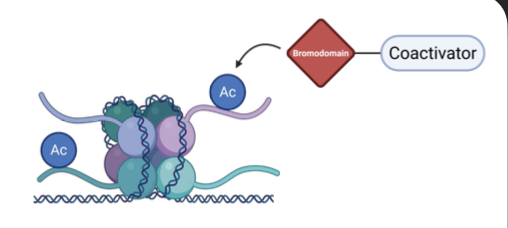
Creates a binding site for a protein domain called a bromodomain

Reduced chromosome compaction
The reduction in WHAT charge in the histone tail causes a WHAT in chromatin compaction
Means that genes are more WHAT to transcription factors and RNA Pol II
Reduced chromosome compaction
The reduction in POSITIVE charge in the histone tail causes a LOOSENING in chromatin compaction
Means that genes are more ACCESSIBLE to transcription factors and RNA Pol II
Creates a binding site for a protein domain called a bromodomain
Many transcription coactivators contain WHAT
These coactivators bind acetylated WHAT and WHAT
Creates a binding site for a protein domain called a bromodomain
Many transcription coactivators contain BROMODOMAIN
These coactivators bind acetylated LYSINES and ACTIVE TRANSCRIPTION
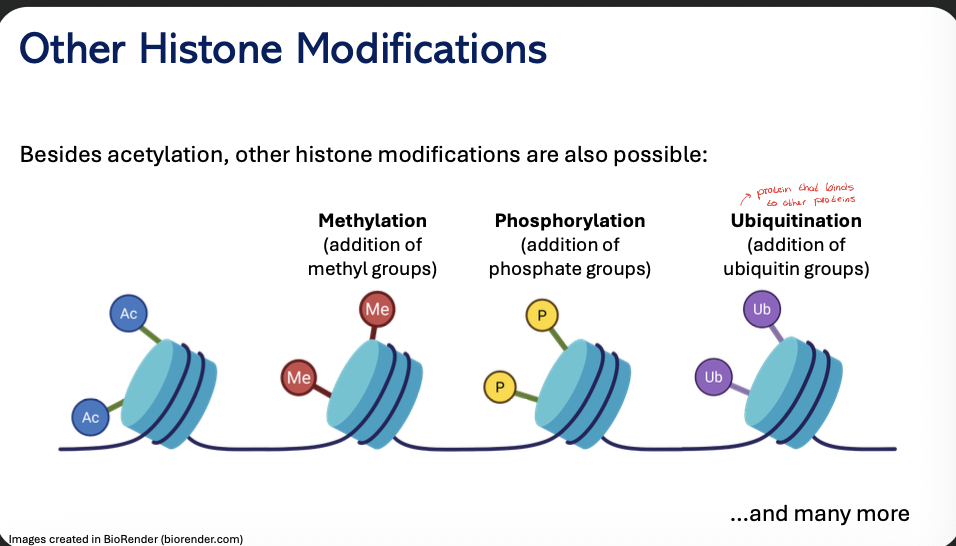
The histone code hypothesis proposes that combinations of epigenetic histone modifications control WHAT by regulating how DNA is WHAT
The histone code hypothesis proposes that combinations of epigenetic histone modifications control GENE EXPRESSION by regulating how DNA is ACCESSED

Transcription factors bind to WHAT
Transcription factors bind to DNA BINDING SITES
Coregulators bind to WHAT
Coregulators bind to OTHER PROTEINS
The predominant DNA modification in vertebrates is methylation of WHAT to form WHAT (5mC) at WHAT sites
The predominant DNA modification in vertebrates is methylation of CYTOSINE to form 5-methylcytosine (5mC) at CpG sites (a C is phosphodiester bonded to a G)

85% of CpGs are WHAT and are scattered throughout the genome
Most WHAT CpGs are highly clustered in 200-4000 bp regions called WHAT
50% of CpG islands are associated with WHAT, and the majority of promoters are associated with WHAT
85% of CpGs are METHYLATED and are scattered throughout the genome
Most UNMETHYLATED CpGs are highly clustered in 200-4000 bp regions called CpG ISLANDS
50% of CpG islands are associated with PROMOTERS, and the majority of promoters are associated with CpG ISLANDS
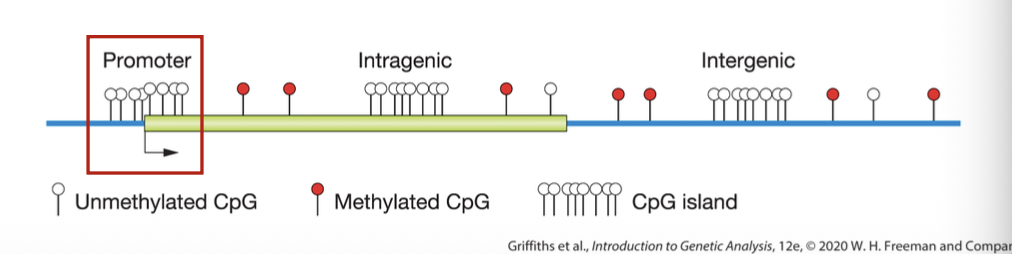
CpG islands at promoters are generally unmethylated in WHAT genes and methylated in WHAT genes
CpG islands at promoters are generally unmethylated in EXPRESSED genes and methylated in UNEXPRESSED genes

Unmethylated CpG islands are associated with WHAT chromatin and WHAT transcription
Unmethylated CpG islands are associated with OPEN chromatin and ACTIVE transcription
Methylated CpG islands are associated with WHAT chromatin and WHAT transcription
Methylated CpG islands are associated with CLOSED chromatin and REPRESSED transcription
