Myositis and Muscle diseases
 Call Kai
 Learn
 Practice Test
 Spaced Repetition
 Match
 Flashcards
 Knowt Play
1/32

There's no tags or description
Looks like no tags are added yet.
33 Terms
List the signs of Muscle Disease (4)
What is the difference between Myalgia vs Myositis
Signs of Muscle Disease:
Fixed weakness (true muscle weakness)
Premature fatigue/exercise intolerance
Postexertional aches, cramps, myalgias
Problems w/ ADLs
Myalgia is not Myositis
Muscle diseases: weakness > pain
Myalgia syndromes: pain > weakness
EX: Fibromyalgia, Polymyalgia Rheumatica, Regional/Diffuse Pain Syndromes
Cramps +painful sustained contractions + involuntary contractions often relate to?
Cramps +painful sustained contractions + involuntary contractions often relate to:
Lower motor neuron disease,
Electrolyte disorders,
Circulatory disorders
List “ the cardinal symptom” of Muscle Weakness (4)
List the muscle affected and how presentation is different across varying diseases (3)
Weakness:“ the cardinal symptom”
Difficulty w/ ADLs
(Getting up from chair, put on socks, Up/Down Stairs, etc)
Knee Pain
Common Complaint
Due to Muscle Weakness
Head:
Ptosis, dysphagia, dysphonia, palate weakness
Gower's sign and Trendelenburg gait
Muscles Affected:
Most myopathic = Prox. Muscle Groups
Distal = Late presentation or inclusion bodies
Asymmetric = neuropathic or infectious
List the Factors suggesting another diagnosis instead of Polymyositis or dermatomyositis
Factors suggesting another diagnosis instead of Polymyositis or dermatomyositis
Asymmetric or distal weakness
Intermittent symptoms
Muscle pain without weakness
Marked muscle atrophy
Calf hypertrophy
Scapular winging
Family history of muscle disease
Medications that can cause myopathy
Neuropathic symptoms or findings
DDX of Myopathies (7)
Autoimmune /Inflammatory disorders but also
Paraneoplastic or Neoplasm
Drugs
Infections
Endocrinopathies
Neuropathic disorders
Inborn errors of metabolism/storage disorders
Pain syndromes
List the myopathies associated w/ these age of onset:
childhood - teen
18-50
>50
List the myopathies associated w/ these time of onset:
Months - Yrs
Weeks - Months
Days - Weeks
Episodic
Age of onset:
Childhood - teen:
Duchenne Dystrophy
Juvenile dermatomyositis
18-50:
inflammatory myopathy,
metabolic myopathies,
Endocrinopathies,
various dystrophies
– > 50:
inclusion body disease,
inflammatory associated with cancer
Time to onset:
Months – years:
inclusion body,
dystrophy
Weeks – months:
Inflammatory,
drug/toxic,
Endocrinopathies
Days – weeks:
Infectious,
Dermatomyositis (rare),
drug induce rhabdomyolysis,
Episodic:
periodic paralysis
For Myopathies; things to look for and Ask? (6)
DDX if:
Muscle Pain at rest: (5)
Exercise intolerance: (1)
Cramps: (2)
Non Muscular Findings and what they indicate (6)
Things to look for and ask
Inability to lift head or swallow saliva:
poor prognostic sign.
Movement abnormalities ((dystonia, myokymia)
lower motor neuron disorders
Muscle volume: unaffected.
Atrophy
lower motor neuron disease,
long standing untreated myopathies.
Family history
Just how sick does this individual look
Inpatient vs. outpatient work up
“Severity categorization”
DDX if:
Muscle Pain at rest:
drug induced,
Juvenile Dermatomyositis,
severe inflammatory (with necrosis),
infectious,
myopathy with metabolic bone disease
Exercise intolerance:
Metabolic myopathies (esp. CPT deficiency)
Cramps:
dystrophies,
metabolic myopathies
Non Muscular Findings
Rash:
Dermatomyositis, SLE, PSS
Other Rheumatic disorders:
Raynaud’s, sicca, interstitial lung changes
Endocrine:
delayed reflexes, exophthalmos
Mitochondrial:
seizures, stroke like phenomena, retinopathy, sensory neural hearing loss (MELAS)
Rhabdomyolysis:
Extreme weakness and “coca cola” urine
Myoglobinuria:
drug induced rhabdomyolysis
(stimulants and opiates),
CPT deficiency
If the pt presents w/ Shortness of breath with myositis or myopathy:
DDX (5)
Labs (2)
Generally?
What about Dysphagia + dysphonia: (3)
Shortness of breath with myositis or myopathy *
DDX:
Inflammatory lung interstitial lung disease
Acid maltase disorder
Carnitine deficiency.
deconditioning + poor exercise tolerance
Anti- Synthetase syndrome
Labs
ANA +, anti-Jo-1 Antibody +,
It is generally not an early sign/symptom.
Dysphagia + dysphonia:
Lower motor neuron disease,
ALS (primary bulbar)
Inflammatory myopathy.

Dermatomyositis: heliotrope rash involving eyelids

Dermatomyositis: Heliotrope rash on eyelids

Dermatomyositis: rash lower neck and chest

Childhood dermatomyositis:
rash elbows, knees

Dermatomyositis: macular rash and acanthosis nigricans

Dermatomyositis: Trash on extensor surface of PIP, MCP, DIP knuckles
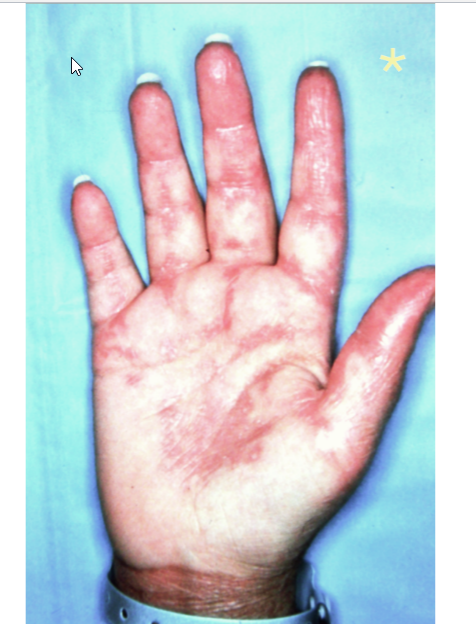
Dermatomyositis: Mechanic’s Hand

Dermatomyositis, childhood: subcutaneous calcification, knees and lower extremity
Initial Labwork you should order? (6)
Other Studies? (3)
List the Muscle Related enzymes when damage or death (5)
Initial Labwork
CBC, Chemistries
ESR, CRP
TSH, free T3 , Free T4 if TSH abnormal
Glucose
Muscle enzyme analysis
CK, Aldolase. Sometimes Myoglobin
Carnitine:
If neg. biopsy or nonspecific toxic/meta changes
Other studies
EKG
if has cardiac history, findings, or symptoms
PFTs
if lung symptoms or prior history
Malignancy work up
Muscle related enzymes
CK:
Types: CK-MM (90%); Also CK-MB
AST, ALT
AST >> ALT for muscles
LDH
Type II fibers
Aldolase
Also related to RBC lysis
Myoglobin
[Urinary] does not correlate w/ serum
renal tubular resorption, water resorption, and proteolytic factors
More sensitive than CK
List the Autoantibodes present in Myopathy
List the overlap w/ other diseases (5)
Autoantibodies
ANA and Myositis Specific Antibodies (MSA)
Overlap w/ other diseases:
SSA/SSB with Sjogren’s
90% Sjogren’s are ANA and/or RF positive
RNP with MCTD
ANA/dsDNA/Sm with SLE and overlap
SCL-70 with PSS and overlap
RF/CCP with RA and overlap
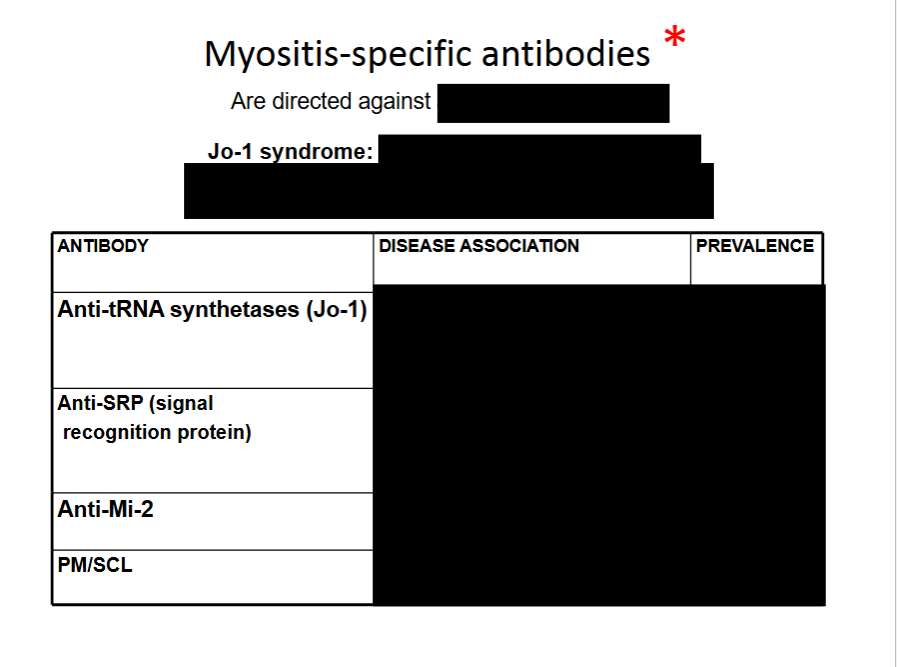

Describe EMG/NCV *
Uses (3)
Typical findings (3)
Describe Biopsy
Uses
Procedures
Stains
EMG/NCV *
Uses:
Differentiates
neuropathic vs. myopathic disorders
weakness from poor effort.
Severity.
Helps localize site for biopsy:
Biopsy opposite side.
Typical inflammatory finding is:
Increased insertional activity, fibrillations, sharp waves
Spontaneous high frequency discharges
Low amplitude/short duration polyphasic motor unit potentials
Muscle Biopsy
Uses:
Provides histology and generally more accurate diagnosis, prognosis and therapeutic options
Procedure:
Select weakest muscle group that is not atrophic)
Proximal muscle site for most biopsies
Often Deltoid or Vastus Lateralis
Distal site if suspect Inclusion Body Myositis
Open biopsy: yes. (Needle biopsy often not advised)
Stains:
H & E & “Special” Stains
Electron Microscopy
NOTE:
• Inflammatory disorders may “skip” around, so blind biopsy may miss an inflamed area.
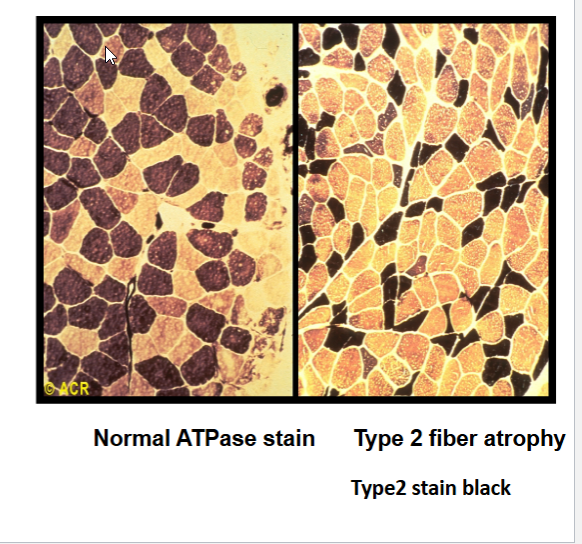
Type 2 fiber atrophy
Causes
What does it look like?
Disuse
Steroids
Aging
Malnutrition/
cachexia
Hypothyroid
Alcohol

Increased Risk Factors for Malignancy?
Increased Risk Factors for Malignancy
Older age at onset
Severe skin disease, shawl sign, necrosis
Resistance to treatment
Prior malignancy with risk of relapse
(Less risk if interstitial lung disease present)
Describe Imaging Studies:
Types?
Helpful for?
Imaging studies
Types: Ultrasound, CT, and MRI
MRI w/ fat suppression or STIR = guide biopsy; but not diagnostic
Helpful for:
Infectious etiology
CT abdomen/pelvis for ovarian cancer
Treatments for Inflammatory Myopathies?
When to Hospitalize?
Treatments for Inflammatory Myopathies
Prednisone
Taper slowly (-20%/month)
Watch CKS and strength
If Severe: “pulse” Methylprednisolone therapy
250 mg Q 6 hours x 3 days then decrease to Prednisone 20 mg t.i.d.
Less CNS affect and less dysrhythmias
Check electrolytes Q 6-12 hours
Specifically looking for Hypokalemia
Glucose checks as required
Low dose anxiolytics as necessary
DMARD therapy for steroid sparing effect
Methotrexate, Azathioprine, Cyclosporine, Mycophenolate mofetil
Rituximab IV, Cyclophosphamide,
Intravenous Immunoglobulin
Hydroxychloroquine for Dermatomyositis
When to hospitalize
Extremely high CK: 10,000 or more
Profound weakness and inability to perform basic hygiene/walk, falls, or falling risk.
Dysphagia with aspiration.
Loss of neck flexors
Describe Poly/Dermatomyositis hospital patient
Complications to Consider:
Hospital Location: (2)
What to do: (4)
Poly/Dermatomyositis hospital patient
Complications to Consider:
cardiac conduction abnormalities or CHF
Hospital Location:
ICU/IMC
What to do:
Elevate head of bed to 30 degrees at all times
Aspiration precautions
Get Swallowing studies
Bedside PFTs Q 2-4 hours:
if FVC decreases by 20% or at <50% expected, check ABGs and Pulmonary consult (elective intubation ?)
Describe IV IgG vs. Plasmapheresis
Complications (2,2)
Cost
List non-drug tx
IV IgG vs. Plasmapheresis
Complications:
Plasmapheresis:
infection,
Hypotension
IVIG
headache/meningismus
Infusion rate related
Money:
IVIG = more expensive
NOTE: Watch for CP status
Non Drug Treatments
Exercise
Can be done early on.
Bed rest generally only in rhabdomyolysis
PROM/AROM
Physical therapy
Gait evaluation and training
Swallowing evaluations
OMM
What to consider for pts w/ myositis, hyperlipidemia, and cardiovascular disease
Pt with myositis, hyperlipidemia, and cardiovascular disease
Statins = relative CI
Recommend monitoring CK ~ every 1-2 months
If CK 2x baseline: discharge/recheck
If no change, consider repeat biopsy.
List the drugs that can induce myopathy
Presentation of neuropathic disorders?
Drug Induced Myopathy
Alcohol
Statins/fibrates, Gemfibrozil
Amiodarone and simvastatin (Inhibit CYP3A4)
Cocaine/stimulant drugs/heroin
Colchicine
Steroids
Hydroxycholorquine (Plaquenil), D- Penicillamine
Phenytoin, valproic acid
Nicotinic acid
Zidovudine
Diuretics:
Neuropathic Disorders:
Presentation:
Asymmetry, distal involvement
Cranial neuropathies
Ptosis
Atrophy
Abnormal DTr
NOTE: Inclusion Body Myopathy = distal
List the Endocrine disorders associated w/ myopathy
List the metabolism/storage disorders
Endocrine Disorders
Acromegaly
Cushing's syndrome
Hypo/hyperthyroidim
Hyperparathyroidism
Diabetes:
Neurogenic atrophy, or as Diabetic muscle infarct
Inborn errors of metabolism/storage disorders
Glycogenoses
Lipid storage disorders
Mitochondrial disease
Carnitine Deficiency
Carnitine palmitoyltransferase deficiency Presentation (4)
Carnitine palmitoyltransferase deficiency
Extremely high CK, rhabdomyolysis
Early adult onset
labor (sustained) intensive job provokes, but often tolerate short burst of exertional activity
At risk from stimulant drug rhabdomyolysis


