310 exam 2
 Call Kai
 Learn
 Practice Test
 Spaced Repetition
 Match
 Flashcards
 Knowt Play
1/100

There's no tags or description
Looks like no tags are added yet.
101 Terms
demand is measured by
customer services levels, aka the perfect order
inventory turnover
the number of times within a time period the inventory investment is recouped
order-to-delivery lead time
customer expectations; purchasing, manufacturing, and shipping lead time
pull processes
execution is initiated in response to a customer order
push processes
execution is initiated in anticipation of a customer order
push/pull boundary
separates push processes from pull processes
push process pro
less carrying costs
push process con
longer delivery lead time
pull process pro
faster order-to-delivery lead time
pull process con
carry costs
factors that determine pull or push strategy
customer expectations of order-to-delivery lead time and forecast accuracy
make-to-stock process
standard products
make-to-order process
custom products
assemble-to-order process
option products (requires WIP inventory, sub-assembly, components on hand)
production economies of scale
the cost advantage that arises with increased output of a product resulting from fixed costs being spread over a larger number of units
volume-variability profiling
to improve decision-making related to procurement, manufacturing, distribution, and inventory strategies

A
high volume products with low variability
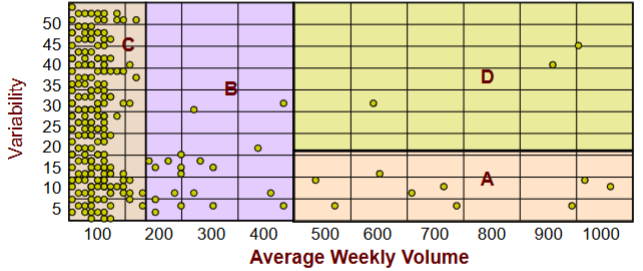
B
Medium volume products with low-to-medium variability
C
All low volume products

D
medium-to-high volume products and high variability
assembly line
sequence of workstations connected together by a materials-handling system, which is used to assemble components into final product
batch & queue
all the units in a given lot complete a particular stage of production before they move onto the next stage
market mediation function
the variety of products reaching the marketplace matches what consumers want to buy
cellular manufacturing
manufacturing system where the equipment and workstations are arranged in an efficient sequence, continuous and smooth movement of inventories and materials to produce products from start to finish in a single process flow, while incurring minimal transport or waiting time
cellular manufacturing benefits
reduced inventory levels, reduced production time, increased customer responsiveness
cellular manufacturing cons
high production and shipping costs
demand management
the mutual modification or creation of demand across firms in the SC for the purposes of improving the long-term performance of the individual companies and the SC as a whole
collaborative forecasting
purposive exchange of specific and timely information (quantity, level, time horizon, location, probability of new business…) between trading partners to develop a single shared projection of end user demand
demand planning
coordination of the flow of derived demand through companies in the SC for the purposes of improving the long-term performance of the individual companies and the SC as a whole
independent demand is…
end user demand
CPFR stands for…
collaborative planning, forecasting, and replenishment
manufacturer strategy and planning
account planning and market planning
retailer strategy and planning
vendor management and category management
collaborative strategy and planning
collaboration arrangement
manufacturer demand and supply management
market data analysis and order planning
retailer demand and supply management
POS forecasting and replenishment planning
collaborative demand and supply management
sales forecasting and demand planning
demand planning
coordination of the flow of derived demand through companies in the SC for the purpose of improving the long-term performance of the individual companies and the SC as a whole
manufacturer execution
product & supply planning and logistics/distribution
retailer execution
buying/re-buying and logistics/distribution
collaborative execution
order generation and order fulfillment
manufacturer analysis
execution monitoring and customer scorecard
retailer analysis
store execution and supplier scorecard
collaborative analysis
exception management and performance assessment
order planning
order plan is created consistent with the sales forecast, capacity limits, MOQ, lead time, safety stock rules, and current inventory position
replenishment planning
reconciles customer demand with an organization’s inventory levels and policies to determine time-phased replenishment needs
barriers to CPFR
requires synchronous changes in corporate culture/trust, measuring value and financial results, insufficient organizations/process enablement, lack of scalability from the pilot stage
CPFR implementation
develop CPFR front-end agreement, create joint business plan, create sales forecast, identify exceptions for sales forecast, resolves/collaborate on exception items, create order plan, identify exceptions for order plan, resolve/collaborate on exception items, order generation
functional demand
predictable demand
innovative demand
unpredictable demand
functional product life cycle
> 2 years
innovative product life cycle
3 months to 1 year
functional contribution margin
5% to 20%
innovative contribution margin
20% to 60%
functional product variety
low
innovative product variety
high
functional average margin forecast error at the time production is committed
10%
innovative average margin forecast error at the time production is committed
40% to 100%
functional average stockout rate
1% to 2%
innovative average stockout rate
10% to 40%
functional average end-of-season markdowns
0%
innovative average end-of-season markdowns
10% to 25%
functional lead time required for make-to-order products
6 months to 1 year
innovative lead time required for make-to-order products
1 day to 2 weeks
two types of products
functional products and innovative products
physical function costs
converting raw materials into parts, components, FGs, and transporting and storing goods
market mediation costs
ensuring the variety of products reaching the marketplace matches what the consumers want to buy
return on assets
profit generated by the assets possessed by the firm
strategic profit model
a method for summarizing the factors that affect a firm’s financial performance, measured by ROA
profit planning
margin, income statement, gross margin, operating profit, net profit margin
margin
the difference between the price and the “cost” of a product or service
gross margin
total sales revenue - total COGS
operating profit
gross profit - operating expenses
net profit margin
operating profit - (taxes&interest)
current assets retailers own
inventory, cast, assets receivable
fixed assets retailers own
fixtures, equipment, vehicles, real estate
current assets retailers owe
payroll, accounts payable, rent/overhead, short term loans
fixed assets retailers owe
long term loans, mortgage
inventory turnover definition
the number of times within a time period the inventory investment is recouped
inventory turnover equation
COGS / average inventory at cost
net profit margin definition
how much profit (after taxes, interest income, and extraordinary gains & losses) a firm makes divided by its net sales.
net profit margin interpretation
reflects the profit generated from each dollar of sales
income statement
summarizes a firm’s financial performance over a period of time
net sales
total revenue received by a retailer that are related to sell merchandize during a time period
COGS
number a retailer pays to vendors for the merchandise the retailer sells and transportation costs
gross margin/profit definition
indicates how much profit the retailer is making on merchandise sold, w/o considering the expenses associated w/ operating the store and corporate overhead expenses
slotting fee/slotting allowance
charging vendors for space in their stores
chargeback fee
if merch bought from the vendor does not meet all the terms of the purchase agreement
operating expenses definition
overhead costs associated w normal business operations
operating profit margin equation
gross margin - operating expenses
net profit margin definition
other income or expenses not associated with the retailers fundamental operations
assets
economic resources owned or controlled by a firm
current assets definition
can be converted to cash within one year
fixed assets definition
not likely to be converted to cash within one year
performance objectives
a numerical index that can be measured, a timeframe within the object is to be achieved, and resources needed to achieve the objective
top-down planning
goals get set at the top of the org and are passed down to the lower operating levels
bottom-up planning
lower levels in the company developing performance objectives that are aggregated up to develop overall company objectives
output measures
assess the results of a retailers’ investment decisions
productivity measure
determines how effectively retailers use their resources- what they get on their investments in inputs
input measures
the resources or money allocated by a retailer to achieve outputs, or results