UF BSC2010 Exam 2 (updated)
 Call Kai
 Learn
 Practice Test
 Spaced Repetition
 Match
 Flashcards
 Knowt Play
1/210

There's no tags or description
Looks like no tags are added yet.
211 Terms
Genotype
An organism's genetic code

Phenotype
An organism's physical traits; caused by genotype
Chromosome
Where genetic material is carried
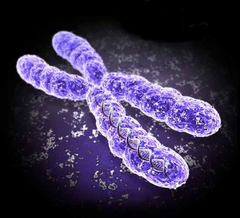
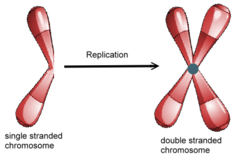
chromosome disclaimer
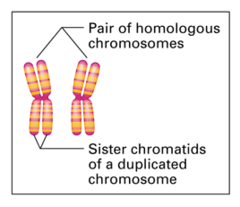
chromosomes stereotypically look like X shape (aka has 2 sister chromatids)
but can look just like an l shape (so just 1 chromatid)
so both sides of the picture are chromosomes (just single vs double stranded types or unreplicated vs replicated)
XX vs XY chromosome
XX = female
XY = male

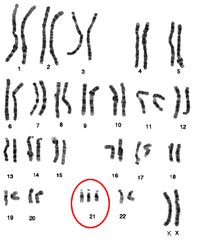
Aneuploidy & 2 types
= abnormal # of chromosomes
types:
trisomy = 2n +1 (one extra chromosome)
monosomy = 2n - 1 (one fewer chromosome)
Polyploidy
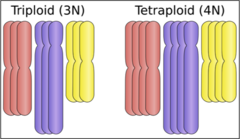
= having an extra *set* of chromosomes
types:
triploidy = 3 sets
tetraploidy = 4 sets
Sister chromatids
The 2 strands shown in a replicated chromosome

Centromere
Point of attachment of sister chromatids

Homologous Chromosomes
Pair of separate chromosomes that are the same size & appearance
Alleles
Different versions of the same gene

Mutation
Accidental change to DNA
Silent mutation
Does not result in a functional change
Codon
Sequence of 3 bases

Sense codons
Codons that DO code for amino acids
-they've got the sense to
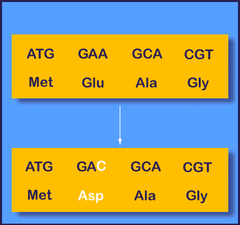
Missense mutation
Result in a change in an amino acid
-ex: GAU codes for aspartic acid, while GUU codes for valine so a change from GAU to GUU results in diff amino acid
Nonsense mutation
Insertion of premature stop codon
- so NO sense codon, stops before it gets to code
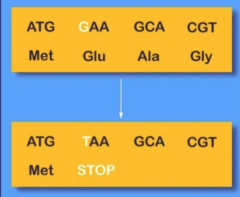
Loss-of-stop mutation
When stop codon is changed to sense codon
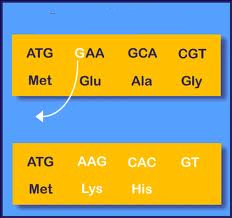
Frameshift mutation
When 1 or 2 bases (3 is different mutation) are inserted in a sequence, thus moving the reading frame
-Can be insertion or deletion
Mismatch Mutation & Repair
Corrects incorrect bases after replication ends

mRNA (messenger RNA)
The message/blueprints for making protein
- Copies genetic instructions from nucleus & acts as messenger (tells what the order of amino acids is/how to build the given protein)
tRNA (transfer RNA)
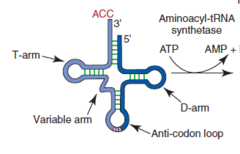
The delivery truck for making proteins
-Top side carries correct amino acid to growing polypeptide strand & bottom side (called anticodon bc opposite the codon) binds to mRNA to read its instructions

tRNA shape
funky T
-ignore labels on picture (just know general shape & amino acid on top, anticodon on bottom)
Anticodon
Where the tRNA binds to mRNA (lines up w/ codon that mRNA has, hence called ANTIcodon)

rRNA (ribosomal RNA)
The factory where mRNA and tRNA come together (looks like seat)
-rRNA glues them the amino acids together (once tRNA brings them over) to form chain

Protein synthesis
2 steps: transcription & translation
Transcription
RNA -> DNA
blank
blank
blank
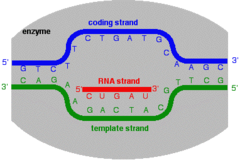
Coding vs template strand
Coding = Strand with the same sequence as the mRNA (except U is switched for T)
Template = strand complementary to the coding strand- read by RNA polymerase
What happens after transcription/ during post-transcriptional processing?
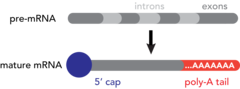
1) Guanine cap (g-cap) is added to 5' end of pre-mRNA to protect mRNA
2) Poly-A tail of 100-200 molecules (long ass chain of just A) is added to 3' end of pre-mRNA (again to protect the strand)
3) RNA splicing occurs
-Introns are cut out of spliced genes, extrons remain (names annoyingly backwards)
Intron
Junk, sequence of nucleotides that are transcribed but REMOVED from pre-mRNA after transcription

Extron
Nucleotide sequences that are not removed after transcription
-Glued by spliceosomes

Spliceosomes
The scissors and glue for pre-mRNA
-Cuts introns out & glues extrons together to form mature mRNA
-"splice" = join

Code for the "start codon"
Amino acid: Methionine (MET)
Sequence: AUG
3 sequences for "stop codon"
UAA, UAG, UGA
Translation
mRNA -> protein
Polypeptide synthesis: A site
(Aminoacyl) entry site
-Where incoming charged tRNA meets the ribosome (rRNA's seat job)

Polypeptide synthesis: P site
(Peptidyl) binding site
-Where the amino acid brought by the tRNA is actually attached to the growing polypeptide chain (rRNA does its gluing job)

Polypeptide synthesis: E site
Exit site, where tRNA molecules move to be released by the ribosome
overall: tRNA shifts right to left (EPA)

Processes that can occur in post-translational processing
Glycosidation, Phosphorylation and Proteolysis
Glycosidation
Addition of a sugar
Phosphorylation
The addition of phosphate group
Proteolysis
Breakdown of proteins
Pyrimidines
C, T, U
- have only one ring
Purines
A, G
-two ringed
"PURe As Gold)
Central Dogma
DNA -> RNA -> Protein
aka Replication -> Transcription -> Translation
(the flow of genetic info transformation)
Origins of Replication
Site DNA replication begins, where proteins attach to the DNA and form "replication bubbles"
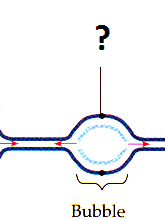
Replication Fork
Formed as a result of "replication bubbles", DNA replication proceeds in both directions here

Amplification
Artificial process that increases/amplifies DNA
- Used in lab, not part of normal process (forced)
Leading vs lagging strand
Leading = runs 5' to 3' so synthesized normally
Lagging = runs 3' to 5' so keeps falling behind bc enzyme keeps backtracking to synthesize small segments in 5' to 3' direction

Initiation, Elongation, & Termination disclaimer
Initiation, Elongation, & Termination are the 3 general steps (in that order) that occur for DNA replication, transcription, & translation (so occurs 9 times total)
Semi conservative
DNA Replication is this
-when new DNA is formed, one strand (template strand) is "old" (dark blue) and the other is "new" (light blue) aka some old is conserved

Synthesis of leading vs lagging strand
Leading -> Continuous
Lagging -> Discontinuous (synthesis occurs in small segments aka okazaki fragments)

Helicase
Unwinds the double helix

Primase
Makes RNA primers that are necessary for DNA polymerase (primase makes short starting point of 3 bases & polymerase builds off of it)
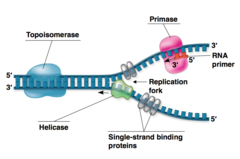
DNA polymerase
Adds nucleotides to both strands during DNA replication

Ligase
An enzyme that "glues" two fragments of DNA to make a single fragment

end-replication problem
every time a chromosome is made, the next one is shorter
Telomeres
Junk nucleotide sequences that repeat hundreds of times at the end of chromosomes to protect them
- Solution to the end replication problem- protects chromosome bc this is cut off instead of important info
similar function to Poly A (protect ends)

Telomerase
Build telomeres
-Only in sex cells not somatic cells (why aging occurs, body cells worn down)
Mitosis
Cell division for somatic (body) cells that produces 2 identical diploid cells

who does mitosis & meiosis
eukaryotes do (aka animals, plants, fungus- everybody but bacteria)
- prokaryotes don't (aka bacteria) bc don't have membrane-bound organelles to divide
Meiosis
Cell division for germ/sex cells that produces 4 different haploid cells
- 2 parts (meiosis 1 and meiosis 2 each w/ their own PMAT)
- haploid because 2 gametes fuse together to form diploid zygote (1 + 1 = 2)

Symmetrical vs Asymmetrical cell division
Sym- A single cell produces 2 identical cells of the same size and contents
Asym- A single cell produces a second cell unlike the first cell
Asexual vs sexual reproduction
Asexual = A single parent produces identical offspring
Sexual = 2 parents produces different offspring
Binary Fission
How single-celled prokaryotes reproduce- is a form of asexual reproduction
Binary fission & who does it
Prokaryotes (bacteria) cell division
- classic example of asexual reproduction
Gamete vs Zygote
gamete = sex cell
-From mom or dad (egg or sperm)
zygote = 2 gametes together
- both egg & sperm
- z comes later in alphabet
Fertilization
Process in which haploid gametes from meiosis are combined to form a diploid zygote
Cancer
Uncontrollable cell division
Binary Fission Steps
1) Signal to initiate 2) DNA replication 3) DNA segregation 4) Cytokinesis
ori vs ter site in replication
ORI site = replication starts (ORIgin of replication) vs replication ends at TER site (TERminus of replication)
Karyotype
A display of the chromosome pairs of a cell arranged by size and shape.

Kinetochores
protein structures on the centromeres, the microtubules latch onto these to drag chromosome

sister chromatids vs homologous chromosomes

Chromatin
the material chromosomes are made of
Centrosome
Regions associated with spindle fiber formation and spindle poles during mitosis.
Are the organizing center for microtubules in cell and sites for synthesis and replication of microtubules

Centrioles
Hollow microtubule rings arranged perpendicular to each other- have same structure as cilia and flagella in that they are made of 9 pairs of microtubule doublets arranged in a circle

Cell Cycle Order
G1, S(synthesis), G2, M(mitosis)

Interphase
Period of cell's life where doing normal functions- 90% of cell's life cycle.
Interphase: G1 phase (growth 1)
Normal functions & prepares for cell division as grows up
- most time of life spent here
Interphase: G0 Phase
Cell "exits" interphase to rest
-goes back to normal functions, but not preparing for cell division bc lacks nutrients for the process
Interphase: S (synthesis) phase
DNA is replicated
Interphase: G2 phase (growth 2)
Cell grows & produces proteins in preparation for Mitosis
M phase (mitosis)
Cell division (includes the PMAT stages)
G1S checkpoint inhibitor
Rb (retinoblastoma protein)
- when present, cell cycle is inhibited at that checkpoint
Ploidy at diff Stages
G1 = 2 diploid
S = 2 to 4 diploid (bc replication) transition
G2 = 4 diploid
Meiosis 1 = 2 haploid
Meiosis 2 = 1 haploid (end result)
Alleles vs Locus
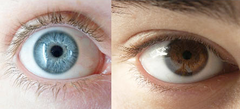
Locus are where alleles resides (DNA at each locus varies so different phenotypes are caused like brown vs blue eye color)
- you inherit one allele from each parent
Mendel Laws (for true-breeding bc Mendel got lucky w/ that)
Law of Segregation = each parent has their own copy of a gene/allele, but due to segregation, only one is passed down to child (2->1)
-ex: tall & short mom & dad -> tall kid
Law of Independent Assortment = genes are handed down independent of one another
- ex: stem color & size are independent
Law of Dominance = dominant & recessive rules
ex: T vs t
Probability Calculations P(A or B) & P(A and B)
P(A or B) = P(A) + P(B)
P(A and B) = P(A) x P(B)
Dependent/Linked vs Independent/Unlinked Assortment
Dependent = Loci assort together, inherited as one unit
- loci close to each other on the same chromosome
- ex: if have R allele then also have Y allele vs if have r allele also have y allele
Independent = loci don't affect each other (9:3:3:1)
- loci on entirely diff chromosomes or far apart on same chromosome
Diplontic vs haplontic life cycle
Diplontic = Organism is diploid & gametes are haploid
Haplontic = Organism is haploid & gametes are diploid
- named after whatever it spends its life as
Prophase (mitosis)
1) Nucleolus disappears
2) Chromosomes condense
3) Mitotic spindle & centrosomes form

Prometaphase (Mitosis)
small stage between prophase & metaphase (not mentioned in PMAT acronym tho)
1) Nuclear envelope breaks down
2) Spindles attach to centromeres at kinetochores

Metaphase (mitosis)
Chromosomes line up in the middle of the cell at the "metaphase plate" or "equator"

Anaphase (Mitosis)
Cell elongates, chromosomes are split in half into sister chromatids and dragged to opposite sides
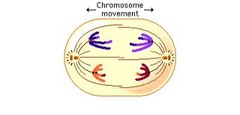
Telophase (Mitosis)
1) Spindle breaks down
2) Nucleoli reform
3) Chromosomes uncondense
*basically the opposite of Anaphase*
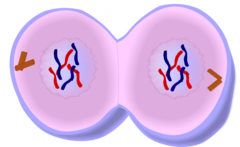
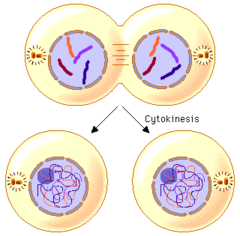
Cytokinesis
2nd component of mitosis (M phase): splits a cell into two parts
- looks similar to telophase but the distinction is that they fully separate here