L127: Farm Animal Dermatology
 Call Kai
 Learn
 Practice Test
 Spaced Repetition
 Match
 Flashcards
 Knowt Play
1/157

There's no tags or description
Looks like no tags are added yet.
158 Terms
1. Sessile or pedunculated
2. head, neck, shoulders most common but can occur anywhere in cattle
3. 5-6 months up to 3 years
4. Spontaneous regression in most cases
5. Juveniles more commonly infected than adults
What is the clinical presentation of bovine papillomavirus?
papilloma virus and bracken fern ingestion
What is enzootic hematuria?
BPV-1
Which BPV strain is associated with lesions on the nose, teats, and glans penis?
BPV-2
Which BPV strain commonly affects the head, neck, and brisket?
BPV-2
Which BPV strain can occasionally involve the gastrointestinal tract (GIT)?
BPV-3
Which BPV strain causes atypical lesions on the head and neck (sometimes interdigital)?
BPV-4
Which BPV strain is associated with the GIT and urinary bladder?
BPV-5
Which BPV strain causes smooth, white teat lesions?
BPV-6
Which BPV strain causes round, flat or frond-like teat lesions?
BPV-1
Which BPV strain most likely caused these lesions?
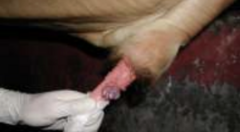
BPV-2
Which BPV strain most likely caused these lesions?
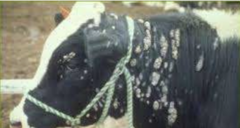
BPV-6
Which BPV strain most likely caused these lesions?

1. appearance
2. biopsy to make sure they are not neoplastic (SCC)
3. PCR
How is BPV diagnosed?
1. Bening neglect
2. Surgery, cryosurgery, laser, cautery
3. Crushing
4. Fly control
What is the treatment for BPV?
naïve (young/unexposed) animals
What animals are mainly affected by BPV?
potentially unreliable because they are strain-specific
What is the problem with commercial BPV vaccines?
made from warts taken from the infected animal/herd and processed into a vaccine for that same herd
How are autogenous BPV vaccines made?
not practical for small herds
What is a limitation of an autogenous BPV vaccine?
fomites from improperly cleaned equipment like tattoo pliers, ear taggers, and halters
How is BPV spread?
parapox virus
What causes contagious ecthyma or orf?
1. sheep and goats
2. juveniles more commonly affected than adults
What animals are affected by contagious ecthyma or orf?
scabby mouth or sore mouth
What are common alternate names for Orf?
lips and face
Where are lesions typically found in juveniles with Orf?
udder/teats (from nursing lambs/kids)
Where are lesions typically found in adult animals with Orf?
zoonotic
What is an important concern with Orf?
hands
Where do lesions typically appear in humans infected with Orf?
orf lesions in a juvenile
What is this?

orf lesions in an adult
What is this?
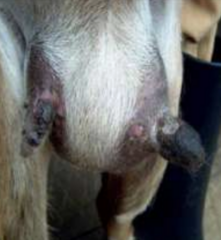
damaged skin
What allows parapox virus to enter?
scabs
Where does parapox virus replicate?
papules → vesicles → pustules → scabs → resolution
What is the lesion progression for Orf?
3-4 weeks
How long can it take for Orf lesions to resolve?
no
Do Orf lesions leave a scar?
less than one year
How long is Orf immunity after infection?
more than 15 years
How long can hardy virus survive in scabs?
oral mucocutaneous junction, usually at commissures
Where do Orf lesions typically start?
muzzle and nostrils
After initial lesion formation, where does Orf commonly spread?
edema and scabs (crusts)
What types of lesions develop as Orf progresses?
can enter the respiratory tract
What serious complication can occur if Orf spreads beyond the oral region?
during nursing
How is Orf commonly transmitted from lambs/kids to adult ewes/does?
coronary band and dew claws
Where else can Orf lesions occur besides the mouth?
rare severe form with widespread mucosal involvement
What is malignant Orf?
1. presentation
2. electron microscopy of scabs
3. PCR
How is Orf diagnosed?
removal of scabs and topicals
What can delay Orf healing?
respiratory obstruction, malnutrition, dehydration
What are the main causes of death in severe Orf cases?
painful oral lesions → inability to eat
Why can Orf lead to malnutrition?
lambs
Which population is most at risk for death from Orf?
supportive care with soft palatable food and bottle or tube feeding
What is the main treatment approach for Orf?
isolate affected animals and quarantine new arrivals
How should Orf be managed in a herd?
vaccination
What is recommended for Orf prevention due to short-lived immunity?
about 2 years
How long is the Orf vaccine effective?
first few days of life
When should animals be vaccinated for Orf?
live virus vaccine
What type of vaccine is used for Orf?
applied to a scarified (scratched) area of skin on pinna, axilla, inner thigh
How is the Orf vaccine administered?
local lesion/reaction at the site
What reaction should occur after proper Orf vaccination?
no
Should the Orf vaccine be used in a naïve (uninfected) herd?
vaccine is live and can introduce disease
Why should you NOT vaccinate a naïve herd for Orf?
swinepox virus
What is the etiologic agent of swine pox?
poxviridae genus suipoxvirus
What viral family does swine pox belong to?
piglets and young growers
Which age group is most commonly affected by swine pox?
1. direct contact and fomites
2. mechanical vectors
How is swine pox transmitted?
hog louse (haematopinus suis) and biting flies
What are the most important vectors for swine pox?
poor hygiene, overcrowding, ectoparasites
What are the major risk factors for swine pox?
no
Is swine pox zoonotic?
papules → vesicles → pustules → thick crusts
What is the progression of swine pox lesions?
1. Ventral abdomen, inner thighs, axillae, groin
2. Face, ears, snout (vector-associated)
What is the typical distribution of swine pox lesions?
mild fever, anorexia, depression (variable)
What are the systemic signs of swine pox?
secondary bacterial infection
What is a common complication of sever swine pox?
self-limiting 2-3 weeks
How long do swine pox infections last?
1. history and characteristic lesions
2. eosinophilic intracytoplasmic inclusion bodies seen on dermatohistopathology
3. viral isolation, PCR, or electron microscopy
How is swine pox diagnosed?
1. Exudative epidermitis
2. Mange
3. Vesicular diseases (FMD, VS), ASF, CSF
What are the differential diagnoses of swine pox?
1. No specific antiviral therapy
2. Supportive care
3. Treat secondary bacterial infections if present
4. Control lice and biting insects
5. Isolate affected pigs during outbreaks
6. Improve sanitation and reduce crowding
7. No commercial vaccine available
What is the treatment for swine pox?
naïve livestock and naïve humans
Who is most at risk for dermatophytosis infection?
years if cool and dry
How long can dermatophyte spores persist in the environment?
trichophyton verrucosum
What is the primary dermatophyte in cattle?
1. trichophyton verrucosum
2. trichophyton mentagrophytes
What dermatophytes affect sheep and goats?
microsporum nanum
What is the primary dermatophyte in pigs?
thick gray-white crusts on face, neck, periocular region
What is the classic appearance of dermatophytosis in cattle?
mild or subclinical
How does dermatophytosis typically present in sheep?
young or stressed animals
Which goats are most commonly affected by dermatophytosis?
mild and self-limiting
How does dermatophytosis typically present in pigs?
cattle
Which species has the highest zoonotic risk for dermatophytosis?
1. Typically head, neck and perineum but can cover the entire body
2. Gray-white crust slightly raised above the skin
3. Often circular and up to 3 cm diameter
4. Not always round
5. Shed scab and middle has alopecia
6. Not pruritic
7. Recover in 4-5 weeks
What is the typical clinical presentation of ringworm?
1. Typical lesions
2. Skin scrape and cytology at margins
3. Disinfect skin, let dry, sterile brush, put it all in a bag and submit for culture
4. DTM (Dermatophyte test medium) kits
5. Woods lamp but many fungi do not fluoresce
How is ringworm diagnosed?
1. reduce environmental contamination
2. Recover in spite/despite treatment in 90 days
3. Betadine sprays and scrub - q12-24 hrs
4. Antifungals - topical, the "conazoles", q12hrs
5. Whitfield's ointment - 6% benzoic acid and 3% salicyclic acid seems to be best, apply 2x/day
6. Keratolytic, antimicrobial, and antifungal
7. Sprays or washes of entire animal(s) - Lime sulfur, others
What is the treatment for ringworm?
hygiene, sunlight, reduce stocking density, clean fomites
What are the control strategies for ringworm?
dermatophilus congolensis
What organism causes rain rot?
motile cocci
What do dormant spores of Dermatophilus congolensis become when activated?
very hardy
How well do Dermatophilus spores survive in the environment?
all livestock and all ages
Which animals can be affected by Dermatophilus congolensis?
cutaneous streptotrichosis
What is Dermatophilus infection called in cattle?
mycotic dermatitis, strawberry foot rot
What is Dermatophilus infection associated with in sheep?
orf
What disease can act synergistically with Dermatophilus in sheep?
damaged, wet skin
What type of skin condition is required for infection to occur?
1. Rain, high humidity, cooling methods like misters and irrigation
2. External parasites
3. Trauma, abrasive terrain and plants
What conditions predispose rain rot?
1. Pyramid-shaped crusts, paintbrush lesion
2. Healed lesion under the scab eventually
3. Scabs easy to remove
4. Organism remains in the scab/crust
5. May not be visible on sheep unless palpated "lumpy wool disease"
What are the characteristic lesions of Dermatophilus congolensis?
1. Fleece and hide damage
2. Loss of production
3. Loss of lambs due to fly strike and pneumonia
What is the economic impact of Dermatophilus congolensis?
"lumpy skin" from Dermatophilus congolensis
What is this?

"strawberry footrot" from Dermatophilus congolensis
What is this?
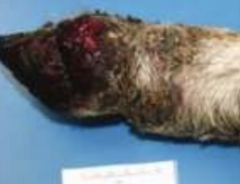
1. Ovine progressive dermatitis
2. Lower leg - coronet to stifle, small coalescing scabs
3. Scabs grow, wart-like, hair loss
4. Bloody fleshy mass under the scab like a strawberry
5. Not painful unless inter-digital
What are the characteristics of strawberry footrot?