Fall of Rome Midterm Study Guide
 Call Kai
 Learn
 Practice Test
 Spaced Repetition
 Match
 Flashcards
 Knowt Play
1/57

There's no tags or description
Looks like no tags are added yet.
58 Terms
Regal Period
753-509 BCE. Rome ruled by series of kings.
Republic Period
509-31 BCE. Rome principally governed by State. Also in Republic period: the conquest of Italy is complete (272 BCE) and over centuries, what is now known as Italy was slowly conquered and incorporated into a Roman "state". Key characteristics of that was a generous treatment of defeated groups and believing defeat is never final, failure is not an option.
Also in this period, wars with Carthage and Greek East in 264-149 BCE.
Empire Period
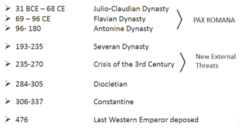
31 BCE - 476 CE. Rome ruled by an emperor (later emperors)
What/where was Rome?
A city in the middle of Italy (founded 753 BCE), originally a tiny city-state. Can also be used to refer to the Roman Empire, a vast collection of conquered states and regions.
Later, the empire is comprised of provinces that are administered by governors
What was a Roman?
A person from either Rome, the city, or the Roman Empire. Gradually becomes a legal, political, and cultural category
What was romanization?
The process of gaining Roman citizenship and how this right was extended to conquered peoples
What does the "Fall of Rome" mean?
Can refer to the dissolution of the Roman Empire, the 'deterioration' of Roman society, the collapse of the region containing the city of Rome, and/or the collapse of the region containing peoples calling themselves 'Roman'.
When did Rome fall?
1. 363 CE (Final demise of Paganism)
2. 395 CE (Empire splits permanently into two)
3. 410 CE (Visigoths under Alaric sack Rome)
4. 476 CE (last Roman emperor in the West deposed)
5. 1453 CE (fall of Constantinople = Eastern Empire)
Why did Rome fall?
No single answer to this question. "The triumph of barbarism and Christianity" - Edward Gibbon
What are some features of the world in which Rome emerged?
Limited technology, difficulties of travel and communication, slavery is ubiquitous, agriculture is the primary economic activity, geopolitical entities (city states, empires), limited knowledge of world geography (Lots of the world was not known to Romans, maps depict just North Africa, Europe, and some of Asia)
What was the Senate?
Key player in the Republic and the early Imperial period. A principal deliberative body, led by two consuls.
What were Consuls?
Chief executive officers, elected annually.
What role did the army have?
Key player in the late Republic and all of the Imperial period. Army service was very important politically in early Roman history, the changes in nature and composition of the army are crucial determinants of the course of Roman History.
What is the practice of "decimation?"
A severe form of military discipline in which a group of ten soldiers (tenth = deci, hence decimation) would draw lots to select one man to execute, which was then carried out by the other nine men. Very effective at keeping soldiers in line.
What were some strengths of the Roman army?
Conventional battlefield combat, siege warfare, mobility, camp construction, and engineering. Romans were the greatest military engineers in the ancient world.
What weapon did legionary soldiers carry?
Carried a javelin and a short sword and also carried a Dolabra (pickaxe) which was used more often than their weapons. They were also well trained in group fighting and mobile.
What do "successful" empires tend to have?
Respect their adversaries, integrate conquered people, extension of Roman citizenship to subject peoples, and rely more on consent than compulsion.
Who was Julius Caesar?
Considered one of the, if not the best, military minds of all time, known for the Conquest of Gaul (modern day France, Belgium, Germany), Caesar's Civil War (& Crossing the Rubicon) ○ 'Crossing the Rubicon' meant coming into Italy with an army, which was considered treason, had intensely loyal followers within his legions, but was not liked by the senators of Rome. Towards the end of the Republic,the republican system of government and military fall apart. 1st century BCE (100 - 1 BCE): ○ String of civil wars, with soldiers loyal to their generals, rather than the state. Caesar attempts to establish 1-man rule, is assassinated on the Ides of March, 44 BCE
First Triumvirate
An alliance between Caesar, Pompey the Great, and Marcus Licinius Crassus that fell apart pretty spectacularly, lead to a Roman Civil War that Caesar ultimately won - which leads to him declaring himself emperor.
Augustus (FKA Octavian)
Was adopted postmortem by Caesar (adoption in Rome was as good as being the flesh and blood child of whoever had adopted you). Octavian establishes a more discreet form of the 1-man rule, known as the Principate (a well-disguised hereditary monarchy), Octavian is defined by his humbleness and his ability to move in silence (something Caesar lacked, and why he was assassinated). Octavian is awarded with the title of Augustus by the Roman Senate in 27 BC.
Who is considered to be the best emperor Rome ever had?
Augustus is considered the best emperor Rome ever had (succeeded by the Julio-Claudian Dynasty):
Tiberius (r. 14 - 37 CE)
Caligula (r. 37 - 41 CE)
Claudius (r. 41 - 54 CE)
Nero (r. 54 - 68)
Julio-Claudian Dynasty Dynastic Trends
14 - 68 CE: defined by "eccentric stability," fragility of the political system (dependent on the survival of one man, problems with succession), Praetorian Guard makes and breaks emperors, intra-dynastic rivalries contribute to extermination of extended imperial family (bo one left after Nero)
Julio-Claudian Dynasty Power Dynamics
Emperor has 3 important 'constituencies': 1. Soldiery (emperor's position depends principally on the support of the army and loyalty of the Praetorian Guard a potential Achilles heel), 2. Population at Rome (support of 'mob' at Rome essential for stability), 3. The Senate
What was the Praetorian Guard?
Republican law had forbidden troops from being stationed or operating in Italy, so the new emperors established a new military unit to station in and around Rome (the Praetorian Guard was a contingent of elite soldiers, meant to serve as the imperial bodyguard (both to emperor and family)). But they often played a disruptive and self-serving political role, received frequent donatives (cash gifts) from the emperor.
Praetorian Guard and 27 BCE
Augustus creates the P.G. as a permanent bodyguard of 9 cohorts. Each cohort may originally have been 500+, later 1,000+ men.
Praetorian Guard and 2 BCE
Augustus appoints two Praetorian Prefects to command the rest of the P.G. (prefects are directly responsible to the emperor, subsequent emperors sometimes preferred having 1 praetorian prefect, prefects possessed immense power, could be key political actors in Rome)
Praetorian Guard and ~37 CE
According to the ancient Roman historian Tacitus, praetorian prefect Macro had Tiberius killed to bring Caligula to power. After an erratic 4 year reign, most people including the P.G. were dissatisfied with Caligula (several officers of the P.G. conspired to assassinate Caligula, Caligula was killed on January 24th, 41 CE). Of the 3 emperors after Augustus, 2 were killed by the P.G.
Praetorian Guard and ~41 CE
P.G. takes appointing the next emperor into their own hands, declaring Claudius, Caligula's uncle, the new emperor (Claudius was disabled, and old, so the Senate was not happy with this but didn't have another choice. Claudius ended up being an effective emperor, but the P.G.'s main goal was having an emperor at all because they needed one to remain a legitimate military institution) TLDR: the Praetorian Guard is declaring and assassinating emperors left and right
Praetorian Guard and ~54 CE
Nero is a horrible, cruel emperor that ends up causing many uprising, eventually flees Rome and kills himself. Left no heirs, end of the Julio-Claudian Dynasty.
Who ruled in the "Year of the Four Emperors" in 69 CE?
Galba - Otho - Vitellius - Vespasian
Galba
Proclaimed emperor by Spanish armies; enormous bribes to soldiers of the Praetorian Guard lead them to proclaim Galba as emperor as well. Galba officially succeeds Nero as the next emperor, but Galba's lieutenant, Otho, secretly promises the Guard huge sums of money to declare him emperor. Guard murders Galba, Otho is emperor.
Vitellius
Proclaimed emperor by armies posted on German frontier. Marches into Italy and defeats Otho's forces, Otho commits suicide. Vitellius establishes himself in Rome
Vespasian
Declared emperor by legions in the East. Vespasian's armies, but not the man himself, march on Italy and Rome and defeat Vitellius and his army. Vespasian wins. TLDR: Military support created emperors.
"Secret of Empire"
Emperors can be made outside of Rome (involvement of legionary armies outside of Rome = grave magnification of the problem with Praetorian Guard). In the final analysis; size of military force trumps location (this has massive negative long-range repercussions). The emperor did not need to be from a prominent aristocratic family and the emperor did not need to operate from Rome (the expansion of the pool of potential emperors will prove to be hugely consequential for Rome's decline and fall).
Pax Romana (Roman Peace)
31 BCE - 180 CE: A period of security, peace, prosperity, health (rebellions in provinces occur - but relatively infrequently, consent more important than compulsion, romans enjoy military superiority over external enemies). Cost of maintaining army not yet an intolerable burden on the state. Sound administration of Empire. Great time for public infrastructure and safety due to this massive army (merchants and people use the roads, currency is standardized, aqueducts improve public health, etc., resembles a modern economy & lifestyle for the first time in history). When people of the Roman Empire were the happiest overall.
Pax Romana: Five "Good" Emperors of Antonine age (all adopted)
Nerva (96-98)
Trajan (98-117)
Hadrian (117-138)
Antoninus Pius (138-161)
Marcus Aurelius (161-180)
Economics of the Pax Romana
Military infrastructure (especially roads) and pacification spurred trade within the Roman Empire. It is easier to move goods and areas within the Empire are safe (as well as goods, the exchange and circulation of ideas - especially religion - is huge during this period. Roman Empire becomes an enormous, unified economic zone ○ Common currency, laws, language, etc. (compare to the European Union now). State revenue flow: taxation of provinces → Italy → military disbursements in provinces.
Italy vs. the Provinces
Italy vs. the Provinces: Italy was the privileged center of the empire with things like tax exemptions and a higher % of proper citizens, while the provinces were under the rule of a governor and were subject to taxes. Total provinces: Under Trajan (r. 98-117), empire at its maximum extent: 46 ○ Under Diocletian (r. 283-305), empire reduced in size: 96. Though, over time the distinction between Italy and the provinces faded. Due to emperors from the provinces (Trajan, Hadrian). As well as a shift away from Rome as a political center, towards the emperor himself being more important. Senators from the provinces.
Edict of Caracalla
212 CE: Grants citizenship to all free residents of the empire. Economic leveling.
Cities of the Pax Romana
Composed of a forum that acted as a hub of social, political, and economic life. Had extremely complex infrastructure by ancient standards. Had specific public officials (aediles) to maintain this infrastructure. Aqueducts supply public fountains with water (massive drainage systems helped remove outflowing water, contributed to the extensive refuse or waste management, public latrines and baths helped maintain relatively high standards of hygiene). Public buildings provided places for religious worship, entertainment, leisure, and economic opportunity. Urban architecture was influenced by the Greeks (Romans developed the use of the arch, Utilitarian architecture was a revolutionary development).
Broad pattern of political developments
Individual Emperors establish Dynasties (mostly hereditary, with male blood relative, preferably son, as imperial successor). Between Dynasties: Political Unrest or Civil War.
Two main problems: Succession: who was to be the next emperor? AND To what extent would he limit his autocracy?
General trends: increasing marginalization of the senate, shift in nomenclature from princeps (first citizen) to imperator (emperor), and development of imperial cult
Antonine Emperors: "Golden age" of Empire
Relative peace and prosperity throughout the Antonine Dynasty. Thanks to adoption of each emperor rather than hereditary succession (which was mostly accidental, not done intentionally).
Antonine Emperors
Nerva (96-98)
Trajan (98-117)
Hadrian (117-138)
Antonine Pius (138-161)
Marcus Aurelius (161-180)
Trajan (98-117)
First 'non-italian' emperor, another great military mind (under Trajan, the empire reaches its greatest extend). Widely regarded as the second best emperor of Rome, just after Augustus (nicknamed "optimus" ("like the robot"), "May you be as lucky as Augustus, and as good as Trajan," and had some welfare policies in place, (especially for orphans)
Hadrian (117-138)
Trajan died on the way back from conquering Mesopotamia, adopted Hadrian takes over. Hadrian was a lover of Greek culture (nicknamed "Graeculus")(was homosexual). A great builder (of walls!) and restorer (see: Pantheon). Focused a lot less on expanding and more on defining the extent of the empire with these walls. Territorial/military reentrenchment is the hallmark of his reign, systematically abandons Trajan's military conquests, construction of physical barriers marking the borders of Roman Empire (most famous: Hadrian's Wall in England), and pulls back to defensible positions
Antonine Pius (138-161)
Sound imperial and economic manager, and pretty uneventful reign; almost continuous peace. The "Indian Summer" of the Roman Empire (trends of Antonine Age before Marcus Aurelius: Pax Romana reaches its peak: peace and prosperity under Hadrian, Pius Antoninus, ideal of imperial conquest abandoned after Trajan - Roman Empire has become an essentially static, defensive entity - ,emerging social strains (widening gap between rich and poor and emergence of two-tier legal status). Honestiores v. humiliores: more upright v. more humble (takes the place of Roman citizen vs. noncitizen and declining importance of Rome as the imperial center)
Causes of the Fall of Rome: External Factors
Barbarians become burdensome for the Roman army, Parthians in the east and Germans in the north, problems in Britain, and Africans evading Spain
Causes of the Fall of Rome: Internal Factors
The allocation of military resources becomes a regional problem: the region that is not defended is resentful towards Rome. Also problems with unity.
Causes of the Fall of Rome: Environmental Factors
Deforestation and pandemics (period of the Pax Romana corresponds with the most ideal climate that the Romans ever faced). "If you can't control your boundaries, the enemy can use your roads." All three are manifested in the reign of Marcus Aurelius.
Marcus Aurelius (161-180)
Stoic philosopher who was also the author of the Meditations. Power Sharing (two emperors): Initially, Marcus shared the throne with his adoptive brother Lucius Verus (wanted to share power in respect of the previous emperor's wishes and motivated also by the fact that the empire was too big to be ruled by a single man - just like there were multiple consuls). So, multiple emperors at the same time (ex: two senior and two junior emperors; one for the east, one for west)
Co-emperors a harbinger of things to come, foundational to the fall of Rome (both have the title of "Augustus", only Marcus' position as Pontifex Maximus indicates a higher level of auctoritas). Arrangement ends with Lucius' death in 169 (similar arrangement with Marcus and son Commodus from 176 - 180).
Problems in the East
Upon Marcus' (and Lucius') accession, Parthians stir up trouble in East. Parthians seize Armenia and invade Syria. Initial defeat of Roman armies (Romans commit to a full-scale war)
Problems in the East: War against Parthia (162-166)
Parthia was a long-standing rival empire to the Romans, which would finally succumb to the Sasanid Persians in 224 CE.
62 - 166 CE: conducted (at least nominally) by Lucuis and necessitates transfer of significant Roman forces from Danube
165 - 166 CE: Roman armies under Cassius achieve decisive victories, Parthians sue for peace
Problems in the East: Disastrous Consequences of Eastern Military Campaign
Campaign apparently "successful" because of Roman war machine proving itself after decades of inactivity, Parthians humiliated, and Armenia added to Roman Empire. BUT, there were also problems in the west like transfer of western armies to east leading to weak western/Danubian frontier, German tribes taking advantage of roads, and make it to Greece. As well as the discredited Parthian empire falling to Sasanian Persians (a more formidable, aggressive foe) and the Antonine Plague that was brought back from the east.
Antonine Plague
One of the top 3 worst recorded plague's (type not certain, but symptoms resembled smallpox). It affected the army first (no medical defense) and then urban spaces (recruited slaves, gladiators, and germanic tribe members). Millions died, army ravaged (some areas of Europe, Western Asia, and Northern Africa lose ~30% of their population + depopulation, food shortages and famine, and economic breakdown)
Did Romans ever recover from the Antonine Plauge?
After this period its hard for the army to generate soldiers, mostly made up of Germanic people instead of Romans (common people cannot identify a traditional Roman army anymore due to the amount of Germanic people in the military).
Marcus and Lucuis both die of the plague -> some historians claim the plague is the main reason the Empire fell
Rise of Christianity
Takes place during the Imperial Period (31 BCE - 476 CE). Also takes place as Rome declines, may have contributed to that decline.
Rise of Christianity: Varieties of Religious Systems and Beliefs
In the imperial period, Roman religious life involved a rich blend of belief systems from all over the world: 1. State religion (largely based on the anthropomorphic Olympian pantheon, including imperial cult), 2. Various superstitious (e.g. witchcraft, fortune-telling, astrology, numerology), 3. Philosophical systems (esp. Stoicism, Episureanism, Neoplatonism), 4. Various mystery religions (e.g. Mithraism, Eleusinian mysterious), 5. Judaism and Christianity
Unlike modern day religion, these beliefs were not mutually exclusive. It was very common to combine beliefs or practice many different aspects of different religions. Then, Christianity comes in and does not allow for polytheism in its church, it is mutually exclusive from other religions.
Rise of Christianity: Religious Diversity of the Roman Empire
Vast assortment of religions thriving in the 1st - 3rd centuries CE. Romans very tolerant and accepting of the religions of those they conquered (many 'foreign' religions became extremely popular among Romans, like the worship of the Egyptian goddess Isis, and polytheistic religions essentially 'open-ended'). Pax Romana enabled interchange of not just goods, but of religious ideas and beliefs (movement of Paul (e.g. Athens, Corinth, Ephesus) as a leather worker and Chrisitan proselytizer shows this pattern.