protein structure and function
0.0(0)
Studied by 0 people Call Kai
 Learn
 Practice Test
 Spaced Repetition
 Match
 Flashcards
 Knowt Play
Card Sorting
1/271

There's no tags or description
Looks like no tags are added yet.
272 Terms
1
New cards
Primary Structure
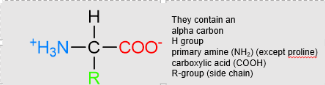
A sequence of amino acids bonded together by peptide bonds
2
New cards
How do amino acids differ?
By their R group (side chain)
3
New cards
How are peptide bonds formed?
By a condensation reaction
4
New cards
How are peptide bonds broken?
By hydrolysis using water
5
New cards
Relationship between gene complexity and protein diversity
As gene complexity increases, protein functional diversity increases
6
New cards
Why are proteins described as dynamic?
They can move and change conformation to perform functions
7
New cards
Examples of dynamic proteins
Kinesin, actin and myosin
8
New cards
Residue
An amino acid within a peptide chain
9
New cards
Dipeptide
2 amino acids joined together
10
New cards
Tripeptide
3 amino acids joined together
11
New cards
Oligopeptide
Several amino acids joined together
12
New cards
Polypeptide
Many amino acids joined together
13
New cards
Main chain
NH₂-CH-COOH backbone
14
New cards
Side chain
Series of R groups attached to the backbone
15
New cards
What dictates protein structure and function?
The amino acid sequence
16
New cards
Effects of amino acid sequence on proteins
Protein stability, solubility, enzyme activity, recognition and disease
17
New cards
Secondary structure
The local folding of a protein backbone into α-helices and β-sheets
18
New cards
Alpha helix
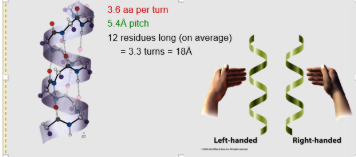
Common right-handed secondary structure
19
New cards
Beta sheet
Secondary structure composed of β-strands

20
New cards
Cause of alpha helix and beta sheet formation
Different conformations adopted by the protein backbone
21
New cards
Alpha helix
Usually a right-handed helix
22
New cards
Pitch of an alpha helix
The height of one complete turn of the helix
23
New cards
Why do alpha helices form?
To allow optimal hydrogen bonding between main chain groups
24
New cards
Hydrogen bonding in alpha helices
C=O of one residue hydrogen bonds with NH of another residue
25
New cards
Alpha helix hydrogen bond pattern
Residue i bonds to residue i+4
26
New cards
Residues per turn in an alpha helix
3.6 residues per turn
27
New cards
Alpha helix dipole
An overall dipole exists along the length of the helix
28
New cards
Beta sheet
A secondary structure composed of two or more beta strands
29
New cards
Orientation of beta strands
Can be parallel or antiparallel
30
New cards
Typical number of beta strands in a sheet
2 to 22 strands
31
New cards
Typical beta strand length
Up to 15 residues, average about 6
32
New cards
Antiparallel beta sheet
Adjacent strands run in opposite directions
33
New cards
Parallel beta sheet
Adjacent strands run in the same direction
34
New cards
Hydrogen bonding in beta sheets
Provides optimal hydrogen bonding between main chain groups
35
New cards
Why are antiparallel beta sheets more stable?
Hydrogen bonds are straighter and therefore stronger
36
New cards
Mixed beta sheet
Contains both parallel and antiparallel strands
37
New cards
Peptide bond structure
Rigid and planar
38
New cards
Why are peptide bonds rigid?
Partial double bond character caused by electron delocalisation
39
New cards
Percentage of trans peptide bonds
Approximately 99%
40
New cards
Why are cis peptide bonds uncommon?
They create steric clashes between adjacent R groups
41
New cards
Exceptions to trans peptide bond preference
Proline and glycine
42
New cards
Why does peptide bond geometry matter?
It restricts the conformations proteins can adopt
43
New cards
Which backbone bonds can rotate?
The bonds on either side of the alpha carbon
44
New cards
Protein backbone representation
A linked sequence of rigid planar peptide groups
45
New cards
Torsion angle
A dihedral angle describing polypeptide conformation

46
New cards
Phi angle (φ)
Torsion angle around the Cα-N bond
47
New cards
Psi angle (ψ)
Torsion angle around the Cα-C bond
48
New cards
Alpha helix side chain orientation
Side chains point outwards and downwards

49
New cards
Why do alpha helix side chains point outwards?
To avoid steric clashes with the main chain
50
New cards
Amphipathic helix
A helix with both hydrophobic and hydrophilic sides
51
New cards
Why are beta sheets pleated?
To maximise hydrogen bonding potential
52
New cards
Beta sheet side chain arrangement
Successive side chains alternate above and below the sheet

53
New cards
Beta sheet repeat distance
A 2-residue repeat spans approximately 7 Å
54
New cards
Amphipathic beta sheet
A beta sheet containing both hydrophobic and hydrophilic faces
55
New cards
Why are natural beta sheets twisted?
Because of the chirality of L-amino acids
56
New cards
Loop
A connection between secondary structures that lacks regular phi and psi angles
57
New cards
Turn
A more ordered connection between secondary structures
58
New cards
Location of loops and turns
Usually found on the surface of proteins
59
New cards
Flexibility of loops and turns
More conformationally flexible than regular secondary structures
60
New cards
Catalytic protein function
Enzymes catalyse chemical reactions
61
New cards
Structural protein function
Provides support in tissues such as muscle, skin and hair
62
New cards
Signalling protein function
Proteins such as insulin and growth hormone transmit signals
63
New cards
Immune protein function
Antibodies protect against pathogens
64
New cards
Regulatory protein function
Transcription factors regulate gene expression
65
New cards
Transport protein function
Haemoglobin transports oxygen
66
New cards
Poisonous protein function
Toxins produced by organisms such as snakes and spiders
67
New cards
Ramachandran plot
A graph showing allowed phi and psi torsion angle combinations
68
New cards
Why are torsion angles restricted?
Steric hindrance limits possible conformations
69
New cards
Disallowed regions of the Ramachandran plot
Regions where steric clashes occur
70
New cards
Where should most amino acids fall on a Ramachandran plot?
Within allowed regions
71
New cards
Alpha helix Ramachandran angles
Phi = -57° and Psi = -47°
72
New cards
Beta sheet Ramachandran angles
Phi = -120° and Psi = +120°
73
New cards
Why is proline conformationally restricted?
Its side chain covalently links back to the main chain
74
New cards
Typical phi angle of proline
Approximately -60°
75
New cards
Why is glycine more flexible?
It has only a hydrogen atom as its side chain
76
New cards
Effect of glycine on protein conformation
Provides additional degrees of freedom
77
New cards
Steric clash
Unfavourable overlap of atoms occupying the same space
78
New cards
Van der Waals clash
A steric overlap between atoms that prevents certain conformations
79
New cards
Protein folding hierarchy
Folding occurs in a hierarchical fashion

80
New cards
First step of protein folding
Small regions of secondary structure form first
81
New cards
Why do early secondary structures persist
Stabilising forces help retain them
82
New cards
What happens to unstable protein structures?
They unravel and are replaced by more stable conformations
83
New cards
When do tertiary and quaternary structures form?
After stable secondary structures have formed
84
New cards
Protein folding funnel model
Proteins sample many different conformational states during folding
85
New cards
Conformational freedom of unfolded proteins
Very high
86
New cards
Entropy of unfolded proteins
High entropy
87
New cards
Final folded state of a protein
Lowest energy state
88
New cards
Valleys in a folding funnel
Represent populated folding intermediates
89
New cards
Can proteins misfold?
Yes
90
New cards
Entropy
A measure of disorder
91
New cards
What does entropy favour?
Greater disorder
92
New cards
Effect of protein folding on peptide ordering
Folding increases ordering, decreases entropy
93
New cards
How is entropy loss compensated during folding?
Water molecules become more disordered
94
New cards
Cause of protein aggregation during misfolding
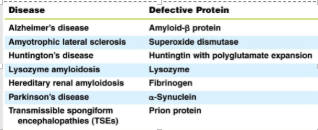
Exposed hydrophobic residues stick together, Loss of protein function
95
New cards
List some diseases caused by defective misfolding…
96
New cards
Chaperones
Proteins that assist correct protein folding
97
New cards
How do chaperones help?
Provide chambers and energy to refold misfolded proteins
98
New cards
Antibody structure depends on….
Tertiary and quaternary structure plus disulphide bonds

99
New cards
Antibody chains
Heavy chains and light chains
100
New cards
Antibody domains
Variable domains and constant domains