radiation safety lesson #9
 Call Kai
 Learn
 Practice Test
 Spaced Repetition
 Match
 Flashcards
 Knowt Play
1/45

There's no tags or description
Looks like no tags are added yet.
46 Terms
federal law or indiana law? each individual state determines qualifications.
indiana law
what are the three significant changes to dental radiology licensing?
1. must obtain a permit from the ISDH in order to take dental radiography
2. "on the job" training is eliminated and replaced
3. training programs must be approved by ISDH
does a dental hygienist need a dental radiography permit?
no, covered from your education
does a dental assistant need a dental radiography permit?
yes, must pass DANB to obtain a state license after the student permit expires that allows you to take radiographs under supervision of DDS
"provisional permit"
DA student issued permit to take dental radiographs under supervision as a student, expires 6 months after education is done
can you be on the job trained?
NO, training must be completed
what happens if DA student cannot pass DANB exam prior to the expiration of student permit?
cannot take radiographs
machine inspection law
must be evaluated by physicist every 3 years, certification must be posted on machine
ALARA Principle
As Low As Reasonably Achievable; guiding doctrine to minimize radiation exposure. (take only necessary radiographs) helps ensure that the radiation dose is kept as low as possible to achieve the desired outcome
what is the guiding principal of dental radiography?
ALARA "as low as reasonably possible"
ALADA Principle
As Low As Diagnostically Acceptable; minimizes radiation while obtaining diagnostic images. radiograph may not be perfect but clinically, what needs to be seen can be seen
Patient Radiation Health & Safety Act of 1981
Federal law requiring radiation machine operators to be state certified.
Indiana X-Ray Machine Inspection Frequency
Evaluated at least every 3 years by a qualified physicist.
Thyroid Collar Effectiveness
Reduces radiation exposure to the thyroid

Rectangular Collimation Effectiveness
Decreases overall patient radiation exposure
what must be done if you are seeing a child?
use child settings
risk management
informed consent! pts have self-determination so they can refuse treatment if they want
liability
dentists are legally accountable or liable to supervise the performance of dental auxilliaries
Aluminum Filtration Requirement (≥70 kVp)
Requires a minimum of 2.5 mm total aluminum filtration.
Long PID vs Short PID
A long PID exposes 80% to 85% less tissue than a short PID.
Indiana Dental Patient Record Retention
Patient records must be kept for 7 years.
Indiana Dental X-Ray Image Retention
Dental radiograph images must be retained for 5 years.
Primary Radiation Beam
High-energy central ray traveling in a straight line from the tubehead.
Secondary Scatter Radiation
Radiation deflected from its path upon striking matter; most dangerous to operator.
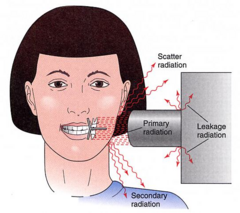
Leakage Radiation
Radiation that escapes or leaks from the tubehead housing during exposure.
Indiana Student Radiography Permit Expiration
Expires 6 months after graduation or immediately upon withdrawal from the program.
Indiana Provisional Radiography Permit
Issued for non-ADA approved programs; expires 6 months from issue date.
Informed Consent
Patient's right to accept or refuse care after receiving full explanation.
Dental Malpractice Negligence
Delivery of dental care that falls below the established standard of care.
Standard of Care
Quality of care provided by dental practitioners under similar conditions.
Radiation Dosimeter Monitoring Badges
Dentist must provide badges, evaluate safety reports, and take corrective action.
Dental Quality Assurance Program
Written plan for regular equipment testing to ensure consistent diagnostic images safely.
negligence
when the diagnosis made or the dental treatment delivered falls below the standard of care
standard of care
the quality of care that is provided by dental practitioners in a similar locality under the same or similar conditions
statute of limitations
the time period during which a pt may bring a malpractice action against the dentist or axillary.... it is the responsibility of the dentist to review and report all information presented on dental images and acquired data sets
documentation
informed consent
number and type of images exposed
rationale for these dental images
an imaging report including diagnostic information obtained from the interpretation of images
who owns the dental images legally?
the dentist, but pts do have the right of reasonable access to their records (they are paying for the interpretation or diagnosis of the images, not for the actual image)
how long should we keep records?
pt records seven years, x-rays for five years
how should you deal with a pt who refuses x-rays?
you should never work on an area without a current image of the problem area, pt who refuse xray images need to understand that the risk from radiation is minute compared with the risk of working without an image, dental images is now the acceptable standard of care
selection guidelines
used to reduce routine radiation practices just based on recall visits
- can radiographs be transferred from another office?
- child or adult?
- nature of appt? (emergency vs recall)
- pt's risk for caries or periodontal disease
- pt's growth and development (ortho evaluation? maybe panoramic? third molars?)
xray machine type best qualities
high frequency, short wavelength, high kVp for reduction of pt dose and best quality image
filtration
remove xrays of low energy so they don't add needless radiation for pt, 2.5 mm of aluminum, operating at 70 kVp or higher (BOARDS) (review the slide for filtration!)
collimation
made of lead plate, fits over the opening where the x-ray beam exits the tubehead, don't exceed 2.75" in diameter
pointed PID
NOOOOO
increases scatter radiation
outlawed in most states
secondary scatter
deflects from path as it strikes matter (can be in any direction), can be considered most dangerous to operator
radiation monitoring devices
monitors the maximum permissible dose (5 rem/year)