IB BIO SL UNIT C - Interaction and Interdependence
 Call Kai
 Learn
 Practice Test
 Spaced Repetition
 Match
 Flashcards
 Knowt Play
1/70

There's no tags or description
Looks like no tags are added yet.
71 Terms
Q1. Define an enzyme.
A: An enzyme is a biological catalyst, usually a protein, that increases the rate of a chemical reaction by lowering its activation energy without being consumed by the reaction.
Q2. What is a substrate?
A: A substrate is the reactant molecule that binds to an enzyme's active site and is converted into product(s).
Q3. What is an enzyme's active site?
A: The active site is the specific region of an enzyme where the substrate binds and the reaction is catalysed. Its shape and chemical properties determine which substrates can bind effectively.
Q4. What is the difference between the induced fit model and the lock-and-key model?
A: In the lock-and-key model, the active site is described as having a complementary shape to the substrate before binding. In the induced fit model, substrate binding causes the active site to change shape slightly, improving the fit and helping catalyse the reaction. The induced fit model better represents the flexibility of many enzymes.
Q5. How does temperature affect enzyme activity?
A: Increasing temperature initially increases enzyme activity because molecules have more kinetic energy and collide more frequently. Activity rises towards an optimum temperature. Above the optimum, bonds and interactions maintaining the enzyme's structure are disrupted, causing denaturation and a rapid decrease in activity. Low temperatures slow reactions but generally do not denature enzymes.
Q6. How does pH affect enzyme activity?
A: Each enzyme has an optimum pH. Changes in pH alter the charges of amino acid side chains and can disrupt interactions maintaining the enzyme's structure. Extreme pH can denature the enzyme or change the active site's shape, reducing substrate binding and catalytic activity.
Q7. How does substrate concentration affect enzyme activity?
A: Increasing substrate concentration increases the reaction rate initially because more enzyme–substrate complexes form. Eventually, all active sites are occupied most of the time, so the enzyme becomes saturated and the reaction rate approaches a maximum, called Vmax. Adding more substrate then has little effect unless more enzyme is available.
Q8. What is the difference between endothermic and exothermic reactions?
A: Endothermic reactions absorb heat energy from the surroundings, so their enthalpy change is positive. Exothermic reactions release heat energy to the surroundings, so their enthalpy change is negative. Enzymes can catalyse either type of reaction.
Q9. What is activation energy?
A: Activation energy is the minimum energy that reactant particles must acquire for a reaction to proceed. Enzymes lower the activation energy by providing an alternative reaction pathway, increasing the reaction rate.
Q10. Compare competitive and non-competitive inhibition, referring to active and allosteric sites.
Competitive inhibition: An inhibitor binds to the enzyme's active site, competing with the substrate. Increasing substrate concentration can reduce the inhibitor's effect because substrate molecules are more likely to occupy the active site.
Non-competitive inhibition: In the simplified IB model, an inhibitor binds to an allosteric site rather than the active site, changing enzyme activity or the active site's shape. Increasing substrate concentration does not overcome pure non-competitive inhibition.
Q11. What is mechanism-based inhibition? (One sentence)
A: Mechanism-based inhibition occurs when an enzyme converts an inhibitor into a reactive form that then irreversibly inactivates the enzyme.
Q12. What is feedback inhibition?
A: Feedback inhibition occurs when the end product of a metabolic pathway inhibits an enzyme involved earlier in that pathway, preventing unnecessary product formation and conserving resources.
Q13. Give one example of an intracellular enzyme and one example of an extracellular enzyme.
A: Intracellular: Catalase, which breaks down hydrogen peroxide inside cells. Extracellular: Amylase secreted into the digestive tract, where it breaks down starch.
Q1. What is cellular respiration?
A: Cellular respiration is a series of enzyme-controlled reactions in which energy from organic molecules, such as glucose, is transferred into ATP for cellular processes. It may occur aerobically or anaerobically.
Q2. Write the balanced chemical equation for aerobic respiration.
C6H12O6 + 6O2—> 6CO2 + 6H2O
Glucose + oxygen → carbon dioxide + water.
Energy is released and used to produce ATP and heat.
Q3. Where does glycolysis occur?
A: Glycolysis occurs in the cytosol of the cell.
Q4. What are the main products of glycolysis?
A: Per glucose molecule:
2 pyruvate molecules.
2 net ATP molecules.
2 reduced NAD molecules (2 NADH).
Four ATP are produced but two ATP are used, giving a net gain of two ATP.
Q5. Compare aerobic and anaerobic pathways, referring to glucose, oxygen requirements, location, ATP production, and final products.
Aerobic respiration: Uses oxygen as the final electron acceptor in the electron transport chain. Glycolysis occurs in the cytosol; the link reaction and Krebs cycle occur in the mitochondrial matrix, and oxidative phosphorylation occurs at the inner mitochondrial membrane. It completely oxidises glucose to carbon dioxide and water and produces much more ATP, typically around 30–32 ATP per glucose in many eukaryotic cells, although the yield varies.
Anaerobic pathways: Do not require oxygen. Glycolysis occurs in the cytosol and produces a net 2 ATP per glucose. In animal cells, fermentation converts pyruvate into lactate. In yeast, alcoholic fermentation produces ethanol and carbon dioxide. Fermentation regenerates NAD⁺ so glycolysis can continue.
Q6. Compare anaerobic pathways in yeast and animal cells. What products are formed?
Yeast: Pyruvate is converted to ethanol and carbon dioxide. NADH is oxidised to NAD⁺, allowing glycolysis to continue.
Animal cells: Pyruvate is converted to lactate. NADH is oxidised to NAD⁺, allowing glycolysis to continue.
Both pathways provide a net gain of 2 ATP per glucose through glycolysis; the fermentation reactions themselves do not produce additional ATP.
Q7. What is oxidation versus reduction? Explain using OIL RIG.
A: OIL RIG means:
Oxidation Is Loss of electrons.
Reduction Is Gain of electrons.
In biology, oxidation often involves loss of hydrogen or gain of oxygen, while reduction often involves gain of hydrogen or loss of oxygen. For example, NAD⁺ is reduced to NADH when it accepts electrons and hydrogen during respiration.
Q8. Give three examples of cellular processes that require ATP.
Active transport across membranes, such as the sodium–potassium pump.
Muscle contraction involving actin and myosin.
Protein synthesis, including processes involved in translation.
Other examples include vesicle transport, cell division and phosphorylation reactions.
Q1. What is photosynthesis?
A: Photosynthesis is the process by which photoautotrophs capture light energy and convert it into chemical energy stored in organic compounds, using carbon dioxide as a carbon source. In oxygenic photosynthesis, water is used and oxygen is released.
Q2. Write the balanced chemical equation for photosynthesis.
6CO2 + 6H2O —(light)—> C6H12O6 + 6O2
Carbon dioxide + water → glucose + oxygen, using light energy.
This is the simplified overall equation.
Q3. Where does photosynthesis occur?
A: In plants, photosynthesis occurs in chloroplasts. The light-dependent reactions occur in the thylakoid membranes, while the Calvin cycle occurs in the stroma.
Q4. Draw and label the absorption spectrum and action spectrum for photosynthesis.
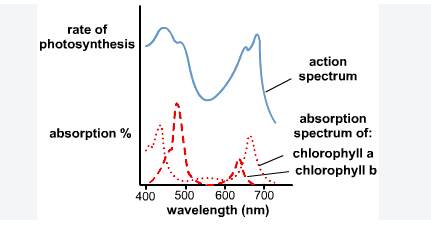
Q5. What is the Rf (retardation factor) in chromatography, and how is it calculated?
The Rf value is the ratio of the distance travelled by a substance to the distance travelled by the solvent front, measured from the same origin.
Rf = Distance travelled by pigment/Distance travelled by solvent front
It has no units and is usually between 0 and 1. Values depend on the solvent, stationary phase and experimental conditions, so they are most useful when compared under identical conditions.
Q6. How does light intensity affect the rate of photosynthesis?
A: At low light intensity, increasing light intensity increases photosynthesis because more light energy is available. Eventually, the rate plateaus because another factor, such as carbon dioxide concentration or temperature, becomes limiting.
Q7. How does carbon dioxide concentration affect the rate of photosynthesis?
A: Increasing carbon dioxide concentration increases photosynthesis when carbon dioxide is limiting because more carbon dioxide is available for carbon fixation in the Calvin cycle. The rate eventually plateaus when another factor becomes limiting.
Q8. How does temperature affect the rate of photosynthesis?
A: Increasing temperature initially increases the rate of photosynthesis because enzyme-controlled reactions occur faster. The rate reaches an optimum, then decreases if high temperatures disrupt enzymes or cause stomata to close, reducing carbon dioxide uptake.
Q1. Explain how an action potential is generated and transmitted, referring to voltage-gated sodium and potassium channels, the sodium–potassium pump, depolarisation, repolarisation, and hyperpolarisation.
A:
Resting potential: The inside of the neuron is negative relative to the outside. Ion gradients are maintained by the sodium–potassium pump, which uses ATP to move three Na⁺ out and two K⁺ in per cycle, alongside selective membrane permeability.
Depolarisation: A stimulus reaching threshold opens voltage-gated Na⁺ channels. Na⁺ enters the neuron, making the inside less negative and then positive.
Repolarisation: Na⁺ channels inactivate and voltage-gated K⁺ channels open. K⁺ leaves the neuron, making the inside negative again.
Hyperpolarisation: K⁺ channels close slowly, so additional K⁺ leaves and the membrane potential becomes temporarily more negative than its resting value.
Recovery: Channels return to their resting states. Ion gradients are maintained by the sodium–potassium pump and other ion movements. The refractory period helps ensure one-way propagation along the axon.
An action potential is an all-or-nothing event: once threshold is reached, it occurs with a characteristic amplitude.
Q2. Explain synaptic transmission, referring to the arrival of an action potential, calcium ion channels, exocytosis, neurotransmitters, and the synaptic cleft.
A:
An action potential arrives at the presynaptic terminal.
Depolarisation opens voltage-gated calcium channels.
Ca²⁺ enters the presynaptic terminal.
Calcium triggers synaptic vesicles to fuse with the presynaptic membrane.
Neurotransmitters are released by exocytosis into the synaptic cleft.
Neurotransmitters diffuse across the cleft and bind to specific receptors on the postsynaptic membrane.
Receptor activation changes ion-channel activity, producing a postsynaptic response.
Neurotransmitters are removed through breakdown, reuptake or diffusion, terminating the signal.
Q3. How does myelin increase the speed of nerve impulse transmission?
A: Myelin electrically insulates the axon, reducing ion leakage across the membrane. Action potentials are regenerated at the nodes of Ranvier, where voltage-gated ion channels are concentrated. The impulse effectively jumps from node to node through saltatory conduction, increasing transmission speed and reducing energy expenditure.
Q1. Briefly describe the neural pathway of a pain withdrawal reflex arc.
A: A pain receptor detects a harmful stimulus. A sensory neuron carries an impulse to the spinal cord, where it communicates with an interneuron. The interneuron activates a motor neuron, which stimulates a skeletal muscle to contract and withdraw the body part. The reflex can occur before conscious awareness of pain because the initial response is coordinated by the spinal cord.
Q2. What is the function of the pineal gland in regulating circadian rhythms?
A: The pineal gland secretes melatonin, particularly in darkness. Melatonin signals biological night and helps regulate the sleep–wake cycle. Light detected by the eyes influences the brain's circadian clock, which regulates melatonin secretion.
Q3. What is the function of the cerebellum?
A: The cerebellum coordinates voluntary movements, balance, posture and motor learning. It helps ensure movements are smooth, accurate and appropriately timed.
Q4. Compare the cerebellum and cerebrum.
Cerebrum: Involved in conscious thought, memory, language, sensory perception, decision-making and initiation of voluntary movement.
Cerebellum: Coordinates movement, balance, posture, timing and motor learning. It fine-tunes movements rather than initiating most conscious actions.
Q5. What is the difference between the sympathetic and parasympathetic nervous systems?
Sympathetic nervous system: Prepares the body for activity or emergencies — increases heart rate, dilates pupils and bronchi, and reduces digestive activity.
Parasympathetic nervous system: Supports rest and digestion — slows heart rate and stimulates digestive activity and energy conservation.
Both are divisions of the autonomic nervous system and often have opposing effects on the same organs.
Q1. What is a pathogen?
A: A pathogen is a biological agent that causes disease, such as a bacterium, virus, fungus or protist.
Q2. What is the first line of defence against pathogens? Give examples.
A: The first line of defence consists of physical, chemical and biological barriers that prevent pathogens from entering the body. Examples include intact skin, mucus, cilia in the respiratory tract, stomach acid, antimicrobial substances in tears and normal microbiota that compete with pathogens.
Q3. What is a macrophage, and what does it do?
A: A macrophage is a phagocytic white blood cell that engulfs and digests pathogens, dead cells and cellular debris. It also releases signalling molecules and can present pathogen antigens to help activate adaptive immune responses.
Q4. What do B lymphocytes do?
A: B lymphocytes recognise specific antigens. When appropriately activated, they can differentiate into plasma cells that secrete antibodies and memory B cells that enable a faster response to future exposure to the same antigen.
Q5. What do T lymphocytes do?
A: T lymphocytes coordinate or carry out cellular immune responses. Helper T cells release cytokines that activate other immune cells, including B cells and cytotoxic T cells. Cytotoxic T cells kill infected or abnormal cells displaying the relevant antigen. Regulatory T cells help limit excessive immune responses.
Q6. What is the function of memory B cells?
A: Memory B cells persist after an initial immune response and respond rapidly when the same antigen is encountered again. They help produce a faster, stronger secondary antibody response.
Q7. Explain blood clot formation, referring to platelets, platelet plugs, clotting factors, prothrombin, thrombin, fibrinogen, and fibrin.
A:
Damage to a blood vessel causes platelets to adhere to the exposed surface and become activated.
Platelets aggregate to form a temporary platelet plug.
Clotting factors activate a cascade of reactions.
The cascade promotes conversion of prothrombin into thrombin.
Thrombin converts soluble fibrinogen into insoluble fibrin strands.
Fibrin forms a mesh that traps blood cells and platelets, stabilising the clot and helping prevent further blood loss.
Q8. What is a zoonotic disease? Give one example.
A: A zoonotic disease is an infectious disease that can be transmitted between animals and humans. An example is rabies, which can be transmitted through the saliva of an infected mammal, usually by a bite.
Q9. What are antibiotics?
A: Antibiotics are medicines that kill bacteria or inhibit their growth. They work against bacterial infections but do not treat viral infections such as influenza. Antibiotic misuse can select for antibiotic-resistant bacteria.
Q10. How can HIV be transmitted?
A: HIV can be transmitted when certain infected body fluids — including blood, semen, vaginal or rectal fluids, and breast milk — enter another person's bloodstream or contact susceptible mucosal tissue. Routes include sexual transmission, sharing contaminated needles, transmission during pregnancy or birth, and breastfeeding. HIV is not transmitted through casual contact such as hugging or sharing food.
Q11. What are antibodies, and how do they work? Refer to agglutination, neutralisation, opsonisation, and pathogen destruction.
A: Antibodies are specific proteins produced by plasma cells derived from B lymphocytes. They bind to complementary antigens.
Agglutination: Antibodies cross-link pathogens, causing them to clump together.
Neutralisation: Antibodies block pathogen attachment or neutralise toxins.
Opsonisation: Antibodies coat pathogens, making them easier for phagocytes to recognise and engulf.
Pathogen destruction: Antibody binding can activate complement proteins, which help destroy certain pathogens and promote inflammation and phagocytosis.
Q12. What is the difference between a primary and secondary immune response?
A: The primary response occurs after the first exposure to an antigen. It develops relatively slowly while specific lymphocytes are activated and multiply. The secondary response occurs after later exposure to the same antigen and is usually faster, stronger and longer-lasting because memory cells are present.
Q13. What is herd immunity?
A: Herd immunity occurs when enough people in a population are immune to an infectious pathogen that transmission becomes less likely, indirectly protecting people who are not immune. The level of immunity needed depends on how transmissible the pathogen is and other population factors.
Q14. How do vaccines work?
A: Vaccines expose the immune system to a pathogen's antigens, or instructions for producing them, without causing the full disease in the usual way. This activates specific lymphocytes and generates memory cells. If the person later encounters the pathogen, the immune system can respond more quickly and effectively.
Q15. What do vaccines contain?
A: Depending on the vaccine, they may contain weakened live pathogens, inactivated pathogens, purified antigens, harmless components of pathogens, toxoids, viral vectors or genetic instructions such as mRNA. Many vaccines also contain stabilisers, buffers and other ingredients; some use adjuvants to strengthen the immune response.
Q1. What is a population, and what is carrying capacity?
A: A population is all individuals of the same species living in a particular area at a particular time. Carrying capacity (K) is the population size that an environment can sustain over time given its available resources and environmental conditions.
Q2. What is the difference between top-down and bottom-up control of populations?
A: Top-down control occurs when predators, herbivores or other consumers regulate populations at lower trophic levels. Bottom-up control occurs when the availability of resources, such as nutrients, light or primary producers, regulates populations at higher trophic levels.
Q3. Draw and explain a sigmoid population growth curve. Label the exponential, transitional, and plateau phases, referring to positive and negative feedback.
Q4. Compare intraspecific and interspecific relationships. Give one example of each.
Intraspecific relationships: Interactions between individuals of the same species, e.g. competition between two male deer for mates.
Interspecific relationships: Interactions between individuals of different species, e.g. a lion hunting a zebra.
Q5. What is mutualism? Give one example.
A: Mutualism is an interaction between two species in which both benefit. For example, bees obtain nectar from flowers while transferring pollen between flowers, helping the plants reproduce.
Q6. Explain the mutualistic relationship between zooxanthellae and reef-building corals.
A: Zooxanthellae are photosynthetic algae that live within coral tissues. They transfer photosynthetic products, including organic carbon compounds, to the coral, providing energy and helping support calcification. In return, the coral provides shelter, carbon dioxide and nutrient-containing waste products. Heat stress can disrupt this relationship, causing corals to expel their algae and undergo bleaching.
Q7. What is allelopathy? Give one example.
A: Allelopathy occurs when an organism releases chemicals that affect the growth, survival or reproduction of other organisms. For example, black walnut trees release juglone, a chemical that can inhibit the growth of some nearby plants.
Q8. What is the difference between an endemic species and an invasive species?
A: An endemic species is native to and restricted to a particular geographical area. An invasive species is a non-native species that establishes and spreads in a new environment, causing or threatening ecological, economic or other harm. Not every introduced species becomes invasive.
Q1. What is an autotroph?
A: An autotroph is an organism that produces organic compounds from inorganic substances using an external energy source. Autotrophs may use light energy or chemical energy.
Q2. What is the difference between a photoautotroph and a chemoautotroph?
A: A photoautotroph uses light energy to synthesise organic compounds from inorganic carbon, usually carbon dioxide. A chemoautotroph uses energy obtained from chemical reactions involving inorganic substances to produce organic compounds from inorganic carbon.
Q3. What is a heterotroph?
A: A heterotroph obtains organic compounds and energy by consuming other organisms or organic matter rather than synthesising its own organic compounds solely from inorganic carbon.
Q4. Compare organic and inorganic matter.
A: Organic matter contains carbon-based compounds associated with living organisms or their remains, such as carbohydrates, lipids, proteins and nucleic acids. Inorganic matter includes substances such as water, mineral ions, oxygen and carbon dioxide. Carbon-containing substances are not automatically organic; carbon dioxide is inorganic.
Q5. Give one example each of a photoautotroph, chemoautotroph, and heterotroph.
Photoautotroph: A green plant, such as grass.
Chemoautotroph: A nitrifying bacterium that obtains energy by oxidising ammonia or nitrite.
Heterotroph: A human or a lion.
Q6. Draw an energy pyramid and explain how it works.
Q7. How is energy lost between trophic levels in an energy pyramid?
A: Energy is transferred inefficiently between trophic levels because:
Organisms use energy in cellular respiration, releasing heat.
Energy is used for movement and other metabolic activities.
Some biomass is not eaten.
Some consumed material is not digested and is lost in faeces.
Some absorbed energy is lost in excretory products.
Consequently, less energy is available to the next trophic level. Energy flows through ecosystems and is eventually dissipated as heat; it is not recycled in the same way as matter.
Q8. Draw and label the carbon cycle, identifying carbon sources and carbon sinks.
Q9. Compare renewable, long-term renewable, and non-renewable resources.
A:
Renewable resources: Replenished naturally on relatively short timescales if managed sustainably, e.g. solar energy and wind energy.
Long-term renewable resources: Can regenerate, but replacement may take decades to centuries or longer, so harvesting must remain within sustainable limits. Examples include mature forests and some fish populations.
Non-renewable resources: Exist in finite quantities or form far more slowly than humans consume them, e.g. coal, oil and natural gas.
The distinction between renewable and long-term renewable is not universal; it depends on the timescale and rate of use.
Q10. What is the Keeling Curve, and how does it relate to climate change?
A: The Keeling Curve is a long-term record of atmospheric carbon dioxide concentration measured at Mauna Loa Observatory in Hawaii. It shows a rising overall trend due largely to human activities, with seasonal fluctuations caused by changes in photosynthesis and respiration, especially in the Northern Hemisphere. Rising atmospheric CO₂ strengthens the greenhouse effect and contributes to global warming.
Q11. Briefly explain how methane is produced in wetlands and peatlands.
A: Waterlogged soils have low oxygen availability. Anaerobic microorganisms decompose organic matter, and methanogenic archaea produce methane during anaerobic metabolism. Methane can escape into the atmosphere through diffusion, bubbles or transport through wetland plants.