Peds exam 1 CS
 Call Kai
 Learn
Learn Practice Test
 Spaced Repetition
 Match
Match Flashcards
 Knowt Play
1/235

There's no tags or description
Looks like no tags are added yet.
Name | Mastery | Learn | Test | Matching | Spaced | Call with Kai | Chat |
|---|
No analytics yet
Send a link to your students to track their progress
236 Terms
What are criterion-referenced tests?
tests that establish cutoff scores
compare a child to self
What are normative tests?
tests that compare to distribution
established standard point scores
compare child to same age peers
Which category of standardized tests establishes cutoff scores?
criterion
Which category of standardized tests establishes age-appropriate scores?
normative
List the criterion referenced peds tests
GMFM
SFA
AEPS
List the normative peds tests
peabody (PDMS3)
bayley
AIMS
BOT3
PEDI
ASQ3
timed floor to stand
Describe the Peabody test
normative
assesses gross/fine motor, HE coordination
ages 0-5yrs (71mo)
What age range is appropriate to administer the Peabody?
0-5yrs (71mo)
Name the 5 subsets of the Peabody
body control
body transport
object control
hand manipulation
HE coordination
Describe the Bayley scales of infant development
norm referenced test
ages 16d - 42mo
gold star for infant development!
Which standardized test is the gold standard to assess infant development?
Bayley
Name the domains of the Bayley
cognitive
language
motor
social-emotional
adaptive
Describe the Alberta Infant Motor Scale (AIMS)
norm test
ages 0-18mo
evaluates WB, posture, and anti grav movements
In what age range is it appropriate to administer the AIMS?
0 - 18mo
In what age range is it appropriate to administer the Bayley?
16d - 42mo
In what age range is it appropriate to administer the Peabody?
0 - 5yrs (71mo)
Describe the BOT3
norm test
8 subsets totals (PT often does bilateral coordination, balance, strength, and dynamic movement)
age 4-21yrs (25yrs?)
In what age range is it appropriate to administer the BOT3?
4-21 years (but Ling said 25 so IDK)
What subsets of the BOT3 are often administered by physical therapists?
bilateral coordination
balance
strength
dynamic movement
Describe the PEDI
norm referenced test
assesses functional activities based on routines questionnaire
good test to indicate health-related outcomes
ages 6mo - 7yrs
In what age range is it appropriate to administer the PEDI?
6mo - 7yrs
Which peds test is a questionnaire used to assess functional activities based on routines?
PEDI
What three domains are assessed by the PEDI?
self-care
mobility
social function
Describe the ASQ3
norm referenced test
to assess developmental and social-emotional areas
commonly used as a screen for autism
ages 0-6yrs
In what age range is it appropriate to administer the ASQ3
0 - 6yrs
Which test is commonly used as a screen for autism?
ASQ3
Describe the timed floor to stand test
norm referenced test
like the TUG but for kids
norms available for ages 4-15 (m, f, and combined)
Describe the GMFM
criterion test
looks at movement ability, not quality
66 or 88 item test
ages 6mo - 5yrs
List the 5 dimensions assessed by the GMFM
lying/rolling
sitting
crawling/kneeling
standing
walking/running/jumping
The GMFM has specific norms for which populations?
cerebral palsy and down syndrome
Which standardized test assesses movement ability instead of quality?
GMFM
Describe when it would be more appropriate to administer the GM66 instead of the GM88
primarily for children w/ CP
based on barefoot testing
gets progressively harder
Describe when it would be more appropriate to administer the GM88 instead of the GM66
for children w/ CP or DS
recommended for children w/ ambulatory aids / orthoses
Describe the SFA
criterion test
measures performance of functional tasks as it relates to school
grades K-6th grade
Which standardized test assessed performance of functional tasks in the school?
SFA (school function assessment)
In what age range is it appropriate to administer the SFA?
K - 6th grades
Describe the AEPS
criterion test
used in Indiana EIP
ages 0 - 6yrs
In what age range is it appropriate to administer the AEPS
0 - 6yrs
Which standardized test is used in the Indiana EIP?
AEPS
List some timed tests that may be administered to a pediatric patient
2min walk test
6min walk test
10m walk test
timed floor to stand test
Which standardized test would be appropriate to administer in an early intervention program?
AEPS
Which standardized test would be appropriate to administer in a school?
SFA
Which standardized test(s) would be appropriate to administer in an outpatient setting?
PMDS
BOT
Bayley
GMFM
Which standardized test(s) would be appropriate to assess a child's participation section of the ICF model?
SFA
AEPS
ASQ3
What is "efficiency"?
the amount of useful energy that can be derived from a given energy supply
Define step length
measured from heel center of footprint to heel center of the footprint of opposite foot
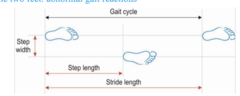
Define stride length
measurement between the heel points of two footprints of the same foot
2x step length
ex. left foot to left foot

Define cadence
steps per minute
the total number of steps divided by ambulation time
Heel strike typically emerges by ____
2yrs
(18-24mo)
When will a child typically have the max amount of (normal) genu valgum?
3-3.5yrs ish
Around what time will a child's walking velocity begin to normalize with their height?
4-6yrs
List the five major attributes to typical walking
1 - stability in stance
2 - foot clearance in swing
3 - appropriate pre-positioning for initial contact
4 - adequate step length
5 - energy conservation
What types of interventions may be appropriate to address stance phase stability deficits?
SLS
trunk stability exercises
single and double leg balance
hip strengthening (esp ABDs)
What types of interventions may be appropriate to address deficits in foot clearance during the swing phase of gait?
walk w/ flippers
stepping over obstacles
walking on heels
stability exercises
At what age should children have adequate/full knee extension?
around 18-24mo
What kinds of interventions may be appropriate to address deficits in foot placement during initial contact?
stretching hams/PFs (for full knee ext)
strengthen quads/DFs
articulating or solid AFOs if necessary
What are some potential MSK causes of toe walking?
tight heel cords
weak posterior chain
What are some potential neurological causes of toe walking?
tone/spasticity
(common for individuals w/ CP)
What are some potential sensory causes of toe walking?
avoiding/seeking behaviors
What initial intervention would be appropriate for an individual who walks on their toes?
need adequate ROM first
stretching
serial casting
braces
What are some potential MSK causes of in-toeing?
hip restrictions
antetorsion
tibial torsion
forefoot adductus
What are some potential causes of foot drop / toe dragging in children?
weak DFs
sensory - dragging toes for sensory input
something neurologic
Describe the typical knee alignment for newborns
typically born w/ more genu varum, will eventually straighten out by 1-2yrs
normal physiologic (slight) genu valgum at 2+ years (F>M)
In terms of LE development, how might children who are non-ambulatory or become ambulatory later in life be affected?
lack of WB may have delayed/slowed bone growth
typically more genu varum
poor development, higher risk of fracture
Define femoral torsion vs femoral version
torsion - amount of twist in the femur, angle between femoral neck and femoral condyles
version - position of femoral head in the acetabulum
Which term describes the angle of the femoral neck relative to the femoral condyles?
femoral torsion
Which term describes the position of the femoral head relative to the acetabulum?
femoral version
Describe femoral antetorsion
femoral head is rotated forward relative to femoral condyles
Describe femoral retrotorsion
femoral head is rotated posteriorly relative to femoral condyles
Describe femoral anteversion
femoral head is positioned anterior in the acetabulum
(results in thigh ER)
Describe femoral retroversion
femoral head is positioned posterior in the acetabulum
(results in thigh IR)
Describe the degree of femoral torsion and version present at birth
newborns have the max amount of torsion and version
~30d antetorsion
~60d anteversion
~30d external rotation
Normal adult femoral antetorsion is ____
12deg
How can femoral torsion be measured?
indicated and predicted by TPAT or hip IR/ER values
How can femoral version be measured?
ONLY with imaging
MRI best, but can also do CT and US
What is a normal (adult) femoral neck angle? How does this differ for newborns?
adult - 126deg
newborn - 140deg
Describe normal knee alignment development starting at birth
0-18mo - normal genu varum
18-30mo - begin to straighten out
3+ yrs - slight genu valgum
women tend to have more genu valgum (normally)
Infants are typically born with more ___ tibial torsion, but progressively becomes more _____
at birth, more internal (-) tibial torsion
progresses to more external (+) tibial torsion
Describe the normal alignment of the knee and tibia at birth
knee - genu varum
tibial - internal tibial torsion (-)
Describe the normal alignment of the hip, knee, and tibia at birth
hip - coxa valga (~140deg)
knee - genu varum
tibia - internal torsion (-)
Describe normal foot development from birth
born with flexible flat feet (fat pad on plantar surface)
medial longitudinal arch develops ~2-6yrs d/t weight bearing
When does the medial longitudinal arch in the foot typically develop?
born with flat feet
arch develops ~2-6yrs
You are evaluating a 2-year-old with primary concern of flat feet and genu valgum. Is this typical? Explain.
yes! normal
fat pad in foot doesn't start dispersing until 2-6yrs
knee alignment generally normalizes ~10yrs (ish)
Name the components of a torsional profile
foot progression angle (FPA)
hip ER and IR
trochanteric prominence angle test (TPAT)
thigh-foot angle (TFA)
forefoot alignment
Describe how to measure the foot progression angle (FPA)
angular difference between long axis of foot (bisect the 2nd met) and line of walking progression

Describe how to denote in-toeing vs out-toeing according to the FPA
in - minus sign
out - plus sign
What is a normal foot progression angle?
average FPA is +10deg
ranging from -3 to +20deg
What position is generally best to measure hip rotation in children?
prone
Describe the norms for hip rotation in children
similar to adults
40-45deg of ER/IR
at birth ~70deg ER
Describe the relationship between femoral antetorsion and hip rotation ROM
antetorsion is indicated by increased IR > ER
*excessive* FA is predicted if difference between IR/ER is >45deg
(not assumed for
How can hip rotation be used to indicate/predict femoral antetorsion?
IR>ER indicates femoral antetorsion
difference of >45deg (IR>ER) predicts excessive femoral antetorsion
(not assumed for
Describe the relationship between femoral retrotorsion and hip rotation ROM
retrotorsion is indicated by increased ER > IR
(not assumed for
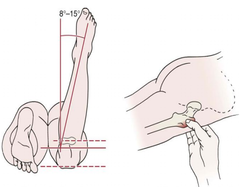
Describe the trochanteric prominence angle test (TPAT)
prone w/ knee bent to 90
internally rotate the hip
palpate the greater trochanter at its most prominent place during hip rotation
look at foot position
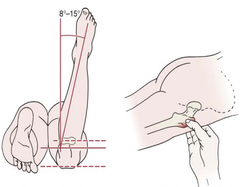
Describe how to interpret the TPAT
if the foot is turned out --> suggests antetorsion
if the foot is turned in --> suggests retrotorsion
You complete a torsional profile on your 5yr old patient. They have 70d of hip IR and 25d of hip ER.
Is FA indicated based on these measurements? Is excessive FA predicted?
Explain why.
yes, FA is indicated (IR > ER)
excessive FA is indicated (difference >45d)
Describe some potential implications of excessive hip interval rotation
in-toeing gait pattern
knee valgus
decreased SLS
external tibial rotation
PFJ instability, anterior knee pain
ankle pronation
What are some potential complications of W sitting?
increased risk of hip subluxation or dysplasia
Describe some potential implications of excessive hip external rotation
toe-out gait
likely a soft tissue limitation rather than bony
Describe how to measure the thigh foot angle
measured in prone w/ knee flexed to 90d
angle between the axis of the foot and midline axis of the thigh
What is a normal thigh foot angle?
mean thigh-foot angle in childhood is +10
range +5 to +30