2 / Geology of Planets / GEOL 109 / Exam 2 Flashcards
 Call Kai
 Learn
 Practice Test
 Spaced Repetition
 Match
 Flashcards
 Knowt Play
1/100

There's no tags or description
Looks like no tags are added yet.
101 Terms
Would you be surprised if tomorrow's newspaper reported that a volcano was discovered erupting on Mercury?
Yes, that is not expected to happen on Mercury today.
What causes the differences between impact craters on the Moon and those on Mercury (the extent of the ejecta blanket and secondary cratering)?
different gravitational attractions on each planet
What do thermal models of Mercury's evolution suggest about its history?
That it developed a metallic core early in its history.
The oldest types of terrains on both the Moon and Mercury are __________.
heavily cratered terrain
Which of the following features IS NOT found on the Moon and Mercury? (Check all that apply)
dunes
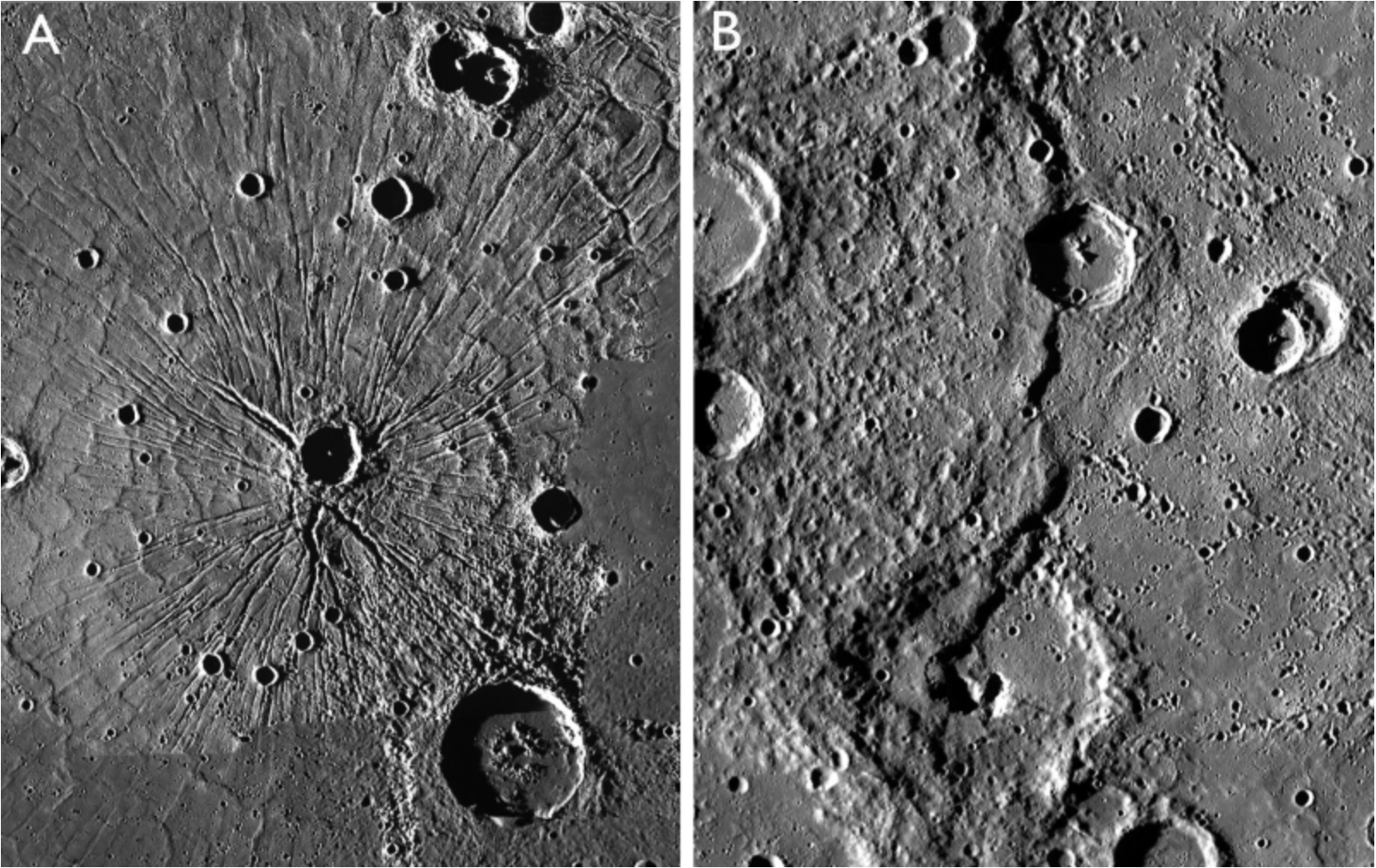
Which image shows a feature that formed by contraction of Mercury's surface?
Right picture; the trench/line thing
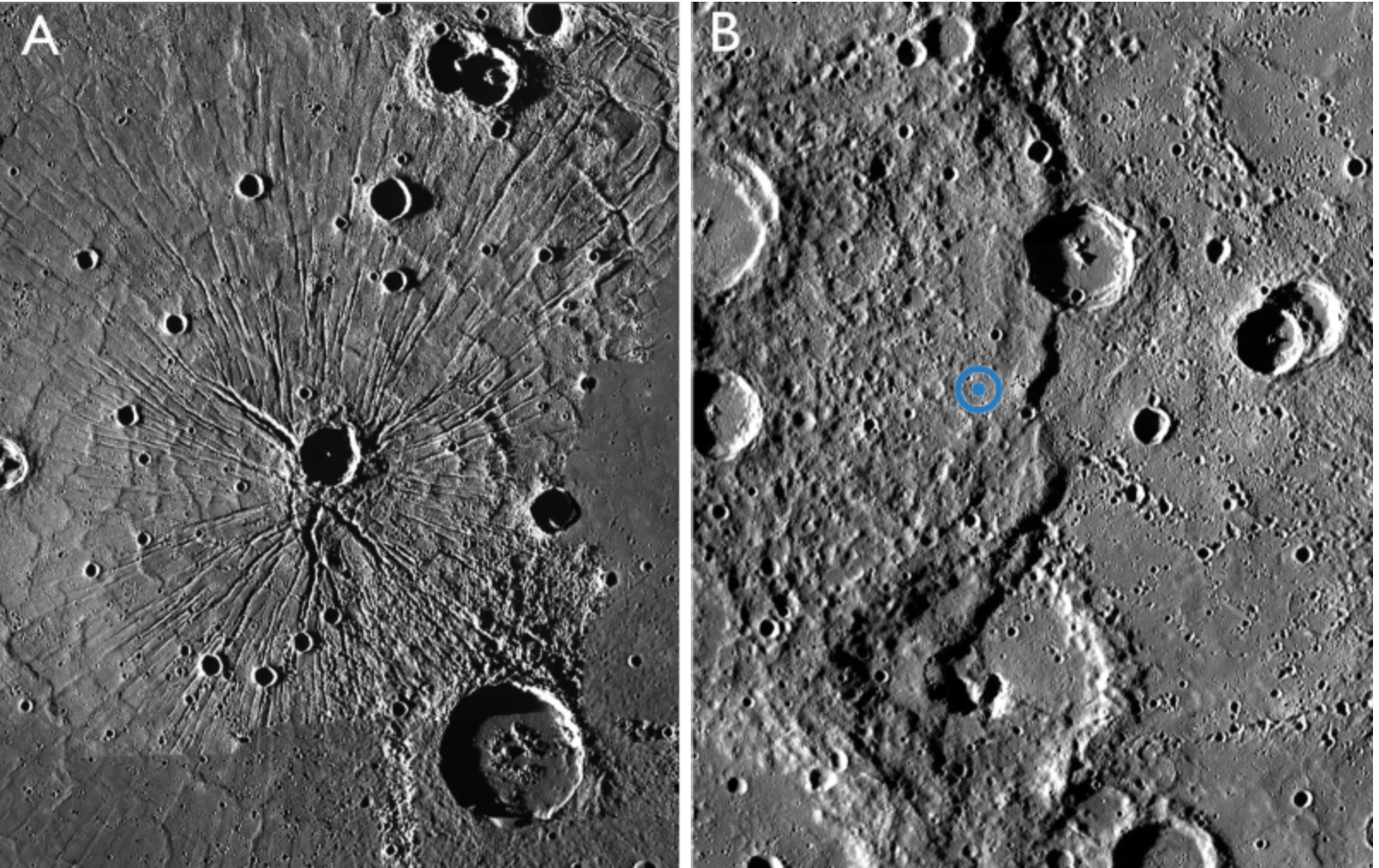
Which of the following tectonic processes are thought to have occurred on Mercury? (Check all that apply)
graben formation due to extension
thrust faulting due to contraction of the planet
Mercury's smooth plains ________.
may be similar in origin to the lunar maria

One of these impact craters is on the Moon and the other is on Mercury. Click on the one on Mercury.
Left; much more defined crater

What explains Mercury's iron large core? Choose the two most likely.
A large impact stripped away the silicate shell from an already differentiated Mercury.
Mercury formed near the Sun in a zone that was oxygen-poor and rich in metallic iron.
Although both Mercury and Mars have similar gravity fields, Mars has an atmosphere whereas Mercury does not. What is a possible explanation?
Mars is more volatile rich.
Which planetary body has (basically) no magnetic field today?
Mars
Which of the following are important differences between the nature of the martian hemispheres (north and south)? (Mark all that apply)
ages
number of young volcanoes and volcanic plains
elevations
the number of impact craters
What is the evidence for ground ice (or ground water) on Mars? Choose all correct answers.
fluidized crater-ejecta patterns, chaotic (collapse) terrains
This is a colored topographic map of Mars, with high elevations in brown and white and low elevations in blue. Click on the Valles Marineris.
blue, looks like scratches or a big scar, near Tharsis Bulge


This is a colored topographic map of Mars, with high elevations in brown and white and low elevations in blue. Click anywhere in the cratered highlands.
all the yellow, cratered part


This is a colored topographic map of Mars, with high elevations in brown and white and low elevations in blue. Click anywhere in the youngest plains.
on top, blue, smooth, uncratered
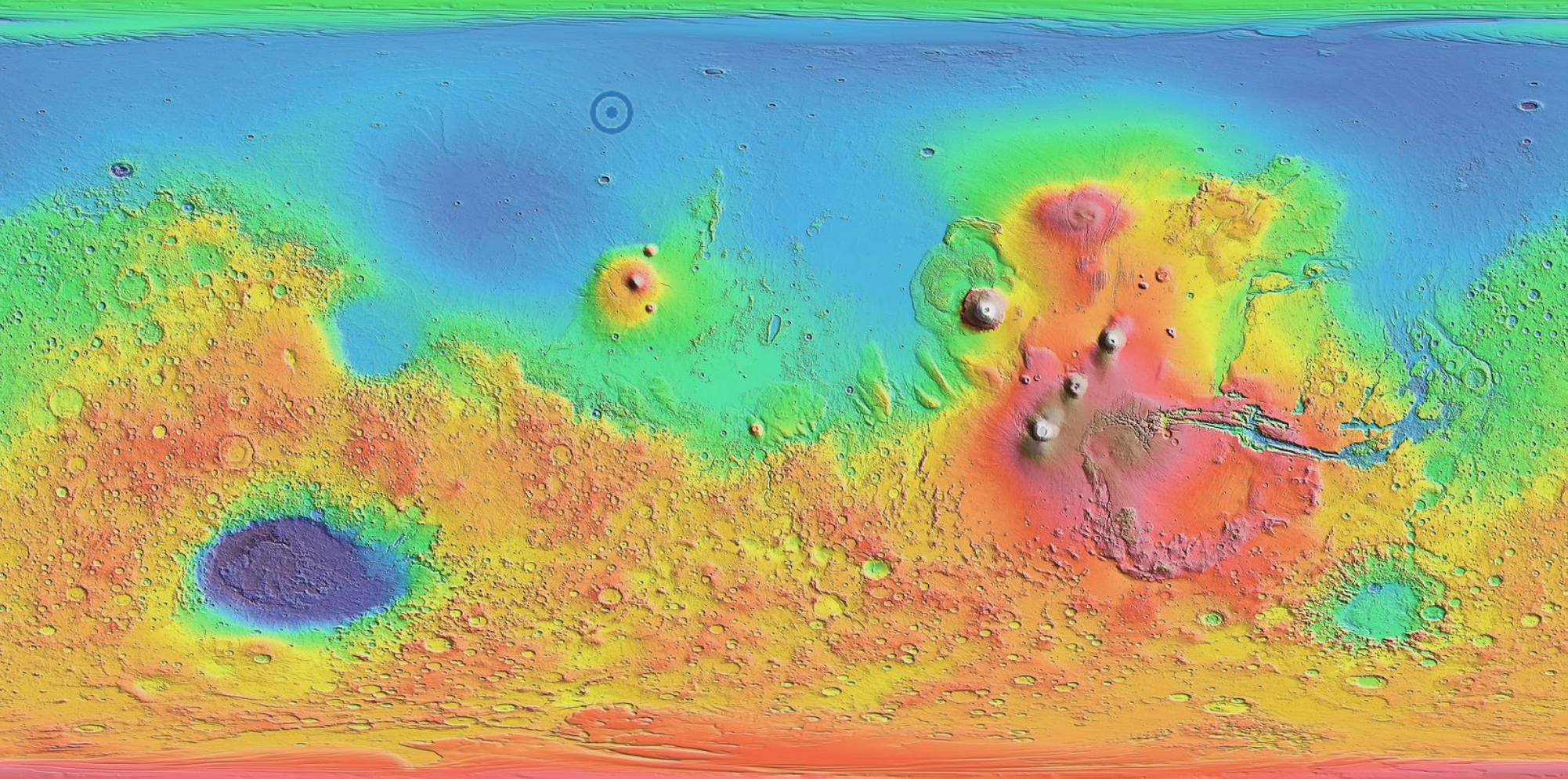

This is a colored topographic map of Mars, with high elevations in brown and white and low elevations in blue. Click on the volcanoes of the Tharsis bulge.
looks like a pyramid constellation with one big volcano at the top and three on bottom
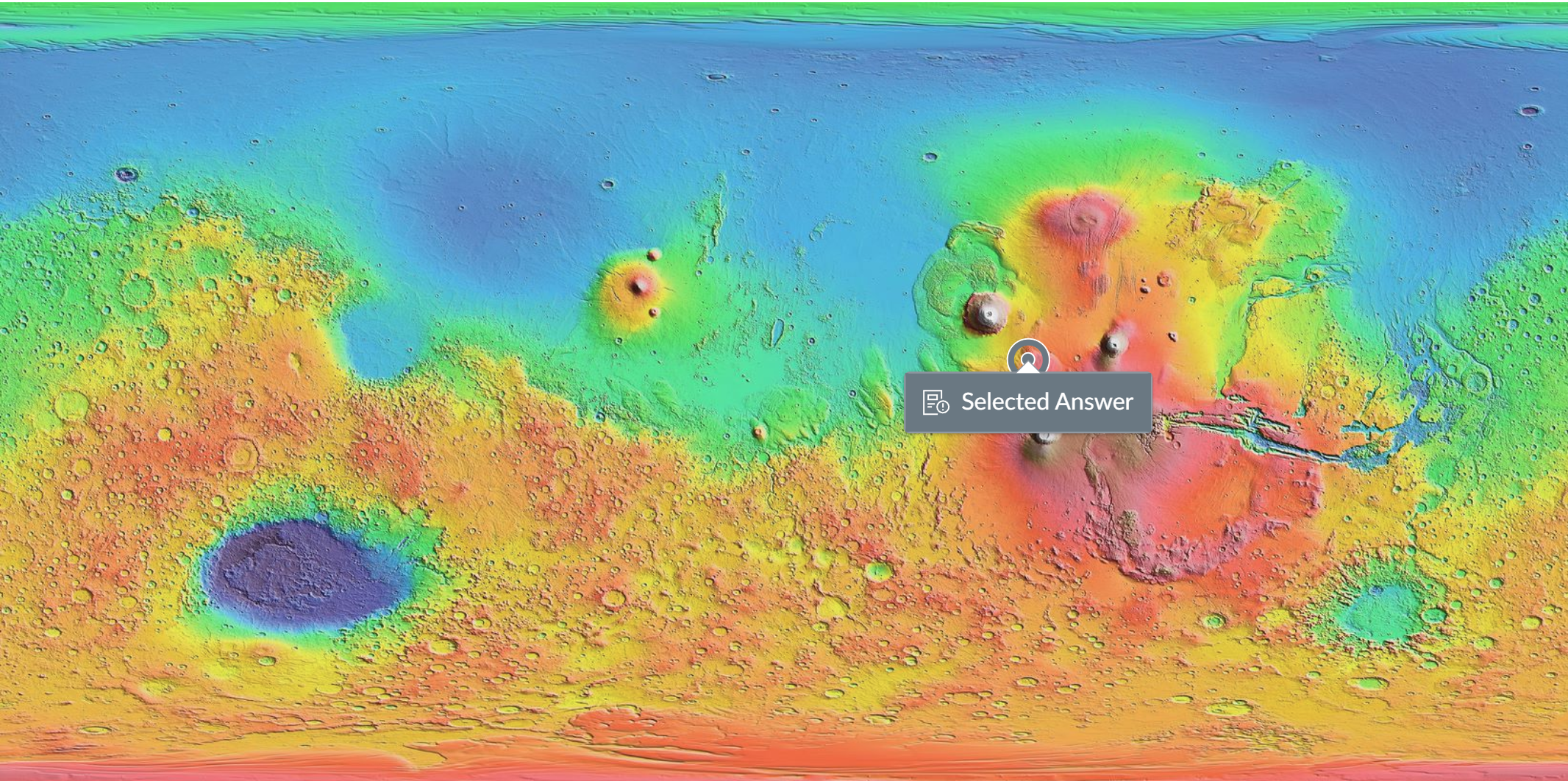
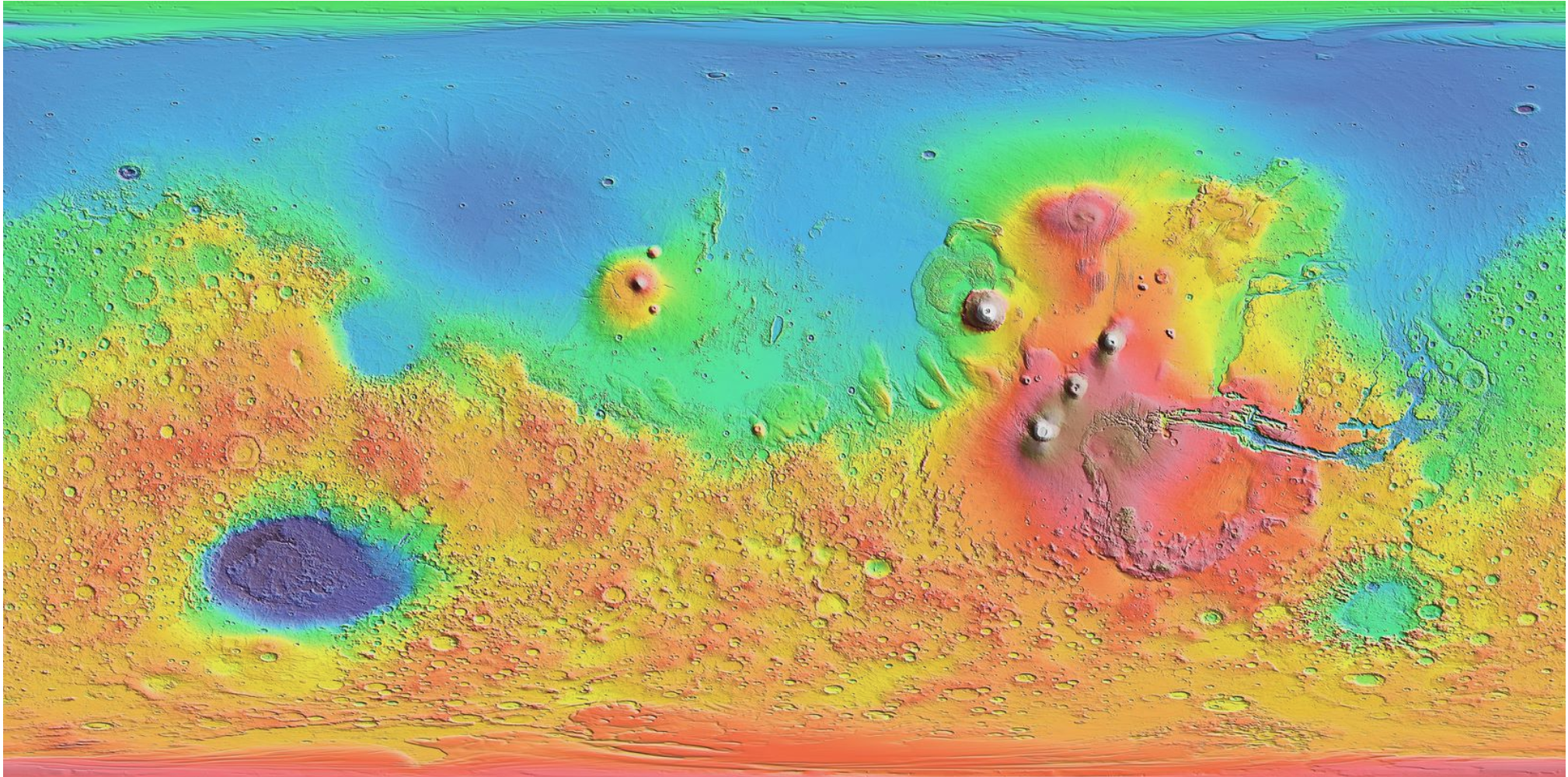
This is a colored topographic map of Mars, with high elevations in brown and white and low elevations in blue. Click on a thick sheet of ice
red part at the bottom


How did these vast valleys on Mars form?
The outflow valleys were eroded by liquid water.
Martian valley networks are ____________________________________.
restricted in occurrence to the oldest parts of Mars
The outflow channels on Mars are different from river systems on Earth in what way?
they appear to come from below the surface and lack extensive collection systems
The largest dune fields on Mars are ____________________.
in the polar regions
Why does Mars lack a current, well-integrated hydrologic system?
It is too cold.
Which of these geologic features are not found on all of the following planets—Mercury, Mars, and Earth? (Choose all that apply)
sand dunes
river valleys

What is the probable origin of the dark colored features in this image of the surface of Mars? It is about 20 km across.
These features are dunes shaped by the wind.
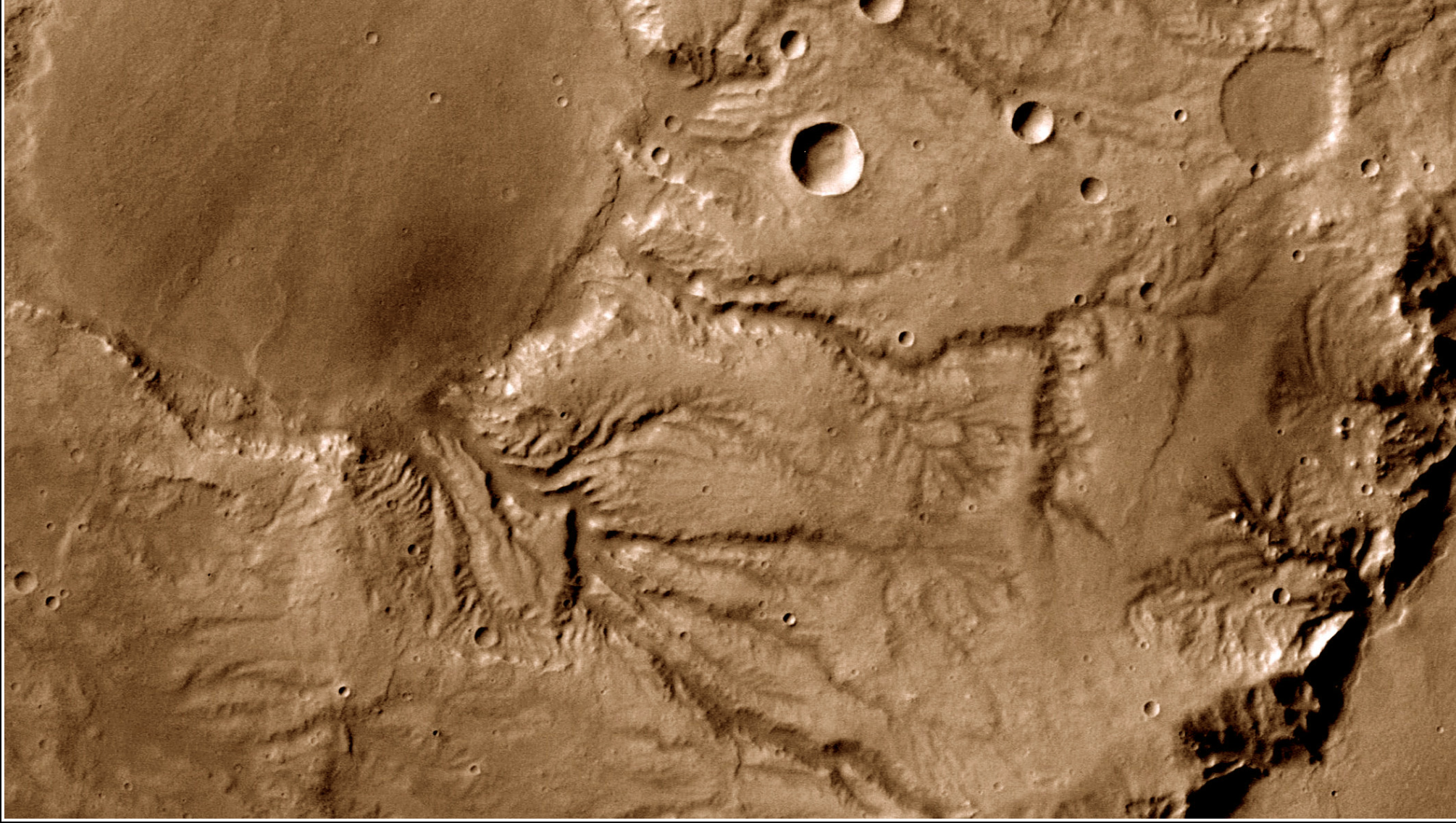
What is the probable origin of the features shown in this image of the surface of Mars?
These are dendritic channels eroded by liquid water.

What is the probable origin of the irregular ovals in this image of the surface of Mars?
Sublimation of ground ice caused collapse of the surface it make pits.
What is the Tharsis "bulge"?
A large dome that was associated with the development of an extensive fracture system.
Which is NOT a way that Mars and Mercury differ substantially in what way(s)?
The strength of their gravity fields.
Graben formation is usually associated with which process?
lithospheric extension
Which features of Mars indicate a distinctive geologic process that doesn't operate on Mercury or the Moon?
Domal upwarps of the lithosphere and associated fractures caused by mantle plumes.

Note the long light-toned feature that extends diagonally across this image on Mars. Which phrase(s) best describe its possible origin? Choose all that apply.
Low viscosity lava flow
Basaltic lava flow

Examine this image of Mars carefully. What feature is a small shield volcano?
right beneath highest volcano looking thing in picture


Click on the part of this image of Mars that has evidence of tectonic extension.
striped looking part on right side


Click on the feature that is the result of tectonic contraction on Mars.
C (largest wrinkle) lines along left side of picture


Mass movement commonly affect steep slopes on the planets. Click on a landslide in this image of Mars.
looks like a tongue

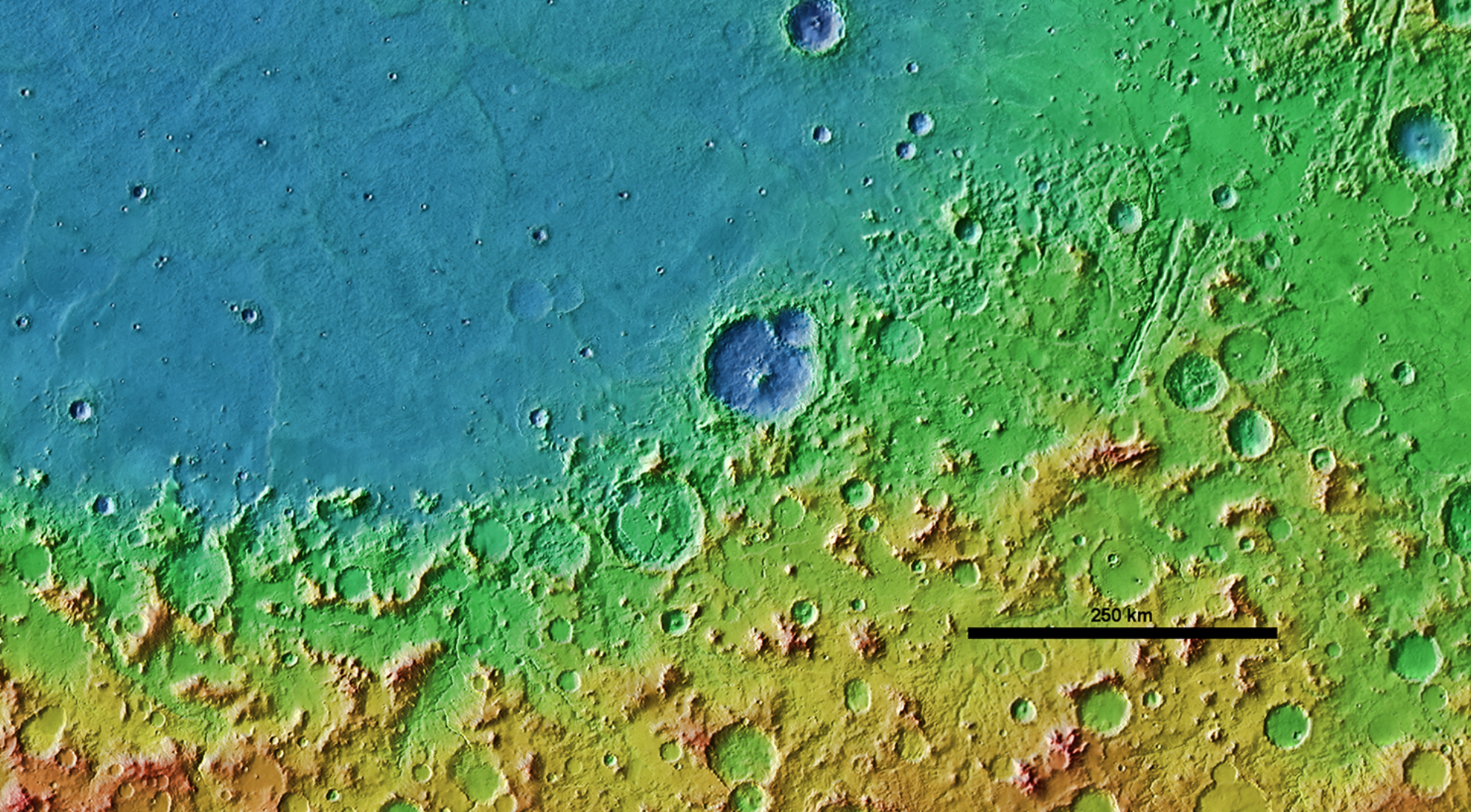
Click on a young volcanic plain in this colored shaded relief map along Mars' Great Escarpment.
in the top left corner, blue, smooth

Which planetary body's interior stayed warm longer?
Mars
What is the probable origin of the smooth plains in the Northern Hemisphere of Mars? Choose all that apply.
The depression probably started to form as a giant impact crater that covered half of the planet.
Sediment from a series of temporary seas smoothed it out.
Does Mars have a plate tectonic system like Earth?
No, it lacks a system of moving plates.

What was the sequence of events that shaped this part of Mars? Put the following descriptions into the proper order with the oldest on bottom and youngest at the top. Not all descriptions apply and should be left out.
YOUNGEST
Development of shield volcanoes
Eruption of Lava plains
Extensional tectonics
Formation of rampant crater
OLDEST
These diagrams show the history of Mars but they are not in the correct chronologic order. Put the event into the proper order with the oldest first and the youngest last.
Comets, cratered, lego hair, lava plain continent, peninsula, cells within continents

Which of the following statements about Venus is (are) true? Choose all that apply.
The diameter of Venus is almost the same as that of Earth.
The atmospheric gases create a large Greenhouse effect.
If Venus is so close to Earth, why has it taken so long to understand what the solid surface of Venus is like?
Its surface is buried beneath a very cloudy atmosphere.
Which of the following is a major difference between Venus and Earth?
atmospheric composition
Radar images of Venus show all of the following except __________.
river valleys

Study this colored topographic map of Venus and identify the following provinces using the letters on the map. Blue is low, with green, yellow, red, and white progressively higher. A highland, lowland, and upland.
A: Lowland
B: Highland
C: Upland
Which of the following statements is an accurate description of the atmosphere of Venus?
The venusian atmosphere is rich in carbon dioxide.
Conditions on Venus are such that which of the following are true? Choose all that apply.
Pure lead would be a liquid on its surface.
The pressure is about 90 times that on Earth.
What is one of the major causes of the high temperatures on the surface of Venus?
the greenhouse effect
Large amounts of water (as gas or liquid) on Venus _________.
have probably been lost to space and by combination with surface materials.
Impact craters on Venus that are larger than about 30 km in diameter are __________.
not common because of the planet's dynamic interior and young surface
The structure and appearance of impact craters changes with size. Study these radar images of impact craters on Venus. Arrange them from smallest (at the top) to largest (at the bottom).
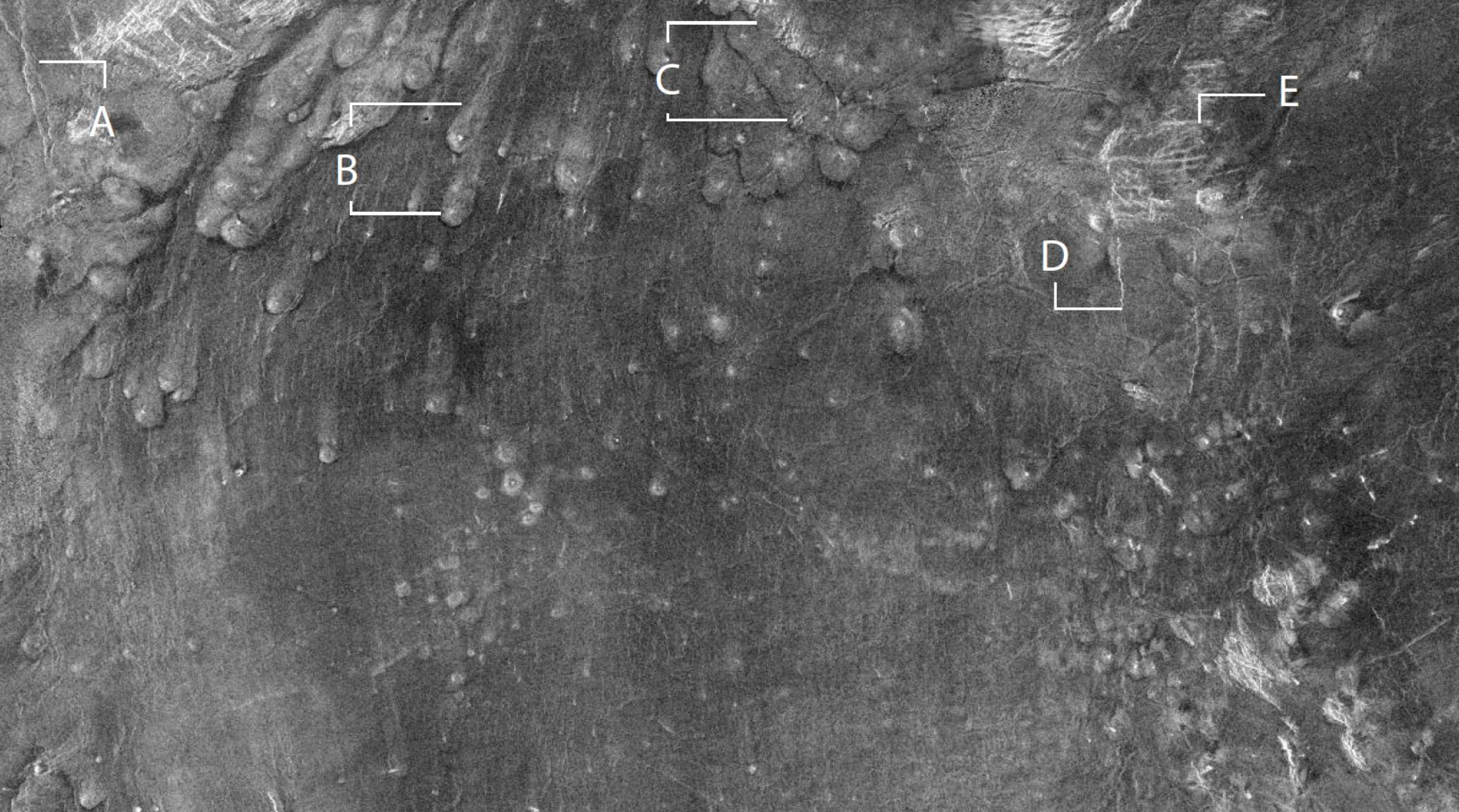
Click on the letter of the area of this radar image of Venus that has been shaped by eolian (wind) processes.
B

About how old is the surface of Venus as judged from the abundance of meteorite impact craters?
Millions of years old.
The two large volcanoes of Venus, Theia Mons and Rhea Mons, lie on the flanks of a structure similar to which of the following?
The East African Rift valley.
Folded mountain belts are important tectonic landforms. Which of the following statements is the most accurate description of folded mountain belts?
They are found around the margins of highlands on Earth and Venus.
What is the most important factor in the volcanic and tectonic evolution of Venus as compared to Mars?
The size of Venus which makes it cool slower than Mars.
Which of the following are major extensional features on Venus?
Rift valleys and grabens associated with lithospheric domes.

What is the most likely cause of the sinuous feature that extends across this radar image of Venus? The area is a few hundred kilometers across.
Erosion by hot flowing magma.

What is the most likely cause of the radical tectonic features on this part of Venus? The image is a few hundred kilometers across.
Vertical doming
What is the approximate age of the surface of Venus?
The average age of the surface is much younger than any of the Moon's major terranes.
Which is NOT true? Does Venus have a plate tectonic system like the Earth? (Mark all that apply.)
Yes, Venus and the Earth both have a system of plate tectonics.
Why is the history of Venus so different from that of Mars?
Venus is significantly larger than Mars and cooled slowly.
What would have happened on Venus if it had been cool enough for liquid water to form?
Carbonate minerals may have formed in the water and removed the carbon dioxide from the atmosphere.
It is very possible that Venus once had more water and has lost it to space over the millenia.
True
Which gas was most efficiently removed from the Earth's atmosphere since the advent of life?
Oxygen—O2
Helium—He
Nitrogen—N2
Carbon Dioxide—CO2
Water—H2O
Which of these factors control the Earth's hydrologic system? (Mark all that apply.)
gravity
solar energy
topography
temperature
The presence of oxygen (O2) in a planet's atmosphere can indicate ___________________.
the presence of living organisms
Which event drastically modified Earth's geologic history about 3.5 billion years ago?
The advent of life.
Karst topography is produced _______________.
because limestone is relatively soluble in water
Considering the ways it forms, deforms, and crystallizes, glacial ice can be considered to be which of the following?
a metamorphic rock
On Earth and Mars, how is loess deposited? (Mark all that apply.)
As a blanket which mantles the landscape.
By the wind.
As dust-sized particles.
A weak layer within Earth which behaves like a viscous fluid is _________________. (Mark all that apply.)
the outer core
the asthenosphere
How thick is Earth's lithosphere?
Between about 10 and 200 km thick.
Which of the following is not usually associated with a terrestrial subduction zone?
basaltic shield volcanoes
The Earth's oceanic crust is composed mostly of ____________________.
igneous rocks of basaltic composition
Which of the following are true about mid-ocean ridges? (Select all that apply.)
the site of the production of oceanic crust
has abundant extensional normal faults
On Earth, lithospheric plates converge at which plate boundary?
subduction zones
Where are the oldest rocks on Earth found?
In its continental shields.
Why did continents develop on Earth and not on the Moon, Mercury, or Mars?
Only Earth has subduction zones.

Click on the letter of the cross section of Earth that shows where the mafic ocean crust is made.
C

Click on the letter of the cross section of Earth that shows where the silicic continental crust is made.
D
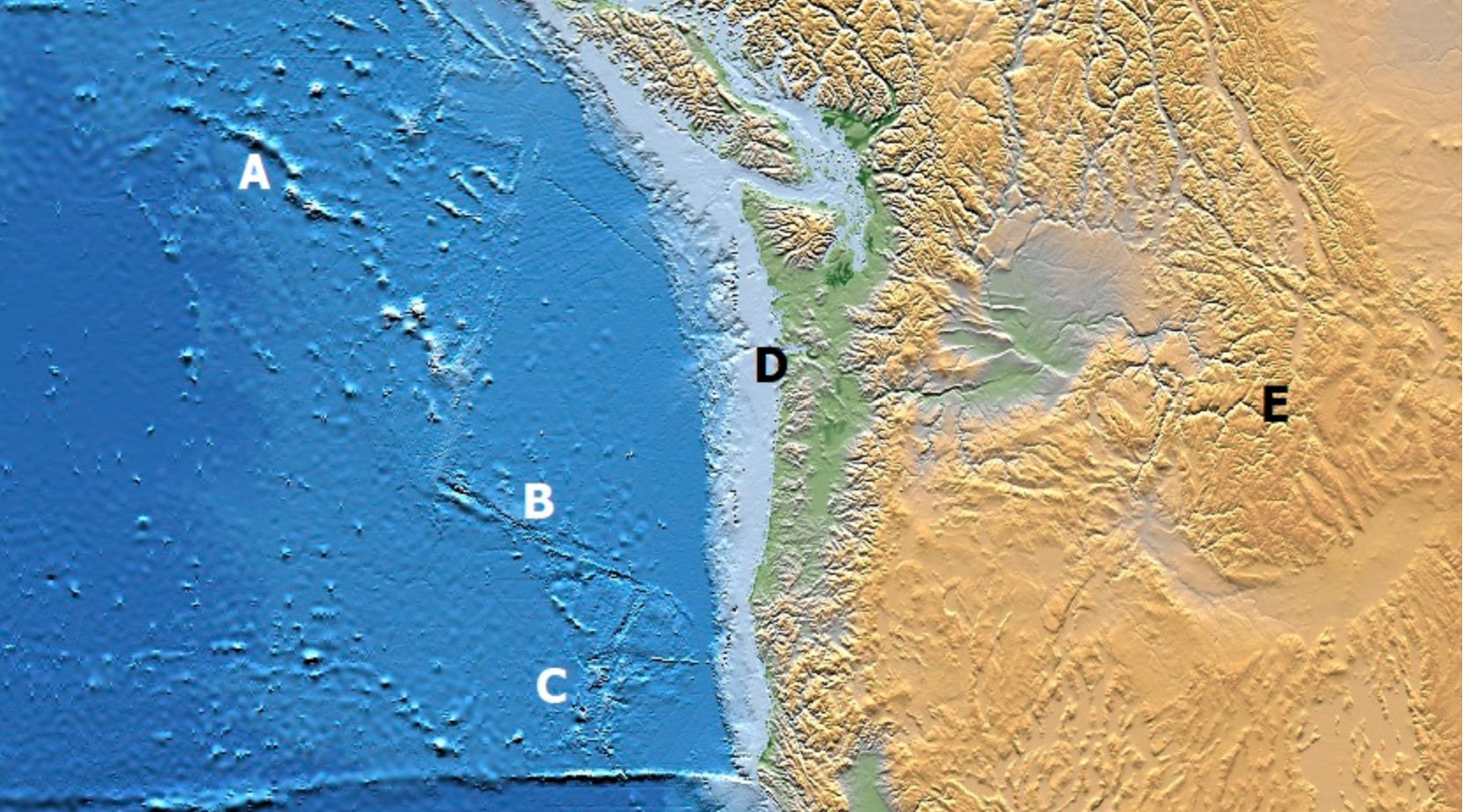
Click on the letter on this shaded relief map that shows a transform plate boundary.
B
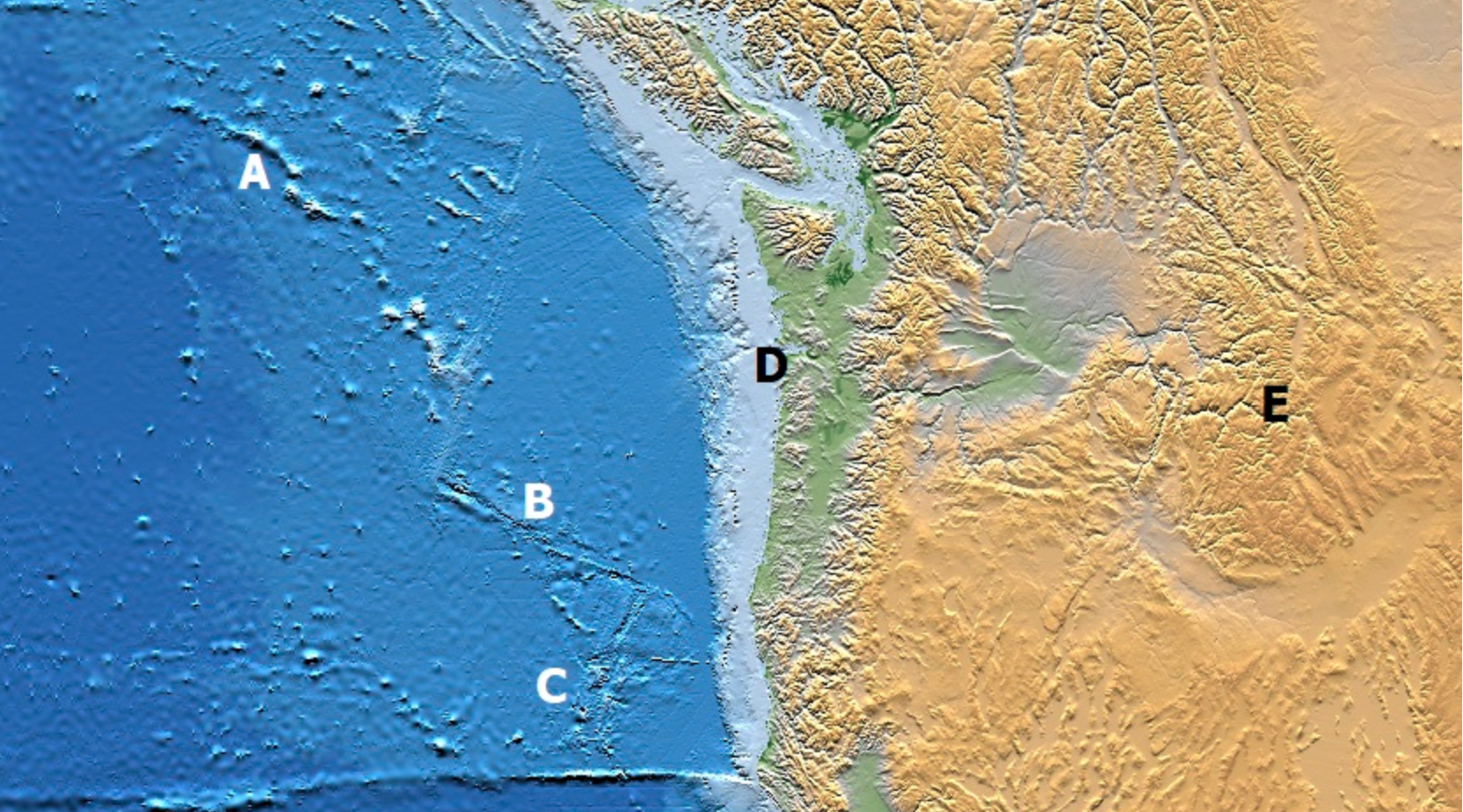
Click on the letter on this shaded relief map that shows a divergent plate boundary.
C

Click on the letter on this shaded relief map that shows a convergent plate boundary.
D
How many meteorite impact craters have been identified on Earth?
About 100
What explains the number of impact craters that have been identified on Earth? (Select all that apply.)
Earth has few impact craters because its ancient surface has been extensively modified by erosional processes.
Earth has few impact craters because many were obliterated by subduction, mountain building, and volcanism.
How did the Chicxulub impact affect Earth?
The impact triggered a series of climate changes that led to the extinction of many species, including dinosaurs.

These images show impact craters on the Moon, Mars, Venus, and Earth. Each has distinctive features because of the geologic processes that affect the surface. Click on the image of the crater on Earth.
A

These images show impact craters on the Moon, Mars, Venus, and Earth. Each has distinctive features because of the geologic processes that affect the surface. Click on the image of the crater on the Moon.
B

These images show impact craters on the Moon, Mars, Venus, and Earth. Each has distinctive features because of the geologic processes that affect the surface. Click on the image of the crater on Mars.
C

These images show impact craters on the Moon, Mars, Venus, and Earth. Each has distinctive features because of the geologic processes that affect the surface. Click on the image of the crater on Venus.
D
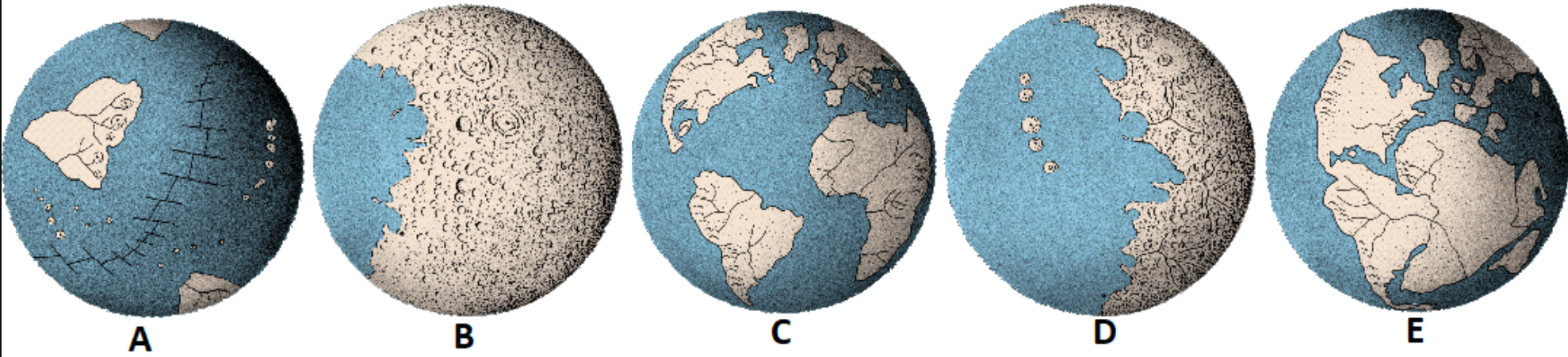
These images show 5 stages in Earth's 4.6 billion year evolution. Sort the images from youngest (present day) at the top, to oldest (primordial Earth) at the bottom.
Why is the Earth a dynamic planet, whereas the Moon and Mercury have undergone very little change during the last 3.5 billion years? (Select all that apply.)
A major difference is that Earth is much larger than the other two.
Because Earth is closer to the Sun than the Moon and Mercury, its hydrologic system has been more actively eroding the surface.
Because Earth has a moon and the others do not, it has been tidally heated and kept warm and active for a long time.
The Moon and Mercury lack atmospheres, but Earth has retained one, which has greatly modified the surface.
What are some of the ways that the advent of life modified Earth's atmosphere/hydrosphere and the geologic processes which act on its surface? (Select all that apply.)
Using energy from the Sun, organisms consumed carbon dioxide and released oxygen into the atmosphere.
The oxygen produced by living things oxidized (weathered) the minerals and rocks at the surface.
The evolution of creatures that make shells of calcium carbonate helped remove carbon dioxide from the atmosphere.
Large quantities of dissolved iron were removed from the ocean to form delicately banded iron-rich sediments.
In what way is the history of Earth similar to the history of the Moon?
Both planetary bodies once had heavily cratered surfaces.
Both eventually developed plate tectonics.
Both once had thick atmospheres of carbon dioxide and nitrogen.
Both have magnetic fields to this day, shaped by convection of molten iron cores.
What are some of the ways that the advent of life modified Earth's atmosphere/hydrosphere and the geologic processes which act on its surface? (Select all that apply.)
ALL OF THE ABOVE
In what way is the history of Earth similar to the history of the Moon?
Both planetary bodies once had heavily cratered surfaces.