Procedures - Unit 2, Finger, hand, wrist, forearm
 Call Kai
 Learn
 Practice Test
 Spaced Repetition
 Match
 Flashcards
 Knowt Play
1/57

Earn XP
58 Terms
Number of bones (per side) in hand:
Phalanges
Metacarpals
Carpals
14
5
8
True or False:
The central ray should be directed to the associated distal interphalangeal joint when positioning for a PA finger.
False
What bone articulates with the trapezium?
first metacarpal
DIP stands for?
Distal Interphalangeal Joint
PIP stands for?
Proximal Interphalangeal Joint
MCP stands for?
Metacarpophalangeal Joint
IP stands for?
Interphalangeal Joint
The central ray for an oblique hand is directed towards the:
3rd metacarpophalangeal joint
The first carpometacarpal joint of the thumb is classified under which movement joint type?
saddle joint
What is the carpal bone that articulates with the 1st MCP?
Trapezium
What is the carpal bone that articulates with the 2nd MCP?
Trapezoid
What is the carpal bone that articulates with the 3rd MCP?
Capitate
What is the carpal bone that articulates with the 4th MCP?
Hamate
The lunate and scaphoid bones articulate with the _______ proximally.
Radius
The most frequently fx carpal bone:
Scaphoid
The lunate articulates with the ________ (bone).
Radius
The radial tuberosity is located on the ________ & ________ side of the radius.
Medial and Anterior
The two processes of the proximal ulna:
Olecranon and Coronoid processes
Notch on the proximal ulna where articulation with the humerus occurs:
Trochlear Notch
To evaluate the interphalangeal joints in the oblique and lateral positions, the fingers must be _______ to the _______
parallel
IR
What portion of the humerus articulates with the ulna to form the elbow joint:
Trochlea (distal humerus)
What are the processes at the distal ends of the radius and ulna?
Styloid Processes
IP joints are ginglymus, which is defined as:
Hinge-type
Movement in 2 directions: flexion and extension
MCP joints are ellipsoidal (condyloid), which is defined as:
Condyloid type
Movement in 4 directions: flexion, extension, abduction, and adduction. (Circumduction)
List the joint classifications for:
IP
MCP
Ginglymus (hinge)
Ellipsoidal (condyloid)
List the joint classifcations:
CMC (thumb)
CMC (2nd - 5th)
Saddle
Plane (gliding)
List the joint classifcations:
Intercarpal
Wrist
Elbow
Plane (gliding)
Ellipsoidal (condyloid)
Ginglymus (hinge)
_______ deviation provides the best demonstration of the lateral carpal including the trapezium, trapezoid, and __________.
Ulnar
Scaphoid

_______ deviation provides the best demonstration of the medial side of the wrist.
Radial

To prevent superimposition of the radius & ulna, the forearm is placed with the hand __________ and in an ______ projection.
Supinated
AP

The scaphoid fat stripe (wrist) can be viewed on which projections?
PA and Oblique
The pronator fat stripe (wrist) can be visualized on which projection(s)?
Lateral
To avoid excessive MCP joint overlap in an oblique hand, the hand should be angled no more than ______ degrees.
45
The Nogaard Method (aka _____________ position) is used for early detection of _________________. Describe this view:
Ball Catcher’s
Rheumoatoid arthritis
Bilateral hands (to compare with each other). Hands are oblique 45 degress with palms up.

What is an alternative to a fan-lateral hand to evaluate a fracture or foreign body?
Lateral in Extension and Flexion

Describe the Brewerton method:
AP Axial of the Hand
Supinate hand with fingers touching IR. Flex hand 65 degrees. CR 15 degress promixally toward ulna (3rd MCP joint).
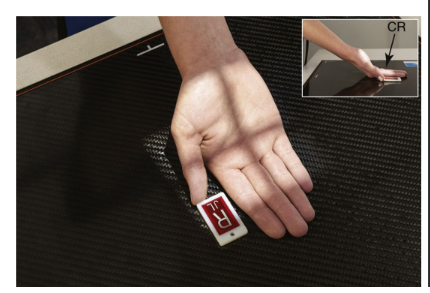
Which method x-ray is best performed to evaluate Rheumatoid Arthritis in the second to fifth MCP joints?
Brewerton method
Which of the following statements regarding the Norgaard method (Ball Catcher's position) is (are) correct?
1. Bilateral AP oblique hands are obtained
2. It is used for early detection of rheumatoid arthritis
3. The hands are oblique about 45 degrees, palm up
1, 2, and 3
What method is best used to evaluate a Bennett fracture?
AP Axial of Thumb (CMC views)
CR is angled 15 degrees proximally (towards wrist)

Why should the hand be slightly arched / fingers bent for a PA wrist?
Reduce OID of carpals and makes sure carpals are flat against the IR.
An AP axial thumb is also known as _________
Modified Roberts

Why is it important to support the fingers so that they remain parallel to the IR?
Prevent foreshortening of phalanges
Prevent obscuring of IP joints
The wrist joint is classified as what type of movement:
Ellipsoidal
The Gaynor-Hart method is primarily used to evaluate:
Carpal Tunnel Syndrome
CR 25-30 degrees proximally to long axis of hand
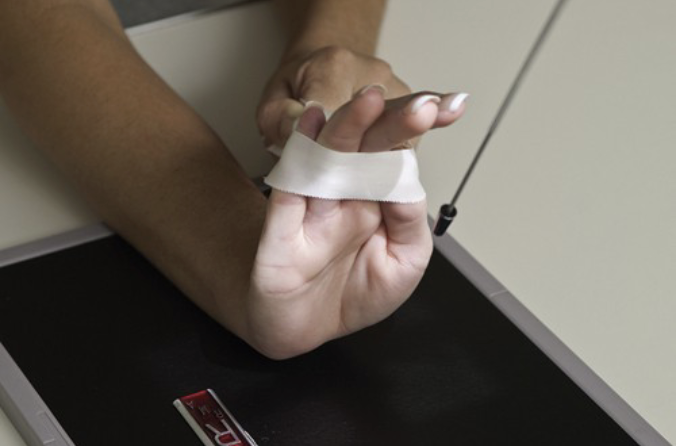
A PA axial projection to visualize the scaphoid bone requires _________ deviation of the wrist and a _________ degree tube angle directed proximally.
Ulnar
10-15
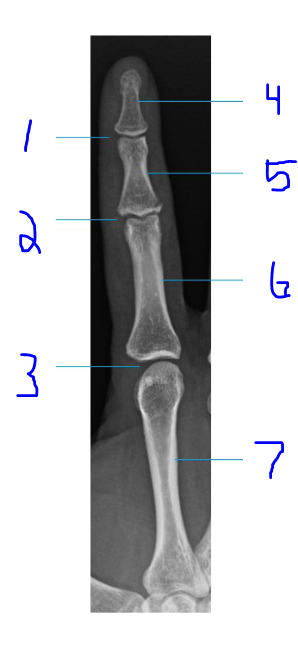
Label
DIP (Distal interphalangeal) joint
PIP joint
MCP joint
Distal phalanx
Middle phalanx
Proxmial phalax
Metacarpal
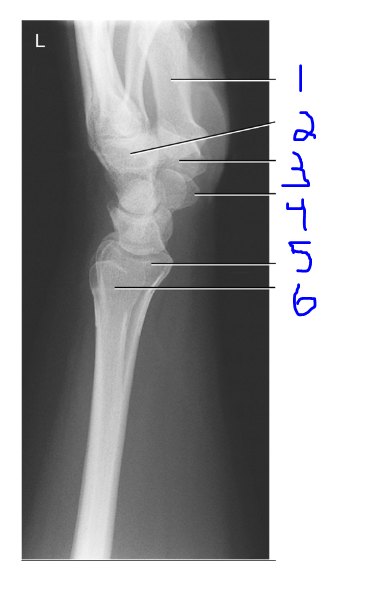
Label
Thumb
Capitate
Trapezium
Scaphoid
Radius
Ulna
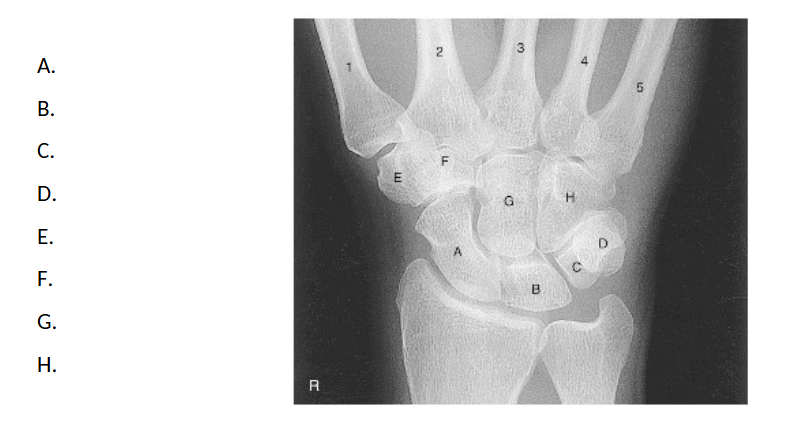
Label A-H
A. Scaphoid
B. Lunate
C. Triquetrum
D. Pisiform
E. Trapezium
F. Trapezoid
G. Capitate
H. Hamate
Oblique Wrist: Image Criteria
Distal radius, ulna, carpals, and at least to the mid-metacarpals.
Trapezium and Scaphoid should be well visualized
45 degrees

What projection may be done in replacement of an oblique thumb?
PA Hand
Lateral Wrist: Image Criteria
Distal radius, ulna, carpals, and at least to the mid-metacarpals.
Ulnar head superimposed over distal radius
Proximal 2nd - 5th metacarpals all appear aligned and superimposed

What projection may be done in replacement of a PA Digit?
PA Hand
PA thumb results in:
a lot of OID. Not a common projection
Oblique Hand: Image Criteria
Midshafts of metacarpals should not overlap
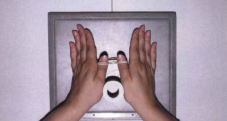
PA Stress Thumb (Folio Method)
Hands side by side, rotated laterally 45 degrees, thumbs in PA, wrap rubber bands around distal thumb
Skier’s Thumb (hyperextension and ulnar collateral ligament)
Plane/Gliding movement type examples:
Intermetacarpal, intercarpal, and 2nd-5th carpometacarpal joints
Ginglymus/Hinge movement type examples:
IP joints (fingers & toes) and elbow
Ellipsoid/Condyloid joint movement type examples:
MCP joints and wrist