VOCAB EXAM 2/Concepts
 Call Kai
 Learn
Learn Practice Test
 Spaced Repetition
 Match
Match Flashcards
 Knowt Play
1/86

There's no tags or description
Looks like no tags are added yet.
Name | Mastery | Learn | Test | Matching | Spaced | Call with Kai | Chat |
|---|
No analytics yet
Send a link to your students to track their progress
87 Terms
Protists
all eukaryotes except plants, animals, and fungi
Diplontic
multicellular stage is diploid (2N)
Haplontic
multicellular stage, if present, is haploid (1N)
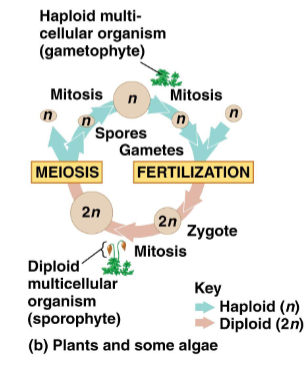
Alternation of generations
both haploid and diploid multicellular stages
Diplontic Life Cycle
Gametes are only 1N cells
Fertilization produces 2N zygote
zygote divides by mitosis to produce 2N multicellular organisms
most animals, some protists

Haplontic Life Cycle
Fertilized zygotes are only 2N cells, and immediately undergo meiosis
Haploid cells divide by mitosis to produce clones or 1N multicellular organism
Gametes produced by mitosis
Most fungi, some protists

Alternation of generations Life cycle
zygotes divide by mitosis to produce 2N multicellular sporophyte, which produces 1N spores by meiosis
Spores divide by mitosis to produce 1N multicellular gametophyte, which produces 1N gametes by mitosis
most plants, some protists
pellicle
protein bands underneath membrane
alveoli
flattened vesicles under plasma membrane
Coral bleaching
coral expel zooxanthellae when stressed
Sex
mixing of genetic information from two individuals
usual process: meiosis followed by fertilization
reproducation
formation of new individuals
Conjugation
sex in ciliates
Process:
Start and end with same 2 individuals
each gets new genetic information
Phycoerythrin
gives them red color
Colonial
possible intermediate step to multicellularity
multicellular
isolated cells cannot survive alone
heterotrophs
feed by ingestion and internal digestion
Embryonic development of animals
zygote undergoes cleavage
Blastula stage
Gastrulation
cleavage
mitotic division without getting bigger
blastula stage
hollow ball of cells
gastrulation
cells from blastula wall move inward to form tissue layers
radial symmetry
often sessile or drifting
no left-right or front-back
bilateral symmetry
usually move actively
cephalization
cephalization
concentration of nerve tissue and sensory structures at front of body
differentiation
cells specialize during development
Diploblastic
2 layers
ectoderm —> outer covering
endoderm —> lining of gut
triploblastic
3 layers
ectoderm —> outer covering
mesoderm —> muscles, skeleton
endoderm —> lining of gut
Acoelomate
no cavity, just solid mesoderm tissue
pseudocoelomate
cavity in between mesoderm/endoderm
coelomate
cavity lined on all sides by mesoderm
Determinate cleavage
developmental fate of cells determined fate of cells determined early
indeterminate cleavage
each early cell can develop into complete organism
protosomes
“Mouth first”
blastopore —> mouth
deuterostomes
“mouth second”
Blastopore —> anus
segmentation (animals)
repeated body units
may be identical or specialized
Epidermis
outer layer
pores (ostia)
Choanocytes
inner layer
capture food, move water
Mesohyl
gelationous matrix between cell layers
Gastrovascular cavity
incomplete gut with only one opening
polyp
sessile mouth/anus up
medusa
mobile, mouth/anus down
Mesoglea
gel in between
cnidocytes
epidermal cells specialized for prey capture
Nematocysts
cnidocytes with stinging toxins
Lophophore
Ring of ciliated tentacles
Found in ectoprocts and brachiopods
Trochophore
planktonic larve with band of cilia
found in colluscus and some annelids
Planarians
free living flatworms
Neodermata
parasitic flatworms
Corona
Crown of cilia
Mantle
Dorsal sheet of tissue; secretes shell
Mantle cavity
water-filled space; holds gills
Radula
Ribbon of teeth to scrape food
Open circulatory system
“Blood” empties into open space and directly contacts tissue
chromatophores
pigmented epithelial cells
parapodia
paddles on each segment
Chaetae
bristles made of chitin
Clitellum
secretes cocoon for reproduction
ecdysis
molting in order to grow
A Thin, flexible cuticle allows for?
allows gas excgange
restricted to damp habitats
A thick, strong cuticle?
provides excellent protection
requires jointed appendages for movement
Prokaryotes are… (2)
bacteria
archaea
eukaryotes are…
Eukarya
Prokaryotic cells
no membrane-bound
single circular chromosome
divided by binary fission
Eukaryotic cells
membrane-bound organelles
multiple linear chromosomes
divide by mitosis or meiosis
Prokaryote Morphology
small
unicellular, but may form colonies
3 basic shapes
Spherical —> cocci
rod-shaped —> Bacilli
spiral —> Spirilli
Prokaryote morphology inside the cell
single circular chromosome in nucleoid region
plasmids
Prokaryotic ribosomes
no organelles, but may have infoldings of plasma membrane
Prokaryote Morphology Cell boundaries
most have rigid cell wall
Bacterial cell walls made of peptidoglycan
archaea cell walls not made of peptidoglycan
archaea cell walls not made of peptidoglycan
Two forms of bacterial cell walls, based on peptidoglycan thickness
distinguished by gram staining
may also have polysaccharide capsule
Prokaryote morphology external
flagella for locomotion
Fimbriae
pili
Fimbriae
used for adhesion
pili
used to transfer DNA between cells
Endospores
non-reproductive, dormant
highly tolerant of environmental conditions
Binary fission
chromosome duplication
chromosome segregation
cell elongates
cell splits down the middle
Prokaryote Reproduction plasmids
small separate pieces of DNA
Reproduce independently
can be passed to others
can be inserted into or removed from main chromosome
Rapid generation time
binary fission every 1-3 hours, or even faster
transformation
picking up DNA from enviroment
Transduction
getting DNA injected by a virus
Conjugation
getting DNA from another bacterium, through a pilus
Horizontal gene transfer (Sources of GV)
movement of DNA between individuals
very common in prokaryotes
occurs across species, and even across domains
Photoautotrophs
energy from light, carbon from inorganic CO2
includes photosynthetic species
Photoheterotrophs
energy from light, but carbon from organic molecules made by other organisms
Chemoautotrophs
energy from oxidizing inorganic compounds, carbon from inorganic source
nitrogen fixers
nitrogen fixers
convert atmospheric N2 gas into ammonia (NH3) usable by other organisms
Chemoheterotrophs
energy and carbon from organic molecules
most common across all groups
herbivores, predators, decomposers, parasites
Obligate aerobes
require presence of oxygen
aerobic respiration
Obligate anaerobes
require absence of oxygen
anaerobic respiration (fermentation)
Facultative anaerobes
can alternate, depending on environmental conditions
How can Horizontal gene transfer complicates phylogenetics?
gene flow between unrelated lineages
leads to genetic homoplasy
Importance of Prokaryotes
key players in element cycling
important in many symbiotic relationships
mutualism, commensalism, parasitim