History and Theory midterm
 Call Kai
 Learn
Learn Practice Test
 Spaced Repetition
 Match
Match Flashcards
 Knowt Play
1/64

There's no tags or description
Looks like no tags are added yet.
Name | Mastery | Learn | Test | Matching | Spaced | Call with Kai | Chat |
|---|
No analytics yet
Send a link to your students to track their progress
65 Terms
Reflexivity
Confounding of the agent and of the object of the study so that
The knowledge produced by the agents (and their characteristics) effects how objects respond while being studied
The knowledge produced by psychology applies as much to the agents as the objects
Agent = the psychologist
Object = participant
This is a recognition that we apply the knowledge to others, ask much as it to the researcher
example of reflexivity
Intelligence testing
Dr Horace Mann Bond: black people performed worse in IQ tests when the test was administered by a white tester than a black tester
One must recognize the context, bias, and environment behind research
This helps one to appreciate and better understand human behaviour
Factors outside of psychology affect the definition and practise of psychology, the type of knowledge generated, how this knowledge is received
Psychology and psychologist exist within a web of other factors: social, political, cultural
Context is KEY
One must look at the events going on around the researchers when major studies came out
Social Constructionism Leipzig Model, Germany, Wundt vs Paris Model, France, medical context
Leipzig Model, Germany, Wundt
experimenter was also a subject
equal status btw experimenter and subject
Paris Model, France, medical context
experimenter in control
subject recipient of treatment or manipulation
The agent was also the object (researching on themselves) - Wundt study
Paris model was the opposite - there was an authoritative control over participants
Social constructionism shows the fundamental difference in how studies were conducted and how it changed the result of the findings
Indigenization
Big I: Indigenous Peoples’ psychology; theories, viewpoints, etc.
little i: psychology is connected to and originates from particular
peoples and places
modern psychology originated in Germany and exported around the globe in the late 1890s
early 1900s-1920s: U.S. Psych became bigger than European Psychology
psychology was international (i.e. not homogenous)
• WW2 + suspicion of Germans as Nazis →US psychology became dominant
Lower case "I" indigenization = this is the connection of people and places in psychology and embracing differences among cultures
This is the opposite of homogenization (same)
Indigenous psychology movement
Psychology is rooted in euro-centric and western cultural beliefs
a movement against the homogenization of psychology, mainly in global south and low- and middle-income countries that emerged post WW2, gaining international attention in the 1980s (Danzinger, 2009)
the movement developed in the context of anti-colonialist movements (e.g. civil rights, Black nationalist movements)
led to both superficial and fundamental changes in psychological research
Schools of thought in psychology = acknowledging the different lenses of psychology
today, psychology is more international (i.e. not universal or homogenous) than it was before the 1980s
explicit efforts to make it and keep it international
efforts to be aware of the imperialist nature of psychology that came from Europe and the U.S.
schools of psychology
assumptions of western Eurocentric/North American psychology
see below
Individuality
individual is the focus of behavior. Determinants of behavior reside in the individual’s brain/mind, and interventions must be at this level rather than the broader societal context.
Reductionism
Small, tangible units of study that yield well to controlled experimentation are favored.
Experiment-based empiricism
An emphasis on experiments with controls and experiment group comparisons and uses of ANOVA analyses that often account for 5 to 10 percent of variance. Lab studies are often favored over field studies.
Scientism
The belief that methods of the physical sciences can be applied similarly to social and behavioral phenomena, which results in spurious methods and conclusions that are inappropriate to the subject under study or that avoid studying certain subjects.
Quantification/measurement
“Whatever exists at all ... can be measured,” said Edward Thorndike (Thorndike, 1918). Unless something under study can be quantified, it is not acceptable for study. This, of course, leads to operationalism as the standard for assessing concepts.
Materialism
Favors variables for study that have a tangible existence rather than higher order constructs — I can see it and touch it under amicroscope.
Male dominance
Years of male dominance favors particular topics, methods and populations for study — remember “involutional melancholia,” the psychiatric disease assigned to middle-aged women.
“Objectivity”
Assumption that we can identify and understand immutable aspects of reality in a detached way, unbiased by human senses and knowledge.
Nomothetic laws
Search for generalized principles and “laws” that apply to widespread and diverse situations and populations because of an identification and admiration for the physical sciences.
Rationality
Presumes a linear, cause-effect, logical, material understanding of phenomena and prizes this approach in offering and accepting arguments and data generation
Methods of Historians of psychology
Historiography: techniques and principles used in historical research; actual writing of history.
1. Lost or suppressed data
2. Data distorted in translation
3. Self-serving data
Lost or suppressed data leads to problems of important data never being found
Self serving data: people wanting to present their work in a certain way. One that best presents their work in a certain light that can be incorrect or false
Epistemology
branch of philosophy concerned with theories of knowledge.
i.e., theories about how we acquire knowledge.
addresses where knowledge comes from
nativism
notion that (some) knowledge is innate
i.e., framework exists from birth.
empiricism
knowledge is acquired via experience.
i.e., from observation and learning
rationalism
reason is the source of knowledge.
mind has innate capacity to organise info from the senses.
senses are insufficient for knowledge.
mind is active, it interprets information from senses.
reasons and discerns meaning.
authority
Epistemology: how do we know what we know.
Rationalism: This where the mind is active with the information from our senses and uses reason to come to an understanding if things
Authority is in direct contrast of rationalism
Differences in epistemologies
Indigenous epistemologies: this means there re different viewpoints WITHIN the ind groups. There are also similarities. But there is no single ind epistemology
This shows how there are difference between the ind and western worlds on how knowledge is generated.
Ind is more social relation based, and western is more based on science and empiricism
Both definitions are valid and both are good to know. This is known as two eyed seeing, where two worlds intersect.

Monism
e., is the mind separate from the brain?
monism, dualism
monism = one fundamental reality
perfectly interconnected world
problem? Which reality is the real one?!
Types of monism
Materialism is a type of monism where all real things are composed and reduced to matter.
Idealism is the belief that mental experience is all that matters. Reality is created by your own personal and lived experience
What's common between the two, is that either its both the mind and body, or its only the mind. But both agree that there is only one perfect and interconnected world.
Dualism
dualism = two realities
mind and body
Dualism simply means there is a mind and a body. There are different types within it
interactionism:
mental and physical events are real
mental events influence other mental events and body events
body events influence other body events and mental events
Interactionism: The connection between the mind and body is a cyclical event and one that is completely connected BUT not one that is the same - unlike monism.
This one allows for the cross over between mental and physical events
psychophysical parallelism:
mental events and physical events are real
mental events influence other mental events
physical events influence other physical events
do not influence each other
Mental events CANNOT influence physical events
Rene Descartes (1596 - 1650)
founder of psychology? ... no, he wasn’t a psychologist
influenced by Aristotle
Aristotle's vegetative soul, animal soul, rational soul
soul was the basic element or unit; things were alive because they had a soul
Descartes wonders if anything is true?!
concludes: “I think therefore I am, or exist”
truth found through human ability to reason
apply principles of geometry to other areas of knowledge
what were his “rules”
Rule of evidence: “never accept anything as true unless I recognised it to be certainly and evidently as such ...”
axioms = self-evident and certainly true features
Rule of Analysis: divide each problem into smaller parts
Rule of Synthesis: start w/ simplest and gradually move to most complex
Rule of Enumeration and Review: ensure you have considered all components of the problem (i.e. break it down), and then evaluate the process
Nativist and Rationalist
argued one can arrive at truth on their own, and believe in innate ideas, from God
nativist ~ innate ideas exist pre-experience
Rationalist
He believed the truth one has and the knowledge is there, but its yet to be uncovered
He believed the mind is sperate from the body as well. in slide 21
He has nativist views and rationalist perspectives
The pineal glad is what linked the mind with the body.
Be believed in the interaction of the mind and the body (dualism)
He saw the body as a machine
Not a new idea
Animals - mechanistic
Humans are different from animals
Descartes mind body interactionism
separate mind (soul) and body
human body & physical things – same rules
-mind - own rules that are from God
know self via introspection; the act of looking inwards
The mind is governed by its own rules given by God
The time this was written was at a time when religion was at an all time high
His last point means that the only way we know ourselves is though looking at ourselves and the introspection of us
Descartes: philosophy of the mind
Soul and the brain
Soul; as rational, unified
Yet the brain is so divided
Where do they meet?
John Jocke (1632 - 1704)
Knowledge comes from experience, very similar to empiricism
The mind is a blank slate
Gottfried Leibniz (1646 - 1716)
mind like veined marble
mind innate properties, like reason
“necessary truths”
“except the intellect itself!”
He did not believe the mind is blank or made of paper, we have innate properties
The veined marble means you can take away the colors of the marble, but the veins make is difficult to change the base structure of the marble
He proposed the psychophysical parallelism and how its governed by the hand of god. There is no interaction between the mind and the body
psychophysical parallelism
two clocks
hence, study the mind separate from the body
philosophical basis for psychology as separate from physiology
his theory on monadology
The fundamental building blocks of the universe are made of simple building blocks called monads
These are infinite
They are soul like and not material atoms that make up the mental and physical reality

Levels of awareness
apperception – highest level, focus attention, self-consciousness or reason
perception – aware, but not as sharp as apperception
petites perception – below level of awareness, but critical for higher levels of perception
Leibniz’ waterfall analogy; petite perceptions as individual droplets
thresholds
Immanuel Kant (1724 - 1804)
agrees with elements of empiricism and rationalism
agrees knowledge from experience
But! need a priori knowledge
“Critique of Pure Reason” (1781/1787)
Hume, the skeptic
noumenal world: external world, “things-in-themselves,” existing in a “pure” state
phenomenal world: internal world, subjective
psychology would never be a science (see your text)
Kants domains of reality
Hume, the skeptic
Noumenal world: external world, "things in themselves" existing in a "pure" state
Phenomenal world: internal world, subjective
Psychology would never be a science
He believed psychology would never be a science because mental phenomena cannot be observed directly by an independent observer as can be done with physical phenomena
German psychophysics
Study of the relation between the perception of a stimulus event and the physical dimensions of the stimulus being perceived.
Psychological part: perception
Physical part: physical dimensions
These methods were mainly a German phenomenon
Ernst Weber (1795 - 1878)
Two-point thresholds
Weber’s Law
Some key terms/points:
Not absolute difference that matters, but proportional relation
Thresholds
“Just noticeable difference” (jnd)
Just noticeable difference (JND) The threshold of where you can sense the noticeable difference between weight or size of substance
Measurement and math to understand mental events
Physical world: psychological experience is not one-to-one ratio
Mathematical relation between mental and physical
These are an application of mathematical principles to mental events - in this case, sensation and perception
Gustav Fechner (1801-1889)
Fechner wanted to disprove materialism because it ignored the existence of a soul and the interconnection between physical and soul
experimental psychologist?
psychophysics to tackle mind-body question
measure psychological sensations and physical stimuli
1860 publication, “Elements of Psychophysics
Deeply religious and very big on the workings of the soul
He created psychophysics to tackle the questions of the mind and body questions. He wanted to measure both experiences
Its said the he was the first to create a book on experimental psychology
Fechner elements of psychophysics
Use jnd as a unit of measurement
Absolute threshold = as the intensity increases above the threshold, a person experiences a jnd (then another, and another)
Difference thresholds
The JND above the threshold is whats known as the difference threshold
The JND happen slowly, light a light changing, but we don’t know the EXACT point in which the change happens
Muller and the law of specific energies of nerves
“an impression made on two different nerves of sense, though with the same instrument, will produce two distinct sensations” (Bell, 1811
Müller: nervous system acts as a filter between people and the external world
Handbook on Human Physiology (1833-1840)
A good example of this is the tongue and how some nerves are for taste, and some for sensation
Our understanding of the world is made through the physiology of our nervous system
He made THE authoritative textbook on human physiology in the 1800s
Mulers influence on Helmholtz
Helmhotz studied with Müller; befriended Ernst Brücke, Emil du Bois Reymond, and Karl Ludwig
vitalism = idea that there exists a life force
materialism = the only reality is physical matter
Helmholtz’s Theory of Colour Perception
Christine Ladd-Franklin’s Evolution Theory of Colour Perception
Mullers students started to challenge his work with the idea of vitalism (there is a life force) and materialism (the only reality is physical reality)
That there's life outside human physiology
Wilhelm Wundt (1832 - 1920) and a new science
He was the first to open up the doors of experimental psychology
He wanted to asses the questions of the mind and the brain
He was one of the first to formalize the study if psychology as we know it today
He wanted to make psychology less physiology (can't be tested) and wanted to make them more experimental so it could be tested
He provided one of the first multi disciplinary perspectives to psychology (bio, social..)
Introspection and psychology
introspection methodology is a cornerstone of psychology
however, the nature of introspection was hotly debated, namely:
How it should be defined
How it should be used
Implications of the findings using this method
key figures who disagreed on introspection included: Wundt, Oswald Külpe (Würzburg School), William James, Edward Titchener
Wundts Volkerpsychologie
Folk Psychology” or “Cultural Historical Psychology”
higher mental processes (language, morality, culture, religion, learning) connected to history, cultural background and social environment
non-experimental methods only were useful for studying higher mental processes: cross-cultural comparisons, historical analysis, case studies, ethnographic data, phenomenological accounts of experience
cultural evolution of human processes: Primitive Man, Totemic Age, Age of Heroes and Gods, Development of Humanity
By studying culture, we could better understand the human mental process. Looking at the primitive man, and those with lower mental ability
Wundt and ethnocentrism
Wundt did not believe mental ability of those from “primitive cultures” was inferior; rather, they still had thepotential to develop complex forms of thought, social organization, etc.
i.e., it was a lack of cultural experience and development, nothing about individual’s abilities
ethnocentric bias: his work still implies Western European cultures are better, characteristic of the time Wundt worked
People from more primate cultures, and the opportunity and potential to develop more complex forms of thought. It was just a lack of cultural experience, and not so much at the individual level
Western European cultures are superior, and with time, more primitive cultures just needed the time to "catch up"
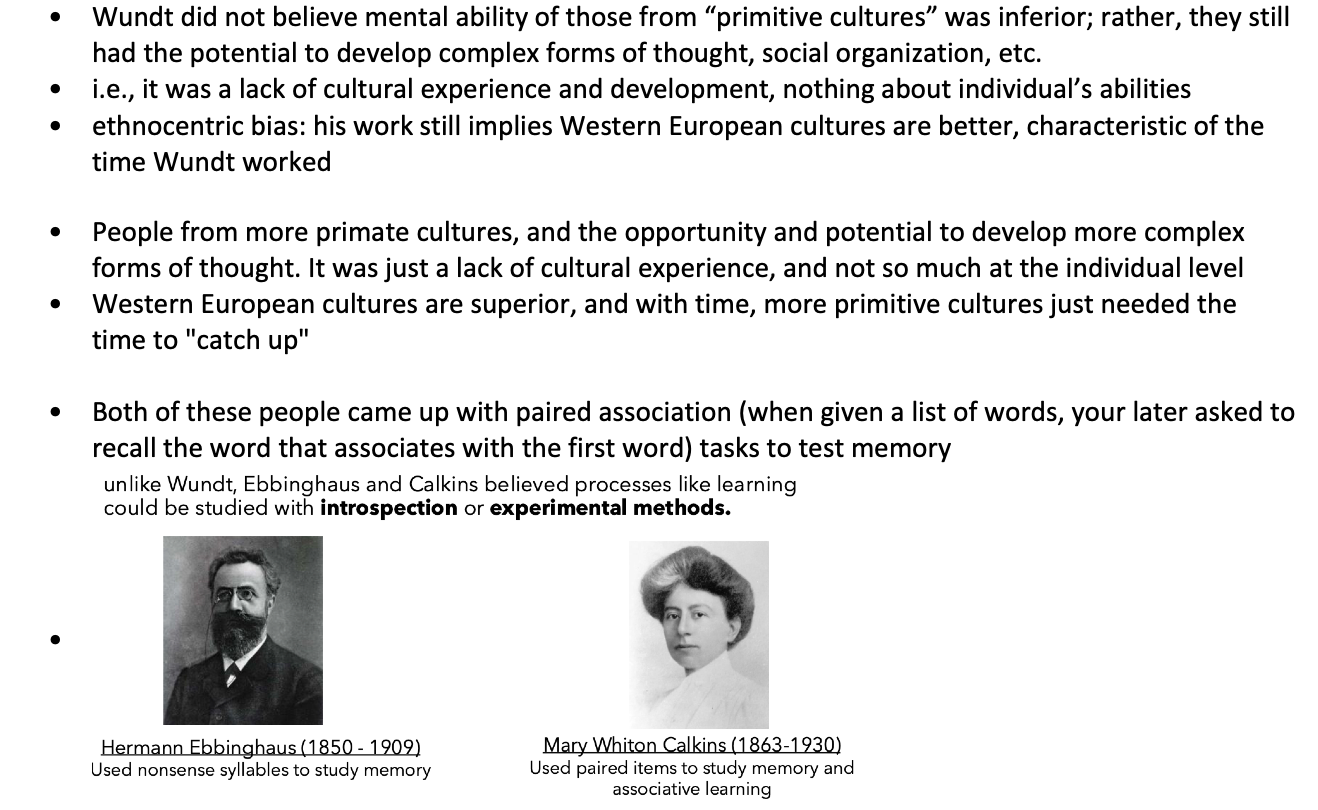
Both of these people came up with paired association (when given a list of words, your later asked to recall the word that associates with the first word) tasks to test memory
G stanley Hall (1844 - 1924)
First PhD in psychology
Leipzig in 1879
Lecture at Harvard and subsequently hired at John Hopkins
First experimental psychology lab in 1883
He wrote the first book on adolescence
He went to go study with wudnt the same year he opened his lab and figured that things can be done better
He opened the first experimental lab in psychology in the US
He is known as one of the pioneers on the notion of developmental psychology
founded the American Journal of Psychology (1887)
First journal in the US to publish psychology research
instrumental in forming the APA in 1892
pioneer of the study of adolescence and developmental psychology
early proponent of eugenics (discussed later)
Chrisine Ladd Franklim (1847 - 1930)
studied math at Johns Hopkins, completed requirements in 1882
Did not receive her PhD until 1927
elaborated on work by Müller and Helmholtz on colour vision
challenged “men’s only” policy in psychology
Although she went to school at JH (they thought she was a man based on her name at first), she wasn't given her PDh till about 40 years later because women couldn’t be given advanced degrees
She is one of the instrumental women who fought back against the sexiest beliefs that women cannot work in the field.
James Mark Baldwin (1861 - 1934)
PhD from Princeton
opened first psychology lab at the University of Toronto in 1889
founded the journals called Psychological Review and Psychological Bulletin
He argued that psychology's first goal should always be structural. Then the second should be functional. Know what works, then know how it works
Anatomy created the basis for physiology, so structuralism should be the basis for functionalism
Titchener and the experimentalists
He created an informal group pf experimental psychologists made of up all men
He wanted to a group made of all men where they didn’t have to sensor themselves and could do whatever they wanted pretty much
He didn’t want women in the group, but he supported women in his labs
KNOW THIS TIMELINE

Evaluating Titcheners contributions
Titchener was one of the first to propose that psychology was an experimental discipline
focused on trained adult observed
however, there are important limitations to his contributions, including:
individual differences?
what about children, adolescents?
lack of application outside of the lab
He did a lot of basic lab research so his work wasn't easily applicable outside the lab
Fall of structuralism
Structuralism was very isolated
primary reason for its downfall? → its methods
1. specifically, introspection
2. inconsistent results across RT studies
3. controversy over imageless thoughts (kinesthetic sensations)
4. bias by using trained observers
behaviourism contributed a great deal to end structuralism
revisit in week on Behaviourism
He has inconsistent results in his reaction time studies
why didnt Wundts Volkerpsychologie catch on
Why didn’t Wundt’s folk psychology catch on?
1. Cultural differences? (Ellis & Stam, 2015)
Germany: defend science to philosophers
North America: defend to academics and administrators
Quantified the value of the research, and this would have been connected to application of new statistics
2. cross-cultural work of the 1900s by psychologists was poorly done and mainly
by “sabbatical opportunists” (Lonner, 1974)
culture considered an external force to be statistically considered
sought to confirm eugenic and racist ideas
Contributions of functionalism
Most of modern psychology as we know it is
functional. Its supposed to be broad and not as fixed
When titchner died, structuralism died

KNOW THIS TIMELINE

Indigenization
resistance against Euro-centric or German-centric versions of psychology
emergence of a functional, more applied psychology
review this summary of everything
emergence of Psychology as a distinct science via opening of research labs in Germany and North America
Big P and little p psychology
different variations in the use of introspection as a metho
experimental psychology (vs. Folk Psychology) emerged as the exemplar
evolution of psychology in North America
study in Europe, return to America, open research labs
different topics, schools of thought
Structuralism and Functionalism as dominant schools of thought for the new
science
Different definitions of psychology (indigenous and western)
Ind definition is very dependant on individual worldviews and these views differ depending on which group and tribe you are a part of.
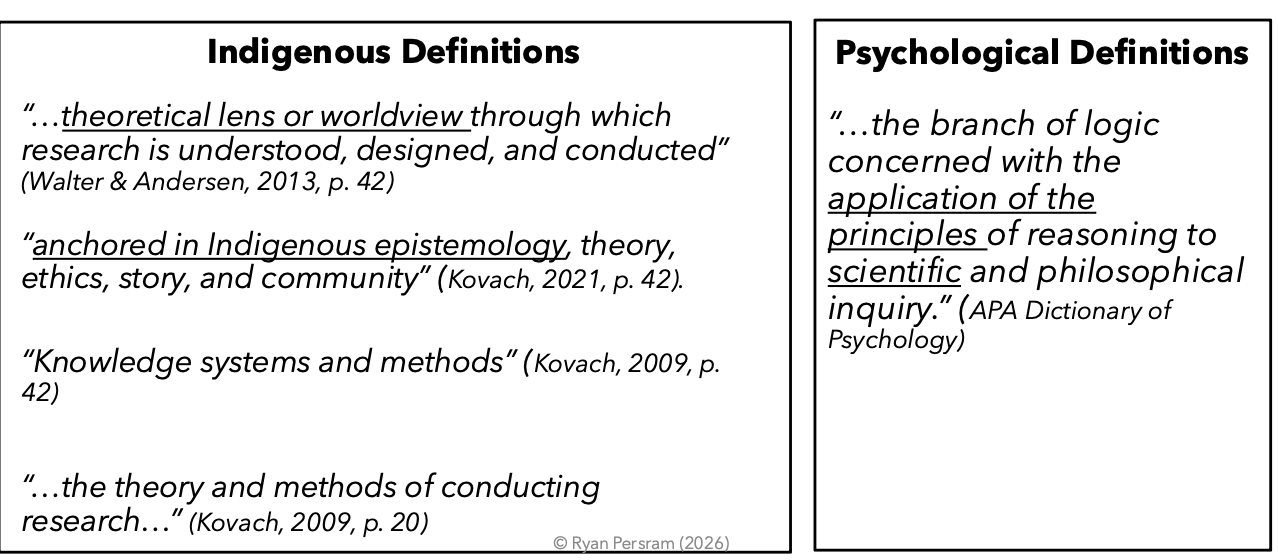
Different methodologies

3 ways Darwinian theory or evolutionary theory impacted psychology
As Heidbreder (1933: 106) observed, Darwinian theory implied that
psychologists had to study people in terms of their "development both genetic and phylogenetic,
[their] position in the array of animal species,
and the means by which [they] adapt themselves to [the] environment:'
Each of these implications became an area of study in psychology.
Comparative psychology. Darwin established "the continuity between human and
nonhuman animals. From his time on, one could not reasonably regard humans as fundamentally independent of the rest of the animal kingdom" (Dewsbury, 2009b: 69). This
suggests that a great deal can be learned about people by comparing them with other
species. Thus, the study of animals should be part of psychology
Another Darwinian idea to have a profound influence on psychology was variation between members of the same species (Herrnstein and Boring, 1966: 407). Individual members of a species differed from each other, and these individual differences determined how well or how poorly individuals adapted to the environment. The measurement of individual differences became the focus of a great deal of work in
psychology
3 methods for making psychological measurements outlined by Fechner
Method of just noticeable differences. Also known as the method of limits, this procedure can be used to measure both the absolute threshold and the differential threshold. In its simplest form the method involves increasing or decreasing the magnitude of a stimulus until the subject detects a change. Thus, for example, one could have a device that emitted a tone ofwhich the volume could be continuously varied (e.g., Woodworth and Schlosberg, 1954: 196). You could begin with the volume control completely off and then gradually increase the volume until a listener reported being able to hear the tone. You would then record the volume at which the listener began to report being able to hear the tone.
Method of right and wrong cases. This procedure is also called the method of constant stimuli because it relies on a set of preselected stimuli that vary in magnitude. These stimuli are presented to the observer in a random order, and it is the observer's task to say whether or not each one is perceptible. The absolute threshold corresponds to that value of the stimulus which the observer reports being able to perceive 50 per cent of the time.
Method of average error. The method of average error is similar to the method of limits in that it involves one stimulus that does not vary and another stimulus that does. However, in this case the variable stimulus is under the control of the observer and is not varied by the experimenter. For example, the observer could be shown a line and asked to adjust a variable line so that the two appear equal in length. This is called the point of subjective equality. There will almost inevitably be some error in the subjects' judgments, the average of which constitutes the difference threshold.