Week 1: Joints, Ligaments & Muscles
 Call Kai
 Learn
Learn Practice Test
 Spaced Repetition
 Match
Match Flashcards
 Knowt Play
1/20

There's no tags or description
Looks like no tags are added yet.
Name | Mastery | Learn | Test | Matching | Spaced | Call with Kai | Chat |
|---|
No analytics yet
Send a link to your students to track their progress
21 Terms
Medial Meniscus
Thicker, C-shaped fibrocartilage disc on the medial tibial plateau; provides shock absorption and stability; attached to the MCL.

Lateral Meniscus
Nearly circular (O-shaped) fibrocartilage disc on the lateral tibial plateau; thinner and more mobile than the medial meniscus.

Patellar Ligament
Runs from inferior patella to tibial tuberosity; transmits quadriceps force to extend the knee.
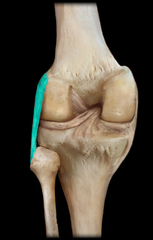
Medial Collateral Ligament (MCL)
Broad flat band from medial femoral epicondyle to proximal tibia; prevents knee valgus (abduction).

Lateral Collateral Ligament (LCL)
Cord-like band from lateral femoral epicondyle to fibular head; prevents knee varus (adduction).
Anterior Cruciate Ligament (ACL)
Intra-articular ligament running from anterior tibia to lateral femoral condyle; prevents anterior tibial translation.

Posterior Cruciate Ligament (PCL)
Intra-articular ligament running from posterior tibia to medial femoral condyle; prevents posterior tibial translation.

Acromioclavicular Ligament
Connects the acromion process to the lateral clavicle; stabilizes the AC joint against separation.


Coracoclavicular Ligament
Runs from coracoid process to underside of clavicle; primary stabilizer preventing downward/medial scapular movement.
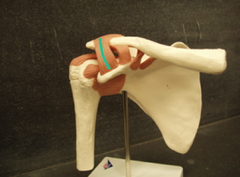
Coracoacromial Ligament
Runs from coracoid to acromion, forming a protective roof over the glenohumeral joint and rotator cuff.
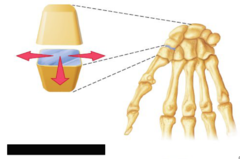
Nonaxial Joint
Allows gliding only with no axis; examples include intercarpal and intertarsal joints.
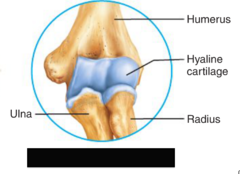
Uniaxial Joint
Allows movement around one axis (flexion/extension only); examples include the knee, elbow, and IP joints.
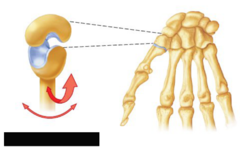
Biaxial Joint
Allows movement in two planes; examples include radiocarpal and metacarpophalangeal joints.
Multiaxial Joint
Allows movement in three axes plus rotation; occurs exclusively at the hip and shoulder.

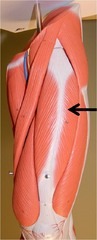
Hamstrings (Semitendinosus, Semimembranosus, Biceps Femoris)
Origin: Ischial tuberosity. Insertion: Proximal tibia and fibula. Action: Extend hip, flex knee.

Quadriceps Femoris
Origins: AIIS (rectus femoris) and femur (vasti). Insertion: Tibial tuberosity via patella. Action: Extend knee (rectus femoris also flexes hip).

Gastrocnemius
Origin: Medial and lateral femoral condyles. Insertion: Calcaneus via Achilles tendon. Action: Plantarflex ankle, flex knee.
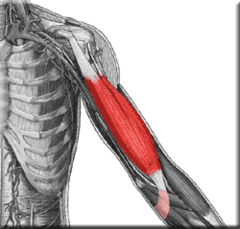
Biceps Brachii
Origin: Glenoid region and coracoid process of scapula. Insertion: Radial tuberosity. Action: Flex elbow, supinate forearm.

Pectoralis Major
Origin: Clavicle and sternum. Insertion: Greater tubercle of humerus. Action: Adduct, flex, and medially rotate arm.

Sternocleidomastoid (SCM)
Origin: Sternum and clavicle. Insertion: Mastoid process of temporal bone. Action: Flex neck, rotate head to opposite side.

Gluteus Maximus
Origin: Iliac crest, sacrum, and coccyx. Insertion: Gluteal tuberosity and IT tract. Action: Extend and laterally rotate hip.