BIOL 214 M5-M6: Meiosis & DNA Replication
 Call Kai
 Learn
 Practice Test
 Spaced Repetition
 Match
 Flashcards
 Knowt Play
1/66

There's no tags or description
Looks like no tags are added yet.
67 Terms
Gamete
A haploid reproductive cell (egg, sperm, pollen) produced by meiosis.
Haploid (n)
one copy of every chromosome
Diploid (2n)
two copies of every chromosome (one from each parent) - most somatic cells in eukaryotes
Ploidy
number of copies of chromosomes
haploid = 1 copy of each chromosome
diploid = 2 copies of each chromosome
Zygote
the diploid cell formed when two gametes fuse
Somatic cell
any cell that isn't a gamete (i.e., most of the body's cells)
Homologous chromosomes
pair of chromosomes (one maternal, one paternal) that are similar but not identical — they carry the same genes but potentially different alleles (gene variants).
Sister chromatids
two identical halves of a single replicated chromosome joined together at a region called the centromere

Which statements accurately describe the chromosomes in this cell? Select all that apply.
A. The cell is n = 3, because there are three different types of chromosome present.
B. The cell is n = 6, because there are a total of 6 chromosomes present in the cell.
C. The maternal and paternal chromosomes carry the same allele at gene C, but different alleles at gene A and gene B.
D. The chromosomes are unreplicated—no sister chromatids are present.
E. The cell is diploid.
A. The cell is n = 3, because there are three different types of chromosome present.
C. The maternal and paternal chromosomes carry the same allele at gene C, but different alleles at gene A and gene B.
D. The chromosomes are unreplicated—no sister chromatids are present.
E. The cell is diploid.
Meiosis
Meiosis I: 1 diploid cell → 2 haploid cells (the "reduction" step).
Meiosis II: those 2 haploid cells → 4 haploid cells total.
Before any division begins, chromosomes replicate
Each chromosome becomes two identical sister chromatids joined at the centromere.
This does not create new genetic information — it just creates duplicate copies of the same information (2N stays 2N; you just now have 2 chromatids per chromosome instead of 1).
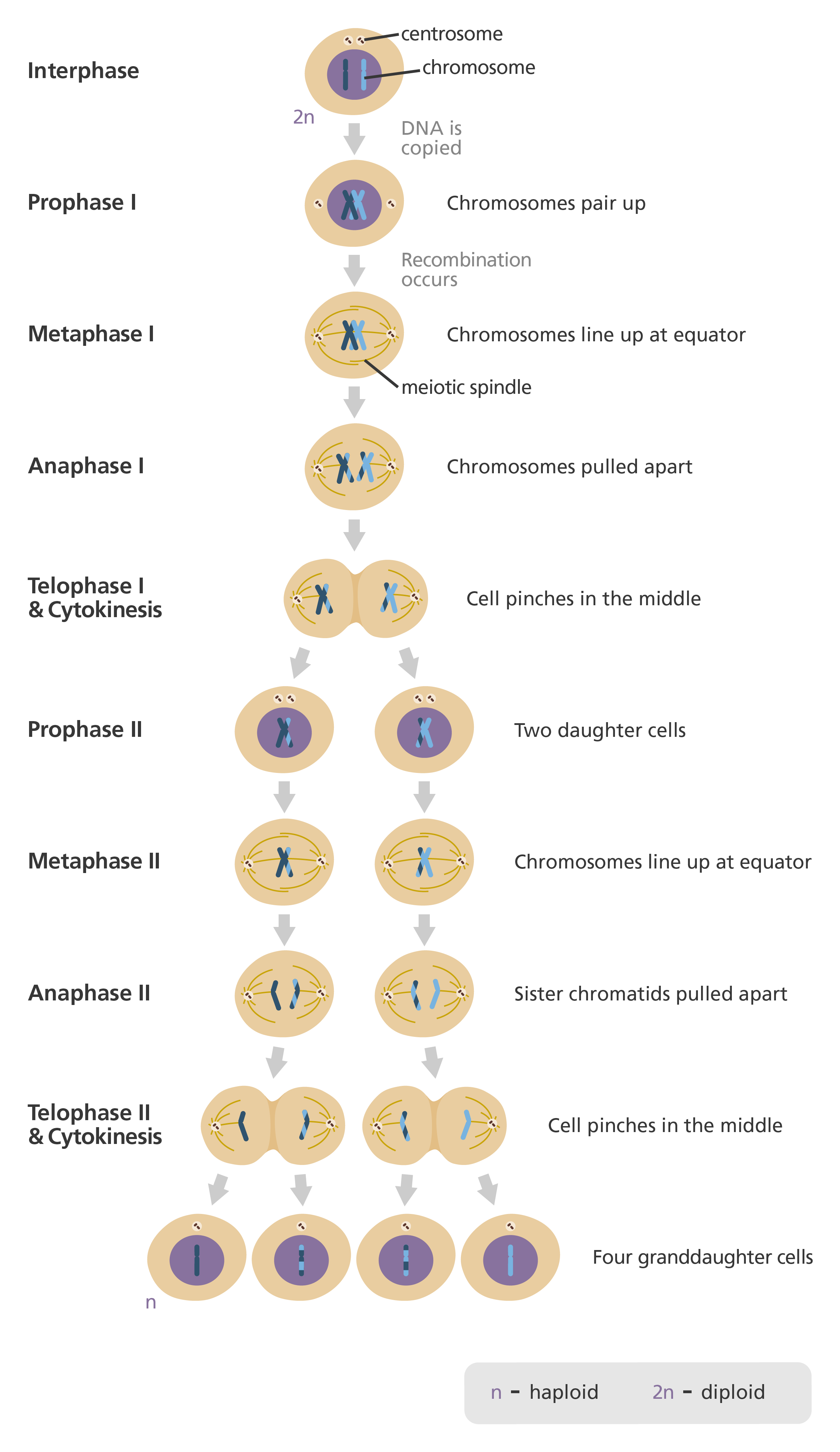
Interphase
DNA is copied
still 2n, but now 2 chromatids for each chromosome
cohesin holds replicated chromosomes (individual sister chromatids) together
Cohesin
Ring-shaped protein complex that holds duplicated sister chromatids together
Prophase I
Chromosomes pair up (synapsis)
Held together by a synaptonemal complex
Recombination occurs (crossing over)

Synaptonemal complex
A structural protein scaffold which brings homologous chromatids into close physical proximity so the exchange of information can occur during meiosis Prophase I
Facilitates synapsis → the physical pairing & close alignment of 2 homologous chromosomes (one from each parent)

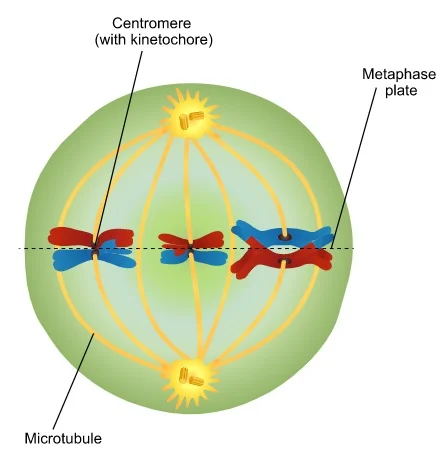
Metaphase I
Homologous chromosome pairs line up at equator — line up is important!
Independent assortment occurs (one of each homologous pair is randomly attached to the spindle of each pole)
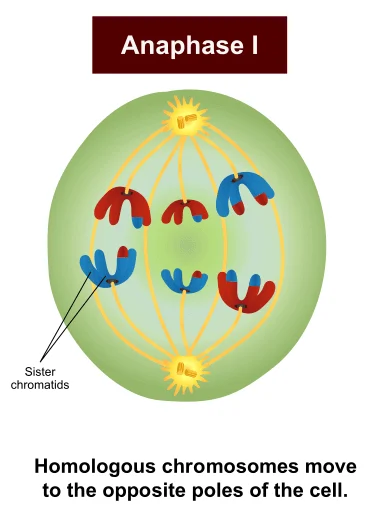
Anaphase I
Homologous chromosomes pulled apart
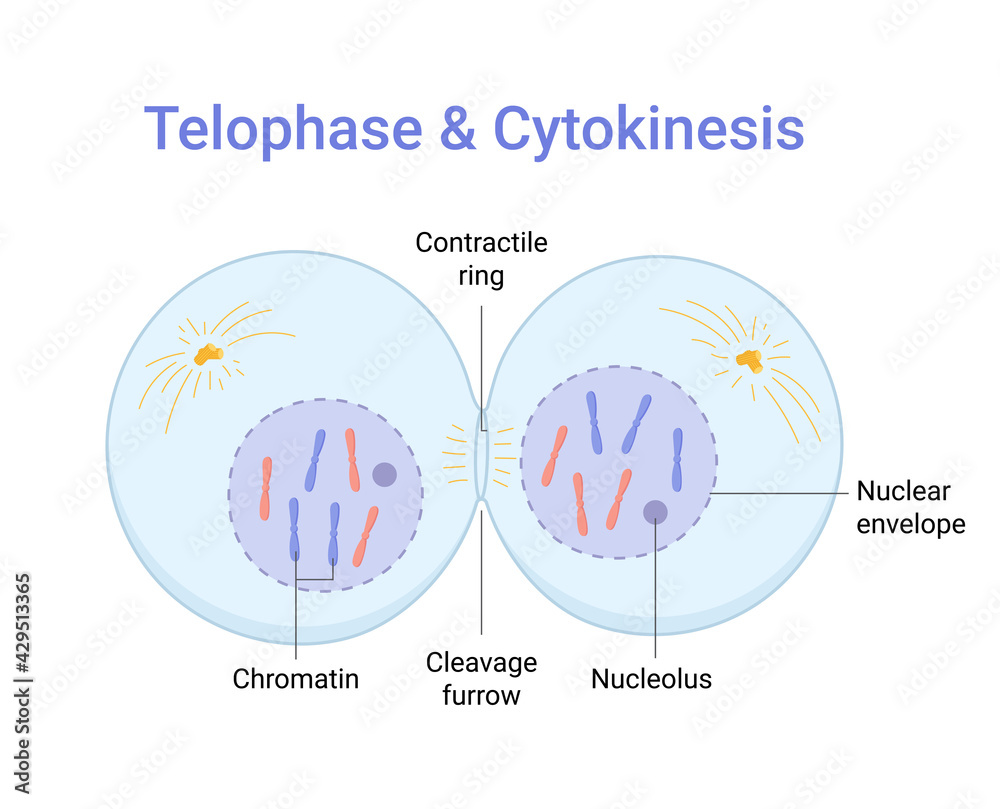
Telophase I & Cytokinesis
Cell pinches in the middle
Divides into two daughter cells (n=haploid)
Prophase II
Two haploid daughter cells
Chromosomes condense & nuclear envelope breaks down

Metaphase II
Individual chromosomes line up at equator in each cell
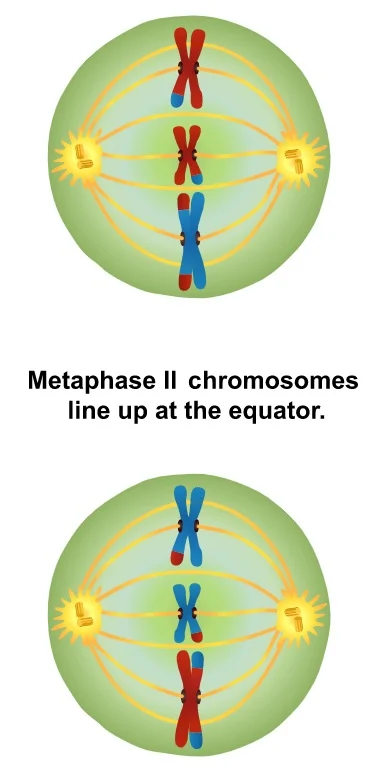
Anaphase II
Sister chromatids are pulled apart
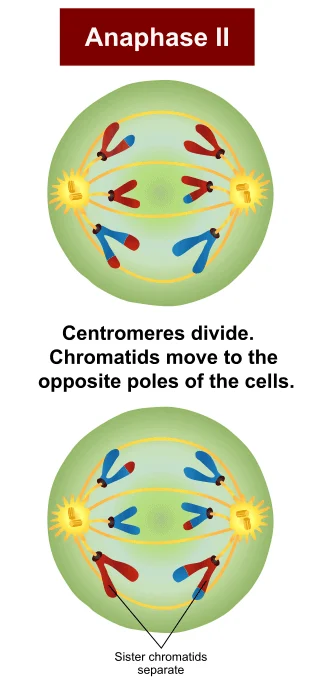
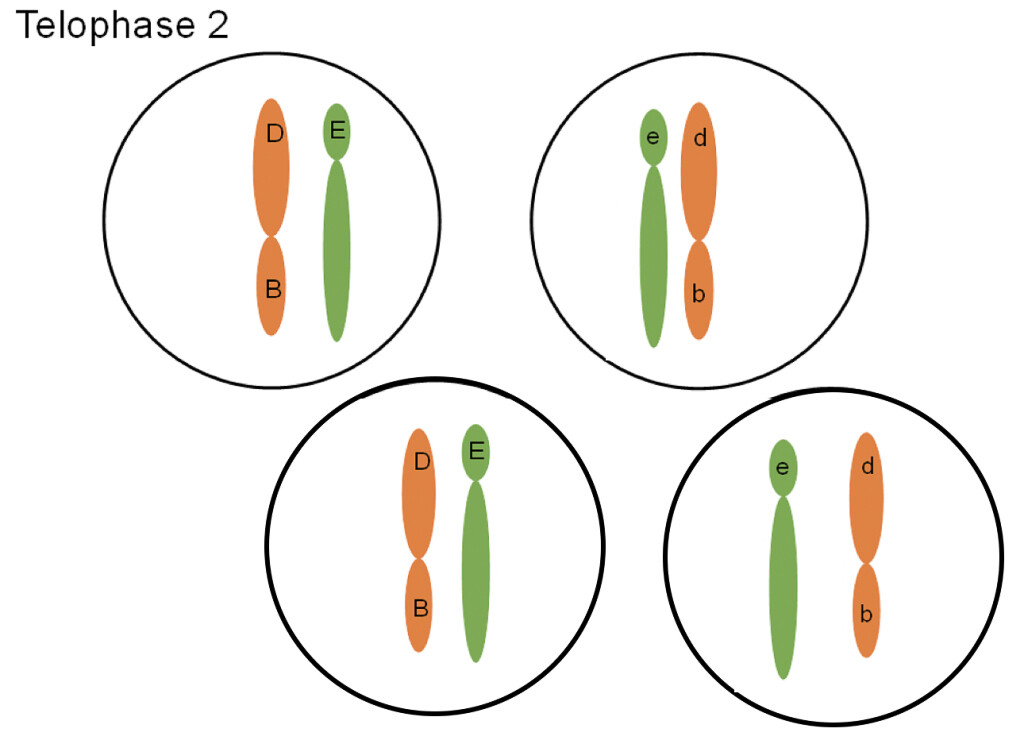
Telophase II & Cytokinesis
Cell pinches in the middle
Produces four genetically distinct haploid daughter cells
one cell looks like one parent
2nd cell looks like one parent
2 cells don’t look like either
In what step of meiosis does it go from 2n to n?
Anaphase I (homologous chromosome pairs separate) and Telophase I (cell divides into 2 haploid daughter cells)
Sources of variability arising during meiosis and fertilization
Crossing over — physical exchange of genetic material between homologous chromosomes in prophase I
Independent assortment — random orientation of homologous pairs during metaphase I/anaphase I
Crossing over
A physical exchange of genetic material between non-sister chromatids of homologous chromosomes (Prophase I)
Result: new combinations of alleles that didn't exist in either parent chromosome before — these are called recombinants.
More crossover events = more variation (a single chromosome can have multiple crossover points along its length).
What are the prerequisites for all crossovers?
homologous pairing and synapsis
Independent assortment
At metaphase I, homologous pairs line up at the metaphase plate — but which homologue (maternal or paternal) faces which pole is random, and happens independently for each chromosome pair (~50/50 for each pair, independent of how other pairs orient).
occurs during metaphase I and carries into anaphase I
each possible configuration occurs with equal probability

The 23 chromosome pairs of humans allow how many different combinations of maternal and paternal chromosomes?
2^23 different combinations
SPO11
A conserved meiosis-specific protein (relative of topoisomerase) that initiates meiotic recombination by catalyzing double-strand breaks in the replicated DNA
Cells repair these breaks using a homologous chromosome as a template
Repair can resolve as either a crossover or a non-crossover
How does crossing over ensure proper meiotic chromosome segregation, and what's the molecular pathway behind it?
SPO11 (topoisomerase relative) creates double-stranded breaks in replicated DNA → 3′ end invades the homologous template → DNA synthesis → repair resolves as crossover (CO) or non-CO.
Crossovers create physical links (chiasmata) between homologs, reinforced by cohesin.
This creates tension that aligns the bivalent (paired homologs) at the metaphase plate and orients homologs toward opposite spindle poles (crossover assurance).
Homologs separate at meiosis I; after meiosis II, 2 of 4 daughter chromosomes are parental (A–B, a–b) and 2 are recombinant (A–b, a–B).
Without crossing over, meiosis fails to proceed properly.

know this ig
Who are the pioneers of genetics?
Miescher – first identified DNA in cells (1869)
Levene – DNA is composed of nucleotides (proposed tetranucleotide structure)
Experiments that established DNA as the genetic material:
Griffith (1928)
Experimented w/ virulent & avirulent forms of pneumonia bacteria
Discovery: transforming principle
Conclusion: A transforming substance (S factor) transformed Avirulent R cells into virulent S cells, but S cells could not be transformed into R cells… Guessed it was a protein (incorrect)
Experiments that established DNA as the genetic material:
Avery, MacLeod, McCarty (1944)
Biochemical experiments using R and S cell extract
Wanted to identify the chemical nature of the transforming principle
Conclusion: DNA is the transforming principle (S factor)
Experiments that established DNA as the genetic material:
Astbury (1947)
DNA has a regular structure with a consistent diameter, unlike proteins that take on many shapes
Assumed it was a “simple” molecule & proteins carried more info…
Experiments that established DNA as the genetic material:
Chargaff (1949)
Predictable proportions of nucleotides
Chargaff’s Rules: in double-stranded DNA, the number of adenine (A) units equals thymine (T) and the number of guanine (G) units equals cytosine (C)
Experiments that established DNA as the genetic material:
Hershey & Chase (1952)
Used radioactive labeling in bacteriophages to definitively show DNA (not protein) is the genetic material + directed the production of viral particles
Experiments that established DNA as the genetic material:
Franklin (1953)
Additional physical characteristics of DNA molecule
X pattern indicates helix
Consistent diameter of 2 nm
Distance b/w stacked bases is 3.4 angstroms
Phosphates on the outside, bases radiating inward
Experiments that established DNA as the genetic material:
Watson & Crick (1953)
Put it all together → Double helix
Created model w/ correct base structures + Franklin’s data + Chargaff’s rules

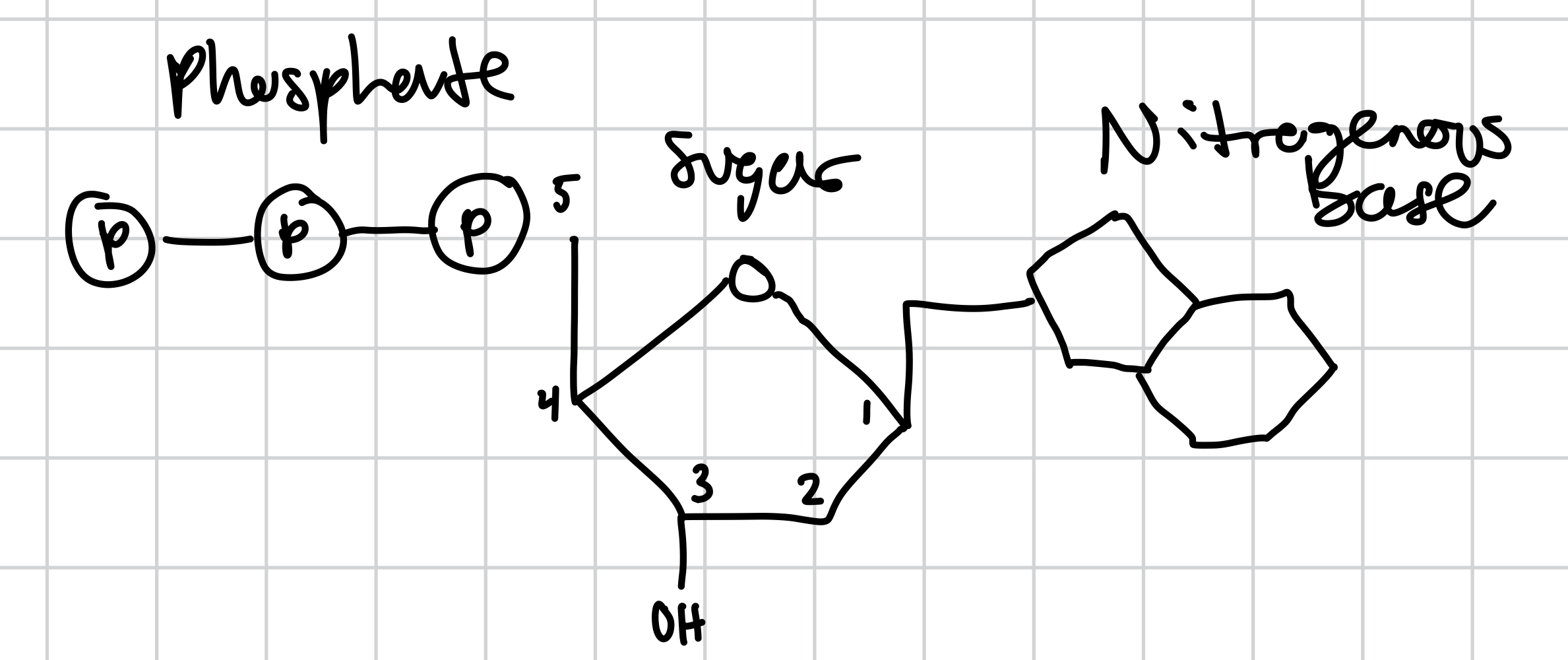
Nucleotides are made up of what 3 components?
Phosphate group, ribose sugar (5-carbon), nitrogenous base
Know how to draw & label
Phosphodiester linkage/bond
The covalent bond joining the 3′-OH of one nucleotide to the 5′ phosphate of the next (joins nucleotides together)
Phosphodiester bond = dehydration reaction
takes phosphate groups off for energy to make phosphodiester linkage

Bonding in DNA
Covalent bonds hold the backbone together
Hydrogen bonds hold the two strands together (b/w base pairs)
Base pairing of DNA
Adenine & Thymine (A-T) → 2 hydrogen bonds
Cytosine & Guanine (C-G) → 3 hydrogen bonds
Each pair is one purine + one pyrimidine, which keeps the helix a constant width.
Purines
2 rings (6-membered and 5-membered)
Adenine
Guanine
Pure As Gold
Pyrimidines
1 ring (6-membered)
Cytosine
Thymine
Uracil
CUT the Py
Why are DNA strands anti-parallel?
Bases can only line up close enough to hydrogen bond if the strands are antiparallel
DNA structure (general)
Polymer made from nucleotide monomers
Nucleotides linked by phosphodiester bonds
5’ end (phosphate group) and 3’ end (hydroxyl group)
Double stranded, strands held together by hydrogen bonds
Helical, strands run anti-parallel
Base pairing: A-T, C-G
Three Models of DNA Replication
Conservative — parent double helix stays intact & an entirely new double helix is made
Semi-conservative — both strands act as a template for the synthesis of a new complementary strand (So, each daughter molecule = 1 old parental strand + 1 newly made strand)
Dispersive — each strand is a patchwork of old & new DNA sections
Semi-conservative is the correct model — if we have the template, we know the complementary strand! (A-T, C-G)
Meselson-Stahl Experiment
Established DNA replication was semi-conservative
introduced an important quality of nucleic acids (based on their sequence)
What enzymes are involved in DNA replication?
Helicase
Single-stranded binding proteins (SSBs)
Topoisomerase
Primase
Sliding Clamp
DNA Polymerase III
DNA Polymerase I
DNA Ligase
Telomerase
Helicase
unwinds DNA double helix by breaking hydrogen bonds, creating single-stranded regions
Single-stranded binding proteins (SSBs)
stabilize DNA and prevent digestion of single stranded regions
Topoisomerase
relieves tension associated w/ untwisting of the double helix (twisting tension that builds up ahead of the fork) by cutting, unwinding, and resealing the DNA
Primase
synthesizes an RNA primer in the 5’-3’ direction to provide a starting location for DNA polymerase
makes sure nucleotides end w/ 3’ hydroxyl group
has to do this b/c DNA polymerase can’t start a new strand from stratch, it needs an existing 3’-OH to build on
Sliding clamp
encircles double-stranded DNA and attaches DNA polymerase to the template so it can synthesize thousands of bases without falling off
DNA Polymerase III
primary DNA replication enzyme that synthesizes when working in the 5’-3’ direction (adds to 3’ end of growing strand) and proofreads when working in the 3’-5’ direction
DNA Polymerase I
removes RNA primer and fills in short stretches of DNA
DNA Ligase
forms final covalent linkage to complete the backbone b/c DNA pol I cannot form the phosphodiester link → forms a “nick” instead
joins Okazaki fragments together
What is the end-replication problem and how does telomerase fix it?
Problem:
At the very end of a linear chromosome, there isn't enough space left to lay down one final primer.
This results in unreplicated ends of DNA, which causes the telomeres of the chromosome to get shorter w/ each round of replication.
In certain cells, we don’t want this b/c this would eat into genes that are needed and the cell would die.
TELOMERASE extends the ends of linear eukaryotic chromosomes so they don't shrink every time a cell divides.
enzyme made of protein & RNA template
only active in specific cell types that require continuous division (stem, germ, cancer cells)
Origin of replication
Where replication begins, creating a replication fork
DNA replication occurs in both directions on both strands radiating out from the origins of replication
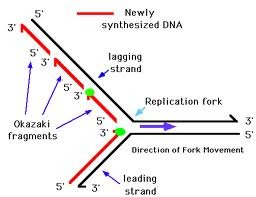
Leading Strand vs. Lagging Strand
Because the strands are antiparallel and polymerase only works 5′→3′:
Leading strand: synthesized continuously in the same direction the fork opens, so one primer and one polymerase can keep going as the fork opens.
Lagging strand: synthesized discontinuously, in short pieces called Okazaki fragments, each needing its own RNA primer. The polymerase works away from the fork, so it has to keep restarting as the fork opens further.

Okazaki fragments
short, newly synthesized DNA pieces that form on the lagging strand during DNA replication
composed of a short RNA primer at the 5' end and a short stretch of DNA nucleotides at 3’ end
Why does replication involve a continuous leading strand and discontinuous lagging strand?
One daughter strand can be synthesized in one continuous piece by a DNA polymerase working toward the forking point of the parental DNA
But to make the other daughter strand, polymerase molecules must work outward from the forking point → new strand synthesized in short pieces as the forks open up
DNA repair during replication (checkpoints)
Checkpoint 1: Polymerase does a double check once the nucleotide binds but before it is covalently linked
Checkpoint 2: Polymerase moves 3’-5’ and has exonuclease function – replaces nucleotide
Errors cause mutations → evolution
DNA repair after replication
Mismatch repair
endonuclease
Base excision repair
Nucleotide excision repair
fixes damage such as thymine dimers that form after UV exposure
endonuclease
Others depending on the severity of damage to the DNA
Replisome
The multi-molecular machine that works at the replication fork, copying DNA
All enzymes & other proteins involved in DNA replication combine to form this single machine, the replisome!
Exonuclease vs. Endonuclease vs. BOTH
Exonuclease
Removes nucleotides from the end of DNA strands
DNA polymerase has this type of enzymatic activity during proofreading
Endonuclease
Removes nucleotides from the middle of DNA strands
Used during excision repair after UV damage creates T-T dimers
Used during mismatch repair after replication has finished
BOTH
Recognizes incorrect geometry in DNA
Uses hydrolysis to break phosphodiester bonds
nondisjunction in meiosis 1 vs. meiosis 2
Meiosis 1:
Homologous chromosomes fail to separate during Anaphase I.
Gamete outcome: 100% of the resulting gametes are abnormal
Two gametes have an extra chromosome (n + 1).
Two gametes are missing a chromosome (n - 1).
Meiosis 2:
Sister chromatids fail to separate during Anaphase II.
Gamete outcome: 50% of the resulting gametes are abnormal (2 out of 4, while 2 are normal).
Two gametes are normal (n).
One gamete has an extra chromosome (n + 1).
One gamete is missing a chromosome (n - 1).