First Aid - REPRODUCTIVE - Pathology - Part 1

0.0(0)
Studied by 0 people
call kaiCall Kai
learnLearn
examPractice Test
spaced repetitionSpaced Repetition
heart puzzleMatch
flashcardsFlashcards
GameKnowt Play
Card Sorting

1/124

encourage image

There's no tags or description

Looks like no tags are added yet.

Last updated 9:10 PM on 10/3/26
Name
Mastery
Learn
Test
Matching
Spaced
Call with Kai
Chat

No analytics yet

Send a link to your students to track their progress

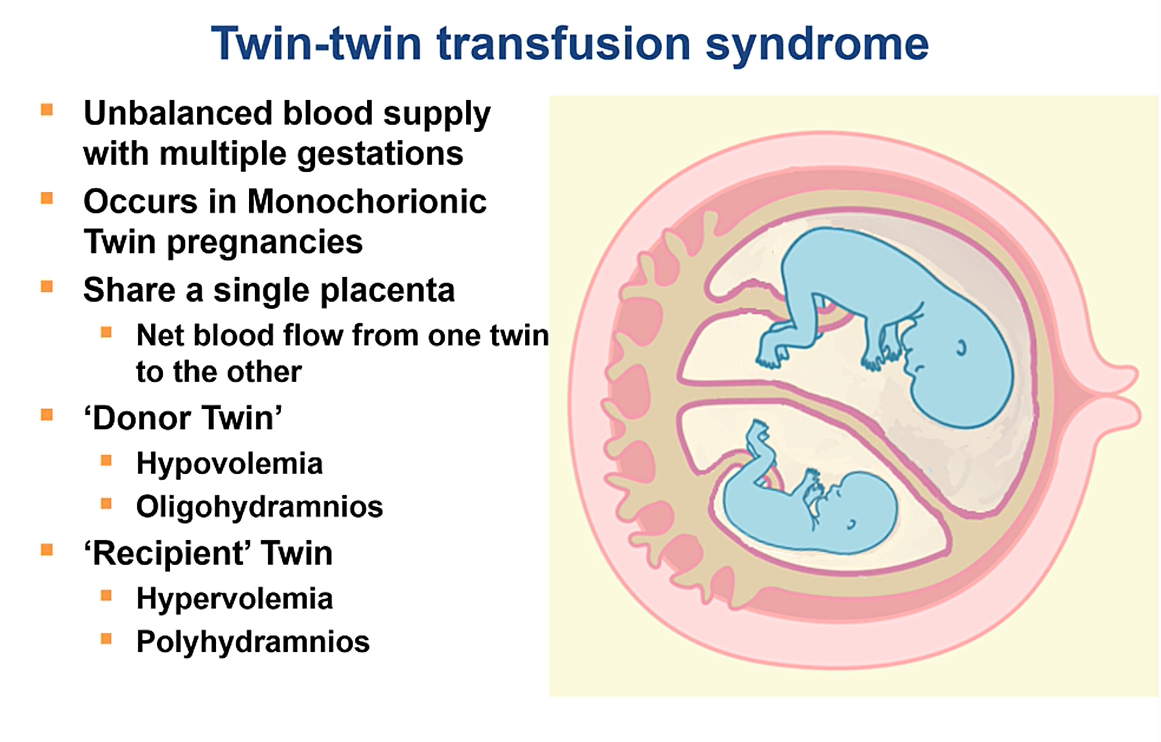
125 Terms
1
New cards
Fetal alcohol syndrome - Major presentation
Developmental delay<br>Microcephaly<br>Characteristic facial abnormalities<br>± Limb dislocation<br>± Heart defects
2
New cards
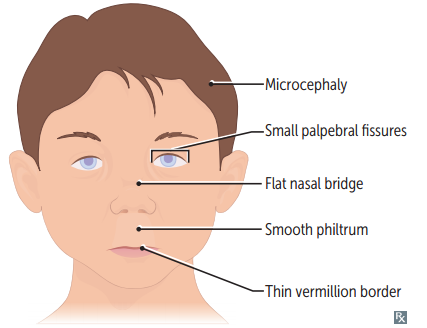
What facial abnormalities are characteristic of fetal alcohol syndrome?
Smooth philtrum<br>Thin vermilion border<br>Small palpebral fissures<br>Flat nasal bridge
3
New cards
What severe CNS malformation can occur in fetal alcohol syndrome?
Holoprosencephaly
Holoprosencephaly
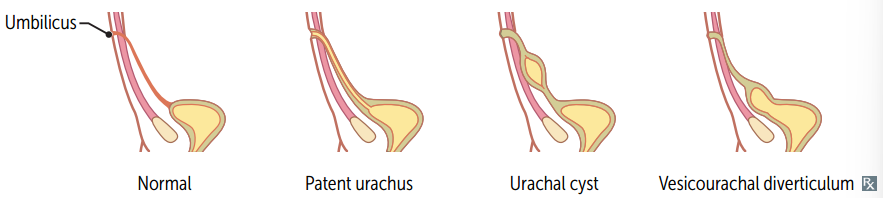
4
New cards
What is one proposed mechanism of fetal alcohol syndrome?
Alcohol exposure → impaired migration of neuronal + glial cells → abnormal CNS development
5
New cards
A newborn has developmental delay, microcephaly, small palpebral fissures, a smooth philtrum, and a thin vermilion border. What is the diagnosis?
Fetal alcohol syndrome
6
New cards
Fetal alcohol syndrome - Treatment
Supportive care
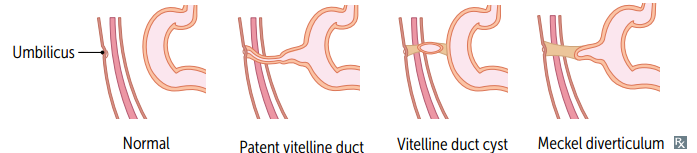
7
New cards
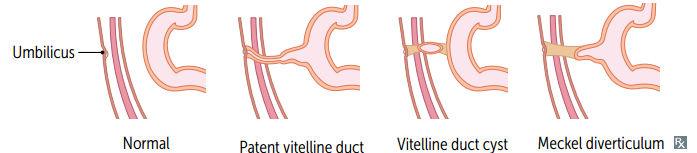
What is neonatal abstinence syndrome?
A neonatal withdrawal syndrome involving the CNS, autonomic nervous system, and GI tract, usually 2° to maternal substance use (especially opioids)
8
New cards
Neonatal abstinence syndrome - Presentation
  • Uncoordinated sucking reflexes

  • Irritability

  • High-pitched crying

  • Tremors

  • Tachypnea

  • Sneezing

  • Diarrhea

  • ± Seizures


9
New cards
Why does neonatal abstinence syndrome cause irritability, tremors, diarrhea, and autonomic symptoms?
Chronic in-utero drug exposure → neonatal drug withdrawal after delivery → CNS/autonomic hyperactivity + GI hypermotility
10
New cards

A newborn has a high-pitched cry, irritability, tremors, tachypnea, sneezing, diarrhea, and poor/uncoordinated sucking. Diagnosis?

Neonatal abstinence syndrome due to opioid withdrawl

11
New cards
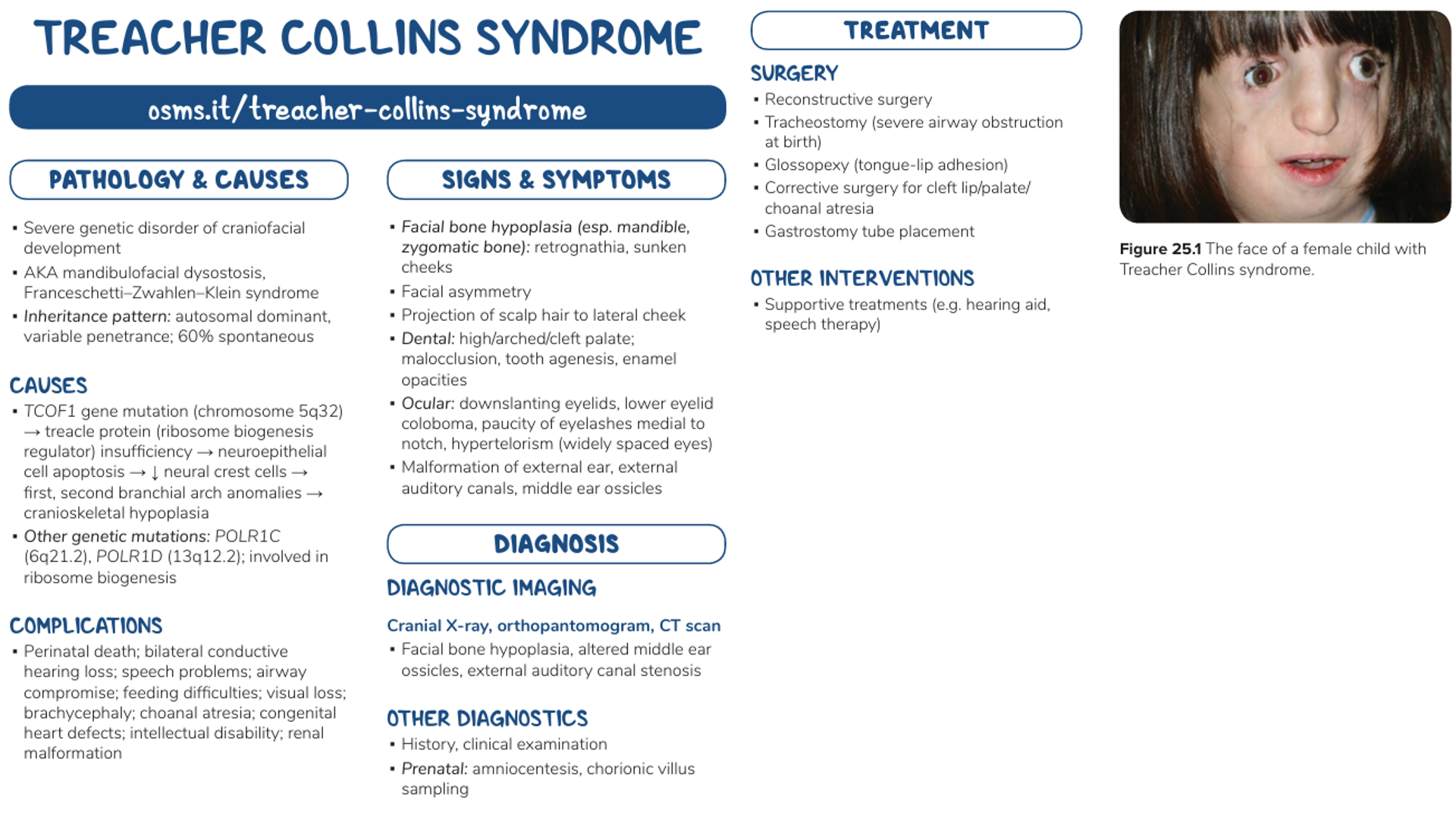
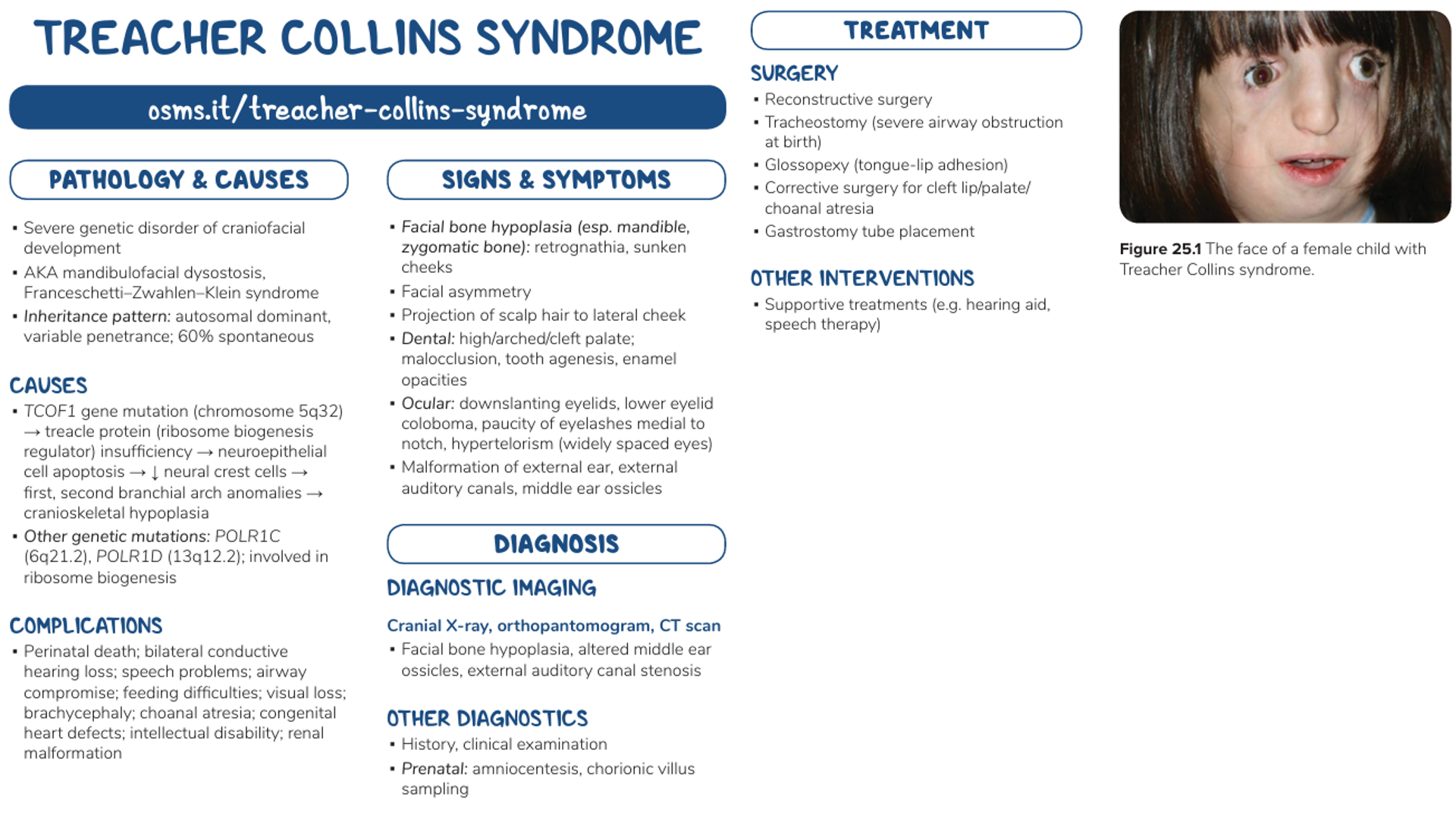
Neonatal abstinence syndrome due to opioid withdrawal - Treatment
  • Methadone

  • Morphine

  • Buprenorphine


12
New cards

How can Neonatal abstinence syndrome be prevented on a population or worldwide level

Universal screening for substance use in all pregnant patients
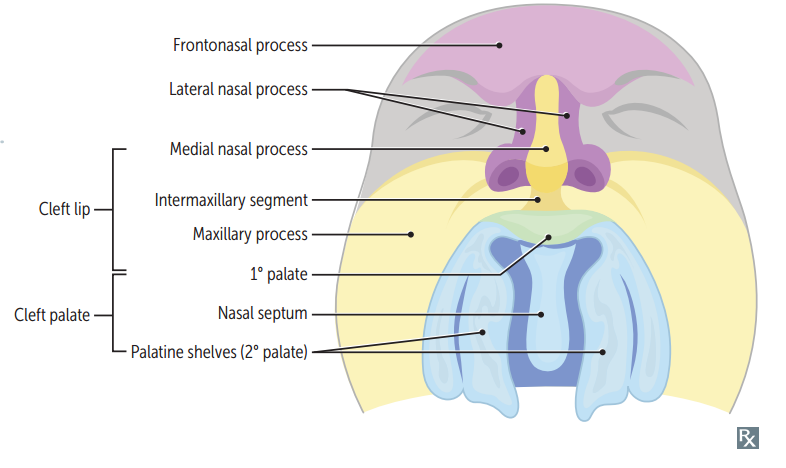
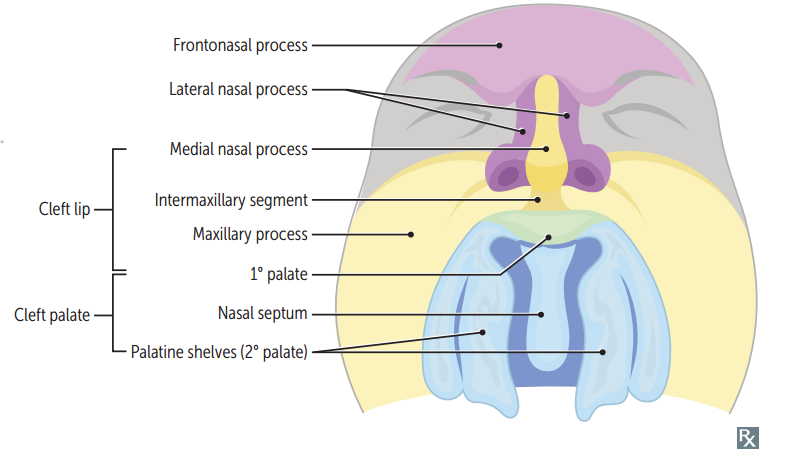
13
New cards
What is the main source of amniotic fluid?
Fetal urine (mainly) + fetal lung fluid
14
New cards
How is amniotic fluid mainly cleared?
Fetal swallowing + intramembranous absorption
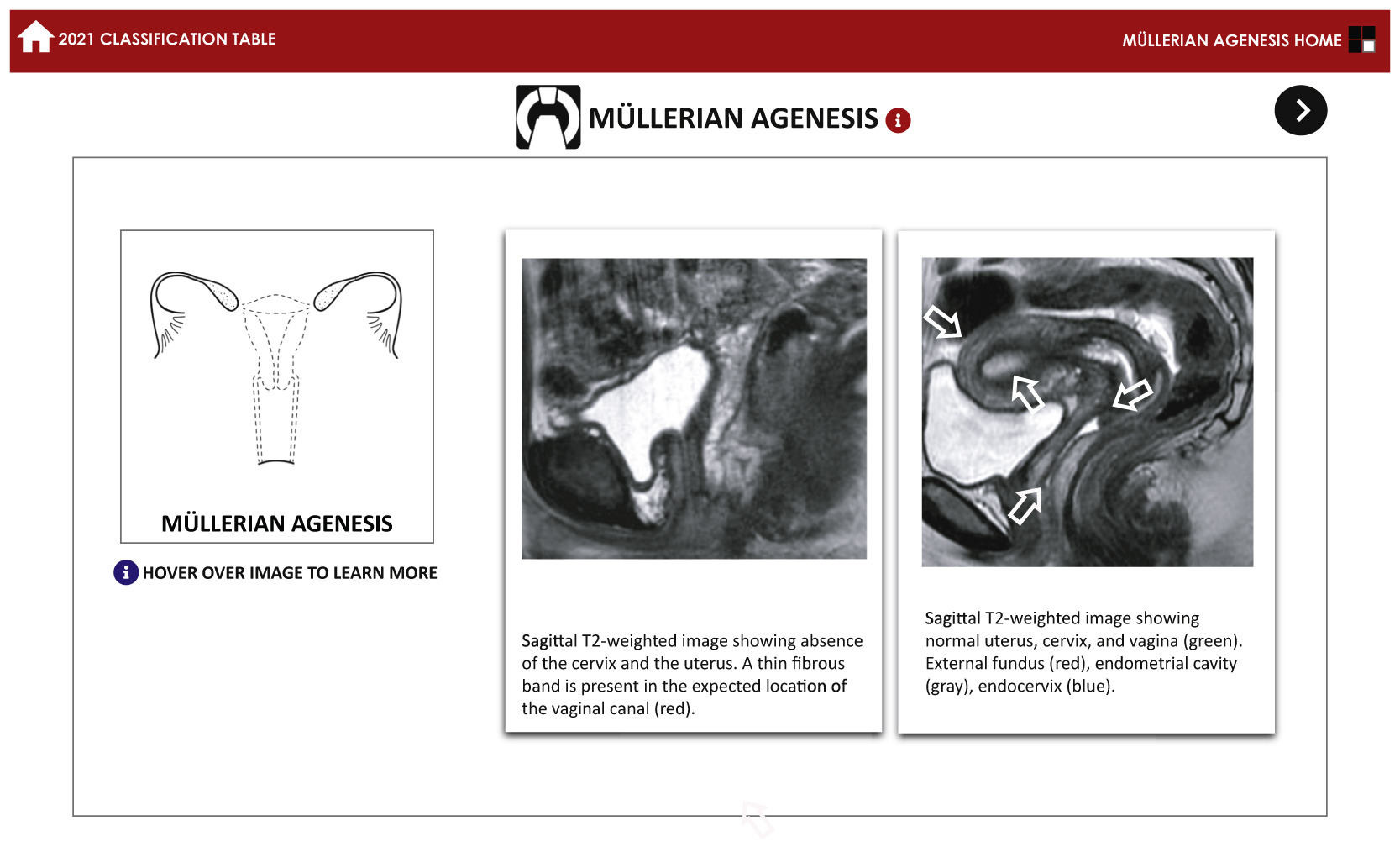
15
New cards
Polyhydramnios - Major associations

Mechanical: Fetal malformations that impair swallowing:

  • esophageal/duodenal atresia,

  • anencephaly

Others:

  • Maternal diabetes

  • Fetal anemia

  • Multifetal gestation

  • May be idiopathic


16
New cards
Why can esophageal or duodenal atresia cause polyhydramnios?
Obstruction → fetus cannot effectively swallow amniotic fluid → ↓ fluid clearance → polyhydramnios
17
New cards
Why can anencephaly cause polyhydramnios?

Impaired fetal swallowing → ↓ amniotic fluid clearance → polyhydramnios


Anencephaly = Anencephaly is a fatal neural tube defect in which a baby is born without major parts of the brain and skull, occurring in about 1 in 4,762 U.S. births and resulting in death within hours or days.


18
New cards
Why can maternal diabetes cause polyhydramnios?
Maternal hyperglycemia → fetal hyperglycemia → osmotic diuresis → ↑ fetal urine production → polyhydramnios
19
New cards
Why can fetal anemia cause polyhydramnios?

Anemia → ↓ O₂-carrying capacity → compensatory ↑ cardiac output + renal perfusion → ↑ fetal urine production → polyhydramnios


Fetal anemia: a condition in which a fetus has an abnormally low number of red blood cells or hemoglobin, most commonly caused by Rh alloimmunization, infections such as parvovirus B19, or fetomaternal hemorrhage, and it is primarily diagnosed using middle cerebral artery (MCA) Doppler ultrasound.

20
New cards
Oligohydramnios - Major associations
  • Placental insufficiency

  • Bilateral renal agenesis (No urine production)

  • Posterior urethral valves in males


21
New cards
Why can posterior urethral valves cause oligohydramnios?
Bladder outlet obstruction → impaired fetal urine excretion → ↓ amniotic fluid
22
New cards
Why can placental insufficiency cause oligohydramnios?
↓ Placental perfusion → ↓ fetal renal perfusion → ↓ fetal urine production → oligohydramnios
23
New cards
What can profound oligohydramnios cause?
Potter sequence
24
New cards
A fetus has bilateral renal agenesis and severe oligohydramnios. What complication should you think of?
Potter sequence
25
New cards
A fetus has severe oligohydramnios. Which broad mechanisms should you think of first?
↓ Fetal urine production/excretion or ↓ placental perfusion
26
New cards
Twin-twin transfusion syndrome (TTTS) occurs in what type of twin pregnancy?
Monochorionic twin gestations
27
New cards
Why does twin-twin transfusion syndrome occur only in monochorionic twins?
Monochorionic twins share a placenta → placental vascular connections can form between the twins → unbalanced blood flow may develop from one twin to the other
28
New cards
Twin-twin transfusion syndrome - Pathophysiology
Unbalanced arteriovenous anastomoses in a shared placenta → net blood flow from donor twin → recipient twin
29
New cards
Twin-twin transfusion syndrome - Donor twin findings
↓ Blood volume → hypovolemia + oligohydramnios<br>May appear "stuck" because the amniotic sac contains very little fluid
30
New cards
Why does the donor twin develop oligohydramnios in twin-twin transfusion syndrome?
Donor loses blood volume → ↓ renal perfusion → ↓ fetal urine production → oligohydramnios
31
New cards
Twin-twin transfusion syndrome - Recipient twin findings
↑ Blood volume → hypervolemia + polyhydramnios
32
New cards
Why does the recipient twin develop polyhydramnios in twin-twin transfusion syndrome?
Recipient gains blood volume → ↑ renal perfusion → ↑ fetal urine production → polyhydramnios
33
New cards
A monochorionic twin pregnancy shows one twin with oligohydramnios and a "stuck twin" appearance, while the other has polyhydramnios. What is the diagnosis?
Twin-twin transfusion syndrome
34
New cards
What placental abnormality underlies twin-twin transfusion syndrome?
Unbalanced vascular anastomoses between the twins within a shared placenta
35
New cards
How does the timing of monozygotic twin splitting affect chorionicity and amnionicity?
Splitting 0–4 days → dichorionic diamniotic<br>Splitting 4–8 days → monochorionic diamniotic<br>Splitting 8–12 days → monochorionic monoamniotic<br>Splitting ≥13 days → monochorionic monoamniotic with incomplete separation/conjoined twins
36
New cards
Why are monozygotic twins at risk for twin-twin transfusion syndrome only when splitting occurs after chorion formation?
Later splitting can produce a shared chorion/placenta → placental vascular anastomoses can connect the fetal circulations → risk of TTTS
37
New cards
What is the urachus?
Intra-abdominal remnant of the allantois that forms a duct between the fetal bladder and umbilicus
38
New cards
What happens to the urachus normally after birth?
It obliterates → becomes the median umbilical ligament, which is covered by the median umbilical fold of peritoneum
39
New cards
Why are persistent urachal anomalies clinically important?
Failure of urachal involution can predispose to infection and may increase risk of malignancy, especially adenocarcinoma, if untreated
40
New cards
Patent urachus - Defect
Total failure of the urachus to obliterate
41
New cards
Patent urachus - Classic presentation
Urine discharge from the umbilicus
42
New cards
A newborn has urine leaking from the umbilicus. What is the most likely diagnosis?
Patent urachus
Patent urachus
43
New cards
Urachal cyst - Defect
Partial failure of urachal obliteration → persistent fluid-filled cavity between the umbilicus and bladder
44
New cards
What lines a urachal cyst?
Uroepithelium
Uroepithelium
45
New cards
How can a urachal cyst present clinically?
It may become infected → painful midline mass below the umbilicus
46
New cards
A child presents with fever and lower abdominal pain. Exam reveals a tender midline suprapubic mass without urinary symptoms. Imaging shows a fluid-filled structure between the bladder and umbilicus. What is the most likely diagnosis?


Urachal cyst
47
New cards
Vesicourachal diverticulum - Defect
Slight failure of urachal obliteration at the bladder end → outpouching of the bladder
48
New cards
Patent urachus vs urachal cyst vs vesicourachal diverticulum

Patent urachus → complete persistence, urine drains from umbilicus
Urachal cyst → central persistent cavity
Vesico-urachal diverticulum → persistence at bladder end causing bladder outpouching

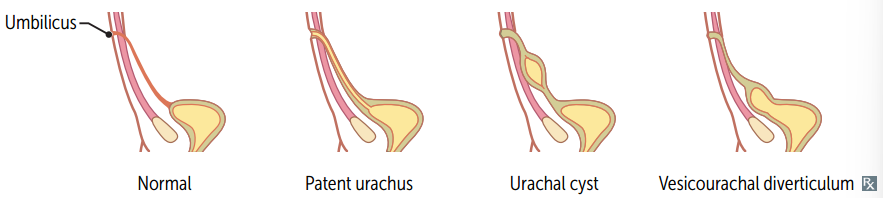
<p>Patent urachus → complete persistence, urine drains from umbilicus<br>Urachal cyst → central persistent cavity<br>Vesico-urachal diverticulum → persistence at bladder end causing bladder outpouching</p>
49
New cards
A urachal abnormality communicates completely between the bladder and umbilicus. Which anomaly is this?
Patent urachus
Patent urachus
50
New cards
A urachal remnant persists only in the middle, with both ends closed. Which anomaly is this?
Urachal cyst
Urachal cyst
51
New cards
A urachal remnant persists only near the bladder, producing a bladder outpouching. Which anomaly is this?
Vesicourachal diverticulum
52
New cards
What is the vitelline duct?
Also called the omphalomesenteric duct; connects the yolk sac to the midgut lumen during embryonic development
53
New cards
When does the vitelline duct normally obliterate?
Around week 7 of development
54
New cards
Patent vitelline duct - Defect
Total failure of the vitelline duct to obliterate
55
New cards
Patent vitelline duct - Classic presentation
Meconium discharge from the umbilicus
56
New cards
A newborn has meconium draining from the umbilicus. What is the most likely diagnosis?
Patent vitelline duct
57
New cards
Vitelline duct cyst - Defect
Partial failure of the vitelline duct to obliterate → persistent cyst along the tract
58
New cards
What complication is associated with a vitelline duct cyst?

↑ Risk of volvulus

<p>↑ Risk of volvulus </p>
59
New cards
Meckel diverticulum - Defect
Slight failure of vitelline duct obliteration → outpouching of the ileum
60
New cards
Why is Meckel diverticulum a true diverticulum?
It contains all layers of the intestinal wall
61
New cards
Meckel diverticulum - Typical clinical course
Usually asymptomatic
62
New cards
What heterotopic tissues may be found in Meckel diverticulum?
Gastric tissue and/or pancreatic tissue
63
New cards

How can Meckel diverticulum cause GI bleeding?

Ectopic gastric mucosa secretes acid → adjacent ileal mucosal injury/ulceration → melena or hematochezia
64
New cards
Meckel diverticulum - Possible presentation
Melena<br>Hematochezia<br>Abdominal pain
65
New cards
Patent vitelline duct vs vitelline duct cyst vs Meckel diverticulum
  • Patent vitelline duct → complete persistence, meconium from umbilicus

  • Vitelline duct cyst → central persistent cyst, ↑ volvulus risk

  • Meckel diverticulum → persistence at ileal end, true diverticulum


<ul><li><p><strong><u>Patent vitelline duct</u></strong> → complete persistence, meconium from umbilicus</p></li><li><p><strong><u>Vitelline duct cyst</u></strong> → central persistent cyst, ↑ volvulus risk</p></li><li><p><strong><u>Meckel diverticulum</u></strong> → persistence at ileal end, true diverticulum</p></li></ul><p></p>
66
New cards
What does the 1st pharyngeal cleft develop into?
External auditory meatus
67
New cards
What happens to the 2nd–4th pharyngeal clefts during normal development?
They form temporary cervical sinuses → normally obliterated by proliferation of 2nd arch mesenchyme
68
New cards
What is a pharyngeal cleft cyst?
Persistent cervical sinus due to failure of obliteration of the 2nd–4th pharyngeal clefts
69
New cards
Where does a pharyngeal cleft cyst classically present?
Lateral neck mass anterior to the sternocleidomastoid muscle
70
New cards
Does a pharyngeal cleft cyst move with swallowing?

No, unlike thyroglossal cysts

<p>No, unlike thyroglossal cysts</p>
71
New cards
A young patient has a painless lateral neck mass along the anterior border of the sternocleidomastoid. The mass does not move with swallowing. What is the most likely diagnosis?
Pharyngeal cleft cyst
72
New cards
Pharyngeal cleft cyst vs thyroglossal duct cyst - key discriminator
  • Pharyngeal cleft cyst → lateral neck, anterior to SCM, does not move with swallowing

  • Thyroglossal duct cyst → midline and moves with swallowing


73
New cards
Pierre Robin sequence - Pathophysiology
Mandibular hypoplasia (micrognathia) → posterior displacement of tongue (glossoptosis) → cleft palate + airway compromise
74
New cards
Why can Pierre Robin sequence cause airway compromise?
Micrognathia → tongue is displaced posteriorly (glossoptosis) → upper-airway obstruction
75
New cards
Why are feeding difficulties common in Pierre Robin sequence?
Micrognathia + glossoptosis + cleft palate → impaired sucking/swallowing
76
New cards
A newborn has micrognathia, a posteriorly displaced tongue, cleft palate, and episodes of upper-airway obstruction. What is the most likely diagnosis?
Pierre Robin sequence
77
New cards
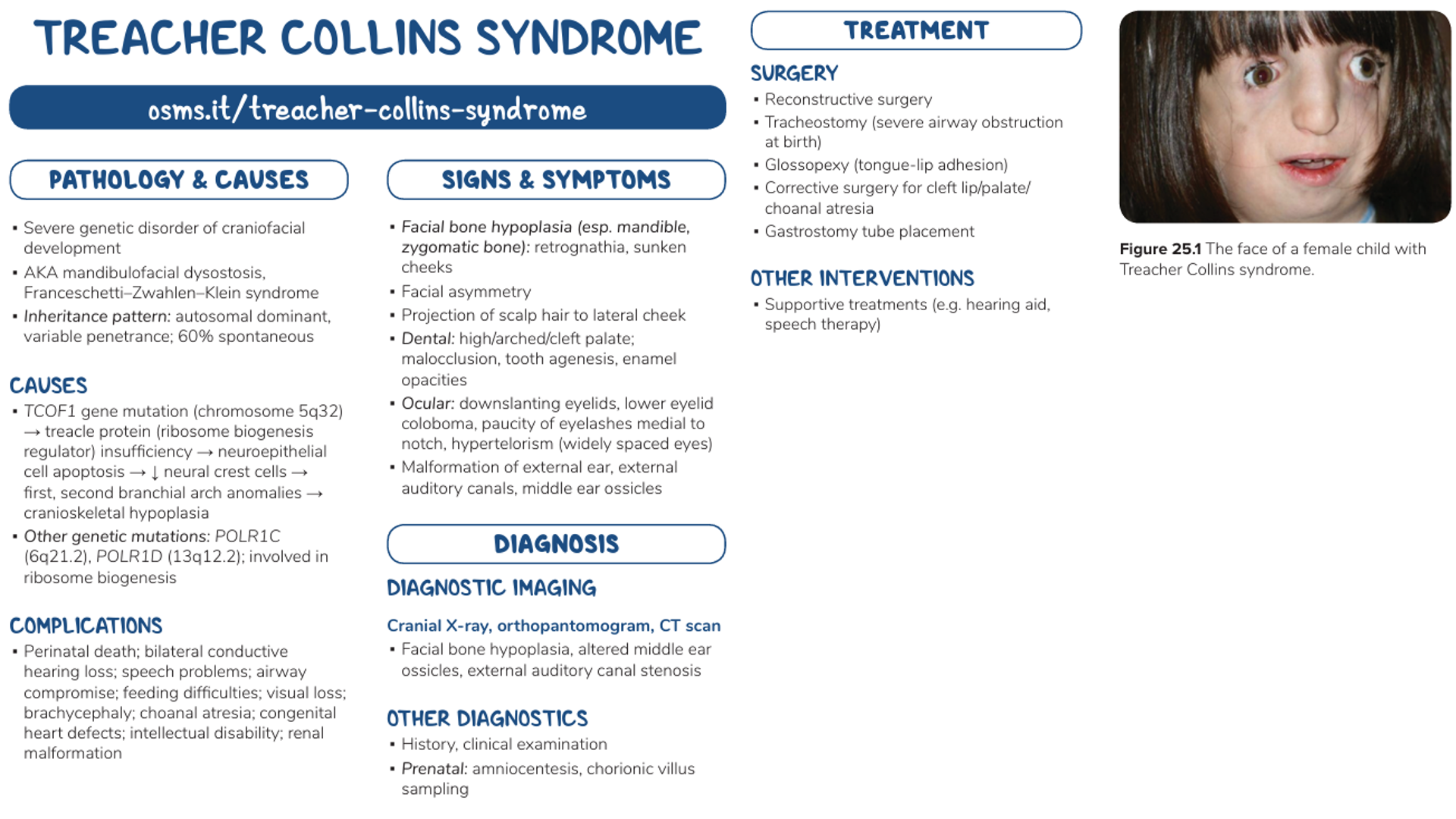
Treacher Collins syndrome - Inheritance
Autosomal dominant
Autosomal dominant
78
New cards
Treacher Collins syndrome - Basic defect
Neural crest dysfunction → abnormal craniofacial development
79
New cards
Treacher Collins syndrome - Major findings
Craniofacial abnormalities (eg, zygomatic bone + mandibular hypoplasia)<br>Hearing loss<br>Airway compromise
80
New cards
Why can Treacher Collins syndrome cause hearing loss?
Craniofacial developmental abnormalities can involve structures of the ear → hearing impairment
81
New cards
A child has bilateral zygomatic hypoplasia, mandibular hypoplasia, hearing loss, and recurrent airway problems. What is the most likely diagnosis?
Treacher Collins syndrome
82
New cards
Pierre Robin sequence vs Treacher Collins syndrome - Key distinction
  • Pierre Robin → micrognathia → glossoptosis → cleft palate

  • Treacher Collins → Autosomal Dominant neural crest dysfunction with broader craniofacial abnormalities + hearing loss

83
New cards
A patient with mandibular hypoplasia also has prominent hearing loss and zygomatic hypoplasia. Which diagnosis is favored over Pierre Robin sequence?
Treacher Collins syndrome
84
New cards
What is the general relationship between cleft lip and cleft palate?
They have distinct, multifactorial etiologies but often occur together
85
New cards
Cleft lip - Embryologic defect
Failure of fusion of the intermaxillary segment (merged medial nasal processes) with the maxillary process → defective formation of the primary palate
86
New cards
Which embryologic structures fail to fuse in cleft lip?
Intermaxillary segment + maxillary process
87
New cards
What does the intermaxillary segment form in relation to the palate?
Primary (1°) palate
Primary (1°) palate
88
New cards
Cleft palate - Embryologic defect
Failure of fusion of the 2 lateral palatine shelves OR failure of a lateral palatine shelf to fuse with the nasal septum and/or primary palate → defective formation of the secondary palate
89
New cards
Which embryologic structures form the secondary (2°) palate?
Lateral palatine shelves
90
New cards
A newborn has a congenital defect of the upper lip extending toward the nostril. Which embryologic fusion failure most likely caused it?
Failure of fusion of the intermaxillary segment with the maxillary process → cleft lip
91
New cards
A newborn has an opening in the roof of the mouth that communicates with the nasal cavity. Which embryologic process most likely failed?
Fusion of the lateral palatine shelves with each other and/or with the nasal septum/primary palate → cleft palate
92
New cards
Cleft lip vs cleft palate - Key embryologic distinction
Cleft lip → failure of intermaxillary segment + maxillary process fusion → 1° palate defect<br>Cleft palate → failure of lateral palatine shelf fusion → 2° palate defect
93
New cards
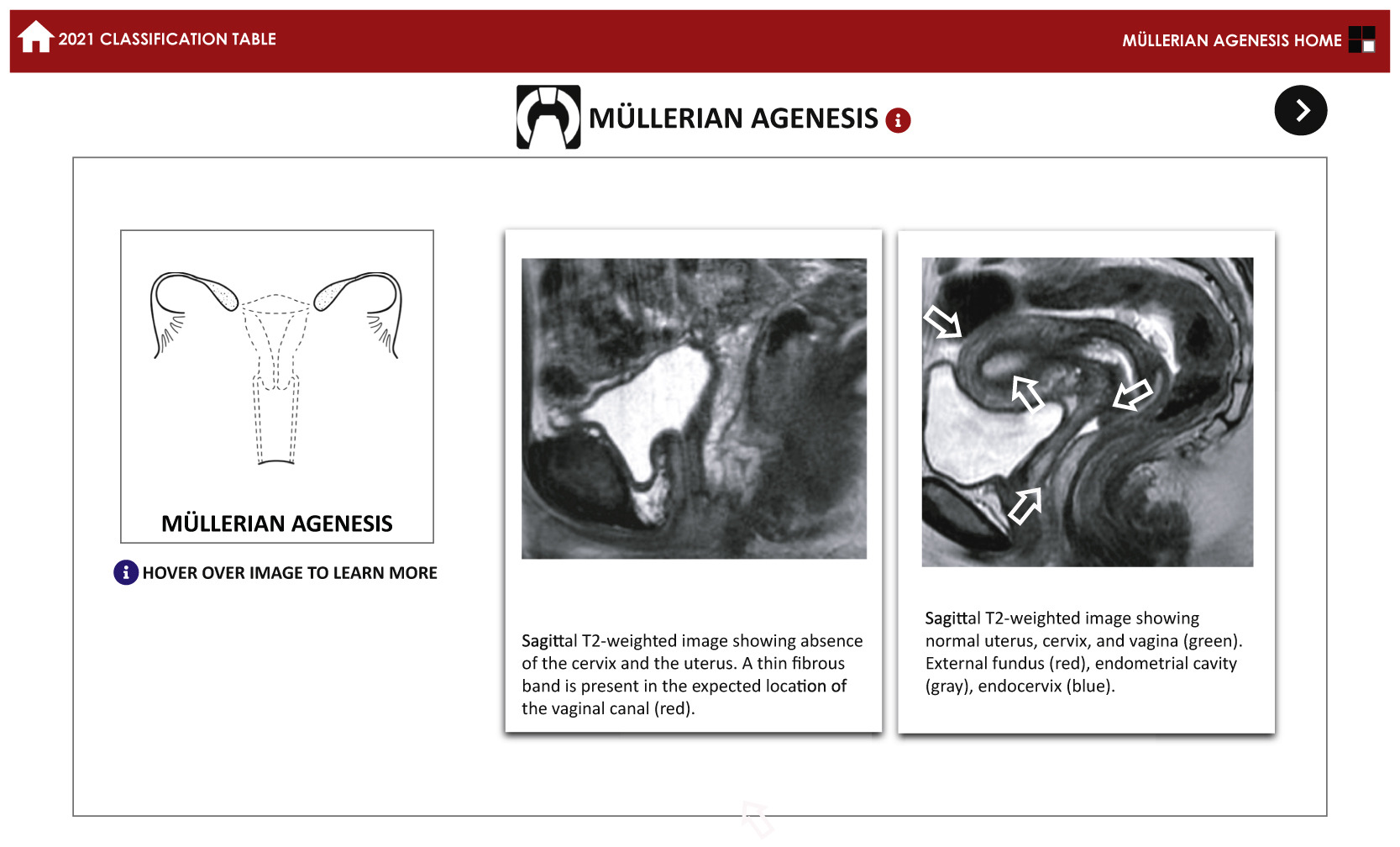
What is Müllerian agenesis also called?
Mayer-Rokitansky-Küster-Hauser (MRKH) syndrome
94
New cards
Müllerian agenesis - Classic presentation
Primary amenorrhea with absent uterus and blind vaginal pouch
95
New cards
What are the external genitalia and secondary sexual characteristics like in Müllerian agenesis?
Normal female external genitalia<br>Normal secondary sexual characteristics
96
New cards
Why are secondary sexual characteristics normal in Müllerian agenesis?
Ovaries are functional → normal estrogen production → normal breast development and other 2° sexual characteristics
97
New cards
What reproductive organs are absent/abnormal in Müllerian agenesis?
Absent uterus + blind-ending vaginal pouch
98
New cards
What urinary tract anomaly is associated with Müllerian agenesis?
Renal anomalies, eg, renal agenesis
99
New cards
A teenage girl is evaluated for primary amenorrhea. She has normal breast development and normal external genitalia. Pelvic imaging shows no uterus, and examination reveals a shortened blind-ending vagina. What is the most likely diagnosis?
Müllerian agenesis (MRKH syndrome)
100
New cards
Primary amenorrhea with normal 2° sexual characteristics: what finding would favor Müllerian agenesis over a disorder with androgen insensitivity?
Absent uterus + blind vaginal pouch in Müllerian agenesis; ovaries are functional