5.2 Feline Upper Tract Respiratory Disease (UTRD)
 Call Kai
 Learn
 Practice Test
 Spaced Repetition
 Match
 Flashcards
 Knowt Play
1/18

There's no tags or description
Looks like no tags are added yet.
19 Terms
Initial signs to look out for
Lacrimation -> nasal discharge -> lesions below nose -> pneumonia as a complication
Etiology of Feline UTRD
Mixed infection:
- Feline herpesvirus (FHV)
- Feline Calicivirus (FCV)
- Bordetella bronchiseptica (primary or secondary)
Other bacteria than may be involved:
Staph, strep, pasturella, Klebsiella, e.coli, mycoplasma
May be confused with chlamydia Felis - causing chronic recurrent conjunctivitis in young cats & Catteries
Main agents causing UTRD
Feline herpesvirus - FHV
Feline calicivirus - FCV
Bordetella bronchiseptica (secondary or primary) - B.b.
FHV or FCV - responsible for 80% of feline UTRD
Occurrence of FHV and FCV as UTRD
Occurrence
FHV & FCV - responsible for 80% of UTRD, both common world wide
FHV - worse, FCV - more often
Most often in catteries / shelters but also in single cat houses
Properties & epidemiology of FHV
Properties
Subclinical infection
Anti-genically stable, poor immunogenicity (no good vaccine)
Unstable in environment (active up to 18hrs)
Epidemiology
Species - cats & other felids only
Transmitted - direct contact only (sneezing)
Latent infection - viral DNA in Trigeminal ganglia
- no replication, no shedding, no disease, no immune response
- reactivation in immunosupression & stress (new place, part, steroids)
- replication starts for 2 weeks, shedding & infects other cats
(Latent = non-productive, replication = productive) reason for persistence in catteries & recurrent disease (Esp kittens)
What is the clinical course of FHV
Subclinical & latent infections
Why properties allows FHV to be latent
Antigenically stable with poor immunogenicity
What property of FHV is responsible for persistence in catteries
Ability to be latent / non-productive stage
Disease is subclinical / latent in trigeminal ganglia until immunosupression or stress which cats are easily exposed to in catteries, virus then is in productive stage
Starts to replicates & shed & infect other cats resulting in recurrent disease & persistent in catteries / shelters
Pathogenesis of FHV
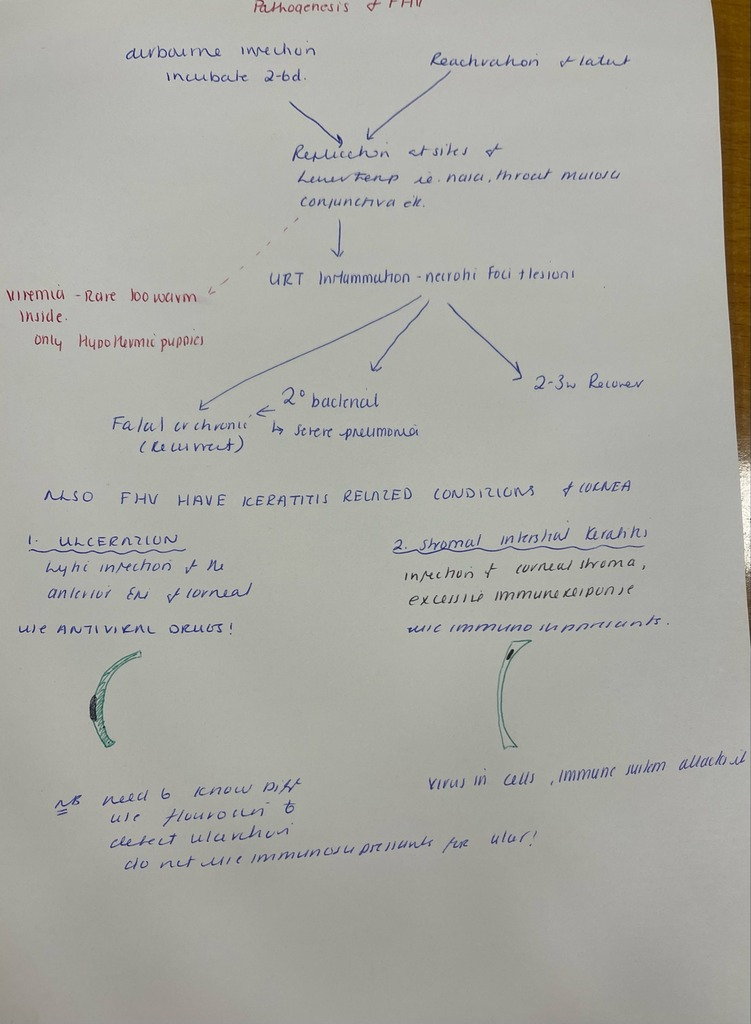
Airborne infection (incubation 2-6d) or reactivation of latent -> replication at low temp site i.e., nasal, throat or conjunctiva -> URT inflammation = necrotic foci & lesions
No virema bc inside it too warm, only in hypothermic puppies
Results
1. 2-3 weeks recover
2. Secondary bacterial = pneumonia, fatal or chronic
Also can caused keratitis
1. Ulceration - lytic infection of anterior epi of corneal - antiviral drugs
2. Stoma interstitial keratitis - excessive immune response due to presence of virus in eye - use immuno suppressants
Need to know which is which before treatment
Immunity of FHV
Short immunity only, against disease not infection cannot prevent reactivation of latency
Serum ab are late & low
Reinfeciton & recurrent disease is possible
Short passive immunity 2-10 weeks ~9w
Vaccination of FHV
Many commercial vaccination - live attenuated or inactivated
Induce immunity, for 3yrs but not solid
Reduces the risk & makes UTRD milder
CORE vaccine
VIP - kittens, catteries endemic in UTRD & shelters
Epidemiology & properties of FCV - feline calicivirus
Doesn't cause as severe UTRD as FHV but occur more often
More immunogenicity, less antigenically stable / more variable
Mutation = long term infection & highly virulent strains
More stable than FHV in environment
- persist 28d at RT
- disinfection: >60C, Sodium hypochlorite,
5% Sodium bicarbonate (best, less toxic & corrosive)
Epidemiology
Pathogenic - cats only
Course
- oral & respiratory mucosa
- but viremia & pneumonia also possible
- or Subclinical infections
Transmission: direct contact, aerosol or phomites
Occur more often than FHV, more immunogenicity, more variable,
reason for persist is variability (not latency)
Causes viremia
More stable in environment - needs dis infection
Also only affects cats, but can be spread through direct, aerosol & phomites
Groups of FCV strains
As FCV is more varibale, it is divided into two groups
Low virulent - UTRD or subclincial (local)
High virulent - severe / systemic diseases
Describe disease of low virulent FCV - causing UTRD
- mild rhinitis
- Erosions of Mouth!!! (Characteristics)
- chronic gingiostomatitis
- good state until it can't eat
- arthritis / self limiting limping bc of immune complexes
- secondary bacterial complications = severe resp disease
FCV related UTRD immunity & vaccination
More immunogenicity = long last immunity but bc it has antigenic variability it reduces its protection, therefore vaccine only have moderate protection
Vaccine - mod protection, last 3yrs, reduce risk or male it milder
Core vaccine as well
Use vaccine with >1 strain (new ones) i.e., purevax not a live one
Epidemiology / occurrence of severe systemic FCV
Occurs in SA hospitals, is very contagious can be brought home to cats through phomites.
94% incident rate at outbreaks, disappears in 2-3m bc strain loses its virulence
More severe in adults cats 50% fatality also can occur in vaccainted cats
Course of systemic FCV
Incubation 1-5d (up to 12)
- severe UTRD (fever, anorexia, mouth erosions, ulcers, nasal & ocular discharge)
- subcutaneous edema (head & legs)
- skin lesions: alopecia, crusts at nose, mouth, ears, eyes & footpads
- jaundice
- lung edema (pleural fluids)
- V+ D+ with blood in feces
- blood in nasal discharge
- DIC & death
Per acute - fever, dyspnea, death
Control of systemic FCV
Medication
Isolation of sick animals
Disinfection - sodium hypochlorite
Resolve itself in 2-3m, vaccine in USA
Bordetella bronchiseptica role in UTRD
- species
- transmission
- typical signs
- treatment / control
Many carriers in dogs cats & other species
Airborne transmission from cats & dogs
Usually occurs secondary to FHV or FCV but may also be primary
Typical signs - cough (other UTRD sneezing is a sign_
Also high temp, exudate from eyes & nose
Sensitive to ab - tetracycline
Vaccine in Europe - novibac Bb IN live attenuated strain